DADA EVENING ORGANIZED BY THE SOUFFLES JOURNAL
February 26, 2017
Review of the Dada Evening organized by the Souffles journal
at Les Frigos (Paris 13th), January 30, 2017
© Francisco Calderon
Dada, no no, a hundred years after its birth, the Dada movement is not dead nor buried; for in gray periods as in crisis periods, Dada resurrects, Dada recites, Dada resists, Dada laughs, Dada cries, Dada curses, Dada chants, Dada sings, Dada dances, Dada plays, Dada trots, Dada gallops, Dada runs, Dada floats, Dada rolls, Dada flies... in short, Dada lives and breathes full health! How could this antidogmatic movement not keep in shape when the world is so upside down? More than ever, Dada retains all its relevance. This is undoubtedly why (anti) commemorations in honor of Dada or Tristan Tzara continue and succeed each other, since 2016 – the year of the movement's birth – with always as much breath, offering us beautiful opportunities to counter the ambient madness, or to exorcise it through laughter as through celebration.
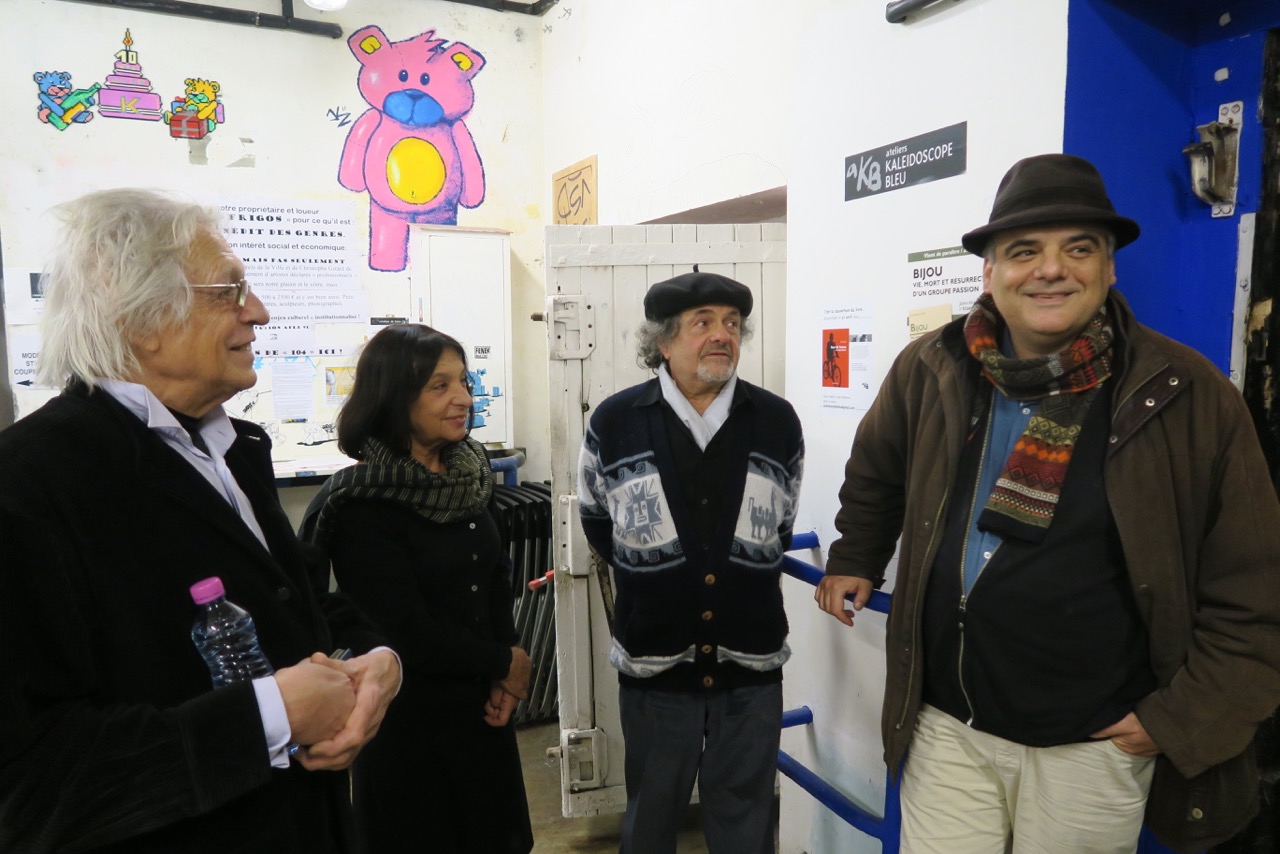
Warm and regenerating, such was the evening in homage to Dada organized by the Souffles journal in Les Frigos of the 13th arrondissement, at the initiative of Élisabeth Morcellet, on Monday January 30, 2017. Through its eclecticism, its performances and its joyful atmosphere, did it not reproduce a bit of the atmosphere of the evenings that, at the beginning of the 20th century, took place at the Cabaret Voltaire? It succeeded in any case in reversing the course of time, probably one of the underlying objectives of Dada shows1.
© Francisco Calderon
Even before the start of the recital, a call was made by a professional hall driver in the person of Alain Snyers. Besides allowing verification of the presence of poets, artists, critics, troublemakers and other preventers of turning in circles, this call served public health by awakening the spirit of the audience, reminding them of the virtues of misbehaving well.
Perfect transition for Chrisophe Corp who, through his introductory poem, emphasized that "To resist is to exist". Indeed, one never finishes resisting ambient stupidity, arbitrary authority as well as moral hypocrisy...
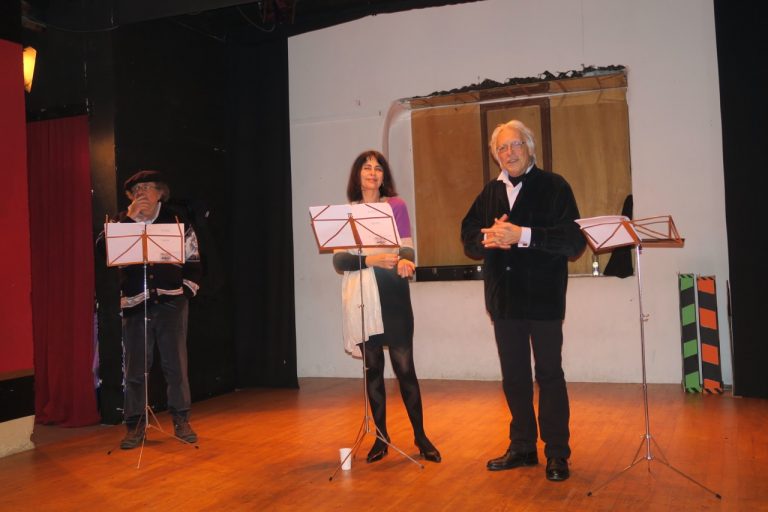
Then a trio of sublime voices (Catherine Jarrett, José Muchnik and Philippe Tancelin) flooded Les Frigos with a florilegium of neo-dada poems, from issue 252/253 of the Souffles journal. It all began with a baritoning Caca, for Dada loves letter shifts (and being shifts), followed by some Dadas sung, proclaimed, twisted, trilled or droned, depending on each one's intestinal dispositions. It was then that from the black and obscure silt of the Duchampian urinal emerged, in an order as unexpected as random, madmen, moons, naked women, suns, meadows, trenches, shells, God, the UN, the ocean, the sea, a cataclysmic chaos...
But all this would have meant almost nothing and would have revealed pure vanity, without the reminder of some maxims from The Necessary to Dada according to the antiphilosopher Monsieur Aa alias Tristan Tzara, able to put ideas back in flesh and chaos in place:
"Dada is the chameleon of rapid and interested change. It transforms – affirms – says the opposite at the same time – without importance – cries – fishes with a line."
"Dada is happiness in the shell and we dadaists, we came out too cooked from its eggs."
In a state of emergency, never part with your Necessary to Dada.
At the first intermission, Alain Snyers, regulating the flow of aqueous poems while signaling the proximity of the Seine, insisted on the instructions to follow in case of flooding: "If necessary, climb on the chairs, if the level rises too high, drain the water!", etc. "Listen to the water?", my neighbor wisely suggested to me...
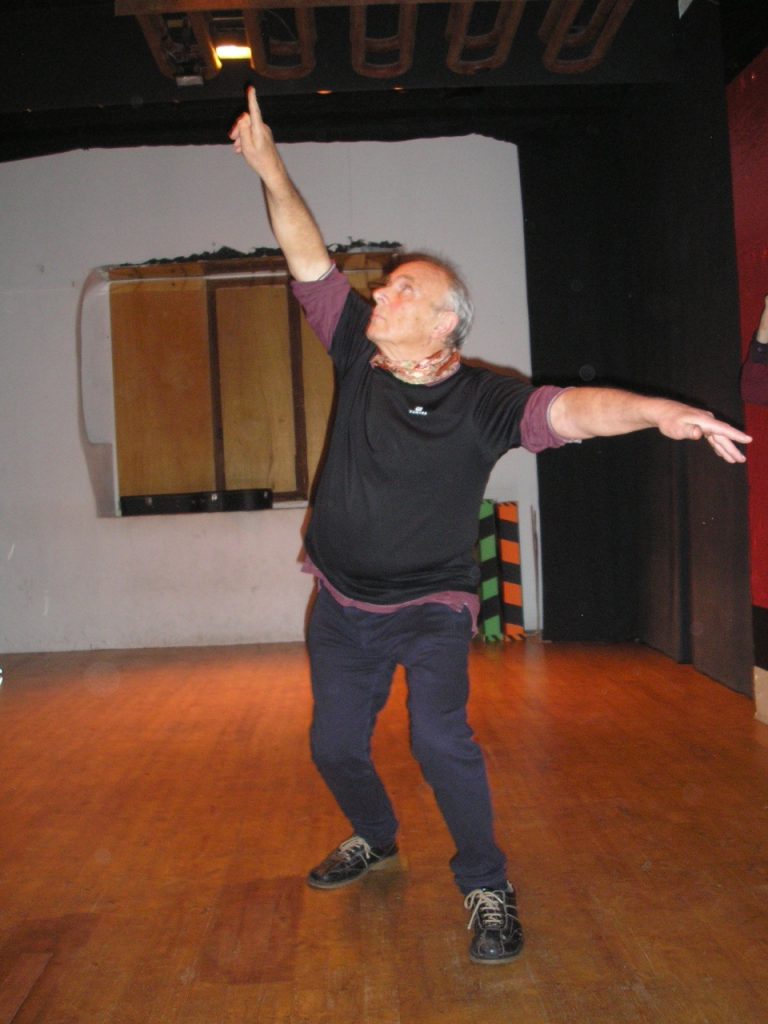
Very competent in his field, Max Horde then proposed to us five methods for tracing "invisible lines", a pastime which, given the high level of technicality deployed, must have occupied him for several years of his life. It is even said that he would have crossed the entire city of New York following a single imaginary line. On the methods of realization of these lines, however, we will reveal nothing here. Point, to the line.
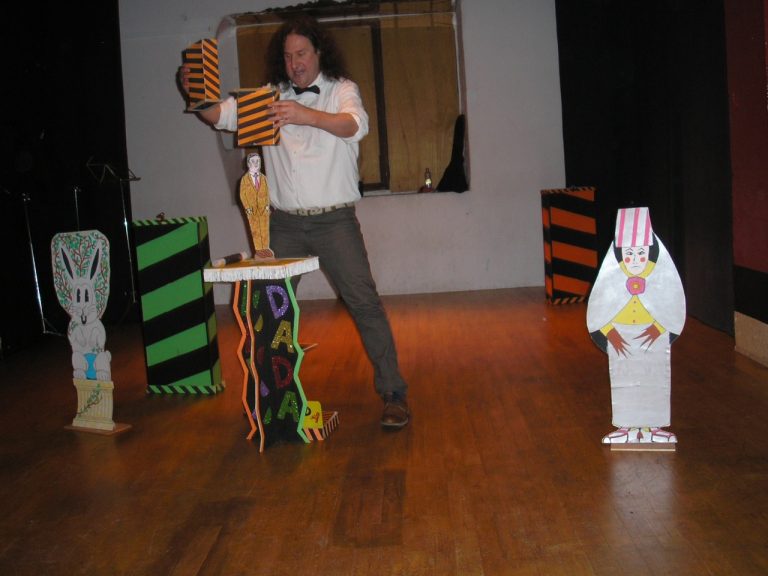
Another extraordinary number: the magic tricks of Sébastien Bergez, who showed rare mastery: he teleported André Breton, made beards appear, quintupled the size of a Dada Manifesto, sawed Tristan Tzara in two and made Arthur Cravan fold in four... Unless it was the opposite. But it doesn't matter. For whoever does not believe in metamorphoses could not be Dada.
Then Richard Piegza, Ana Kuczynska, Max Horde, Philippe Tancelin and Élisabeth Morcellet together realized a vibrant homage to the poet and artist Bruno Mendonça, in a performance entitled The Flying Carpet in Memory of Bruno M., confronting the dreamlike universe of the Thousand and One Nights with the tragic reality of chess and motorcycle races. In the end, in an ecstatic din, wooden wheels, as if extracting themselves from Raoul Hausmann's Mechanical Head or Ubu's oneilles, came out of the road... to reach the audience's legs.
Did the hall driver inform us at that moment of highway safety instructions or fire safety instructions? Hard to say.
But what is certain is that from dadastrophe to dadastrophe we soon reached Hugo Ball's super-bouncing poem, Ball, Ball, originally subtitled, in frank homage to silent cinema comedy, mage, mage, mage.
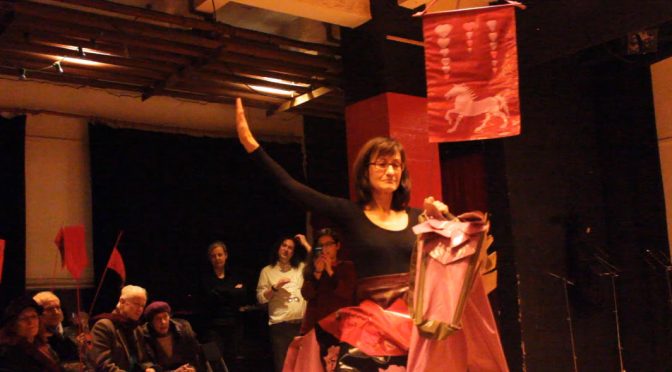
Then, saluting the crowd, Élisabeth Morcellet, as a worthy herald of the evening, Duchampian heroine, appeared in majesty on her playful steed. In a silence populated with flames, the Lady on dada split the air with a few whip strokes. The crowd of the audience, banners in hand, awaited the advent of the original dadasophic breath, to the point of losing their breath. It was then that the oracular words resounded, to an opera tune from 1691 borrowed from Henry Purcell: "DADA DADA... DouDou DouDou... Papa Pipi Panpan Roro... Zaza... Zizi... ZINZIN... OHOHOH EH EH EH..." Thus, the Cold song ding dong made times conjoin (1691-1916-2016 and 2017!), and coagulate, in the renewed advent of the Genius born again at the tété, the neo-Dada spirits2.
After such an acme, the spirit of contradiction required that a fair festival take hold of the room, and that the audience begin to dance to the simultaneous accents of Jean-Pierre Grosperrin's guitar and Wladimir Vostrikoff's balalaika. Wink, perhaps, to the Russian revolutionaries who, in 1916, still carried that wind of liberation which now, alas, seems only a diluted dream.
Finally, as the hour turned its back on Les Frigos, the hall driver, more inflamed than ever, thanked the poets, the artists, the springs, the corkscrews, the record players, the irons, the rats, the white bears, the rainbows... and I could go on.
Ultimate test, ultimate supernatural turn of the evening, the assistant-participants in the show were invited by Max Horde to cross a wall – for impossible is not Dada. "Bravo. You have just crossed an invisible wall. Invisible walls are the most difficult to cross", indicated the tract distributed to the audience, in the purest Dada spirit. Some world leaders, prisoners of their interior watchtowers and obsessed with building real walls, would do well to take a leaf from this...