YVES LALOY AND SURREALISM
par Renée Mabin
January 23, 2017
Choosing a work by the painter Yves Laloy as an icon of surrealist painting seems paradoxical. This Catholic architect never actually joined the movement, nor even participated in its meetings or signed a tract or collective statement. Moreover, much of his work is abstract, starting from geometric forms, lines, triangles, and colored circles. However, it was indeed one of his paintings that André Breton reproduced on the cover of the 1965 edition of Surrealism and Painting: Les petits pois sont verts, les petits poissons rouges. How can we explain the high esteem in which Breton held this work? His emotion was immediate at first sight, in 1958, at a time when, marked by his American experience, he was interested in young artists he had just exhibited at the gallery À l’Étoile scellée, for which he was responsible for programming. Constantly presented at collective Surrealist exhibitions, Yves Laloy’s painting creates, through the architect’s line, an imaginary world reminiscent of the primitives. Moreover, by playing with language, this man of rupture truly encountered the surrealist universe.
It was Geo Dupin who introduced André Breton to Yves Laloy’s painting. Sister of Alice Rahon, who married the painter Wolfgang Paalen, Geo Dupin opened in 1952 a small gallery that the surrealists called À l’Étoile scellée. Breton showed works there by Max Ernst and Man Ray, but also those of a medium like Crépin or young lyrical abstractionists close to the critic Charles Estienne. In 1958, Yves Laloy had abandoned architecture for painting and was living in Paris, where his wife, Jeanne Beauregard, ran a hotel near the Folies Bergère. She met Geo Dupin, who, after closing her gallery, became the collaborator of Inna Salomon at the gallery La Cour d’Ingres, located at 17 quai Voltaire, where surrealist artists such as Herold and Lam, Cardenas and Camacho were exhibited. Geo Dupin did not hesitate to present, at the end of June 1958, some of Yves Laloy’s canvases to André Breton. He was struck by a large painting, a colorful explosion created for a party on the theme of the Rio Carnival, Le grand casque. He and his wife immediately bought a painting each. In September, they dined with Geo at the Laloys’ and his impression was confirmed: the works they discovered “are even more extraordinary than those they knew1.” This fascination alone is evidence of surrealist art2. Breton decided to exhibit the artist as early as October 7 at La Cour d’Ingres and wrote a preface for the catalog, which appears in the 1965 edition of Surrealism and Painting. It seems that Laloy’s work had a particular significance for him, according to José Pierre, who speaks of an event3.
Yet this work is singular, as the artist composes in three different styles, without any real chronology. The first is a rigorous geometric abstraction, rhythmically written in lines and repeated circles. The second creates a kind of underwater universe that seems to be the place of all metamorphoses, which André Breton calls an “underworld where hybrid beings gravitate4.” The third consists of figurative works with simplified forms in which language is inserted. Breton admires all these aspects, which he describes in his preface to the 1958 exhibition, since he owns paintings from each category and even a Cancale landscape painted by Laloy at the beginning5. He thus finds particular qualities in this work, since he rejects figurative art that claims to imitate nature, and the surrealists oppose Abstraction, which in the 1950s occupied a central place in the Parisian art world.
This adherence is explained first by the date of André Breton’s encounter with Yves Laloy. The American experience plays a role in Breton’s choices, now more nuanced towards Abstraction. It should not be forgotten that he was sensitive to Kandinsky’s painting since his arrival in France in 1933. But in the United States, he befriended Arshile Gorky and sympathized with Mondrian. Back in France, he accepted the rapprochement, suggested by the critic Charles Estienne, with lyrical Abstraction and exhibited at the gallery À l’Étoile scellée young artists of this movement, such as Jean Degottex or Marcelle Loubchansky. He also discovered in the Gallic medals exhibited with Lancelot Lengyel a decoration of curves close to Abstraction. But the struggle between geometric Abstraction and lyrical Abstraction does not interest him. Breton rejects pure plasticity and claims those who express “a spirit, that is to say as much Kandinsky as Mondrian6.” What attracts André Breton is precisely this ability of Laloy to implement two opposing tendencies, a vocabulary of curved forms close to those of Kandinsky, found in Le grand casque or La couronne, and geometric lines reminiscent of those of the Navajo Indians. The plurality of Laloy’s styles is therefore not an obstacle for Breton, who privileges not pictorial technique and aesthetics, but the exploration of the irrational powers of the mind.
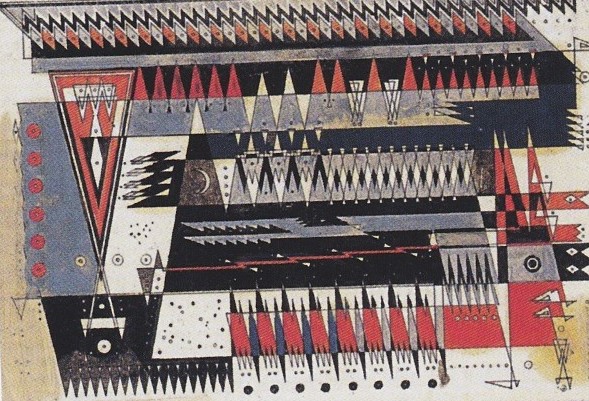
André Breton sees in Laloy’s repetitive geometries the expression of a mental landscape, as confirmed by a letter from the painter to his parents: “My painting is based on a linear drawing: these are lines that compose a labyrinth traversed by an Ariadne’s thread which is the thread of thought. In this labyrinth, I get lost and I save myself 7.” The artist lets himself be guided by forms that multiply and lead him, in a personal quest that is above all spiritual. When André Breton compares these paintings to sand paintings made by the Navajo Indians, it is not only a formal resemblance, but a process comparable to that of primitives in harmony with the spirits of nature. Breton’s interest in Amerindian masks is not recent: it expresses his conception of an art freed from Greco-Roman rationality. In the United States, he visited the Hopi and Zuni Indians and bought Katchina dolls decorated with symbolic geometries. Surrealist art must rediscover this vision, which is that of the primitive, but also that of the child, the medium, and the mentally ill. It is this liberated eye that Breton recognizes in Yves Laloy, linking his works to those of the Indians, but also to the Neolithic engravings of Gavrinis.
But Yves Laloy is neither a self-taught artist nor a naïf. He learned drawing at the School of Architecture. He elaborates his lines rigorously, on graph paper using the architect’s tools, T-square and set square, and paints flat on a table with motifs without relief. His canvases retain a link with this training, since Alain Jouffroy sees in them the plans of an imaginary city. Laloy also learned color by looking at the works of modern painters, such as Matisse, Braque, or Dufy, during his walks in Parisian galleries, and especially old masters, discovering Fra Angelico during a trip to Italy, and El Greco in Spain. In fact, Yves Laloy diverted the formal language of the architect to make it the instrument of pictorial creation. Indeed, he began to practice his profession in his father Pierre Jack’s Rennes office, where he could hardly bear the constraints of a practice that obeyed public commissions, since his father was responsible for the construction of post offices in Sarthe, Mayenne, and Brittany8. But his refusal was deeper. The knowledge of ancient art proved to him the futility of his efforts in the field of architectural creation 9: he knew himself incapable of achieving the perfection of the builders of Greco-Roman or Egyptian antiquity. An “inner storm” eventually led him to abandon his profession, break with his father, and choose painting.
He does not, however, make a clean slate of his apprenticeship, while knowing full well that this formal language no longer has the real as its object. Geometric drawing, abandoning concrete construction, by the repetition of forms, allows a free play, somewhat like the assemblages of a medium who thus creates imaginary architectures. “The saw of triangular forests,” parallel lines, rows of luminous dots, can evoke “the palaces, the airfields or the neon signs of an ‘ideal Jerusalem 10’.” But there is in Laloy no desire to recreate a dream architecture. The use of the circle and the line allows him to distance himself from the external model, to create characters using a line intended for builders, to explore interiority: a painting in which one recognizes a female bust, a heart, a hand, and fish, is entitled Mère intérieure. The canvas evokes motherhood but by homophony and the presence of fish, is also a metaphor for the sea. Yves Laloy the painter thus appropriated the architect’s drawing, which allows him all metamorphoses.
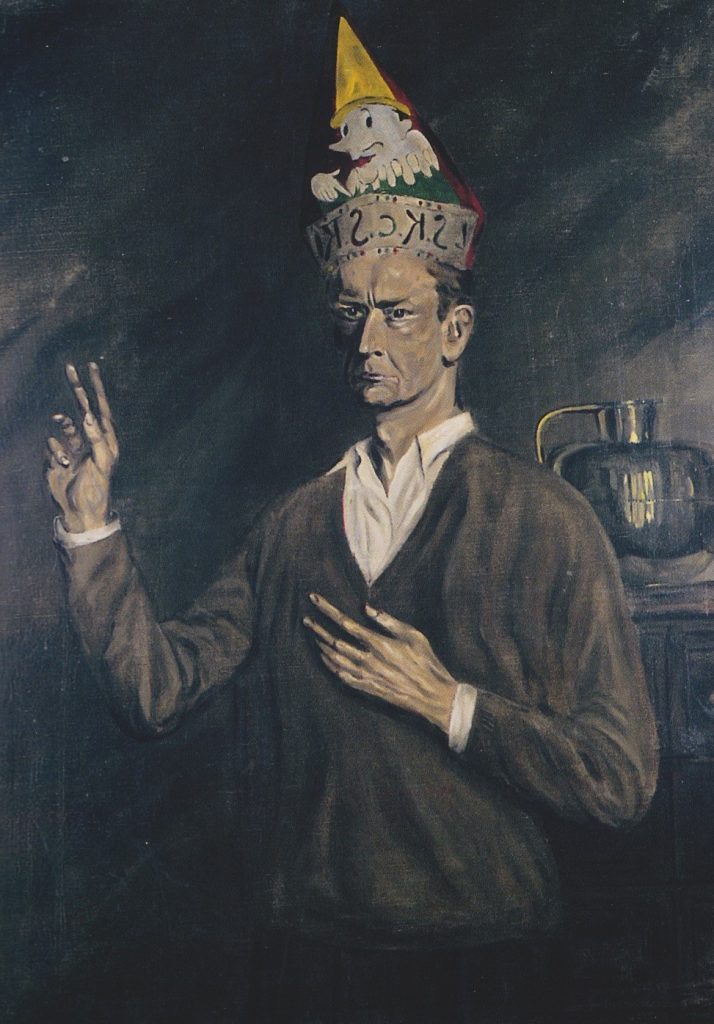
Not only does he free the geometric line from its object, but he subverts it with color. His first figurative works remain in shades of green and gray, in his Cancale landscapes, gray and brown in Le peintre et son double, whose twin characters stretch like portraits by El Greco, landscapes as states of mind, during the crisis of abandoning his profession. From the self-portrait LSKCSKI which represents the artist as a dark monk wearing on his head an advertising hat for chocolate, a distance opens between the double and the painter: a small colorful clown seems to come out of the brain of this tragic being, a prankster spirit who reverses the letters, plays with phonetics as Marcel Duchamp did when he transformed the Mona Lisa, (CSKI / C’est exquis) shows his fantasy through color, yellow, green, and red. From now on, the painter will give free rein to this in his paintings and express himself in a very colorful language.
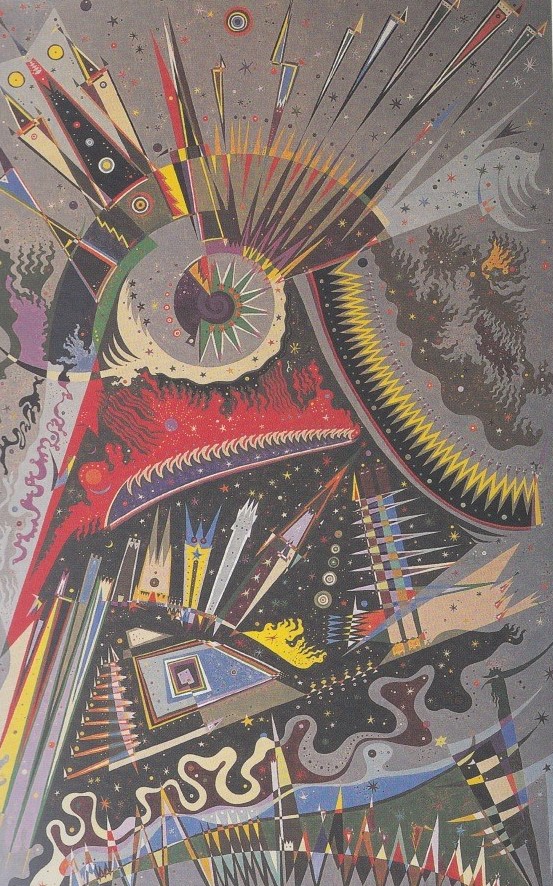
The break is total in his life when he leaves his father’s Rennes office to settle in Paris with his wife and son11. In his work, it is perceptible from 1950, while he was still living in the family home, rue des Viarmes in Rennes. Color explodes in a large-scale decor for a masked ball on the theme of the Rio Carnival. The forms become abstract, in the powerful outburst of Le Grand casque which suggests both the shock he felt and the intoxication of liberation. André Breton was sensitive to the jubilant violence of this painting, which expresses through the festival “a drama of the utmost acuity.” “Laloy is of the race of men of rupture,” emphasizes Alain Jouffroy12. In fact, departures follow one another. In 1955, he left Paris alone for a bicycle trip through Spain, Morocco, Egypt, to the Israeli border where he was taken for a spy. It was a journey to the end of himself, a spiritual quest in the desert. Physical effort in a boundless landscape seemed necessary to him. From 1961, he set off again, this time at sea, for a fishing campaign in Newfoundland, sharing the harsh life of fishermen who cut up fish. Two more campaigns followed, immersed in the world of the sea that had attracted him since childhood. Nature remains present in his work, fantastic animals, undulating waves, symbolic fish. Finally, in 1965, he left for America, stayed two months in Lima, then went to Colombia, to Bogota, then to New York.
This flight to distant places expresses a refusal of social compromises, the reign of money, an indifference to the art market, even as gallery owners such as Carl Laszlo, Miklos Von Bartha in Basel, and Arturo Schwartz in Milan took an interest in his work. It is in this inner struggle in an arid nature that a precious work is born, like the resin of the solitary pine battered by the winds described by the Breton philosopher Jules Lequier, evoked by André Breton13. Beyond any ideology, any pictorial technique, Yves Laloy is thus a surrealist artist. He participated in all the collective exhibitions of this period, Eros in 1959-60 at the Cordier gallery in Paris, Surrealist intrusion in the enchanter’s domain, D’Arcy Galleries in New York in 1960-61, Exposition internationale du surréalisme, Arturo Schwartz gallery in Milan in 1961, and L’Écart absolu, Galerie de l’Œil in Paris, in 1965. The exchange is real between Laloy, who thanks “his friend Breton” on a canvas, and the poet who dedicates a copy of L’Art Magique to him: “To Yves Laloy who was for me the revelation of the year 1960 and the others14.”
In this surrealist context, Laloy’s work evolves in an unexpected direction. In parallel with his abstract paintings, the artist creates small simplified characters, generally from geometric elements. They are often disjointed and everything in them, torso, sex, feet, becomes a face, thanks to small circles that we identify as eyes. At a time when the surrealists are playing the game of “Un dans l’autre,” Laloy, in an apparently naïve way, shows the ambiguities of representation, the ability of drawing to depict at the same time man and bull, fish and wave. The painting chosen by Breton to illustrate the cover of Surrealism and Painting is probably the best example. The two colored circles and their fish—are they two faces, two aquariums, two peas? The title adds to the confusion. Under the appearance of a statement: Les petits poissons rouges, les petits pois sont verts, it reinforces the enigma orally, since “pois sont” and “poissons” are pronounced the same way. Vegetables and fish mingle in the unreality of color. Ultimately, are these two circles not also the eyes of the creative painter?
Yves Laloy thus introduces language into painting. He always liked to write and wrote a now-lost novel and a voluminous treatise on beauty that he unsuccessfully tried to publish. But from the 1960s, writing enters painting. The words do not become pictorial signs as in Miró. They most often remain a calligraphic text in the manner of Magritte. Thus, a curious echo of Breton’s Poisson soluble, a quote from Catherine of Siena in carefully calibrated lowercase letters undulates under a yellow and blue fish: The fish is in the sea and the sea is in the fish. In Magritte’s paintings, words disturb our adherence to the representation of clearly identifiable objects, such as a pipe or an apple. In Laloy, they name geometric forms, simplified signs: a red circle, pink and green curves thus become a Bird-wave. The title guides our vision, but indirectly, because Laloy plays with language, as in his own life. When André Breton asks him for a biographical note, he tells his story through a series of puns and word games, as in this passage that takes as its thread the literal and figurative meanings of colors: “I may be a redhead, but if I write my life, it would make me blush. It is good to laugh, but not to laugh yellow. However, I admit, I have seen all the colors. That’s what turned me to painting 15”
But the text written on the painting is at first reading mysterious. When a navy blue face whose eye is a fish, with a black nose seen from the front and a yellow nose seen in profile, is entitled A la fass on de pis que sot, you have to pronounce the message to restore the spelling and its mischievous meaning: “À la façon de Picasso.” Like Raymond Queneau in his novels, Laloy sometimes writes phonetically, which introduces sound into the painting. In the postwar years, the surrealists were interested in the “language of the birds,” this sound poetry of the Kabbalists. But Laloy’s childish puns like “Quand i z’ ont bu laids saouls rient dansent,” modeled on the proverb “when the cat’s away, the mice will play,” are more reminiscent of the flat jokes of Rrose Sélavy invented by Marcel Duchamp, because they are based on the chance of phonetic associations. These titles written on the canvas slow down our understanding. 3 pairs sonnent en Dieu is only understood orally: “trois personnes en Dieu.” The title thus suggests that we identify three brown and black circles on a midnight blue background as an unexpected image of the Trinity, giving depth to the geometric lines. Words seem capable of metamorphosis like objects: Laloy’s signature itself becomes “la loi” or “là l’oie.” Simplified drawings then take on a plural meaning where opposites can unite, as in the title: Le Mal est mon seul bien.
Thus Yves Laloy escaped a predetermined existence to create through painting a surprising imaginary universe. The sharp rhythms of his geometric lines bear witness to the inner tensions that accompanied his approach. His confrontation with vast desert spaces and maritime expanses did not lead him to surface exoticism. In search of spiritual powers in nature, he was able to join the paths of sand paintings of the American Indians. He indeed escapes the Cartesian spirit of his training through the graphics of his characters and their strange powers, the ambiguity of his titles based on the chance of phonetic games, and childish humor. In his proximity to Surrealism, this loner thus pursued an original work that seduced André Breton because it was a gaze on the unknown world within him.