LINGUA - SIGN, MYTH, GRAMMAR, AND STYLE IN THE WORK OF CARL EINSTEIN
par Klaus H. Kiefer
April 23 2017
“Lingua” – Sign, Myth, Grammar, and Style in the Work of Carl Einstein
Ich fürchte, wir werden Gott nicht los, weil wir noch an die Grammatik glauben…
1. Language Crisis
Carl Einstein (1885–1940) took an early interest in linguistic questions, which is hardly surprising given that, even by the century’s end, the “crisis of language” was everywhere in the air—whether inspired by Friedrich Nietzsche, Hugo von Hofmannsthal (the famous “Letter of Lord Chandos” [“Ein Brief”]), or Fritz Mauthner, or experienced directly through intergenerational communication conflicts, the explosion of knowledge, the advent of mass media, and more.1 The decline of certainties and values demanded creative solutions. Chapter III of Carl Einstein’s early novel, Bébuquin or the Dilettantes of the Miracle (Bebuquin oder Die Dilettanten des Wunders), the first four chapters of which were initially published in 1907 under the title Monsieur Giorgio Bébuquin (Herr Giorgio Bebuquin),2 contains a somewhat paradoxical passage where the author, already in nuce, conceives of the problem of the sign. His spokesperson is Nabuchodonosor (German: Nebukadnezar) Böhm. Böhm stands as an Epicurean intellectual (bohemian, as his name suggests), a kind of mentor—later one might have said “superego”—for Bébuquin; he disappears and is reborn in a cognac vase, reminiscent of the “Golden Pot” (Der goldne Topf) of E.T.A. Hoffmann.3 Böhm criticizes those who have never grasped what makes a good painting: this, he claims, is their flaw. They are high-school students lacking concentration and thus can never get beyond a single concept—and it is precisely the concept that he rejects. The concept is just as nonsensical as the thing itself. One never escapes combinations. The concept aims toward things, but he, Böhm, desires exactly the opposite. (BW, 23)
Diese Leute haben nie ein gutes Bild begriffen, [;] da steckt ihr Fehler. Das sind unkonzentrierte Gymnasiasten, die deswegen über einen Begriff nicht herauskommen [hinauskommen] und gerade den leugne ich. Der Begriff ist gerade so ein Nonsens wie die Sache. Man wird nie die Kombination los. Der Begriff will zu den Dingen, aber gerade das Umgekehrte will ich. (BA 1, 21 ~ BA 1, 98)
This philosophical interest dates back to his school years. At the humanist lycée, Einstein (who completed his baccalaureate in 1904) was fascinated by Plato’s idealist allegory of the cave,4 though we must later consider whether everything the autobiographer of the 1930s recalls about the child’s language is authentic. In any case, in his contemporary review of Bébuquin, Kurt Hiller describes the author as “a young man who has absorbed the quintessence of the spiritual condition of his time and wants to move forward” (tradK = “[ein] junger Kerl, welcher die Quintessenz des geistigen Tatbestands seiner Zeit intus hat und weiter will” [CEM, 52]; ill. 1).
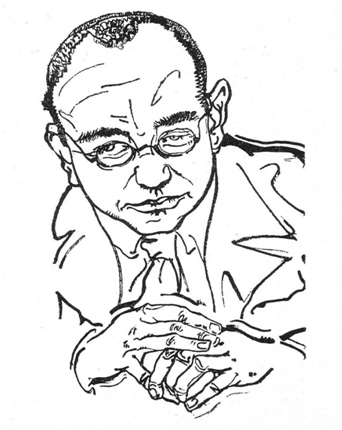
At this stage, Einstein is still far from the art critic he would later become, “a kind of Caruso in his specialty” (tradK = “eine art Caruso in seiner spezialitaet” [Einstein, self-ironically, to Ewald Wasmuth 1932 (DLA)]), and the paintings he knows are not yet “cubist” in nature (see BA 1, 81, 93, 99).9 Böhm, in a professorial tone, laments the circularity of “thing” and “concept,” “Sache” and “Begriff,” which are “combined,” while, at the same moment, Ferdinand de Saussure is focusing on the linguistic sign, whose two elements—“concept” and “acoustic image”—are “intimately united and call to each other.”10 The Dadaist Hugo Ball, for whom Bébuquin was “decisive,”11 discovers the “play” between “thing” and “concept,” from which arises, in parallel, Saussure’s idea of arbitrariness: “Why can a tree not be called Pluplusch, and Pluplubasch if it has rained? And why must it be ‘called’ anything at all?” (tradK = “Warum kann der Baum nicht Pluplusch heißen, und Pluplubasch, wenn es geregnet hat? Und warum muß er überhaupt etwas heißen?”)12 Unfortunately, neither the mystic Ball nor later the Surrealist writers had theoretical competence.13 This is not a criticism, but a fact and a methodological problem. Creators are “essayists” in the literary sense. The interpreter who explains and corrects always arrives post festum.
2. Evolution ‒ Revolution ‒ Destruction
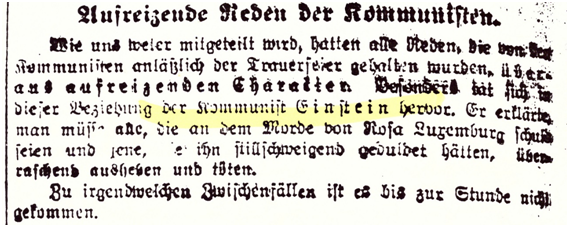
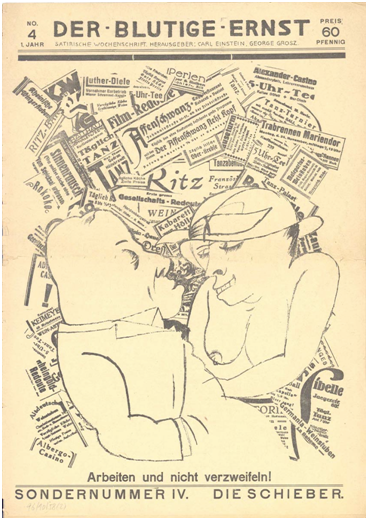
During the Great War and the Berlin revolution, Einstein did not reflect on language, which served him as a political and satirical instrument. Let us pass over his role in Brussels at the Soldiers’ Council (Soldatenrat), which he urged to revolt from a balcony of the City Hall; Max Ernst was a witness to this.14 Shortly thereafter, Einstein delivered a funeral oration, judged—not surprisingly—as aggressive by the liberal and right-wing press, at the burial of Rosa Luxemburg (ill. 2).15 He edited with George Grosz the revolutionary magazine Le Sérieux sanglant (tradK = Der blutige Ernst) which “lashes the parasites [of war and postwar] until they bleed” (tradK = “peitscht die Schädlichen bis aufs Blut” [W 2, 392]; ill. 3).
After the Spartacus defeat, Einstein continued his career as a writer and art critic and quickly developed two fundamental principles:
1 The discovery of African sculpture and the emergence of Cubism, which he observed closely, convinced him that the artist is not obliged to imitate but is free to create: “Repeat or invent—it was necessary to decide.” (K 3MS, 95 = “Wiederholung oder Erfindung ‒ man wollte sich entscheiden.” [K 1, 56]). This had long been proclaimed by Guillaume Apollinaire. However, Einstein’s support for the avant-garde attained philosophical dimensions; he created a true utopia of the creative man. Thus, all metaphysics, whether Platonic or Judeo-Christian, which nonetheless haunt Einstein and his protagonists, are finished, for how can one fill the enormous void abandoned by gods and absolute ideas? In his famous letter to Daniel-Henry Kahnweiler in 1923, which he later wanted to use as a manifesto—though his intention was blocked by the first Surrealist manifesto—Einstein (ill. 4)16 observes:
[…] stories such as the loss of speech, or the dissolution of a person, or the desunification [dissociation] of the feeling of time. That is, to begin with, simple themes […] It was what I had begun to do, in 1906, in Bebuquin, in an uncertain and timid way. The work of the “cubists” confirmed me in the idea that it is possible to bring transformations in the nuances of sensation; this is probably, despite all the talk, the only interesting thing. (EKCM, 49)
[…] Geschichten wie, Verlieren der Sprache, oder Auflösung einer Person, oder Veruneinigung [sic] des Zeitgefühls. Also zunächst mal einfache Themen […]. Solche Dinge hatte ich im Bebuquin 1906 unsicher und zaghaft begonnen. Die Arbeiten der « Kubisten » waren mir eine Bestätigung, dass eine Umnüancierung der Empfindung möglich ist: wahrscheinlich trotz allen Geredes, das einzig interessante. (EKC, 140)
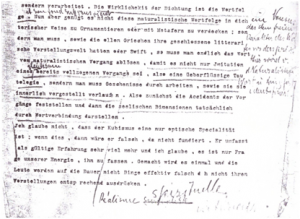
“The loss of speech” is, of course, a reference to Lord Chandos, and the “dissolution of a person” to Ernst Mach (“The self cannot be saved.” = “Das Ich ist unrettbar.”) 17, but I will limit my preliminary commentary to that strange word Veruneinigung (“désunification”), which is not correct usage in German either. With it, Einstein introduces the fourth dimension (time) into the structure of the novel—more radically than traditional narrative with its past tense, its future, etc. This is why the “double self” (“Doppel-Ich”) 18 of Böhm-Bébuquin is both dead and alive. And with the final death of his eponymous protagonist, the Bébuquin concludes of its own accord: “Finished.” (BW, 92 = “Aus.” [BA 1, 130]) 19
2 When writing about avant-garde “Cubist” art during the 1920s, Einstein consistently insists on the superiority of the visual arts over literature—just as he had first intuited in 1907: “Writers truly limp along, pitifully trailing behind painting and science with their lyricism and little cinematic suggestions.” (EKCM, 48 = “Die Litteraten hinken ja so jammerhaft mit ihrer Lyrik und den kleinen Kinosuggestionen hinter Malerei und Wissenschaft her.” [EKC, 139]) 20, he wrote again in 1923 in his letter to Kahnweiler. Indeed, Einstein takes Horace’s ut pictura poesis too literally—he draws on it and esteems his peers according to this principle. In 1931, he does acknowledge that the Surrealist poets attempt to “express a direct sequence of signs” (K 3MS, 202 = “die unmittelbare Zeichenfolge auszusprechen” [K 3, 126])—thus coming close to sensation 21—but he objects: “Nonetheless, the poets still did not dare to throw off the constraints of grammar.” (K 3MS, 202 = “Allerdings wagten die Poeten noch nicht, die Bindung der Grammatik abzuwerfen.” [K 3, 126; cf. FF, 234]) Grammar here represents imposed regulation—what is non-authentic. For Einstein, “automatic writing” or “psychogram,” the term he prefers, and “grammar” are incompatible. Even though he never renounces his belief in the creative human being, doubts about the analogy of the arts increasingly creep into his thought.
Ultimately, the question arises: to what extent was Einstein familiar with the many linguistic experiments of the Surrealists? As Hans T. Siepe has shown 22, there are quite a few Surrealist techniques that manipulate or even dismantle language. This is Dada’s legacy. However, Einstein had little appreciation for endless wordplay; apparently, phonetics did not count as part of grammar for him. As will be shown later, in his own works, Einstein was more engaged with morphology (neologisms) and syntax—domains in which the French language is relatively rigid. According to Clément Pansaers, Dadaist and friend of Einstein, the latter saw Dada as “a pun that farts too long” 23. Among the Surrealists, Einstein endorsed Benjamin Péret’s Le Grand Jeu as “the boldest undertaking” (K 3Me/St, 202 = “mutigste Arbeit” [K 3, 126]) 24, but he never mentions, for example, Leiris’s Glossaire, even though he knew it well. In the notes for BEB II, Aragon’s name appears only once. Breton is cited two or three times (B II, 37–39), categorized as “tribune” or “leader” (W 4, 172), and is subject only to ideological critique:
type bret[on], lyrical revolutionary visionary for posh salons and art dealers. ROSENBERG AND BRETON FOR EXAMPLE, breeding the private revolutionary or Thursday lunch revolutionary at the Viscount’s, with a presentation of geniuses. (tradK)
type bret[on], lyrisch visionaerer revolutionaer fuer teure salons und kunsthaendler. ROSENBERG UND BRETON PAR EXEMPL[E], die zuechtung des privatrevolutionaers oder donnerstags revolutionaeres lunch beim Vicomte mit vorfuehrung der genies. (B II, 37)
This is too little for a comparative study of two distinct poetics, and from this angle, one must take seriously the reflection Einstein recorded in his journal on February 18, 1933:
I see that I will become increasingly alone, a Jew, German-speaking, in France. A Jew without God and without knowledge of our past; German-speaking, but unlike my fellow Germanophones, determined not to let the German language sink into laziness and fatigue. In France—that is, without readers. From now on, I will have a brief conversation with myself each day, since I have long been completely cut off from German-speaking people and books. I will never feel at home in French poetry, because I dream and reflect in German. So now I am condemned by Hitler to remain forever a foreigner without a home. (tradK)
ich sehe, immer mehr werde ich allein sein, jude, deutschsprechend, in frankreich. jude ohne gott und ohne kenntnis unserer vergangenen zeit, deutschsprechend, doch gewillt die deutsche sprache nicht wie meine landsleute und gleichzüngige faul und müde versacken zu lassen. in frankreich, d.i. ohne leser. ich werde jetzt jeden tag mich kurz mit mir unterhalten ; denn seit langem bin ich von gleichsprachigen menschen und büchern gänzlich abgeschnitten. nie werde ich in französischer dichtung zu hause sein; denn ich träume und sinniere deutsch. also nun bin ich durch Hitler zu völliger heimatlosigkeit und fremdheit verurteilt. (AWE, 26; emphasis mine, KHK)
Without going into the details of his loss of the mother tongue, which he already missed in 1929 “like a piece of bread” (“ein Stück Brod [sic]”), as he wrote to Ewald Wasmuth on January 21 of that year (DLA), let us return to the central underlying problem. Why are “object” and “grammar” Einstein’s preferred enemies during his Cubist phase? In The Art of the 20th Century, he defines the object “as a bearer of conventions” (K 3MS, 98 = “Träger der Übereinkünfte” [K 3, 50]). 25 For the avant-garde, imitating the object is thus taboo. But its total destruction—for example in Dadaism or Suprematism (ill. 5)—introduces a danger: the tabula rasa, that is to say,

There is no longer any picture at all. Einstein glimpses the impasse of his own argument and settles for a compromise—a “de-construction” (if one may say so)—ultimately not entirely satisfying: “The lived experience of form is a critique of the object […]” (K 3MS, 98 = “Formerlebnis ist Kritik am Gegenstand […]” [K 3, 59]; emphasis mine, KHK). In his long poem Entwurf einer Landschaft (“Design for a Landscape”), published in German (!) in 1930 by the Galerie Simon (i.e. Kahnweiler’s press), his indignation against the empty paintings of Malevich, Lissitzky, and others still resonates: “Frames shatter from emptiness” (tradMIt, 259 = “Rahmen splittern vor Leere” [BA 3, 73]). 26
Einstein sees the object as “detestable,” yet irreplaceable (a view that, as will be seen later, also applies to the subject) in other respects as well—both philosophical and political: 1 The object belongs to the “external world à la Descartes and Kant” (tradK = “Kantisch Descartische Außenwelt” [W 4, 434]), a split (“Spaltung”) which, according to Einstein, is obsolete. He imagines instead a functional—even “combative” [W 4, 182]—relation between the old adversaries of Western philosophy: subject and object. And 2 the object belongs to the bourgeoisie: “The bourgeois is a paraphrase of an object-centered milieu; he is constituent, a relation between objects. The destruction of the bourgeois is justified in order to preserve dynamism [historical, vital].” (tradK = “Der Bürger ist eine Umschreibung gegenständlichen Milieus, er ist Bestandteil, Beziehung zwischen Gegenständen. Die Zerstörung des Bürgers zur Rettung des Dynamischen ist gerechtfertigt.” [W 4, 148]). The radical tone of this 1921 statement, intended for a Russian journal but unpublished, was not revised later, but clarified: the convention and constitution of the object are not possible without communication. “The rigidity of things is primarily produced by linguistic habit […]” (K 3MS, 99 = “Die Starrheit der Dinge wird vor allem durch die sprachliche Gewöhnung bewirkt […]” [K 3, 59]). It is thus grammar that is responsible for the status quo of things. What idealism! 27
The destruction of grammar is most readily accomplished in short texts—for instance, in poems. Since Einstein had little appreciation for Dadaist and Surrealist wordplay, or for the Futurists’ parole in libertà, what, then, does he himself produce? In 1917, he published a poem in the journal Die Aktion: The Murderous Tree (“Tötlicher Baum”). The text addresses (vv. 3, 14) a soldier torn apart by a grenade and strangled by barbed wire (v. 1: “quere Masche,” cf. Maschendraht / Stacheldraht), whose fragmented body lies across an uprooted tree—a common sight, depicted by photographers and artists such as Otto Dix (ill. 6), and something Einstein had seen firsthand; such things are not imagined:
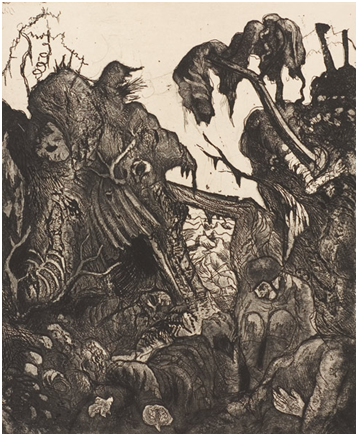
For our purposes, it is enough to quote a few lines from Tötlicher Baum (= Murderous Tree [tradK])—the text is untranslatable:
1 Glasig Zerstücken zerrt tauben Hals in quere Masche. Gefetzter schwert blättrige Luft. […] 14 Griffe gegabelt jammern dir den Ast. Aufwirft Haß in kantenen Rauten. […] (BA 1, 259)
The Einsteinian style bears a clear resemblance to August Stramm’s Wortkunst. 29 Karl Kraus, however, accuses the author of “an insolence in the face of language” (tradK = “Frechheit ins Angesicht der Sprache” [W 1, 402; cf. Einstein’s self-criticism in FF, 116]). 30 Indeed, what is missing from Stramm’s lettrist texts—and from Einstein’s as well—is coherence relative to a perceiving subject. One might thus interpret Einstein’s multiperspectival poem as “Cubist” (v. 15: “angular rhombi”!), yet the label proves unhelpful, since in the end, doesn’t the poem imitate that “other destruction of objects” (tradK = “andere Zerstörung der Objekte” [K 1, 75]) brought about by the Great War, and glorified by many artists?
This fanaticism of “deformation” conjures strange parallels. Fernand Léger wrote to his fiancée Jeanne Lohy on March 28, 1915:
“To all those idiots wondering whether I still am or will still be a Cubist when I return, you can tell them: more than ever. There is nothing more Cubist than a war like this one, which rather neatly divides a fellow into several pieces and sends him off to the four corners of the earth.” 31
3. Fetish and Sign
The young Einstein had turned to art criticism because the artist—painter or sculptor—works with a “more compliant, quicker material” (K 3MS, 376 = “in willigerem, flinkerem Material” [K 1, 171]) than language, which is rigidified by grammar, in order to find adequate modern expressions. Moreover, language seemed to him rather “soiled” (tradK = “etwas sehr versaut” [GGA]), as he wrote to George Grosz in 1927. The avant-garde at the turn of the century was, therefore, “pure” painting. This iconic turn 32 diversified in the second half of the 1920s. On the one hand, Einstein was compelled to follow the “Proteus” Picasso (K 1, 69), who no longer limited himself to decomposing the motif, and on the other hand, Surrealism emerged in 1924. At the same time, Einstein began to analyze the elementary units of what occurs in general. Paul Bouissac is absolutely right: “Dada and Surrealism undoubtedly put ‘semiosis’ in focus,” 33 but no other contemporary artist or intellectual was as attuned to the avant-garde or as capable of grasping this paradigm shift as Carl Einstein. 34
It is striking that Einstein, a staunch supporter of Cubism, already sensed something new in Paul Klee’s work at the beginning of the 1920s. Through the magic of fairy tale—that is Einstein’s idea 35—Klee was capable of creating never-before-seen objects, and not merely decomposing conventional ones (ill. 7). 36 Thus, it is Klee who leads Einstein out of the dead end to which “the annihilation of the object” (K 3MS, 98 = “Vernichtung des Objekts” [K 3, 59])—Cubism’s ultimate consequence—had brought him. In contrast to Dadaism and Suprematism, the Surrealists likewise start from the marvelous to discover the new.
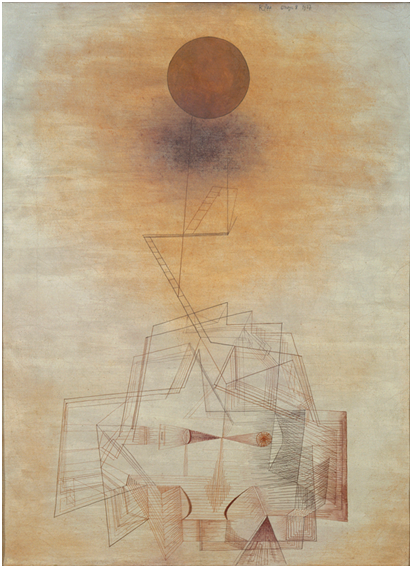
Finally, Einstein—who, as early as his Negerplastik (“Negro Sculpture”) 37 of 1915, was engaged with African art and myths—had the good fortune to discover a modern artist capable of creating at least a personal modern mythology (“private Mythologie” [K 1, 142]). 38 In general, Einstein observes in Art of the 20th Century with regard to the latter half of the 1920s: “One finally detached oneself from the negative phase of the destruction of the object.” (K 3MS, 352 = “Endlich löste man sich aus der negativen Phase der Objektzerstörung.” [K 3, 211])
It is difficult to grasp through what kind of “structuralist activity” Einstein conceived of the sign as a fundamental unit from which follows the “primacy of signs” (tradK = “Primat der Zeichen” [FF, 260]) across all domains and in all of Einstein’s thought, right up to his final writings. Was he influenced by Nietzsche, who had already written in The Will to Power (Der Wille zur Macht): “Subject, object, an agent of doing, the doing and that which it does, all distinct: let us not forget that this is nothing but a semiotics, and denotes nothing real.” 39 (= “Subjekt, Objekt, ein Täter zum Tun, das Tun und das, was es tut, gesondert: vergessen wir nicht, daß das eine bloße Semiotik und nichts Reales bezeichnet.”) 40?
The influence of Ernst Cassirer — whose lectures Einstein had attended at the University of Berlin, and whose Philosophy of Symbolic Forms (Philosophie der symbolischen Formen) began appearing in print with vol. 1: Language [Die Sprache] in 1923 and vol. 2: Mythical Thinking [Das mythische Denken] in 1924—is documented in Einstein’s correspondence with Fritz Saxl (WIA), a collaborator of Aby Warburg and Cassirer. An indirect reference suggests that Einstein at least skimmed Ferdinand de Saussure’s Course in General Linguistics in its 1931 German translation, 41 but Einstein was not merely interested in the scientific analysis of language—he was, even more so, drawn to the use of poetic and aesthetic signs “within social life,” 42 that is, to their “performative” function which, according to Georges Sorel, creates “social myths” ready for action (“Mittel zur Tat” [FF, 43]). Now, the only sign capable of “doing” is the fetish—within an animist (or “biblical”) culture, of course. In the first phase of his ethnological career, Einstein did not yet address the magical power of the sign as fetish; 43 rather, he favored the “deconstructive” power of painting over language frozen in the “refrigerator of grammar” (“frigidaire der Grammatik” [BA 3, 83]; ill. 8), as I have shown.
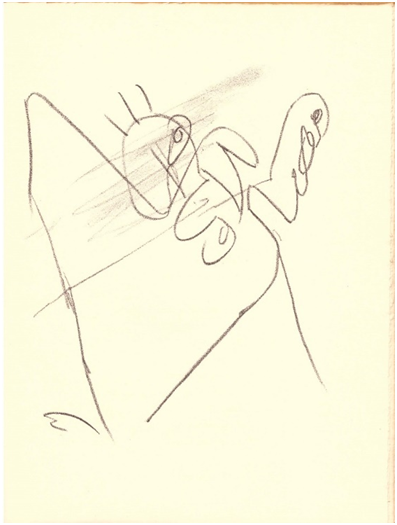
Einstein makes a radical turn once he finally grasps the poetic power of language, which arises from the arbitrariness of the relationship between signifier and signified: “Writing does not imitate facts and things; it evokes them through signs foreign to the appearance of things, etc.” (W 4, 252). In short: “The word is a sign […].” (tradK = “Das Wort ist zeichenhaft […].” [FF, 236]), and this word is the magical utterance so dear to the Romantic poets, the one that “makes the world sing” (Eichendorff). This is the secret cause that generates fictions—yet “the absence of all control exercised by reason” (OCBr, 1, 328) 45 also gives rise to monsters…
Let us note in passing that Einstein’s semiotic observations are not confined to the BEB II files but also appear in Georges Braque, in The Fabrication of Fictions 46, and elsewhere—in short, in a context that spans the late 1920s and the 1930s. 47 While he “irrationalizes” the sign, Einstein, in a complementary reaction, develops a notion of style as a social “regulator” or “control” (W 4, 374; FF, 50). The young author had once loathed any form of style precisely because style “fixes” the flourishing of poetry. Behind this opposition—or rather, complementarity—between arbitrariness and conformity, one recognizes the Nietzschean pair of the “Dionysian” and the “Apollonian,” or Wölfflin’s “metamorphosis” and “tectonics.” “The grammatical combinations of the sentence correspond roughly to the tectonic archetypes of the visual arts.” (tradK = “Die grammatikalischen Satzverbindungen entsprechen ungefähr den tektonischen Typenformen der Kunst.” [FF, 234])
Besides Klee’s work, it is no doubt the Surrealist conception of the dream—Freud-inspired—that pushed Einstein toward a creative conception of the sign. 48 He applies this conception to Braque’s work, who, in the early 1930s, enters a phase of freer, “mythological” figuration. It is no coincidence that the artist chooses Hesiod’s Theogony as inspiration, 49 since this “story of the creation and birth of the gods is also intended as a metaphor for artistic creation,” 50 (Ill. 9), and Carl Einstein is at this very moment an avid reader of Hesiod…
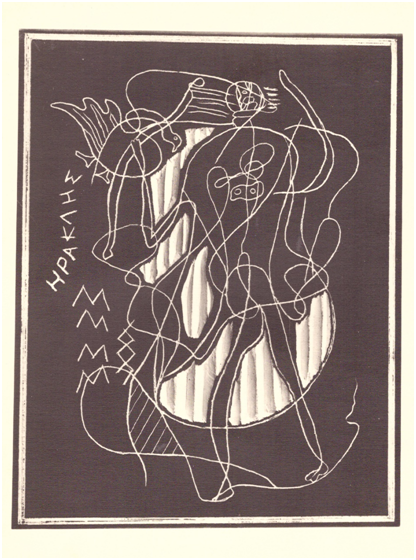
Einstein includes seven engravings in his monograph Georges Braque—which, however, is not “a book about Braque” (tradK = “kein buch ueber braque”) 51—and a true monograph would be required to discuss the intimate relationship between the critic and the artist. Here, it suffices to highlight what I have described as a “poetologization of painting.” 52 Einstein declares in 1931/32: “[…] painting now means making poetry; for it is by making poetry that one creates reality.” (GBMK, 90 = “[…] Malen nun heißt ein Dichten; denn dichtend erschafft man Realität” [BA 3, 326]). Einstein’s contribution to Cahiers d’Art in 1933 calls Braque a “poet” (“Dichter” [BA 3, 246]) 53, and similarly, he speaks of the “poetry” of Klee (“Kleesche Dichtung” [K 1, 142]). Thus, he once again reduces art and literature 54 to the same principle: the symbol, the sign—though without developing a philosophy like Ernst Cassirer’s. And even though he confesses to Ewald Wasmuth in a letter dated 11 March 1931: “All in all, I believe that the visual arts have absolutely nothing to do with literature” (tradK = “Im großen Ganzen glaube ich überhaupt, dass bildende Kunst gar nichts mit Literatur zu tun hat […]” [DLA])—a paradoxical resignation in this context, which is not isolated—Einstein writes in the catalogue for the Georges Braque exhibition he curated for his friend (9 April – 14 May 1933 at the Kunsthalle Basel): “He [Braque] created a grammar of invented forms, a variable syntax, increasingly rich in texture and integration.” (tradK = “Er [Braque] schuf sich eine Grammatik erfundener Formen, eine variable Syntax, und immer reicher wird sie verwebt und verbunden.”) 55
What a “dialectic”: from grammar, poetry’s public enemy no. 1, to the poetic grammar of painting, intersecting with the evolution of the ut pictura poesis postulate—cubist model—toward resignation: “speaking and painting are two entirely distinct things” (GBZi, 15 = “Sprechen und Malen – jedes hat seine eigene Art” [BA 3, 255]) 56, all while proclaiming the reign of a “universal poetry” in all fine arts. Indeed, the avant-garde is a highly dynamic system, and as for Einstein: system is not his strength. To use the expert’s own words: the critic “limps along most pitifully behind” (EKCM, 48) the free artistic production—let alone historical evolution—although the art critic may well exert influence by producing literature himself (albeit of the second order).
- “Requiem for the Self” 57
Einstein’s efforts to define the sign intensify when the ethnologist Einstein conducts a test on himself—that is, when the writer becomes an autobiographer. 58 We do not know what became of the project of a “White ethnology” that Einstein mentioned in a 1931 interview. 59 Was it merely an illusory idea, or was it a book already in press at the Nouvelle Revue Française, lost in the upheaval of Einstein’s departure for Spain and his arrest upon return—his wife Lyda had hurriedly hidden his manuscripts at Georges Braque’s? 60 In any case, Einstein had long since resumed his plan to complete Bébuquin. 61 Ruined by the economic crisis, he wrote on 18 February 1933:
I want to remember myself, since people have forgotten me. The last response that accompanied me constantly was the ticking of my watch; I sold it in order to buy paper. […] Ever since it’s been gone, there is a wonderful silence on the riverbank [the Seine] where I sit. (tradK)
ich will mich meiner erinnern, da die menschen mich vergessen haben. die letzten Antworten, die mich begleiteten, waren die Hackgeräusche meiner Uhr, um Papier zu haben, verkaufte ich sie. […] seitdem sie weggegangen ist, ist es wunderbar still am fluss, wo ich sitze. (AWE, 26)
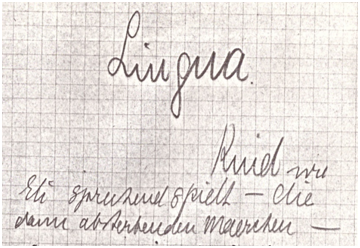
The complex “autobiographical pact” of BEB II, rooted in exile, 62 has been the subject of repeated scholarly study. 63 I emphasize here the young Béb’s acquisition of language—the lingua theme (ill. 10) 64—whatever name he may later bear (Laurenz, etc.).
It is not surprising that the qualities of the “mythomaniac” protagonist (K 3MS, 351 = K 3, 210) closely resemble the child prodigy Paul Klee and the “Neolithic” childhood of Jean Arp (BA 3, 170–174), since we are not dealing here with empirical research of the sort Jean Piaget was undertaking at the same time on language and thought in the child. 65 Einstein draws on fragmented memories of his youth in Karlsruhe as material to be shaped according to his later ethnological and semiotic ideas. 66 Child language creates a mythical cosmology. The little Oedipus conjures a knife to kill the father (B II, 8). Luckily, the floating sign is halted by the parents and schoolmasters who “colonize” the wild child (B II, 19). It is with the word “damned” (tradK = “kaput” [sic] [B II, 8]) that the narrator comments on literacy, and with “broken neck” (tradK = “Genickbruch” [AWE, 19]) on the high school diploma. While the narration of cosmogony is rich in characters, images, and episodes, the split between “subject” and “object” is rendered briefly and abstractly. Nevertheless, three culprits for this “tragedy of children” (tradK = “Kindertragödie” [B II, 19]) can be identified: adult language, which is stronger; the physical laws taught at school; and philosophy. The latter is focused on Plato’s idealism and his allegory of the cave (“hoehlenmaerchen” [sic] [B II, 9]), which neither Béb nor his teachers understand.
How Kant enters the picture—he who is responsible for “one of the primary falsifications of philosophy” (GBKo, 53 = “eine der Grundfälschungen der Philosophie” [BA 3, 293]) because he “established balance between object and subject” (BW, 27 = “[weil er] Gleichgewicht zustande brachte zwischen Objekt und Subjekt” [BA 1, 99])—is something BEB II remains silent on. 67 Yet it is Bébuquin (from which the previous quotation is taken) that resumes the narrative thread, as the protagonist has now entered the academic and artistic milieu of Berlin, where he encounters prominent interpreters of Kant such as Georg Simmel, Alois Riehl, and others, juggling their quotations like a deranged university lecturer (“wildgewordener Privatdozent” [Kurt Hiller, W 1, 501]). The “childhood” chapters of BEB II are thus the “prehistory” in the full sense of the term to Bébuquin. The problem of why the opposition between “subject” and “object” (“[d]ie Entgegensetzung von ‘Subjekt’ und ‘Objekt’”) 68—celebrated by Ernst Cassirer as progressive and emancipatory—is experienced by Einstein as tragic, cannot be fully addressed here. On the one hand, the “self,” the grammatical category par excellence of the subject, is as “detestable” to him as the object, as we already know; 69 on the other, his ego can endure integration into a community—whether communist or capitalist—only briefly. 70
Through the arts—which make use of the arbitrariness of the sign and of dream—Einstein hopes to overcome the “murderous” function of language that stifles the individual: “if Béb speaks, the dead speak with him” (tradK = „wenn Beb spricht, die Toten sprechen mit“ [B II, 8]). But the “grand narrative” that might replace the disastrous Judeo-Christian tradition with some form of blissful animism never comes into view—what exoticism, by the way! In truth, Einstein has only a formal concept of myth, not entirely devoid of meaning, but all the associated mythèmes lack cohesion. The totalitarian state 71, by contrast, has plenty of them… In The Fabrication of Fictions, Einstein resigns himself: “The primitive poets emphasized the collective […]. Modern primitivism emphasizes subjectivity; their [productions] no longer correspond to a reality experienced by all.” (tradK = „Die Primitiven dichteten kollektivbetont […]. Die moderne Primitive ist subjektiv betont; ihre [Figurationen] entsprechen keiner allgemein erlebten Realität.“ [FF, 115]). A rebirth of European culture through the “unity of artistic style across all manifestations of a people’s life” 72, as invoked by Nietzsche, never came to pass—the avant-garde was too heterogeneous. Einstein’s belief in the magical power of the poetic “fetish,” whether literary or visual, crumbles. Artists and intellectuals reveal themselves as mere “fetishists,” and the fetish, that once-“romantic” charm, is now nothing but a superstitious “grigri” (BA 3, 286, 306). Einstein remains well aware of the Enlightenment idea of “the imposture of priests” (FF, 211). Never has self-criticism been so fierce—even suicidal—so lucid, to the point one wonders: why not sooner?
Einstein’s final remark on the relationship between grammar and politics comes in his eulogy at the death of Buenaventura Durruti at the end of 1936:
Durruti, this extraordinarily matter-of-fact man, never spoke of himself, of his own person. He had banished the prehistoric word “I” from grammar. In the Durruti Column, only collective syntax is known. The comrades will teach the literary folk how to renew grammar in the collective sense 73. (tradK)
Durruti, dieser außergewöhnlich sachliche Mann, sprach nie von sich, von seiner Person. Er hatte das vorgeschichtliche Wort „ich“ aus der Grammatik verbannt. In der Kolonne Durruti kennt man nur die kollektive Syntax. Die Kameraden werden die Literaten lehren, die Grammatik im kollektiven Sinn zu erneuern. (BA 3, 520)
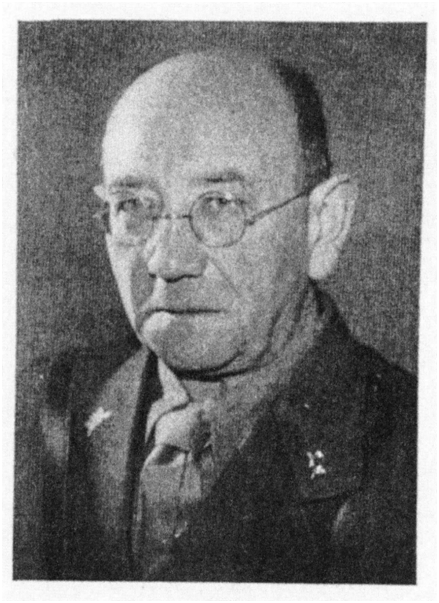
Let us not ask too much consistency from thousands of scattered notes and a turbulent past. In Spain, Einstein (ill. 11) had already moved beyond his “romantic interval,” 74 his belief in the power of the arts
to transform society lay in ruins. Yet in early 1938 (EKC, 106), he had not yet lost all hope. After the victory over fascism, he wanted to return and “write solid books, far from the inclinations of the moderns and the right-thinking of all avant-gardes, books hard and comic” (EKC, 107 = „paar ordentliche Bücher schreiben, fern aller Vorlieben der Modernen und Wohlmeinenden aller Avantgarden, Bücher hart und komisch“ [tradK]). As models, he named Gulliver’s Travels, Don Quixote, Bouvard and Pécuchet—and to this illustrious list he added in a letter to Tony Simon-Wolfskehl in 1923: “Perhaps Bébuquin—if it is finished. Otherwise, it wasn’t worth it. Maybe I’m megalomaniac, but I’m only speaking of intention, not achievement. The devil take the trade.” (tradK = „Vielleicht Bebuquin – wenn er fertig ist. Sonst hat es sich auch nicht gelohnt. Vielleicht bin ich größenwahnsinnig, aber ich spreche nur von Absicht, nicht Gelingen. Der Teufel hole das Metier.“ [CEA, 398])
Abbreviations and Acronyms for the Works of Carl Einstein
AWE = Avantgarde ‒ Weltkrieg ‒ Exil. Materialien zu Carl Einstein und Salomo Friedlaender/Mynona, ed. by Klaus H. Kiefer, Frankfurt/M. – Bern – New York: Peter Lang, 1986 (Bayreuther Beiträge zur Literaturwissenschaft, vol. 8) BA 1, 2, 3 = Carl Einstein: Werke. Berliner Ausgabe, ed. by Hermann Haarmann and Klaus Siebenhaar, Berlin: Fannei & Walz. Vol. 1: 1907–1918, 1994, Vol. 2: 1919–1928, 1996, Vol. 3: 1929–1940, 1996 B II = Notes for “BEB II”; the number after the comma refers not to a page but to a file; this follows the order prior to the unfortunate reorganization of the Carl Einstein collection by Carsten Wurm (“Findbuch”, 2002) BW = Carl Einstein: Bébuquin ou les dilettantes du miracle, preceded by a letter from Franz Blei to the author and followed by a letter from the author to Daniel Henry Kahnweiler, translated and with a postface by Sabine Wolf, n.p.: Les Presses du réel, 2000 (coll. L’écart absolu) CEA = Carl-Einstein-Archiv, Akademie der Künste Berlin; numbers after the comma correspond to the Findbuch CEM = Carl Einstein-Materialien [vol. 1]: Zwischen Bebuquin und Negerplastik, ed. by Rolf-Peter Baacke, Berlin: Silver & Goldstein, 1990 DLA = Deutsches Literaturarchiv, Marbach EKC = Carl Einstein – Daniel-Henry Kahnweiler. Correspondance 1921–1939, trans. and ed. by Liliane Meffre, Marseille: André Dimanche, 1993 (EKCM if the translation is by Meffre) FJD = Fonds Jacques Doucet, Paris FF = Carl Einstein: Die Fabrikation der Fiktionen, Gesammelte Werke in Einzelausgaben, vol. 4, introduction by Helmut Heißenbüttel, ed. by Sibylle Penkert, Reinbek/H.: Rowohlt, 1973 FML = Freud Museum, London GBKo = Carl Einstein: Georges Braque, ed. by Liliane Meffre, trans. by Jean-Loup Korzilius, Brussels: La Part de l’Œil, 2003 GBZi = Carl Einstein: Georges Braque, trans. by M. E. Zipruth, Paris: Chroniques du jour – London: Anton Zwemmer – New York: Erhard Weyhe, 1934 (XXe siècle, vol. 7) GGA = George-Grosz Archiv, Akademie der Künste, Berlin K 1, 2, 3 = Carl Einstein: Die Kunst des 20. Jahrhunderts, Propyläen Kunstgeschichte, vol. 16, Berlin: Propyläen Verlag [Ullstein], 1926, 1928, 1931 (2nd and 3rd editions revised and expanded) K 3MS = Carl Einstein: L’Art du XXe siècle, translated from the 3rd ed. 1931 by Liliane Meffre and Maryse Staiber, Arles: Actes Sud, 2011 OCBa = Georges Bataille: Œuvres complètes, 11 vols., Paris: Gallimard, 1970–1988 OCBr = André Breton: Œuvres complètes, 4 vols., ed. by Marguerite Bonnet et al., Paris: Gallimard, 1988–2008 (Bibliothèque de la Pléiade) tradK = translation by Klaus H. Kiefer tradMit = translation by Liliane Meffre: Carl Einstein 1885–1940. Itinéraires d’une pensée moderne, Paris: Presses de l’Université de Paris-Sorbonne, 2002 W 1, 2, 3, 4 = Carl Einstein: Werke, Vol. 1: 1908–1918, ed. by Rolf-Peter Baacke Vol. 2: 1919–1928, ed. by Marion Schmid Vol. 3: 1929–1940, ed. by Marion Schmid and Liliane Meffre Vol. 4: Texte aus dem Nachlaß I, ed. by Hermann Haarmann and Klaus Siebenhaar, Berlin and Vienna: Medusa and Fannei & Walz, 1980, 1981, 1985, 1992 WIA = Warburg Institute Archive, London
Illustrations
Ill. 1: Max Oppenheimer: Einstein1912, frontispiece, ca. 13 × 10 cm, in: Carl Einstein: Bebuquin, Berlin-Wilmersdorf: Verlag der Wochenschrift Die Aktion, 1917 (Aktions-Bücher der Aeternisten, vol. 5)
Ill. 2: Acht-Uhr-Abendblatt (Berlin), 13 June 1919, p. 2 (newspaper clipping)
Ill. 3: Carl Einstein and Georges Grosz: Der blutige Ernst, no. 41919: Die Schieber (cover)
Ill. 4: Kahnweiler letter (retouched after 1924), Galerie Louise Leiris, p. 11 (excerpt)
Ill. 5: Kazimir Malevich: White Square on White1918, oil on canvas, 79.4 × 79.4 cm, Museum of Modern Art, New York
Ill. 6: Otto Dix: Decaying Trenches1924, etching, 35.3 × 47.5 cm, in: Expressionisten. Sammlung Buchheim, Feldafing: Buchheim Verlag, 1998, no. 553
Ill. 7: Paul Klee: Limits of Understanding1927, pencil, oil, and watercolor on canvas, 56.2 × 41.5 cm, in: Paul Klee: Leben und Werk, ed. by Zentrum Paul Klee, Bern, Ostfildern: Hatje Cantz, 2012, p. 199, Pinakothek der Moderne, Munich
Ill. 8: Illustration III (untitled), ca. 21 × 18 cm, in: Carl Einstein: Entwurf einer Landschaft. Illustrated with lithographs by Gaston-Louis Roux, Paris: Editions de la Galerie Simon, 1930
Ill. 9: Georges Braque: Heracles [illustration II], copper engraving, 20.6 × 16.4 cm, in: Carl Einstein: Georges Braque, trans. by M. E. Zipruth, Paris: Chroniques du jour – London: Anton Zwemmer – New York: Erhard Weyhe, 1934 (XXe siècle, vol. 7), p. 12
Ill. 10: Carl Einstein: Excerpt from “BEB II” (CEA)
Ill. 11: Carl Einstein, anonymous photograph, in: Meridià (Barcelona), 6 May 1938, p. 4 (newspaper clipping)
Notes
Preliminary Note: I cite the French translations of Einstein’s texts before the originals, even though they rarely match the force of the author’s “cubo-expressionist” style, the orthography of which I have also preserved in its irregularity. The letters by Einstein cited here—often unpublished or only partially so—will be printed and annotated in a forthcoming critical edition I am preparing; for now, I merely indicate the archival sources.
1 Cf. Antonius Weixler: Poetik des Transvisuellen. Carl Einsteins « écriture visionnaire » und die ästhetische Moderne, Berlin and Boston: de Gruyter 2016 (spectrum Literaturwissenschaft, vol. 53), pp. 83 sqq.
2 I draw attention to the simultaneous genesis of the Bébuquin and the Demoiselles d’Avignon, both of which approach “absolute art” – “approach,” because Picasso’s painting, derived from a brothel anecdote, becomes fixed at a certain moment of abstraction (cf. Kiefer: “Mit dem Gürtel, mit dem Schleier…” – Semiotik der Enthüllung bei Schiller, Fontane und Picasso, in: id.: Die Lust der Interpretation – Praxisbeispiele von der Antike bis zur Gegenwart, Baltmannsweiler: Schneider Hohengehren 2011, pp. 127–145), and Einstein’s protagonist, according to Gottfried Benn (in a letter to F. W. Oelze, May 31, 1944), “had quite a bit left to do” (tradK = “musste noch allerhand betreiben” [CEM, 79]).
3 Einstein was fond of E.T.A. Hoffmann (cf. his letter to Tony Simon-Wolfskehl, January 25, 1923 [CEA, 389]); for an allusion to Der goldne Topf, see BA 1, 106 = BW, 4: “serpentina alco[h]olica”!
4 Platonism plays an important role throughout Einstein’s work; see Bébuquin, Der unentwegte Platoniker (tradK = The Unwavering Platonist), BEB II, etc. Platonic metaphysics “from above,” i.e., deductive, is responsible for his “terrible trauma of the absolute” (B II, 19); with Böhm’s words (quoted above), Einstein aims to construct an aesthetic “from below,” from elements and sensations, in the spirit of Ernst Mach – even though Mach was considered a “philosopher” of Impressionism. Of the two “solutions” to this “problem,” “totality/monumentality” or “primitivism/cubism,” Einstein opts for the second, whereas his early friend Arnold Waldschmidt chose the first. The latter (like Arnold Breker) decorated the Reich Aviation Ministry (Reichsluftfahrtministerium) in Berlin in 1937 with reliefs.
5 Admittedly, the quotation only appears in the sequel to Bébuquin, “Schweißfuß klagt gegen Pfurz in trüber Nacht” (~ “Infected Foot Complains to Fart in the Gloomy Night” [tradK], published in the journal Front [The Hague], December 1930, pp. 53–61), but already in the first novel similar expressions abound: “They kept on drinking, the alcohol spoke like God from the mouths of the prophets.” (BW, 43 = “Man trank weiter, der Alkohol redete wie Gott aus dem Munde des Propheten.” [A 1, 107]) – But alcohol is merely a “dilettante’s remedy” (BW, 39 = “Hier [Absinth] ein Mittel des Dilettanten.” [BA 1, 105]).
6 One must bear in mind that the young philosopher-author is not particularly rigorous in his terminology.
7 It is a methodological illusion of linguistics to assume that the entirety of the lexicon, syntax, grammar, etc.—everything Ferdinand de Saussure calls langue—is devoid of values; in short: linguistics conceals an ethics.
8 Translating Bild as “painting” or “tableau” hides a German ambiguity. Bild is broader and includes linguistic image, metaphor; yet the poet Einstein detests metaphor, paraphrase, anecdote. Béb wants to become “direct without detour” (“direkt ohne Umweg” [B II, 40; cf. AWE, 12]). Thus, Böhm (and with him the young author) commits a logical-grammatical error in equating the concrete object “painting” with the abstract “concept.” It is only later that Einstein will make use of the poetic flexibility of language.
9 Of course, iconic signs function in the same way across all periods, but non-imitative art heightens awareness of their operation.
10 Ferdinand de Saussure: Cours de linguistique générale, ed. by Charles Bally and Albert Sèchehaye, critical edition by Tullio Mauro, Paris: Payot 1976 (Payothèque), p. 99.
11 Cf. Hugo Ball: Flight Out of Time. A Dada Diary. Preface by Hermann Hesse, trans. by Sabine Wolf, Monaco: Editions du Rocher 1993, p. 39: “Carl Einstein’s The Dilettantes of the Miracle indicated the direction.” (= Die Flucht aus der Zeit, Luzern: Josef Stocker 1946, p. 13: “Carl Einsteins ‘Die Dilettanten des Wunders’ bezeichneten die Richtung.”)
12 Ball: Opening Manifesto, 1st Dada Evening, Zurich, July 14, 1916, in: Dada Zürich. Texte, Manifeste, Dokumente, ed. by Karl Riha and Waltraud Wende-Hohenberger, Stuttgart: Reclam 1992 (RUB 8650), p. 30; cf. Kiefer: Spül müt mür! – Dadas Wort-Spiele, in: id.: Die Lust der Interpretation, pp. 177 sqq.
13 This is the paradox of Raphaëlle Hérout (L’imaginaire linguistique du surréalisme, in: wp/wp-content/uploads/2016/12/Imaginaire-linguistique-HEROUT.pdf, pp. 1–18): attempting to construct a linguistic theory of revolutionary Surrealism based on declarations of goodwill that lack much practice—particularly in the case of Breton. I quote her: “‘What prevents me from disrupting the order of words, from thus attacking the entirely apparent existence of things?’ asks Breton, while insisting that he fully masters syntax.” (p. 10)
14 Cf. Werner Spieß: Max Ernst. Les Collages, inventaire et contradictions, trans. by Eliane Kaufholz, Paris: Gallimard 1984, p. 23: “In the second week of November, in Brussels, he heard a speech by Carl Einstein on the Grand-Place: ‘When he had finished, I went up to him and shook his hand.’” (ibid., p. 460, note 126: “Statement given to the author.”)
15 Cf. Dirk Heißerer: Einsteins Verhaftung. Materialien zum Scheitern eines revolutionären Programms in Berlin und Bayern 1919, in: Archiv für die Geschichte des Widerstands und der Arbeit, no. 12 1992, pp. 41–77, here p. 53.
16 The significant handwritten additions are: above line 2: “et son fond subconscient” (“and its subconscious basis”) and at the bottom of the page: “Réalisme surréaliste spirituelle [sic]” (“Spiritual surrealist realism [sic]”); see Kiefer: Carl Einsteins Briefe – Stilistik und Philologie, paper presented at the Carl-Einstein-Kolloquium, Karlsruhe: Carl Einstein Re-Visited: L’actualité de sa langue, de sa prose et de sa critique d’art / Die Aktualität seiner Sprache, Prosa und Kunstkritik, 2 February 2017, Museum für Literatur am Oberrhein, and 3–4 February, Zentrum für Kunst und Medien.
17 Ernst Mach: L’analyse des sensations. Rapport du physique au psychique, trans. by F. Eggers and J.-M. Monnoyer, Nîmes: Jacqueline Chambon 1996, p. 27 = Die Analyse der Empfindungen und das Verhältnis des Physischen zum Psychischen. Mit einem Nachwort v. Gereon Wolters, Darmstadt: Wissenschaftliche Buchgesellschaft 1985 (1st ed. 1886), p. 20. Einstein declares himself fairly close to Ernst Mach (EKC, 144), but adds: “[Mach] does not take language into account at all. And it is precisely because everything begins with language that I wanted to write the story of a man—not that of an ‘intellectual’—who experiences dead language, in light of his experiences, as something truly deadly.” (EKCM, 54 = “[Mach, der] garnicht die Sprache in Betracht zieht. Und gerade weil die Sache bei der Sprache anfängt, wollte ich die Geschichte eines Mannes schreiben und zwar keines ‘Intellektuellen’, der die tote Sprache wie eine wirklich tötende Sache empfindet gegenüber seinen Erlebnissen.” [EKC, 144]).
18 Max Dessoir: Das Doppel-Ich, Leipzig: Günther 1886 (2nd expanded ed.); see also Fritz Mauthner: Beiträge zu einer Kritik der Sprache, vol. 1: Zur Sprache und zur Psychologie, Frankfurt/M. – Berlin – Wien: Ullstein 1982 (Ullstein Materialien; 1st ed. 1906), pp. 665 sqq.
19 Cf. Kiefer: Äternalistisches Finale oder Bebuquins Aus-Sage. Carl Einsteins Beitrag zur Postmoderne, in: Neohelicon, year 21 1994, no. 1, pp. 13–46.
20 One may assume that Einstein is thinking of poems such as “Alaunstrasse in Dresden” by Ludwig Meidner, which imitates the dynamism of the modern city (“vitesse”!) through a kind of perceptual tracking shot (in: Lyrik des expressionistischen Jahrzehnts. Von den Wegbereitern bis zum Dada. Mit einer Einleitung von Gottfried Benn, Wiesbaden: Limes 1974 (5th ed.), p. 205).
21 Through this quasi-simultaneity—according to the lesson of Lessing’s Laocoon—poetic arts come closer to the visual arts, which Einstein always preferred.
22 Cf. Hans T. Siepe: Le lecteur du surréalisme. Problèmes d’une esthétique de la communication, trans. by Marie-Anne Coadou, Preface by Henri Béhar, Paris 2010 (coll. Les Pas perdus), in: http://melusine-surrealisme.fr/henribehar/wp/wp-content/uploads/2014/10/6.-Siepe_BAT.pdf. At the Rencontres en surréalisme organized by Françoise Py, held at the Halle Saint-Pierre, Paris, on 25 March 2017, Siepe’s presentation (À la recherche d’un nouveau langage: réflexions et pratiques surréalistes) and mine complemented each other ideally.
23 Einstein, cited by Clément Pansaers: Dada et moi, in: id.: Bar Nicanor et autres textes Dada, ed. by Marc Dachy, Paris: Lebovici 1986, pp. 199–208, here p. 203.
24 Cf. Michel Collomb: Dévorer, éjecter, recycler: la logique primitive de Benjamin Péret (unpublished study): “Benjamin Péret, among those who formed the hard core of the surrealist group, was certainly the most consistent in striving to align his life with the idea of revolution.” Le Grand jeu is dedicated to André Breton.
25 In both the first and the final editions of Art of the 20th Century, Einstein’s central concepts remain the same, although there are significant variations between 1926 and 1931.
26 Cf. K 3, 190 = K 3MS, 319.
27 In his famous definition of Aufklärung, Kant cited the Latin phrase (whose origin is not relevant in this context): Caesar non est supra grammaticos (cf. Kiefer: Zur Definition aufklärerischer Vernunft. Eine kritische Lektüre von Kants «Beantwortung der Frage: Was ist Aufklärung?», in: id.: «Die famose Hexen-Epoche» – Sichtbares und Unsichtbares in der Aufklärung. Kant – Schiller – Goethe – Swedenborg – Mesmer – Cagliostro, München: Oldenbourg 2004 [Ancien Régime, Aufklärung, Revolution, vol. 36], pp. 39–52); in Einstein’s case, grammar itself is the dictator.
28 Otto Dix: Zerfallender Kampfgraben (Disintegrating trench), from the cycle Der Krieg (The War), 1924, in: Expressionisten. Sammlung Buchheim, Feldafing: Buchheim Verlag 1998, no. 553.
29 Cf. August Stramm: Die Dichtungen. Sämtliche Gedichte, Dramen, Prosa, ed. by Jeremy Adler, München and Zürich: Piper 1990 (Serie Piper, vol. 980), pp. 89, 93 sq., 102: “Sturmangriff”, “Schlacht”, “Patrouille” etc.
30 Gottfried Benn, a friend of Einstein, chose the poem for his famous anthology, Lyrik des expressionistischen Jahrzehnts (p. 226); cf. Kiefer: Primitivismus und Avantgarde – Carl Einstein und Gottfried Benn, in: Colloquium Helveticum, vol. 44 2015: Primitivismus intermedial, pp. 131–168.
31 Léger, cited in: Georges Bauquier: Fernand Léger – Vivre dans le vrai, Paris: Maeght 1987, p. 74 (tradK = « All diesen Trotteln, die sich fragen, ob ich Kubist bin oder noch sein werde, wenn ich zurückkomme, kannst du sagen: mehr als jemals. Es gibt nichts Kubistischeres als einen Krieg wie diesen, der dir einen Mann mehr oder weniger ordentlich in mehrere Stücke zerlegt und in alle vier Himmelsrichtungen verteilt. »).
32 See Kiefer (ed.): Die visuelle Wende der Moderne. Carl Einsteins « Kunst des 20. Jahrhunderts », Paderborn: Wilhelm Fink 2003.
33 Paul Bouissac: Semiotics and Surrealism, in: Semiotica. Journal of the International Association for Semiotic Studies/Revue de l’Association Internationale de Sémiotique, vol. 25, no. 1-2 1979, pp. 45-58, here p. 55.
34 This is why I named him « maître penseur du surréalisme » in: Kiefer: Carl Einsteins « Surrealismus » – « Wort von verkrachtem Idealismus übersonnt », in: « Der Surrealismus in Deutschland (?) ». Interdisziplinäre Studien, ed. by Isabel Fischer and Karina Schuller, Münster: MV Wissenschaft 2016 (Wissenschaftliche Schriften der Westfälischen Wilhelms-Universität, series 12: Philologie, vol. 17), pp. 49-83, here p. 60.
35 See Einstein's letter to Tony Simon-Wolfskehl, 1923, where he calls Klee « Märchenknabe » (CEA, 399), which means both « garçon féerique » and « enfant prodige ».
36 Einstein reproduces « Limites de la raison » (= Grenzen des Verstandes) 1927 in K 3, 540 in black and white; see Paul Klee und die Surrealisten, ed. by Michael Baumgartner and Nina Zimmer, Berlin: Hatje Cantz 2016.
37 See Einstein: Les arts de l’Afrique. Présentation et traduction par Liliane Meffre. Légendes des œuvres et notes établies par Jean-Louis Paudrat, Arles: Jacqueline Chambon 2015 (Actes Sud).
38 See FF, 67, 115 and elsewhere, which criticize the lack of collective dimension in the modern artist.
39 Friedrich Nietzsche: Œuvres philosophiques complètes, vol. 14: Fragments posthumes (début 1888 – début janvier 1889). Textes et variantes établis par Giorgio Colli et Mazzino Montinari, trad. par Jean-Claude Hémery, Paris: Gallimard 1977, p. 57.
40 Nietzsche: Der Wille zur Macht. Versuch einer Umwertung aller Werte. Ausgewählt und geordnet v. Peter Gast unter Mitwirkung v. Elisabeth Förster-Nietzsche. Nachwort v. Walter Gebhard, Stuttgart: Alfred Kröner 1996 (13th revised ed.; 1st ed. 1906) (Kröners Taschenausgabe, vol. 78), p. 428 (no. 634). This is the edition Einstein should have known; see Nietzsche: Sämtliche Werke. Kritische Studienausgabe in 15 Bänden, ed. by Giorgio Colli and Mazzino Montinari, München: dtv and Berlin and New York: de Gruyter 1980, vol. 13: Nachgelassene Fragmente 1887-1889, p. 258.
41 See Kiefer: Bebuquins Kindheit und Jugend – Carl Einsteins regressive Utopie, in: Historiographie der Moderne – Carl Einstein, Paul Klee, Robert Walser und die wechselseitige Erhellung der Künste, ed. by Michael Baumgartner, Andreas Michel, Reto Sorg, Paderborn: Wilhelm Fink 2016, pp. 105-120, here p. 119. Why the German translation, the book was available in France as early as 1916? He may have bought it during his visit to Berlin in 1931.
42 Saussure: Cours de linguistique générale, p. 33.
43 Einstein is wary of the term: « On peut difficilement décider si le Nègre croit qu’il utilise une statue ou bien si le fétiche exerce une fonction, par sa propre vertu en quelque sorte. » (tradM « La sculpture africaine », in: Les arts de l’Afrique, p. 208 = « Man kann schwer entscheiden, wann der Neger glaubt er benutze ein Bildwerk oder der Fetisch übt gewissermaßen selbständig eine Funktion aus. Diese Empfindungen mögen oft ineinander übergehen. » [BA 2, 83]). For my definition of the fetish as a « pragmème », see Kiefer: Die Lust der Interpretation, pp. 16 and 142 sq. One of the main falsifications of modern linguistics (see GBKo, 53) is the abstraction of language from the fetish function of language (of all media). I believe that Westerners are ashamed of being subjected to a « primitive » use of the sign in every act of communication; see also Kiefer: Kant als Geisterseher, in: id.: « Die famose Hexen-Epoche », p. 37 sq. Kant camouflages the animism that makes (or should make) his « categorical imperative » function by comparing it to a natural law.
44 Ill. 2: Illustration III in: Einstein: Entwurf einer Landschaft. Illustrated with lithographs by Gaston-Louis Roux, Paris: Editions de la Galerie Simon 1930, s. p. opposite the verse « Zerfiele das Wort / Wir atmeten enteist » (BA 3, 75 which does not respect the original composition, tradK = « Si le verbe se brisait / Nous respirerions dégelés »). The title is associated by Einstein who ironizes the « tohu-bohu romantique » (tradK = den « romantischen Wirrwarr » [letter to Ewald Wasmuth, March 11, 1931, DLA]) of the illustrations.
45 Einstein practices this irrational principle from « Bébuquin »: « Immer ist der Wahnsinn das einzig vermutbare Resultat. » (BA 1, 129 = « La folie est toujours le seul résultat probable. » [BW, 88]).
46 As in the case of « Georges Braque », Einstein was obliged to have his works translated in order to publish them after 1933; thus, the French title is authentic, but the translation was not made or has disappeared. See Einstein's letter to Fritz Saxl, second half of May 1935 (WIA).
47 One more reason why it is not logical to postulate a rupture between a « subjectivist » and « materialist » phase; but Heidemarie Oehm's thesis has been outdated for a long time.
48 See Kiefer: Carl Einstein et le surréalisme – entre les fronts et au-dessus de la mêlée (Bataille, Breton, Joyce), in: http://melusine-surrealisme.fr/wp/?p=2069. Einstein's reception of psychoanalysis was late, but in his letter to Sigmund Freud on March 8, 1930, he assured him « quelle influence immense [ses] travaux avaient exercé sur la jeunesse intellectuelle ici » (tradK = « welch ungeheuren Einfluss [seine] Arbeiten auf die geistige Jugend hier ausgeübt haben » [FML]).
49 The art dealer Ambroise Vollard had proposed to Braque to illustrate a poetic book of his choice. Braque's choice to be inspired by Hesiod was unexpected – and the influence of Einstein, a specialist in mythology and connoisseur of Hesiod (see index BA 3), was evident! The two friends spent a lot of time together in Paris and Varengeville.
50 http://www.musee-lam.fr/wp-content/uploads/2011/06/theogonie_FR1.pdf. The sixteen engravings completed before Vollard's death were exhibited at the Musée d’art moderne, d’art contemporain et d’art brut de Lille, June 7 – August 28, 2011. The museum is apparently unaware of the role Carl Einstein played in the production of « Théogonie ».
51 Einstein to Ewald Wasmuth, 1932 (DLA). Einstein reproduces the engraving « Héraclès » in GBZi, 12 = GBKo, 22.
52 Gérard Durozoi and Bernard Lecherbonnier (Le Surréalisme. Théorie, thèmes, techniques, Paris: Larousse 1972 [coll. Thèmes et textes], p. 196) speak of « poétisation », which is more elegant, but I insist on the fact that it is Einstein's theoretical discourse, and not the practice itself; for more details, a possible influence of Aragon, see Kiefer: Diskurswandel im Werk Carl Einsteins. Ein Beitrag zur Theorie und Geschichte der europäischen Avantgarde, Tübingen: Niemeyer 1994 (Communicatio. Studien zur europäischen Literatur- und Kulturgeschichte, vol. 7), pp. 449 sq.
53 Einstein: Braque der Dichter, in: Cahiers de l’Art, year 8 1933, no. 1-2, pp. 80-82; trans. by Bertrand Badiou and Jean-Claude Rambach « Braque le poète » (in: Avant-Guerre, no. 2 1981: Sur l’art, pp. 9-14).
54 Initially, the (absurd) model was painting, the Horatian « pictura ». Also, Einstein's second paradigm, the poetic sign, is far from surrealist « nominalism »; see Siepe: Le lecteur du surréalisme, pp. 52 sq.
55 Einstein: Introduction (untitled) in: Georges Braque, Kunsthalle Basel, April 9 – May 14, 1933. In memoriam Emanuel Hoffmann [catalogue], pp. 5-7, here p. 5. This quote is prefigured in K 1, 76: « Er [Braque] schuf sich eine Grammatik erfundener Formen, eine kanonische Syntax. » Einstein corrects « kanonisch » (« canonical ») with the opposite « variabel » (K 3, 101) since in 1926 he had not yet understood.
56 The recent translation is less radical: « parler et peindre – chacune de ces activités a sa manière propre. » (GBKo, 15). Nevertheless, Einstein had authorized his contemporary translator.
57 TradK = « Totenbuch des Ich » (B II, 17); one cannot use « livre des morts » [du moi] which would be less Catholic and more Egyptian, but with a second complement.
58 See the chapter « Ethnologie im Selbstversuch » in: Kiefer: Diskurswandel im Werk Carl Einsteins, pp. 467 sq.
59 B. J. Kospoth: A New Philosophy of Art, in: Chicago Sunday Tribune. European Edition, no. 4932 (January 18, 1931), p. 5.
60 See Sibylle Penkert: Carl Einstein. Beiträge zu einer Monographie, Göttingen: Vandenhoeck & Ruprecht 1969 (Palaestra, vol. 255), p. 18.
61 See Einstein to Tony Simon-Wolfskehl, 1923: « Den zweiten Teil Bebuquin mache ich fertig – wenn wir zusammen sind. » (CEA, 409 = « Je vais terminer la deuxième partie du Bébuquin dès que nous serons ensemble. » [tradK]).
62 Einstein projects his situation as an exiled writer into the fatal prophecy of a fortune teller at a Lunapark in Karlsruhe: « Je te [Béb] vois tout seul et abandonné assis dans une mansarde dans un pays étranger et tu mourras de tes rêves paralysants » (tradK = « ich sehe dich [Beb] ganz allein und verlassen in einer mansarde in einem fremden land und du wirst an deinem laehmenden träumen sterben » [B II, 19]).
63 See Marianne Kröger: Das « Individuum als Fossil » – Carl Einsteins Romanfragment « BEB II ». Das Verhältnis von Autobiographie, Kunst und Politik in einem Avantgardeprojekt zwischen Weimarer Republik und Exil, Remscheid: Gardez! 2007 (Komparatistik im Gardez!, vol. 5), which discusses all the essential approaches. I emphasize the fact that « BEB II » is not an autobiography of Carl, but a fictionalized biography of Béb who is not an « individuum » in the classical sense, but in the sense of Nietzsche's « dividuum » modern (Nietzsche: Sämtliche Werke. Kritische Studienausgabe in 15 Bänden, vol. 2: Menschliches, Allzumenschliches, p. 76 = « Humain, trop humain. Introduction et notes par Angèle Kremer-Marietti, trad. par Alexandre Marie Desrousseaux et H. Albert, Paris: Le Livre de Poche 1995 [Classiques de la philosophie], p. 84), an unstable type in which Einstein reflects himself as Bébuquin would have done, if he had not turned away from the labyrinth of mirrors « afin d’éviter toute réflexion sur sa personne » (BW, 11 = « um allen Überlegungen über die Zusammensetzung seiner Person vorzubeugen » [BA 1, 92]).
64 « Lingua. / Kind wie Eli sprechend spielt – die dann absterbenden maerchen » (tradK = « Lingua. / l’enfant joue en parlant comme Eli – par cela les contes de fée meurent »). Eli (or Eli Coingule etc.) is a figure from Béb's dreams who, however, makes the same negative experience of « rational » language which tears the child away from his « âge de contes merveilleux » (tradK = « Märchenalter »: see Charlotte Bühler: Das Märchen und die Phantasie des Kindes, Leipzig: Barth 1918).
65 Jean Piaget: Le langage et la pensée chez l’enfant. Etudes sur la logique de l’enfant, Neuchâtel and Paris: Delachaux & Niestlé 1976 (9th ed.; 1st ed. 1923).
66 The text oscillates strongly between « vérité » and « poésie/fiction »; for example, in « BEB II », Béb's gang is afraid of Halley's comet (B II, 9 and 19) which was only visible from April to May 1910 in Germany; Einstein was then 25 years old (see his letter to Emilie Borchardt, 1910 (Swiss Institute for Egyptian Construction Research and Antiquities, Cairo).
67 Kant is also for Hugo Ball « l’ennemi numéro un » (Ball: La Fuite hors du temps, p. 39 = « der Erzfeind » [Die Flucht aus der Zeit, p. 14]).
68 Ernst Cassirer: Philosophie der symbolischen Formen, vol. 2: Das mythische Denken, Darmstadt: Wissenschaftliche Buchgesellschaft 1977 (1st ed. 1924), p. 209. The chapter « Die Herausbildung des Selbstgefühls aus dem mythischen Einheits- und Lebensgefühl » (ibid., pp. 209 sq.) = « L’émergence du sentiment de soi à partir du sentiment mythique de l’unité et de la vie » (in: La philosophie des formes symboliques, vol. 2: La pensée mythique, trad. par Jean Lacoste, Paris: Les éditions de Minuit 1972 [Coll. Le sens commun], p. 207) could serve as a title for everything Einstein writes about language and cosmogony in « BEB II ».
69 Einstein read Pascal several times and, evidently, took the philosopher seriously.
70 See AWE, 21 sq.; see also Einstein's letter to André Gide in 1923: « une grande maison d’édition m’a demandé de diriger la maison. Peut-être que j’accepte. » (FJD). He did not accept, and he also distanced himself from a commitment to the Bauhaus (see his letters to Tony Simon-Wolfskehl 1923, particularly CEA, 412).
71 I do not discuss here how the Nazis built their « mythe du 20e siècle » (Alfred Rosenberg) – which was undoubtedly effective (not only because of the assault sections [SA]), so that Breton and Bataille think of profiting from the same mechanisms, in particular from the « aspiration fondamentale des hommes […] au fanatisme » (OCBr 2, 499 and OCBa 1, 382). By composing « surréalisme » and « fascisme » they conceive the fatal idea of a « surfascisme » (OCBr 2, 1665). The discussion of the myth dear to the surrealists, including Einstein, and to the national socialists remains to be deepened.
72 Nietzsche: Considérations inactuelles I: David Strauss, l’apôtre et l’écrivain, in: Fragments posthumes (Eté 1872 – hiver 1873-1874). Textes et variantes établis par Giorgio Colli et Mazzino Montinari, trad. par Pierre Rusch, Paris: Gallimard 1990, p. 17-89, here p. 22. I quote Nietzsche's prophetic and ambiguous passage in full: « La civilisation, c’est avant tout l’unité du style artistique à travers toutes les manifestations de la vie d’un peuple. Mais le fait de beaucoup savoir et d’avoir beaucoup appris n’est ni un instrument nécessaire ni un signe de la civilisation et, au besoin, s’accorde parfaitement avec son contraire, la barbarie […]. » (= « Kultur ist vor allem Einheit des künstlerischen Stiles in allen Lebensäußerungen eines Volkes. Vieles Wissen und Gelernthaben ist aber weder ein nothwendiges Mittel der Kultur, noch ein Zeichen derselben und verträgt sich nöthigenfalls auf das beste mit dem Gegensatze der Kultur, der Barbarei […]. » [Sämtliche Werke. Kritische Studienausgabe in 15 Bänden, vol. 1: Unzeitgemäße Betrachtungen I, p. 163]). Einstein pursued the idea of stylistic and cultural unity from his trip to Egypt in 1910 (see his letter to Emilie Borchardt, 1910: « in Ihrem land bekam ich die strengste und vollkommenste anschauung von stil, künstlerischer tradition und gesamtkultur. » [tradK = « c’est dans votre pays que j’eus la plus sévère et parfaite vision de style, tradition artistique et culture totale. »]). Although he recognizes the superiority of the « protée » Picasso, he ultimately prefers Braque; see Kiefer: Diskurswandel im Werk Carl Einsteins, p. 321.
73 Liliane Meffre translated this paragraph first, in: id.: Carl Einstein et la problématique des avant-gardes dans les arts plastiques, Berne et al.: Peter Lang 1989 (Contacts. Sér. III: Etudes et documents, vol. 8), p. 134, and in: Carl Einstein 1885-1940. Itinéraires d’une pensée moderne, Paris: Presses de l’Université de Paris-Sorbonne 2002, p. 295; she already notes « des lacunes » in the translation she assumes to be by Augustin Souchy. Thanks to Marianne Kröger who made the original French text available to me, I was able to specify that Einstein omitted only the second paragraph in his radio address (in German or French – no one says), or the editors removed it since this sophisticated grammatical reflection appears out of place in the political context; see Einstein: La colonne Durruti, in: Brochure éditée par les Services Officiels de Propagande de la C.N.T. – F.A.I. Avenida Buenaventura Durruti, 32 Barcelone (Espagne), Seix y Barral, Empresa colectivizada, Barcelona – España (Prix: 1 fr. 50), pp. 18-20.
74 See Kiefer: Modernismus, Primitivismus, Romantik – Terminologische Probleme bei Carl Einstein und Eugene Jolas um 1930, in: Jahrbuch zur Kultur und Literatur der Weimarer Republik, vol. 12, 2008, pp. 117-137.