PAUL SANDA, GRAND EMBLEMS OF THE MARVELOUS FOR ERNEST GENGENBACH
May 19, 2024
Paul Sanda, Grand Emblems of the Marvelous for Ernest Gengenbach.
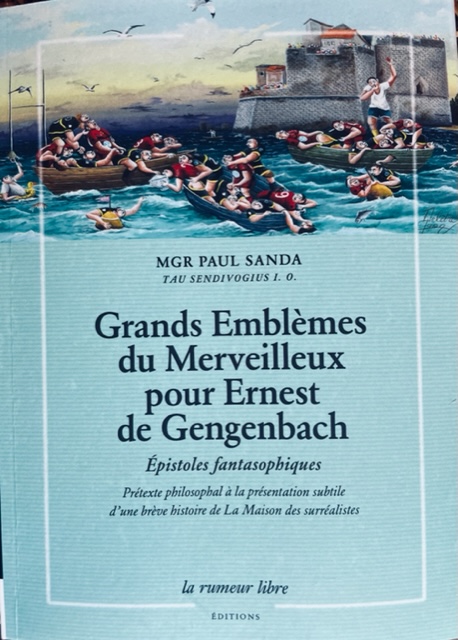
Mgr Paul Sanda, Grand Emblems of the Marvelous for Ernest Gengenbach. That's the title. It is flanked by two subtitles: Phantasophical Epistles, followed by Philosophical Pretext for the Subtle Presentation of a Brief History of the House of Surrealists. Thus adorned, the volume contains 300 dense pages, more than 30 full-page color and black and white illustrations, and it is published by Éditions La Rumeur libre (Sainte-Colombe-sur-Gand) in the year 2024. A very beautiful book, and above all a magnificent monument where unleashed imagination vies with the rigor of abundant erudition, destined by its author (who claims on this solemn occasion his rank of Gnostic bishop) to celebrate the centenary of the Surrealist Manifesto as well as the twenty years of the House of Surrealists of Cordes-sur-Ciel (Tarn). The twenty-four chapters (that is, the body of the work) consisting of "emblem-letters" written by Monsignor Paul Sanda and (fictionally) addressed to "Monsignor Ernest Gengenbach" are preceded by a preface by Patrick Lepetit – the author of The Underground Path of Surrealism where he addresses the relationships between surrealism and esotericism – preface entitled "Ernest de Gengenbach Luciferian Surrealist" and constituting a "subtle pretext for the phantasophical presentation of Paul Sanda in his dwelling". These chapters are followed by a "Reading of the Grand Emblems" by Odile Cohen Abbas, a postface by Marc Petit entitled "The Night of the Stars" and a "Homage to Sarane Alexandrian" by Paul Sanda. A multiple, flamboyant, crackling, sparkling, ardent and generous book, baroque and sometimes explosive, exalted/exultant, which constitutes in itself a veritable and precious library so much it contains proper names, quotations and references. No better way to call for a reading in dizzying immersion of the abundant surrealist universes, their sources and their expansions.
Who is the dedicatee character of Paul Sanda's "emblem-letters"? Born in 1903 in the Vosges, died in 1979 in Eure-et-Loire, Ernest de Gengenbach was a seminarian then Jesuit apprentice in Paris. Due to his excessive taste for women, he will never be ordained a priest. However, he will never cease to evoke and invoke Catholic dogmas, to question and subvert them in a manner that can be said to be fundamentally surrealist. For him, surrealism is "a mysticism without theology... a kind of mystical poaching in the forbidden gardens of the earthly Paradise to steal the fruits of the Tree of Knowledge". He oscillates between a literary and even worldly life, rather alcoholic and even scandalous in the eyes of the "right-thinking", and pious retreats in various monasteries, Solesmes, Saint Wandrille, La Pierre Qui Vire... He is seduced by Jung's thought and haunted by what he calls the "Christian Supernatural". According to André Breton, he manages to reconcile "like no other has been able to do his love of the religious and his love of the profane". However, he breaks with Breton in 1935 after Crevel's suicide, and he reproaches him for having excluded the sacred, the religious, the mystical from his field of exploration. He, Ernest de Gengenbach, author of The Demonic Experience, published by Éditions de Minuit in 1949, then by Eric Losfeld in 1968, can be said to be "pilgrim of the absolute and seeker of the Grail, having all his life sought to reconcile his nostalgia for the surrealist marvelous and his haunting of the Christian supernatural". The twenty-four chapters, "emblem-letters", written by Paul Sanda, find their roots, affirms the author in person, in Gengenbach's own work. We understand that Marc Petit can specify that "it is to a mirror reading that Paul Sanda invites us... in a certain auto-fiction". As Marc Petit also writes, "what surrealism is the name of is not a block or even a solar system, but a nebula, a galaxy where each star is both a microcosmic particle and a monad endowed with a particular point of view on the One-and-All".