PAUL NOUGÉ OR THE SURREALIST LANGUAGE OF CHANCE
par Pierre Taminiaux
May 16, 2018
Paul Nougé or the Surrealist Language of Chance
Belgian Surrealism remained one of the most active and creative branches of Surrealism throughout the twentieth century. I will study here the role of the poet Paul Nougé in its development. It is clear that its most famous representative is René Magritte, an artist who quickly acquired a preeminent international status in the world of modern art. I prefer to focus then on a less known figure, especially abroad, although Nougé is commonly considered a historical personality of the movement in Belgium.
First of all, it should be noted that Belgian Surrealism constituted itself from its origin as a largely interdisciplinary movement that constantly brought together literature, visual arts and music (let us think here of the contribution of the composer André Souris). From this perspective, when speaking of a Belgian surrealist poet, one also inevitably refers to the domain of art to which this poet was linked in one way or another. For Belgian Surrealism, indeed, there was no pure poet. But there was no pure artist either. The poet was always somewhere a man of images or objects and the artist a man of words.
I will therefore use the term: poet for mainly practical reasons. Belgian Surrealism, indeed, questioned the very notion of poetry and its intellectual significance for Western culture. Mallarmé had triggered this questioning in a radical way at the end of the nineteenth century with his poetic masterpiece Un coup de dés jamais n'abolira le hasard.
In this regard, it should be known that Mallarmé was Magritte's favorite poet, even before Edgar Poe whom he nevertheless admired greatly [^1]. The poet of Un coup de dés insisted in particular on the visual and graphic composition of words on the white page. In this sense, he expressed the impossibility of pure poetry, that is, of a strictly verbal form that should only be read and not looked at.
Paul Nougé explored the visual domain both within and outside of poetry. For example, he wrote many visual poems but was also simultaneously a photographer. His practice of poetry must thus be conceived within the framework of a global artistic practice. In many respects, he was therefore as much an artist as a surrealist poet. Avant-garde art, according to his personal perspective, was never simply poetry nor simply painting, but rather any enterprise that possessed a creative dimension and that erased the classical distinctions between disciplines and forms.
Nougé, like most of his Belgian colleagues, opposed the theory of automatism constructed by Breton in The Manifesto of Surrealism of 1924. He was wary of the psychoanalytic approach on which it was based. In other words, he did not think that the unconscious constituted the primary source of poetic imagination. But he nevertheless believed, like Breton, in the revolutionary nature of Surrealism, which is well demonstrated by his signature of the Manifesto of Revolutionary Surrealism in 1947.
The essential question of revolt occupied an important place in the text of this manifesto. This was, according to the signatories, at the origin of the surrealist movement as a whole. But they then reproached Breton and his closest colleagues for having neglected its properly historical dimension which precisely allowed the transformation of revolt into an authentic revolutionary project:
Surrealism succeeded in provoking a crisis of consciousness of the most general and most serious kind. It opened to inner revolt the field of an experience without other limit than that of the universe. It disciplined this revolt in a collective activity. But of the two branches of its compass, it assured only the one it had planted in the heart of the individual, leaving the other to whirl at the chance of a reality that it neglected to consider historically. The passionate test of the conditions made to revolt in the world, it committed the fault of not pursuing it as living perspectives of revolution were outlined outside of it, as the first milestones of revolutionary action were established in the facts, as a revolutionary movement developed that had chances of succeeding, that alone marked the event with its will to succeed.
Nougé therefore subscribes to this renewed revolutionary momentum of Surrealism, at a time when Breton had detached himself from it in favor of either Fourierist social utopia, or various esoteric and magical practices of a pseudo-scientific nature. The emphasis on the historical inscription of the founding revolt of Surrealism implied for the cosigners of this Manifesto unequivocal adherence to Marxism. The latter then seemed to Nougé and his colleagues the only system of ideas capable of "changing life" while "transforming the world." By contrast, Breton's Surrealism had, according to them, progressively abandoned the project of such a synthesis:
For having misunderstood this necessity, it compromised the blossoming of a unitive revolt, alone effective. Far from unifying the two watchwords: change life-transform the world, it made them a dilemma from which the surrealists emerged only individually, dislocating the first surrealist instance. [^2]
The very date of this document, that is to say 1947, can in many respects explain such radical positions. It corresponded to a time when the communist illusion still possessed a certain power among many artists and writers, and not only in Belgium. Paul Nougé and the other signatories of this text thus insisted on the mainly collective nature of the surrealist movement, and therefore by extension, of the revolt envisaged in its reality both artistic and socio-political.
They denounced in this perspective the philosophical drifts and aesthetic renunciations of post-war Surrealism, resulting largely from its commercialization and its growing social and cultural diffusion: "Far from exercising this vigilance, Surrealism has attempted to react to its vulgarization in markets and fairs by an escalation of despair and strangeness, by an esotericism of bad quality – a compromise of publicity and mystery that finished delivering it to its enemies. [^3]"
Nougé also contributed to several Belgian surrealist journals, among which Les Lèvres Nues, which appeared in the fifties and included regular contributions from his colleagues Marcel Mariën and Louis Scutenaire [^4], but also the most important members of the Lettrist International like Guy Debord.
Among these publications, we also find La Carte d'après nature, a journal with a singular format since it appeared in the fifties as a series of postcards combining written texts and images. It includes in particular a tribute to Poe by Magritte as well as an article by Nougé entitled: "Récapitulation," which attempted to synthesize the aesthetic and philosophical project of Belgian Surrealism and to respond to its detractors, who were still numerous in Belgium after the Second World War.
In "Récapitulation," Nougé insisted on the fact that Belgian Surrealism had attempted to accord a substantially equal value and the same dignity to all forms of artistic practices, from found objects to collages and photographs. The Belgian surrealist poet, in this sense, was also and almost inevitably a critic.
Criticism constituted an important aspect of his work, insofar as it allowed him to better formulate his personal ideas on literature and art. The journals then affirmed themselves as the perfect receptacle of the intellectual expression of Belgian Surrealism. Magritte himself was moreover the editor-in-chief of several of them, including La Carte d'après nature. Some, however, had only an ephemeral lifespan. They moreover often testified to the realization of a particular concept, beyond their simple reality as physical objects.
To a large extent, Paul Nougé's poetry was experimental poetry. But it also reflected a form of existential urgency: poetic experimentation required in this perspective the creation of a language above all anchored in the present. It moreover constituted a privileged metaphor of the continuous relationship that Belgian surrealist poetry maintained with the physical world.
The word: experience appeared in Paul Nougé's main work entitled L'Expérience continue, a collection of poems, short stories and aphorisms that came out in 1966, only a year before the author's death 5. This book, which gathered texts written over several decades, reflected the deep concern to constantly bring together poetry and visual arts. But the word: experience also referred to Nougé's scientific training and his professional activities as a chemical technician working in the laboratory.
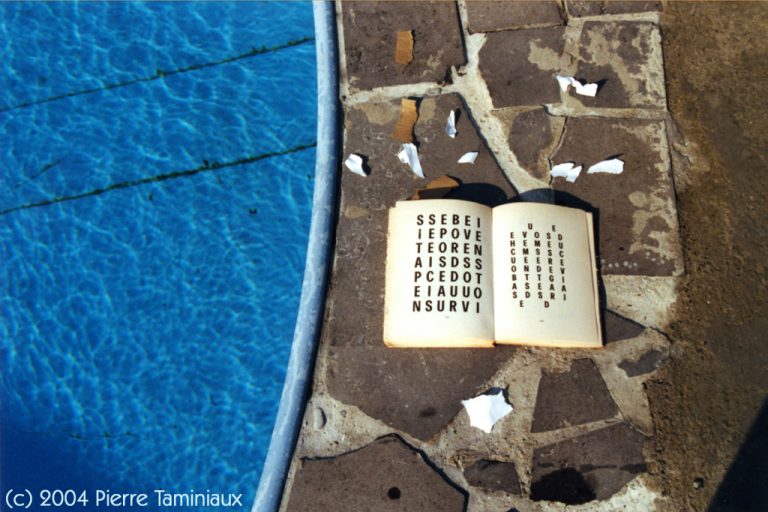
Some of the poems included in this work were composed of large letters that had to be read from top to bottom and not from left to right to constitute real words or verses. This unusual arrangement of pages in these experimental poems expressed Nougé's constant concerns for original forms of reading 6.
It is interesting to note in this regard that Nougé's summa work was celebrated by Francis Ponge, who, as a poet, devoted himself to close observation and sharp description of nature and its forms 7. This apparently surprising relationship allowed to emphasize the quest for a poetic reason in Nougé's work, that is to say of poetry as a mode of knowledge and not only as a sensitive experience. On the back cover of L'Expérience continue, Ponge thus describes the physical characteristics of the poet to better emphasize his artistic and intellectual personality:
Of Paul Nougé – not only the strongest head (long coupled with Magritte) of Surrealism in Belgium, but one of the strongest of this time – what else would I say? Except (but it's always, of course, the same thing) that one could not better define it – this head – than by the properties and virtues of Lydian quartz, that is to say as a kind of basaltic stone, black, very hard, and of which everything that is of low gold fears the touch.
Quite irreplaceable, you see.
Ponge and Nougé, beyond their obvious aesthetic divergences, shared the idea of a quasi-objective poetry, or in any case detached from too heavy a subjectivism. They also linked the question of the very form of poetry to that of art: Le Parti pris des choses, thus, can be read as a set of still lifes become poems. Finally, the scientific approach to poetry attracted them jointly: the poet's gaze, in Ponge, can in this regard be compared to that of a botanist or an entomologist who observes nature in its smallest details.
The notion of experimentation essentially denied the idea of masterpiece. Nougé's poetry fixed its attention on a particular aesthetics of dissemination in poetic language. His poetry was made of pieces and fragments of discourse: he thus regularly resorted to the collage technique to express this truth, a technique that Breton had already illuminated in his first Manifesto with the aim of emphasizing the aleatory aesthetics of surrealist poetry.
Moreover, some of Nougé's poems consisted only of a few words and thus even unconsciously imitated the concise and minimalist form of the haiku. This deep attraction for an eminently purified expression was not foreign to surrealist poetry in general, especially if one considers poems by Paul Éluard in Capitale de la douleur like "Porte ouverte" or "La rivière."
One could evoke in this regard the term of sketch or poetic sketch, which both refer to the work of the artist, painter or draftsman, thus emphasizing the constant plastic analogies of Nougé's work. The poetic form gives the impression of being unfinished, as if suspended, then calling on the reader's imagination.
In L'Expérience continue, Nougé himself uses this term of sketch regarding his "Équations et formules poétiques" which play on consonances and repetitions of certain syllables to establish close relationships between words. As he writes:
It is therefore a question of establishing systems of equations of increasing complexity by the choice and relationship of elements (so as not to confine oneself to substantives and simple proportion) and then to resolve this system in poems.
In the experience related above, the primary relationships are material relationships (sound relationships) used and modified subsequently according to the meaning or effect of the words involved.1928-1929. 8
In another text dating from 1932, he moreover gathered a set of short poems on the body under the title: "Ébauche du corps humain" 9, thus suggesting a kind of poetic anatomy. Scientific metaphors never really left Nougé's language, as shown by the following assertion from the same text: "OUR BODY proposes to us an algebra that has no solution" 10.
But science opens here onto the eminently playful potentialities of language, rather than onto any analytical discourse. It is indeed a question of making meaning slide, of never immobilizing it in a predetermined or already known form. Poetic sketches constitute only a series of propositions or a bundle of hypotheses without real conclusion or answer.
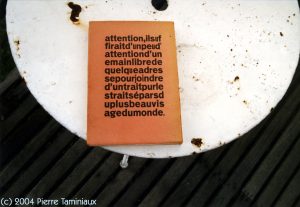
Moreover, Nougé entitled some of these very short poems Cartes Postales. To introduce then those that appear in L'Expérience continue, he writes: "That one wants to imagine a collection without malice. And use it. These cards suit everyone, our enemies, our friends. We know it, there are no more indifferent people." 11 The postcard obviously refers to an everyday object, simple, manageable and above all small in size. Poetry, from then on, must be situated at human height, that is to say material, concrete and yet imaginative. But the postcard also necessarily implies the meeting of words and images. It is in its essence only an illustration enriched by a brief text.
It is thus read and looked at simultaneously as a visual form as much as a verbal one. This theme of the postcard is important for the surrealist movement, if one knows that Breton, in particular, collected them. Nougé, however, specifically associated it with the poetic work grasped in its immediacy and spontaneity. But he thereby emphasized the fragile nature of the poem and its somewhat ephemeral character.
The postcard also poses the question of address and recipient. In this sense, it is never an anonymous object but rather concerns a particular subject to whom it is sent and who receives it. It defines in this perspective a form of intimacy of language beyond a rapid and apparently anecdotal communication.
One could evoke here the fundamental irony of Belgian Surrealism, starting from Nougé. By irony, one must essentially understand the distrust towards any predetermined and invariable truth. But this state of mind also implies the clear and net rejection of theoretical systems like the Freudian interpretation of dreams. By contrast, André Breton adhered enthusiastically to the Freudian intellectual heritage with the aim of expressing his own vision of poetry and art through automatism in The Manifesto of Surrealism of 1924.
This explains why Nougé's poetry is never really oneiric, nor even less hallucinatory, unlike certain canvases by his illustrious colleague Magritte. It mainly engages in speculative interrogations, without ever really imposing a set of striking images or an inner world that would come from the imaginary.
This irony constitutes a common element of the various texts written by Paul Nougé, both in the domain of poetry and in that of the short story. It implied for him a form of deep detachment towards his own words. From this perspective, it should be emphasized that Magritte also manifested a form of emotional distance and self-mockery in his art. One need only think of his "vache" period, a set of deliberately botched paintings that were inspired by the painter's disappointing stay in Paris at the end of the twenties 12.
To be an authentic artist or poet, one must thus feel a kind of doubt before one's own work. This is the important lesson that Paul Nougé endeavored to teach. One could identify such an attitude with philosophical skepticism. The origin of this ironic attitude is found in the avant-garde of the early twentieth century, and more particularly in the work of Marcel Duchamp. From then on, one can reasonably affirm that Paul Nougé's Surrealism was at least as close to Duchamp as to Breton. Duchamp indeed demonstrated through the public presentation of his urinal that anything could be a work of art. Through this original gesture, he revealed his deep suspicion towards the very notion of work of art in Western culture.
Nougé was in this perspective the author of a short essay entitled Notes sur les échecs 13, whose scattered and fragmentary form recalled that of his poetry, and in which he praised the rational character of this game and its mental requirement, starting from a critique of Edgar Poe's ideas on the same subject. He thus wrote: "Chess tolerates no absence, no repentance. The most minimal mental 'failure' entails immediate sanctions (...) The game of chess leaves the mind completely exposed, without possible retreat, without lies, without false pretenses. 14"
This game, according to him, also posed and doubtless primarily the question of freedom. The latter, then, was accessible only to a few, as in poetry and in art. He thus added:
At chess, the most difficult conquest, if not essential, is freedom.
It exists only at the extremes.
By favor of unconsciousness, of ignorance, it is found in the beginner, it reappears in the masters. It disappears in the middle under the weight of mediocre science, automatisms and clichés.
Truth that largely overflows the chessboard, infinitely more general truth. Poetry, painting, war, revolution. 15
In doing so, he placed himself in the shadow of Marcel Duchamp, the most famous chess player of modern art. Irony, in this sense, is always the weapon of an artist or poet who does not adapt to the values and rules of established institutions. It thus affirms a position of non-belonging. The ironic subject, then, lacks faith and absolute belief, insofar as the cultural order in which he lives does not really welcome him.
Nougé fully assumed this marginality which was the result of a deep formal and philosophical requirement. Breton, in this regard, recalled in The Second Manifesto of Surrealism these words of the poet: "I would quite like those among us whose name begins to mark a little, to erase it. 16" In Breton's perspective as in Nougé's, it was a question of criticizing the vain quest for public approval by the surrealist poet or artist.
The ultimate consequence of self-irony is indeed self-negation. Nougé accomplished this process himself without ambiguity. Indeed invited to organize an international exhibition of Surrealism in 1945, just after the war, Magritte asked Nougé to compose a phrase expressing the rejection of the term: surrealism. The latter agreed without hesitation to this request and wrote the following phrase: "Exegetes, to see clearly cross out the word surrealism". 17
The true avant-garde artist, for the Belgian surrealist poet, could not be reduced to a simple label nor confined in a box. In other words, Paul Nougé's Surrealism refused any narrow definition that would have subjugated it to a single and strict formal rule. Concretely, it was also a question for the Belgian group of which he was a part to maintain a certain independence vis-à-vis Breton. It did not then affirm itself as a school of thought nor as an aesthetic system, but rather as the unique possibility of individual and collective experimentation.
He borrowed part of his initial inspiration from Dada and Surrealism while exchanging many ideas and perspectives afterwards with the Lettrist International. His aesthetic identity was thus essentially heterogeneous, since he constantly played with forms as different as poetry, short story, collage or critical essay. But it is precisely this interdisciplinary nature that expressed his unwavering attachment to the surrealist project, and this in a somewhat contradictory manner.
Experimenting with words, objects and images implied the presence of an original hypothesis that had to be validated during the creative process. Poetry and art, in this sense, stemmed from the epistemological value of doubt. Moreover, this suggested the sense of an unpredictable and unknown itinerary. Nougé could thus not determine in advance the arrival point of his poetic writing. He had on the contrary to wander through language permanently.
In a short article entitled "La Grande question," published in Les Lèvres Nues in 1955, Paul Nougé defined his own state of mind as "anxiety." Every form, every movement and every image had thus to be agitated by this feeling. In the absence of a metaphysical or religious system, the surrealist poet, according to him, had to perceive intensely the constant presence of danger around him ("I have the sensation of danger, I have the notion of danger, I have the idea of danger." 18)
This uncertain and precarious situation emphasized the essential role played by chance in surrealist poetry. For Nougé, chance was more decisive than dreams in the construction of his aesthetic identity. It strongly illuminated the playful dimension of his own artistic expression. In this regard, he named some of his visual poems included in L'Expérience continue: "the game of words and chance" 19. As he writes in the following poetic fragment where he speaks of the card game:
The table matters little if you make a CLEAN SLATE. Shuffle, turn over one by one, align the cards. It happens that the game gives you CARTE BLANCHE. But that it be for the moment up to you to depend, beware: THE GAME IS ONLY WORTH ACCORDING TO THE CANDLE. Advance slowly to the fifty-second card. Shuffle, take up again. If you give up, you are lost. 20
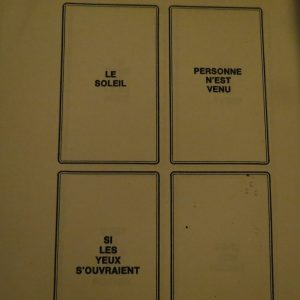
From this perspective, the words are inscribed on playing cards. They thus mix and distribute according to the deal. Some cards, however, remain empty, as if this game called for the presence of white spaces of Mallarméan inspiration. It is never, then, a question of completely filling the page which is divided into several cards. "It is the readers who make the poems," or rather in this case, who plug and complete them, could thus say Nougé by paraphrasing Duchamp's famous formula, "It is the lookers who make the paintings." It matters little, thus, whether the form succeeds or not, whether it has a precise end. This feeling of incompletion is once again eminently Duchampian, if one thinks in particular of the genesis of The Large Glass.
To take up Breton's words on Duchamp in his essay "Phare de la mariée," which evoked regarding his works a set "of interventions in the plastic domain" 21, Nougé's poems can thus appear as "interventions in the poetic domain." In both cases, it is a question of insisting particularly on the rejection of the very notion of finished product (of perfectly accomplished object) in art or poetry.
The word: intervention thus distinguishes itself from the word: production or even from the word: creation grasped in their traditional sense. But it must also be conceived as different from the word: action. In Nougé's poems, indeed, the poet's relationship to language is both and contradictorily active and passive: one must, in a certain manner, let the words do, or rather let them be in their playful and aleatory drift and wandering.
Duchamp's work, in many respects, embodied the most important ideas expressed by Paul Nougé in his article "Récapitulation." The latter had indeed emphasized the egalitarian character of all artistic practices according to the very spirit of Surrealism. It was no longer, in this sense, a question of establishing fixed aesthetic criteria according to which painting would have held a form of natural and indisputable sovereignty over any other discipline.
Duchamp's ready-mades demonstrated the inanity of an academic hierarchy of artistic practices: all of a sudden, indeed, a found object like a urinal or a bicycle wheel acquired a significance as great, if not greater, than a painting or a drawing. This will to classification and hierarchization had also motivated numerous modern philosophical discourses on the arts, including that of Hegel in his Aesthetics.
One can then evoke the common aesthetic relativism of Nougé and Duchamp. It stems from a deep consciousness of the loss of unity of the world and of art (of poetry) in the twentieth century. The avant-garde poet and artist are doomed to the experience of the fragment, whether it is embodied in an abrupt poem or in an object of everyday life. ("I proceed by bursts" 22, thus writes Nougé in 1953). The fragment opens onto the possibility of play, insofar as the latter is inscribed in an ephemeral temporality.
In other words, Nougé's poetic collages and Duchamp's ready-mades escaped in many respects from any desire for duration. Poetry and art had to be lived then in the present, this time which is by essence that of the event. "Life is what happens," said Wittgenstein. "Poetry and art are what happens," could then continue Nougé and Duchamp according to a kind of involuntary paraphrase.
And why play, if not to risk losing? Nougé's poetry (language) only reflects this apparently negative possibility, but which the author transforms into a ray of light. "What derision to know, if knowledge escapes in the instant when one wants to be sure of it. Everything is lost, not to be able to risk losing again 23." he thus writes. And further: "One word following the other and hand in hand, assured finally of not reaching any point, one exists 24."
The essential question posed by avant-garde poetry is therefore indeed that of a "gain despite everything," beyond appearances. Gain and loss always go hand in hand, since nothing really remains, since nothing is eternal. The poet knows that his own language will never be completely accomplished, but it matters little to him. Unlike cinema, then, the words: the end are foreign to poetry and its development. The latter constitutes profoundly only an affirmation of existence at all costs, in the same way as revolt.
It is still for Nougé a question of putting poetry, according to his own terms, "within reach of all hands." He describes to this effect in another text dating from 1935 a "Poetic Machine" and the instructions related to its use:
The machine consists of a rectangular box containing a collection of thirty-two objects.
One places on an empty and normally lit table a sheet of white unlined paper.
One removes an object taken at random and places it delicately at the center of the sheet.
One questions the object without preconceived idea or feeling for the necessary time, variable evidently according to individuals and circumstances that preceded this exercise. The interrogation consists of an attentive visual examination, of a tactile test going from brushing to palpation, and will be completed if necessary by an olfactory test 25.
If one can never really say where and when poetry ends, one can also not say where and when it begins. It can very well, in this sense, be situated outside of words, in the simple examination of an object placed on a table. The poet asks questions by the very fact that he looks at things while touching them. Nougé uses in this regard in this passage the term "of event."
The expression: "Poetic Machine" could also come out of the Duchampian vocabulary, if one thinks for example of the bachelor machine of the Large Glass. This machine contains dreams and desires, indeed, and in this sense, opens onto a particular imaginary. It constitutes in no case a simple objective device. From Nougé to Duchamp, then: Poetry or art instructions for use, that is to say potentially created by everyone, poetry or art as almost harmless practices, emerged from the banality of everyday acts and objects.
Revolt, in such a perspective, is inseparable from the poet's speculative freedom. Such freedom certainly participates in the scientific spirit, without however, speculation having to lead here to a real practical application. To question the real, from then on, is already to answer it, or in any case to go beyond its trivial character.
It is the absence of any prejudice or preconception that allows in this sense the poet to explore the very idea of poetry and the infinite domain of play which necessarily includes that of emotions ("Your heart within reach of the hand play your heart," he writes at the beginning of "The Game of Words and Chance" 26). Nougé advances in some way gropingly in the universe of poetic language. It is in its undecidable and undetermined dimension that his project then requires our attention today, beyond its incontestable and decisive inscription in the history of Belgian Surrealism.
Paris, May 12, 2018, Halle Saint-Pierre, Study Day "The Languages of Surrealism"
ABSTRACT
This article analyzes the Surrealist identity of Paul Nougé's poetry. It focuses on his main work, L'Expérience continue, which was published in 1966 by the Brussels-based publishing house Les Lèvres nues. It is illustrated by some of my own photographs. It stresses the sheer originality of Nougé's esthetic project, which stemmed from the deep consciousness of the almighty power of chance both in life and in art and literature. Nougé was particularly interested in the creation of a visual form of poetry : the words and the letters had thus to be disseminated randomly on the page. This echoed in many ways the spirit of Mallarmé's A Roll of dices will never abolish chance. Nougé was also a conceptualist who emphasized the philosophical dimension of avant-garde poetry. In other words, he never abided by Breton's dogma of automatic writing. But he was not primarily concerned with the expression of the supernatural or the magic either. His poetry constituted a set of verbal hypothesis that were embodied in various linguistic fragments or sketches. This article stresses the important contribution made by Nougé to the journals of Belgian Surrealism, particularly La Carte d'après nature, a journal that was published as a series of postcards in the nineteen fifties. Moreover, it brings together the work of Nougé and that of Marcel Duchamp, to the extent that both favored the speculative nature of the creative process. They also shared the same passion for chess, as demonstrated by Nougé's short essay on the topic, Notes sur les échecs, which was published after his death.
[^1] Magritte initiated in this perspective Marcel Broodthaers, a key figure of Belgian art of the sixties and seventies, to Mallarmé's work, and especially to Un Coup de dés, which inspired Broodthaers' most original artist's book. Broodthaers was also under many aspects the heir of Marcel Duchamp, with whom he shared the passion for concepts and ideas on art. [^2]: No quarter in the revolution!, p. 1.
[^3]: Ibid, p. 2.
4 Among these contributions, we find in particular a short story by Nougé entitled: "Hommage à Seurat ou les rayons divergents," Les Lèvres Nues, 9, November 1956, pp. 26-33.
5 PAUL NOUGÉ, L'Expérience continue, Brussels: Les Lèvres Nues, 1966. We use here for our citations the second edition of the same work, Lausanne: L'Age d'Homme, collection Cistre, 1981.
6 Some of these visual poems composed of large letters inspired my own artistic work, in particular a set of photographs included in an exhibition entitled Pictures from home, which took place at the Alliance Française of Washington in the fall of 2004.
7 I want to refer here to his main book of poetry, Le Parti pris des choses, Paris: Gallimard, 1942.
8 NOUGÉ, L'Expérience continue, Lausanne: L'Age d'Homme, 1981, p. 189.
9 NOUGÉ, Ibid, p. 321-330.
10 Ibid, p. 326.
11 NOUGÉ, Ibid, p. 17.
12 One can also find the illustration of such an attitude in the book Mes Inscriptions by Louis Scutenaire 12. This book represents a kind of ironic confession, an autobiographical enterprise that constantly calls into question the sovereignty of the self in writing. The surrealist poet, here, speaks of himself without ever really taking himself seriously. This ambivalent perspective towards the subject of the work reflects the deep sense of derision in its author.
13 PAUL NOUGÉ, Notes sur les échecs, Brussels: Les Lèvres Nues, 1969.
14 NOUGÉ, Ibid, pp 70-71.
15 NOUGÉ, Ibid, pp 75-76.
16 ANDRÉ BRETON, Manifestes du surréalisme, Paris: Gallimard, Folio/Essais, 2003, p. 127.
17 See in this regard the essay by Marcel MARIËN, "Les pieds dans les pas," in Apologies de Magritte, 1938-1993, Brussels: Didier Devillez, 1994, pp. 110-112.
18 NOUGÉ, "La Grande question," Les Lèvres Nues, 5, p. 36.
19 NOUGÉ, op. cit, pp. 267-286.
20 NOUGÉ, Ibid, p. 271.
21 ANDRÉ BRETON, Le Surréalisme et la peinture, Paris: Gallimard, 1965, p. 118.
22 NOUGÉ, op. cit., p. 130.
23 Ibid, p. 168.
24 Ibid, p. 168.
25 NOUGÉ, Ibid, p. 196.