SURREALIST FREUD-MARXISM: A CRITICAL MYTHOLOGY
par Paolo Scopelliti
August 26, 2019
Surrealism, which we have seen socially adopt the Marxist formula by deliberate choice, does not intend to make light of the Freudian critique of ideas [...]. If it is impossible for it to remain indifferent to the debate that pits before its eyes the qualified representatives of the various psychoanalytic tendencies ― just as it is led, day by day, to consider with passion the struggle that continues at the head of the International ―, it has no need to intervene in a controversy that seems to it to be able to continue usefully for long only between practitioners. [...] But, as it is given by their nature to those it brings together to take into special consideration [...] the definition of the phenomenon of "sublimation," surrealism essentially asks these [...] to supplement by self-observation [...] what is left insufficient by the penetration of so-called "artistic" states of mind by men who are not artists but for the most part doctors.
As early as 1930, through the Second Manifesto, Breton (808-809) officially constituted sublimation as the privileged site of a surrealist mediation between psychoanalysis and Marxism: thus, surrealism will have been the only avant-garde movement to have openly engaged in the Freud-Marxist approach. In this article, I will attempt to sketch at least a very first outline of the history of surrealist Freud-Marxism, which still largely remains to be written, making room for the non-Francophone authors of the Surrealist International, just as important for my subject as their better-known Parisian comrades.
The Serbs Koča Popović and Marko Ristić immediately inaugurate the new course with the essay Nacrt za jednu fenomenologiju iracionalnog [Sketch of a Phenomenology of the Irrational], which appears at the Surrealist Editions of Belgrade in May (da [...] Freuda podvrgne jednoj kritici analognoj Engelsovoj kritici Feuerbacha).
Popović and Ristić (1931:111) therefore reject both "Freudianism," that is, Freudian sociology, which they define disdainfully as "a conception of the world" ("frojdizmom" [...] je jedan pogled na svet) among many others, retaining from psychoanalysis only the set of methods developed by Freud (psihoanaliza kao metoda), as well as the first topography, nevertheless subject to revision: indeed, from a permanent exercise of negation of negation, practiced with the help of Dalí's paranoid-critical method, Popović and Ristić promise themselves the development of a true "ultra-consciousness" (ultra-svesno kao negacija te negacije), which will exhaust by incarnating all levels of the psychic dialectic between desire and its repression.
In France, Tzara 1931 and Crevel 1933, also engaging in the path opened by Popović and Ristić, seek to realize in their turn a synthesis, respectively, between directed and non-directed thinking (Béhar 1992:186) and conscious and unconscious (Béhar 1992:183-186). In 1932, Breton undertook to compose Les Vases communicants, where he develops an original form of surrealist Traumdeutung, indebted to a conciliation between Freud and Marx (Béhar 1992:185). Béhar (1992:186) has effectively synthesized the positions of each as follows:
while Crevel appeals to young scientists to understand behaviors, normal or pathological, in their social context, Breton turns to future poets, those who will ensure the synthetic knowledge of objective reality and individual or collective subjectivity. But it belongs to [...] Tzara to try to respond to this double simultaneous postulation by what he calls an experimental dream, with Grains et Issues.
The rise of Nazism introduced into the Freud-Marxist debate an apparently new datum. Georges Bataille publishes between 1933 and 1934 La Structure psychologique du fascisme. In 1934, Crevel and Yoyotte in turn denounce the affective exaltation characterizing Hitlerism (Béhar 1992:184). Still in 1934, in mid-September, appears in Copenhagen the essay by the Danish surrealist Vilhelm Bjerke-Petersen, Surrealismen : livsankuelse – livsudfoldelse – kunst 1. Bjerke-Petersen was probably the first surrealist to read Wilhelm Reich's Massenpsychologie des Faschismus [The Mass Psychology of Fascism], which had appeared, also in Copenhagen, a year earlier. In his work, Bjerke-Petersen (1934:65) reports on the Reichian interpretation of the rise of Nazism:
If we examine the case of Germany, we realize without difficulty that a [Marxist] propaganda conducted solely with a view to obtaining strictly material improvements is devoid of meaning: for, if people are not ready to benefit from it, such propaganda will immediately prove devoid of any effectiveness. Such is the situation whose sexual aspects Wilhelm Reich examines in his essay The Mass Psychology of Fascism, where he seeks the reasons why, in Germany, entire groups of workers, bourgeoisified and fallen under the sway of Nazism, have moved away from communism (borgerligt instillede dele af arbejdermassen i Tyskland føle sig tiltrukket af nazismen og derved tog afstand fra kommunismen): according to him, the cause would be located in the strength of an unconscious "family bond"* (på grund af de stærke ubevidste "familiebånd").
But Bjerke-Petersen (1934:66) also expresses reservations about Reich from the surrealist point of view:
Reich certainly has every reason to maintain that, if workers were brought to realize that sexual repression is a weapon in the hands of capital, and if they were forced, at the same time, to defy it, they would be well able to destroy this weapon [...]. But this positive example, as well as direct action aimed at the transformation of man himself (omdannelsen af selve mennesket), are a precondition (en forudsætning) for being able to accept, appreciate and use the material goods obtained [by the revolution]. It is precisely in this perspective that a close convergence manifests itself between communism, surrealism and psychoanalysis (en nær forbindelse imellem kommunismen, surrealismen og psykoanalysen).
No "negative critique of the existing," he explains (1934:67, 69), could produce, by itself alone, lasting results: to obtain them,
a complete transformation of the human being and his concepts must well precede it, clearing the ground for new shoots: what surrealism is in the process of realizing. [...] humanity must build from scratch a new human type (et nyt menneske) [...] surrealism will implement this psycho-materialist revolution (den psyko-materialistiske revolution).
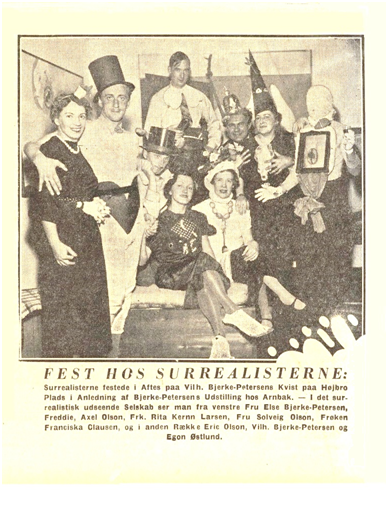
"The surrealists are celebrating! Last night, on the occasion of Vilhelm Bjerke-Petersen's exhibition at Arnbak, Højbro Square, the surrealists celebrated Vilhelm Bjerke-Petersen's success. ― In the surrealist group we recognize, from left to right, Mrs. Else Bjerke-Petersen, Freddie, Aksel Olson, Miss Rita Kerrn-Larsen, Mrs. Solveig Olson, Miss Franciska Clausen, as well as, in the background, Eric Olson, Vilhelm Bjerke-Petersen and Egon Østlund." (Ekstrabladet, October 15, 1936).
To this end, Bjerke-Petersen (1934:61, 56) advocates the generalization, no longer, like Popović and Ristić, of critical paranoia, but indeed of automatism, which will henceforth have to be "diffused until it is practiced by all." Indeed, "surrealism works towards the realization of a direct transfer of dream content" (direkte overføring af det drømte); but, as a collective transfer only structures itself on "several generations," the "task of surrealism" (surrealismens opgave) will henceforth consist in bringing its own contribution to "the psycho-materialist revolution."
Bjerke-Petersen's position, advocating that a psychic revolution devolved to surrealism must precede the Marxist social revolution, obviously diverges from that of Reich, for whom no psychic revolution could have flourished outside a social context already revolutionized; it nevertheless anticipates the position that Contre-attaque will officially take the following year. Indeed, one of the Cahiers de Contre-attaque (1935-36:96-97), by Heine and Péret, should have dealt with Social questions and sexual questions:
Pre-existing the social question, [...] sexual questions risk escaping their revolutionary solution, for as long as the proponents of the Revolution persist [...] in ignoring them. To claim [...] that sexual "perversions" result from the social vices of capitalism and will disappear along with classes, is [...] to betray historical materialism.
Another Cahier, by Heine alone (Contre-attaque 1935-36:98), should have dealt with The revolutionary extremism of Sade:
[Sade] was [...] too much of a philosopher to fail to recognize that the social revolution would only obtain an ephemeral success without the moral revolution proper to definitively win over minds. And it is in the thought of forming a new man, capable of fixing the conquests of the [revolutionary] regime already declining, that he launched the cry of appeal and alarm: Frenchmen, one more effort if you want to be republicans! [...] in 1795.
During his intervention at Contre-attaque (1935-36:110-111) on November 11, 1935, Breton communicated to his comrades the content of a letter that Monnerot had addressed to him the previous year. The latter maintained there that
surrealism must attempt to reduce Hitlerism to its human components [and] compose projects for another use [...] of these solid and vigorous components. The explanation [of Hitlerism] that can be deduced from Marx, such as it was for example exposed by Trotsky, [...] must be completed [...] by the study of "natural crowds" and "artificial crowds" that can be read in Freud's Collective Psychology and Analysis of the Ego.
In turn, Breton (Contre-attaque 1935-36:111-112) suggested
to probe through [Freudian] analysis the human components of Hitlerism [...] and attempt to determine, with the help of these components, [...] a diametrically opposed movement, proceed to the establishment of a grand-style ceremonial, [...] totally unprecedented.
But in his last intervention at Contre-attaque (1935-36:125), that of December 8, 1935, Breton, again denying that "Hitler's striking ascent [could] be explained by the ideological value of Hitlerism," rather attributed it to "the great famine of today," the latter being "both physical and psychic." Now, it is precisely to this "new psychological hunger with paranoid tendency" that Dalí 2 had, five years earlier, entrusted the task of elaborating a modern mythology. According to Dalí, indeed, the dialectical movement of annihilation and restoration of archaic myths suggested that "unconscious thinking" was, despite its symbolic constants, independent with respect to any mythic system: thus, the "moral myths" of the time, far from testifying to a supposed revival of primitive taboos, were rather to be envisaged as the products of a collective transfer, which manifested itself on the scale of contemporary society by the appearance of new myths. Dalí (von Maur 1991:199) would moreover return to this point in 1934, pointing out to Breton that he believed he perceived an analogy between Chirico's "metaphysical" attitude ― who had known how to give a "hyper-original content" to stereotyped myths, by drawing them from their usual contexts ― and the "delirious and Hitlerian" affectivity of Nazism, which was also characterized by the "truculent disorientation" of the myths of patriotism and family.
It is already hard to conceive that Nazism could have been attributed anti-patriotic and anti-family traits; but Dalí (1964:27) went even further, even fantasizing about an effeminate Hitler:
During this time 1934, Hitler was Hitlerizing [...] I was obsessed to the point of fixing my delirium on Hitler's personality, who always appeared to me as a woman. [...] I was fascinated by Hitler's tender and plump back, always so well strapped in his uniform.
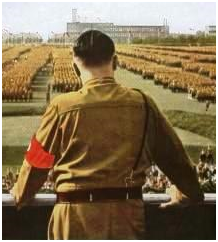
Dortmund 1933: "Hitler's tender and plump back, always so well strapped in his uniform" (detail from a postcard made by Nazi propaganda).
Dali will subsequently develop his delirium in a frankly anti-Oedipal direction. Let us therefore reread his letter from the spring of 1935, where he proposes to Breton, "for the secret laboratory of Contre-attaque," to counter Nazism by structuring a "modern" religion with mytho-political connotations:
From the political point of view, the origin of religions resides, according to psychoanalysis, in father-son relationships: God is an exalted father, and nostalgia for the father is the root of religious visions. The objective myth of the new religion must renew the primitive crime of the father, but without eating him: thanks to the new surrealist moral climate, it will be possible to overcome the feeling of guilt that this fact arouses. It is the religion of sons [...] for the enslavement of god.
This idea may have been suggested to Dalí by an aberrant reading of Freud's The Future of an Illusion, which had appeared in French three years earlier: since we cannot get rid of religions, why not use them against Nazism, which is also one? Be that as it may, Breton reported to Contre-attaque (1935-36:127-128) this staggering proposal, while trying to bring it back into the path of Freudian orthodoxy: only collective psychology, he declared on this occasion, could understand by what means Nazism had been able "to obtain from men this general renunciation of everything that seemed to constitute their own interest."
We seem to hear there the echo of Reich's thesis, as Bjerke-Petersen (1931:65) had presented it in his own book: "in Germany, entire groups of workers, bourgeoisified and fallen under the sway of Nazism, have moved away from communism." However, at the time, in France, only Freud's Mass Psychology and Analysis of the Ego could have served as a reference text on Nazism: in La Structure psychologique du fascisme, Bataille (1933-34:35n1) had already qualified "this work [...] as an essential introduction to the understanding of fascism." For his part, Breton (Contre-attaque 1935-36:130) left it to Trotsky to name Freud openly.
On November 27, 1932, at the end of a lecture he was giving at the Copenhagen stadium, Trotsky had glorified Freud's genius and the importance of the role that psychoanalysis would be called upon to play in any "further development" of humanity:
For human thought to descend to the depths of its own psychic well, it must illuminate the mysterious driving forces of the soul and submit them to reason and will.
The affinity is patent with the thesis that Breton (1924:316) had advocated as early as the first Manifesto:
If the depths of our mind conceal strange forces capable of augmenting those of the surface, [...] there is every interest [...] in capturing them first, to submit them then [...] to the control of our reason.
Presented in this way, Breton's proposal ― consisting in henceforth envisaging Nazism in the light, no longer of Marx alone, but also of Freud ― seemed to claim a Marxist sanction, which was nevertheless still far from being acquired 3. It was nevertheless permissible for Breton (Contre-attaque 1935-36:130) to conclude that "it is, indeed, Freud who, in the present case, will be able to help us best to answer the questions I was asking."
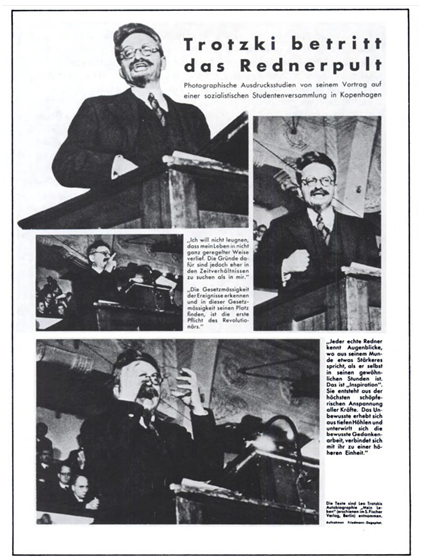
At the bottom right, we read: "Every authentic speaker has experienced those moments when something stronger than usual comes out of his mouth: it is inspiration! It is born from the most highly creative effort of all faculties united. The unconscious then rises from its depths, submitting conscious thinking activity and merging with it until reaching a higher synthesis" (Trotsky, Mein Leben, Berlin 1930).
————————————————————————————-
Breton (Contre-attaque 1935-36:132) recalled that identification is, according to Freud, the phenomenon "by which the Ego seeks to make itself similar to what it has proposed as a model": the affective community thus established would respond to the need for fulfillment "of erotic tendencies, which have deviated from their primitive goals." If Hitler's ascent resulted from a collective sublimation, it indeed fell within the domain that Breton (1930:808-809) had reserved for the development of a surrealist Freud-Marxism. But Freud's work, published in German in 1921, would not yet have been able to allude to the Führer: what were the crowds that Freud had in mind when writing Collective Psychology and Analysis of the Ego?
We know that he had undertaken to compose this essay during the 1st World War, probably as early as 1917. Now, between 1916 and the early twenties, Councils of Workers, Peasants and Soldiers had formed everywhere, even outside Europe, inspiring in some thirty countries mutinies, general strikes and mass uprisings (Koller 2018:47-49). However, the idea of such Councils went back to the Paris Commune (March 18-May 28, 1871), which was the first to entrust control of factories to workers and the choice of officers to soldiers. Marx (1871:314) had himself sanctioned this formula, perceiving in the Commune "a government of the working class, [...] the political formula, finally discovered, which will be able to accomplish the economic liberation of labor." At the very beginning of the October Revolution, Lenin (1917:432), envisaging the formation of Councils as a case of transformation of quantity into quality, had also pleaded for all power to henceforth fall to the "soviets" (Koller 2018:51).
We know only too well what followed: the progressive eviction of Russian "soviets" by the Bolshevik Communist Party, the final establishment of a so-called "dictatorship of the proletariat," the Stalinization of the Soviet Union and Trotsky's exile ― who had, incidentally, also contributed to weakening the "soviets" in favor of the Party... In 1919, however, the psychoanalyst Paul Federn (1919:29, 3-5) had analyzed, with the help of Freud's doctrine, these "revolutions," detecting there an Oedipal conflict in progress 4. Federn (1919:7) had focused on the sudden appearance of Councils (soviets, Räte), which had spontaneously formed in Russia, Austria-Hungary and Germany at the collapse of the three empires, as well as on the spontaneous succession of gigantic strikes, which no longer seemed to him to justify, by themselves alone, either economic demands or Bolshevik propaganda: thus Federn (1919:15-16) explained the events that succeeded before his amazed eyes by a generalized dissolution of paternal authority. In the cities, soldiers and striking workers had taken advantage of the fall of the three emperor-Fathers to form communities of an unprecedented type, which seemed to be governed by the invisible psychological structure of the brotherhood (ihr unsichtbares psychologisches System ist das Verhältnis der Brüder); in the countryside, peasants, naturally linked to the earth-Mother, had immediately seized their chance to finally renew a primordial bond, which their unconscious seemed to have maintained despite millennia of patriarchy (die uralte, in Unbewußtsein festgehaltene Bindung an die Mutter).
The crowds that Freud envisaged when writing Collective Psychology and Analysis of the Ego were therefore those of the Councils: the Sons revolted against the Father. Thus Freud had engaged there in a new reconstruction of the "primordial parricide," more complete than that which he had consigned in 1913 in Totem and Taboo. The beginning of the two versions coincides: the sons, who had just killed and devoured the father of the horde, would have immediately followed their crime by the establishment of both matriarchy and totemism, the latter including the prohibition of incest and the consumption of sacred meals in honor of the father, now deified under the animal form of the tribe's totem. In 1918, Freud had already taken up this story a first time, proclaiming that the evolution of one of his patients ― the famous Wolf Man, who had sublimated his wolf phobia into an obsessive form of "paternal" religion ― renewed that of all humanity, which had finally given a human appearance to its ancient animal totems. Three years later, Freud felt the need to conclude by adding in Collective Psychology and Analysis of the Ego that after the parricide the fraternal community had subsequently had to engage in another struggle still, this time against the Mother; and that the latter ― defeated, certainly, but not devoured and not even killed ― had finally been deified in turn, thus becoming a mother-goddess served by castrated priests. However, Freud slipped over the subsequent involution of this fraternal structure, which would obviously have had to regress afterwards until the restoration of patriarchy.
From then on, Federn's allusions deserve to be dwelled upon: where did the Mother come from? Not from psychoanalysis itself, but indeed from Marxism. In 1891, Engels had opened the preface to the fourth edition of his essay Der Ursprung der Familie, des Privateigentums und des Staats [The Origin of the Family, Private Property and the State] with a eulogy of Bachofen, which was missing from the first edition of 1884:
Until about 1860, there could have been no question of a history of the family [...] The patriarchal form of the family, [...] was identified with the current bourgeois family. [...] The history of the family dates from 1861, from the publication of Bachofen's Mutterrecht [Maternal Right]. [...] What produced, according to Bachofen, the historical changes in the reciprocal social position of man and woman is not the development of the effective conditions of existence of men, but the religious reflection of these conditions of existence in the brains of these same human beings: consequently, Bachofen presents Aeschylus's Oresteia as the dramatic description of the struggle between declining maternal right and paternal right, nascent and victorious in the heroic age. [...] Orestes [...] is pursued by the Erinyes, demonic protectors of maternal right, according to which matricide is the most serious, the most inexpiable of crimes. [...] This interpretation of the Oresteia, new but absolutely correct, is one of the most beautiful and best passages in the entire book. [...] It is obvious that such a conception, where religion is considered as the determining lever of universal history, must finally result in pure mysticism. [...] But all this does not diminish his merit as an innovator*.
It is therefore Engels who introduced Bachofen's matriarchy into Marxism. But, between the latter and Freud's patriarchy, a parallel also emerges: for both are founded in the original interpretation of a myth. From then on, why did Freud never envisage matricide? Did everything therefore come down to choosing one's own myth? An answer can come to us from Fromm (1954:50-51):
Johann Jacob Bachofen, who lived a generation before Freud, [...] understood the centrality of the role that the bond to the mother plays in human development. [But,] while Freud only perceived in the incestuous fixation a negative and pathogenic element, Bachofen clearly saw the ambiguous nature, negative and positive at the same time, of attachment to the mother. To the positive side correspond vital affirmation, freedom and equality, of which the matriarchal structure is imbued. [However,] Bachofen envisaged just as clearly the negative side of such a structure, which holds man in his attachments to nature, blood and soil, thus hindering the development of a rational individuality: eternal child, man remains there incapable of progress.
In the Austro-Marxism of the psychoanalyst Alfred Adler, who was the first to establish the existence of a parallelism between psychic conflicts and social struggles (Nunberg/Federn 1973:15), no trace of matriarchy was yet discovered; but in 1913, just before the war broke out, another psychoanalyst still, Otto Gross (384, 387), would declare that
the psychology of the unconscious is the philosophy of revolution, [...] called to prepare the revolution (berufen als die Vorarbeit der Revolution) [...]. With the help of the psychology of the unconscious, [...] the revolutionary of our time fights [...] against the father and patriarchy. The coming revolution is that for matriarchy (die kommende Revolution ist die Revolution fürs Mutterrecht)*.
Immediately after the war, Gross (1919a:13-20) would explain himself better in the journal Sowjet:
since the destruction of the matriarchal and communist structure of primordial society (der mutterrechtlich-kommunistischen Gesellschaftsordnung der Urzeit) [...], it is only in our days that the revival of the communist ideal has begun to become a reality. [...] A profound meaning seems to affect the myths, which situate the existence of supermen in the past, at the very beginnings of humanity. [...] The subsequent flow of millennia, as well as the ever-increasing development of material, technical and political discoveries, has consigned myths to oblivion, making them disappear. [But] for us, modern men, [...] what antiquity still felt only as a memory [...] takes on the value of a future, [...] where the goods that the past has bequeathed to us will be called upon to merge with the most distant goals (Erinnerungsgut und fernstes Ziel aneinander schließend). [...] Original sin is [...] a primordial event, which would have radically transformed both the structure of society and the character of individuals: since then, all humanity finds itself subject to new rules of social and psychological conduct. [...] The nature of such an event [...] cannot leave any doubts: it is a matter of the abandonment of the free matriarchy of origins (die Abkehr vom freien Mutterrecht der Urzeit) [...]. The Genesis would therefore allude to a cultural catastrophe, having made patriarchal thought (der Vaterrechtsgedanke) the sovereign principle. [...] The couple [Adam and Eve] would symbolize primordial humanity [...]. As for the "knowledge of Good and Evil," it can only refer to the institution of a canon of values and norms. [...] According to Genesis, it is under the impulse of an evil spirit that the woman would have struck the first blow with a view to the institution of this new canon: according to me, this evil spirit would be a symbol of her unconscious (ein Symbol des Unbewußten) ― and, consequently, also of her ignorance of the ultimate consequences of her gesture.
Gross therefore reverses the Freudian chronology: he replaces matriarchy ― which would have been, according to Freud, the consequence of parricide ― with a primordial communist matriarchy, which would have been subsequently overturned by the establishment of patriarchy. It goes without saying that his position was not unanimous in the archipelago of Councils: let us only recall, as an example, the Biennio Rosso, that is, the experience of "sovietist" Workers' Councils in Italy, which took place in Italy between April 1919 and December 1920, without the question of matriarchy being mentioned once (Spriano 1971). Gross (1919b:64) himself was certainly aware of this, he who had the Räte-Zeitung 5 announce his project
to give the Freie Hochschulgemeinde für proletarische Kultur [Free Higher Education Community for Proletarian Culture] courses on "The Psychology of Revolution," which should serve as an introduction to the psychology of the unconscious (psychoanalytic psychology).
The very existence of such a project shows that it was still necessary to spread the Freud-Marxist word among the Councils; but public opinion already associated Bolshevism and the sharing of goods with the idea of matriarchy and the demand for sexual liberation ― therefore, by ricochet, with psychoanalysis too, which was making itself known everywhere for its supposed "pan-sexualism." The "People's Delegate for Public Education of the Hungarian Soviet Republic," Zsigmond Kunfi (1919:3), even had to publish in the official journal of April 17, 1919 that
the Councils of Workers, Soldiers and Peasants [...] do not want to institute the communism of women [...] all those who will propagate the contrary will be considered as enemies of the revolutionary order.
For his part, Federn (1919:17-18, 22-24) emphasized that, if the military defeat had not been able to be overcome, it was indeed because it had carried away the unconscious subordination of the Sons to the Father (die unbewußte Einordnung unter das Vater-Sohnverhältnis): thus,
Bolshevism manifested the return of the primordial tendency (Urtendenz) to parricide;
the formation of Councils, founded in the psychic structure of the brotherhood (ihre psychische Struktur als Bruderschaft), brought back to the present the prehistoric uprisings of the Sons against the Father (die jetzige Revolution [ist] eine Wiederholung uralter Revolten gegen den Vater), which had just committed a new parricide in the person of the deposed emperor;
finally, the totemic meal, that is, the sharing of private property (das Eigentum in gemeinsamen Besitz), overcame the "vacancy of the Father" (Vaterlosigkeit) by the establishment of an egalitarian society, modeled on the brotherhood.
Breton (Contre-attaque 1935-36:133) also wished that, in Collective Psychology and Analysis of the Ego,
Freud [...] had treated the possibilities of identification in a crowd, no longer conceived on the model of the primitive horde, [...] "subjected to the absolute domination of a powerful male," [...] but on that of this horde proceeding to the violent suppression of its leader, of paternal horde that it was becoming a fraternal community;
he nevertheless ignored that Federn (1919:28) had also warned against the danger that the brothers, struck with remorse, would sooner or later come to deify the ideal figure of the killed Father (Vaterideal), thus evoking the appearance among them of a Führer (eines Volksführers), to whom they would finally submit voluntarily, in order to restore the bond to the Father. Could it be that Federn had prophesied there Hitler's ascent, while the Nazi party would only be founded a year later?
Exactly a year later, the Hungarian Austro-Marxist Varga 6 devoted an article to the Bolshevik defeat in Germany, which he motivated by "causes foreign to the economy, [...] those very ones that the school of Freud and Adler presents to us." Varga explained the failure by the "mass psychology" adhering to social democracy: the latter, even while their leaders were betraying them, had refused to integrate the ranks of the Councils, thus acting against their own interest (D'Abbiero 1984:165). It was from these false leaders that the masses had to fear, in the immediate future, the return (Federn 1919:12): Hitler would only manifest himself later, and would in turn be accused of having diverted the masses from their own interests. However, the irrationality of collective behaviors had already exposed the limits of the "classical" Marxist model, which did not take it into account at all: from then on, the debate that Varga had just opened would oppose for a decade historical materialism to mechanistic materialism, spreading knowledge of Freudian "sociology" in Marxist circles, who expected from it a precious contribution to overcome their impasse (D'Abbiero 1984:159). It is this context that produced the psychoanalytic explanations of Nazism (D'Abbiero 184-185): Vergin's essay, Das unbewußte Europa : Psychoanalyse der europäischen Politik [Unconscious Europe: Psychoanalysis of European Politics], of lesser value after all, preceded both Reich's essay, Massenpsychologie des Faschismus 1933, and Bataille's, La structure psychologique du fascisme (1933-34).
Reich (1933:43) remarked that
the structure of human action, that of the "subjective factor in history," was not studied, because scientific psychology did not exist at the time of Marx and he was not a psychologist, but indeed a sociologist.
But the reciprocal was just as true: Marxism could finally bring psychoanalysis to a better understanding of the social nature of the psyche, and Fischer 1928 even envisaged "dialectical materialism as a psychological method" (der historischer Materialismus als psychologische Methode) (D'Abbiero 162-164). Six years later, Popović (1934:229, 231) in turn devoted an article to the interaction between psychoanalysis and Marxism 7, noting that
the deficiencies of psychoanalysis can all be explained by insufficient knowledge of sociology ― that very one, which motivates the objective of psychologizing social facts. [...] Freud certainly conceived that social facts fall as much under psychology as under sociology; but, knowing nothing about Marxism, he would not have known how to use it.
Popović's "sociology" was therefore, quite simply, Marxism. As for Freudian "sociology," this had entered, since the publication of Mass Psychology and Analysis of the Ego, into a profound involution, which had not escaped the Serbian surrealist (Popović 1934:228n2):
As early as 1927 [...], Freud had published Die Zukunft einer Illusion* [The Future of an Illusion]: an essay, which very easily augured the form that his sociology would take subsequently. His most recent pseudo-sociological essays, Das Unbehagen in der Kultur [Civilization and Its Discontents], as well as the last pages of Neue Folge der Vorlesungen zur Einführung in die Psychoanalyse [New Introductory Lectures on Psychoanalysis], have confirmed the first fears. The way in which he envisages society in these texts no longer even appears "objective" to us [...]: he has become frankly reactionary.
Only the Freudian notion of "identification" still resisted, since it now allowed the explanation of Nazism. Reich (1933:97-98) also claimed it:
The nationalist Führer [...] concentrates in himself all the affective representations proper to the Father, [...] severe but protective. [...] even more important is the identification with the Führer on the part of the mass-man.
But Reich (1933:99), while perceiving the analogy with the proletarian movement ("The drive to identification," he remarked, "is identical, but it addresses comrades of the same stock rather than the Führer"), and therefore the ambiguity inherent in the tendency, refused to subscribe to the myth of a contemporary renewal of parricide (Reich 1933:101):
If sociologically limited psychoanalysts reconduct revolution to the revolt of children against their father, it is because they only think of the intellectual milieu, where this factor is, indeed, determining; but their interpretation could not apply to the working class.
He maintained, indeed, that the agricultural mode of production rather corresponded to a patriarchal morality, characterized by private property, sexual repression and the unity of the family (Reich 1933:78-79): the new Nazi legislation 8 ― which had just resurrected outdated forms of land ownership, founded in the notion of an "indissoluble unity between blood and soil" ― was it not finalized to renew "the bonds of a feeling of life, spontaneously sprung from the bosom of the people" (die aus dem natürlichen Lebensgefühl des Volkes herausgeborene Verknüpfung)? The conclusion to which Reich (1933:131) arrived, in a way that was certainly too hasty, was therefore that,
in the ethnological domain, reactionaries [...] support the patriarchal theory, while Marxists rather lean towards the matriarchal theory.
On the other hand, the dialectical complementarity between the two attitudes had not escaped Bjerke-Petersen (1934:16), who knew how to grasp the "spirit of the time" (tidsånd) more clearly than Reich:
In our days, a great number of interconnected manifestations creates certain cultural formations, whose validity appears so profound, that we can often envisage them as belonging to a worldwide movement. That these are limited to the work executed by a circle of persons, their influence nevertheless remains worldwide. In the immediate, we [scil. the surrealists] only recognize as such the proletarian movement and fascism. Year after year, a network is weaving around the Earth, which keeps uniform ideas and perceptions united. Certainly, the numerous simultaneous movements can differ greatly; but, between a multitude of manifestations belonging to different lines, there can also exist a close link, which thus comes to shape, to a large extent, our entire era. Such a spirit of the time does not always evolve by stages: it can suddenly give rise to diametrically opposed tendencies, and even to behaviors trying to stifle their own source.
Much later, Fromm (1954:51n14) will note similarly:
It is remarkable that [...] two opposed conceptions could each integrate an aspect of the matriarchal structure. In the Marxist current, advocating freedom and equality, Engels gave an enthusiastic welcome to Bachofen's theories. Much later, [...] the master thinkers of Nazism 9 seized them with just as much enthusiasm, [...] but for the opposite reason: what seduced them was indeed the irrational nature of attachment to blood and soil.
On the other hand, Reich had given a good welcome to the Engelsian idea of a primordial "matriarchal communism," which he believed had been validated by Malinowski's discoveries; but the latter, who had indeed dealt in 1924 the most serious blow to the Oedipus myth, would also deny in 1935 the myth of Urkommunismus, which the Trobrianders did not practice. We wonder again if everything therefore came down to choosing one's own myth ― or even, if need be, to building one from scratch... For, it must be said, the Oedipal reconstructions imagined by Freud do not at all agree with Greek mythology:
the Sons revolted against the Father of the horde would be much better represented by the Titans rather than by Oedipus, who has no brothers;
it is precisely because Sophocles' Oedipus is finally not castrated that Freud, striving to make data that oppose it fit with his idea, came to maintain that blindness stood in, for Oedipus, for self-inflicted castration! Now, quite the contrary, the most archaic versions of the "mytheme of royal succession" (Uranus-Kronos-Zeus), which Egyptian and Hindu mythologies have preserved for us, prove that originally the deposed father was struck as much by castration as by blindness: the two mutilations remaining quite distinct, it is implausible that one could have designated the other;