FOLLOWING THE THREAD OF THE PARCA
attempt to explore the rozsdéen strata
par Borbála Kálmán
March 1, 2015
Following the Thread of the Parca, attempt to explore the rozsdéen strata, by Borbála Kálmán, published in Mélusine numérique journal n° 1
Endre Rozsda was born on November 18, 1913, a Tuesday. The child constantly drawing on the walls of the family home declares a few years later: "I will be a painter". And as "in the case of the one who affirms: I will be a train conductor"(1), he indeed became a train conductor, or more exactly the machinist of his own time machine. "It is the material that creates the mental surface from which I can set out in search of time. The time machine transports me into the past and makes me discover things that I did not understand at the moment when I was living them"(2). Reading these lines, we suddenly feel a powerful desire to join Rozsda in his temporal walks, or, quite simply, to have access to these experiences. Unfortunately, Rozsda's machine is not within reach; however, there remain memories capable of transporting us to the past and thanks to which the ambiguity of some aspects of the painter's career, still little examined, become more comprehensible to us, late spectators of his works. Let us take for example the relationship that linked Rozsda to surrealism or the vision that some of his contemporaries had of him. From this emerges in a more specific manner a cross-section represented by the years 1957-1965: the beginning of Rozsda's second stay in France, as well as his first exhibition at the Furstenberg Gallery – the international recognition of his relationship to surrealism and the insertion of his work within one of André Breton's important publications. Here are the considerable events framing these few characteristic years of a short but all the more intense period. By examining more closely the strata of this section, it will be through the highlighting of theories, practices and pictorial techniques that it will be possible to explore the aspects of Rozsda's work that incited the influential actors of French surrealism to count the Hungarian painter in the group. It then becomes possible to highlight the true meaning of Endre Rozsda's "specific surrealism".
Perception and Reception
The year in question: 1961. Endre Rozsda's work (Windows) figures with those of Meret Oppenheim and Toyen, among others, at the Mostra Internazionale del Surrealismo, that is the International Exhibition of Surrealism, in Milan. The direction of the exhibition falls to André Breton, the organization to José Pierre, a faithful member, for a long time, of the ship piloted by Breton, as well as to Tristan Sauvage who is none other than Arturo Schwarz: one of the first exhibitions in his bookstore transformed into a gallery is a cooperation with Breton(3). In total, fifteen hundred catalogs leave the printing house to account for the event, followed by fifty copies each containing original engravings by some of the participating artists(4). The edition immediately strikes the unwarned spectator by its cover: a black and white photograph, colored in yellow, occupies the entire space of the vertical format; it is a group photo.
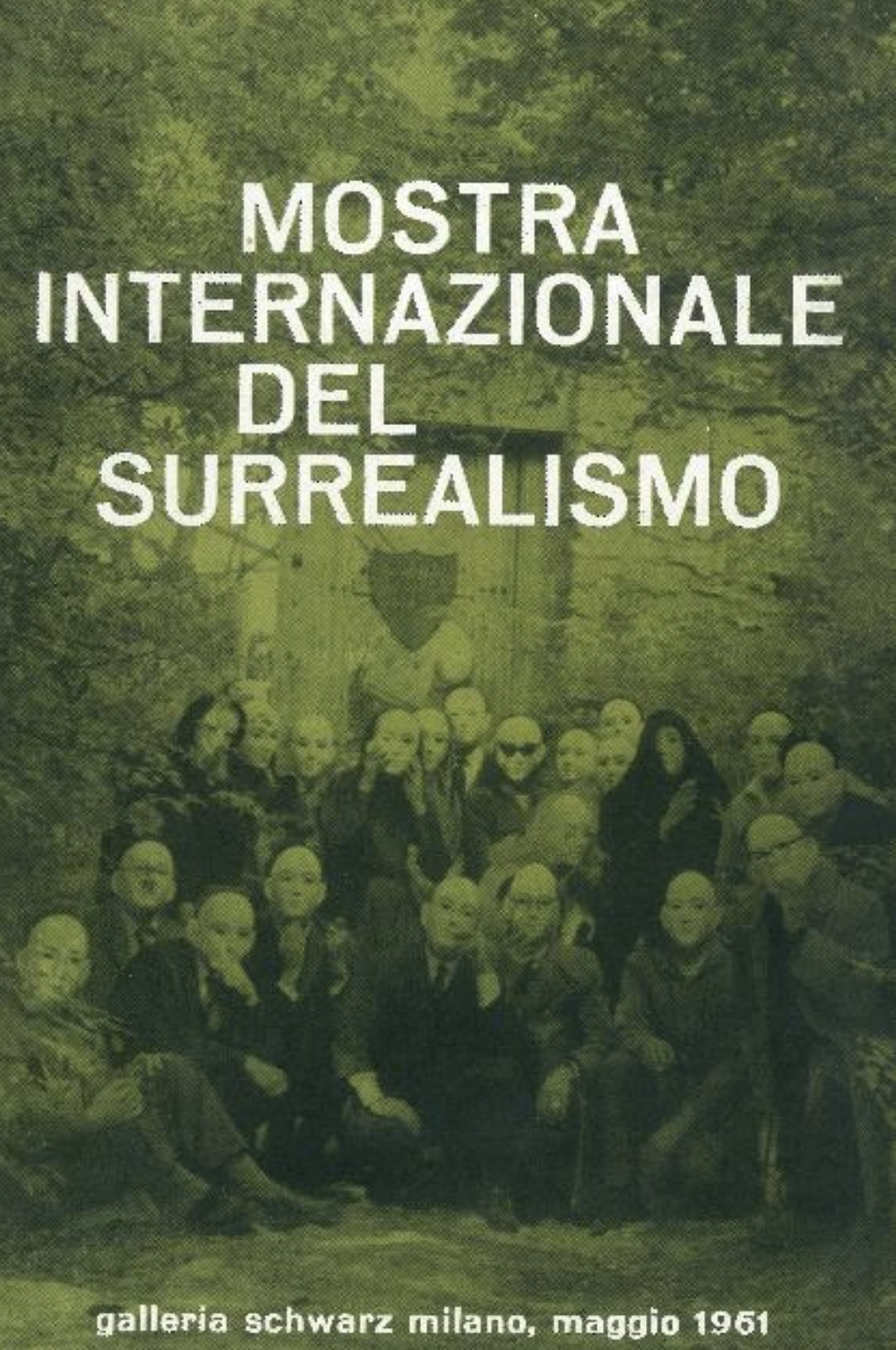
Human figures, we count twenty-two (perhaps twenty-three): each figure wears a mask in front of their face, some completing it with sunglasses, others with pipes. Similar to apparitions, expressionless spirits, stiff, who would have donned human appearance. Eighteen artists participate in the exhibition(5), hence the probability that alongside the participants, the "organizers" are also present in the photograph. According to our current knowledge, this would be the only existing and published photograph where Rozsda, tirelessly photographing his environment and himself but appearing only on an insignificant number of shots taken by others, would be "visible together" with Breton and several of his fellow artists. In the background emerges a wall covered with a mantle of ivy with in the center a wooden door equipped with ironwork; abundant vegetation surrounds them. The place where we are: Milan. On the first page of the catalog appears the title of the text: "The Despair of Gardeners or Surrealism and Painting since 1950"(6). The organizers are clear about the objective of this group exhibition: to prove that surrealism follows an existing and even prosperous line, and that the artists exhibiting at the mostra are among the leaders – clearly dissociated from the "ersatz" that had invaded galleries and museums the fifteen previous years(7). The text signed José Pierre "warns" the public on the one hand against surrealist "by-products" using one of the well-known recipes of some great predecessors (Max Ernst, Roberto Matta, André Masson), on the other hand against "vulgar arrivistes" who, incapable of obtaining recognition of their work by their own name, mobilize an army of reporters around their "supposed surrealist activity" – as an example, he cites Salvador Dalí and Simon Hantaï(8). Pierre also undertakes to clarify some notions: "... Surrealism is not defined by the means used, but by a revolutionary conception of existence extended to moral behavior as to creative behavior"(9). The exhibition in question is, according to his assertions, formally exempt from big names, does not wish to be retrospective, and has as its sole aim to represent the "actuality" of surrealism (with works dating at most from ten years) and, perhaps most importantly: only works "painted by Surrealists in the proper sense of the term" figure in the exhibition. Pierre distinguishes within this circle the artists who "discovered and welcomed with enthusiasm by the Surrealists, have accepted to be considered as their own". Endre Rozsda is named precisely within that group. It therefore becomes manifest that the Hungarian painter, who avoids most of the time the "categorization" and classification of his art, considers this "label" still conceivable. From the point of view of research on Rozsda's work, the Milan catalog of 1961, long remaining in the shadows, highlights that the contemporary spokespersons of this period of surrealism indeed evoked the works of the Hungarian painter among the most current of the said movement.
The relationship between Rozsda and the French writer, poet and theorist André Breton is to be counted from the latter's introductory text written in 1957 for Rozsda's exhibition, presented at the Furstenberg Gallery in Paris. This text has become supposedly emblematic of rozsdéen work(10), but it is not the only document testifying to the professional attention that Breton paid to the Hungarian painter, as the Milan exhibition also reveals among others. A project for a special issue of the French magazine L'Œil, typed, anonymous and subsisting in draft form, undeniably indicates that, according to the pleiad composed of professional editors like Breton, José Pierre, and Joyce Mansour, Rozsda belonged to the category of dreamer among the five types of surrealist painters identified within a nebula of illustrious names linked to surrealism(11). This new "classification", more specific, allows us to highlight an essential element to the present attempt: the clearly oneiric aspect of Rozsda's art. Let us mention a verbal reminiscence as well:
Once, when Breton, his second wife and Simone Collinet were dining at my house, I showed them my recently executed paintings and asked them if, according to them, I was indeed surrealist, because I had the impression that my paintings were no longer really surrealist. To which Breton had replied: "Naturally, because it is your perception of life that is surrealist, and that is what matters"(12).
This evening may have taken place at the same time as the publication of the corrected edition of Breton's "artistic bible", the volume of Surrealism and Painting, that is the "bretonnian pantheon" in which the author had inserted a work by Rozsda accompanied by his 1957 text(13).
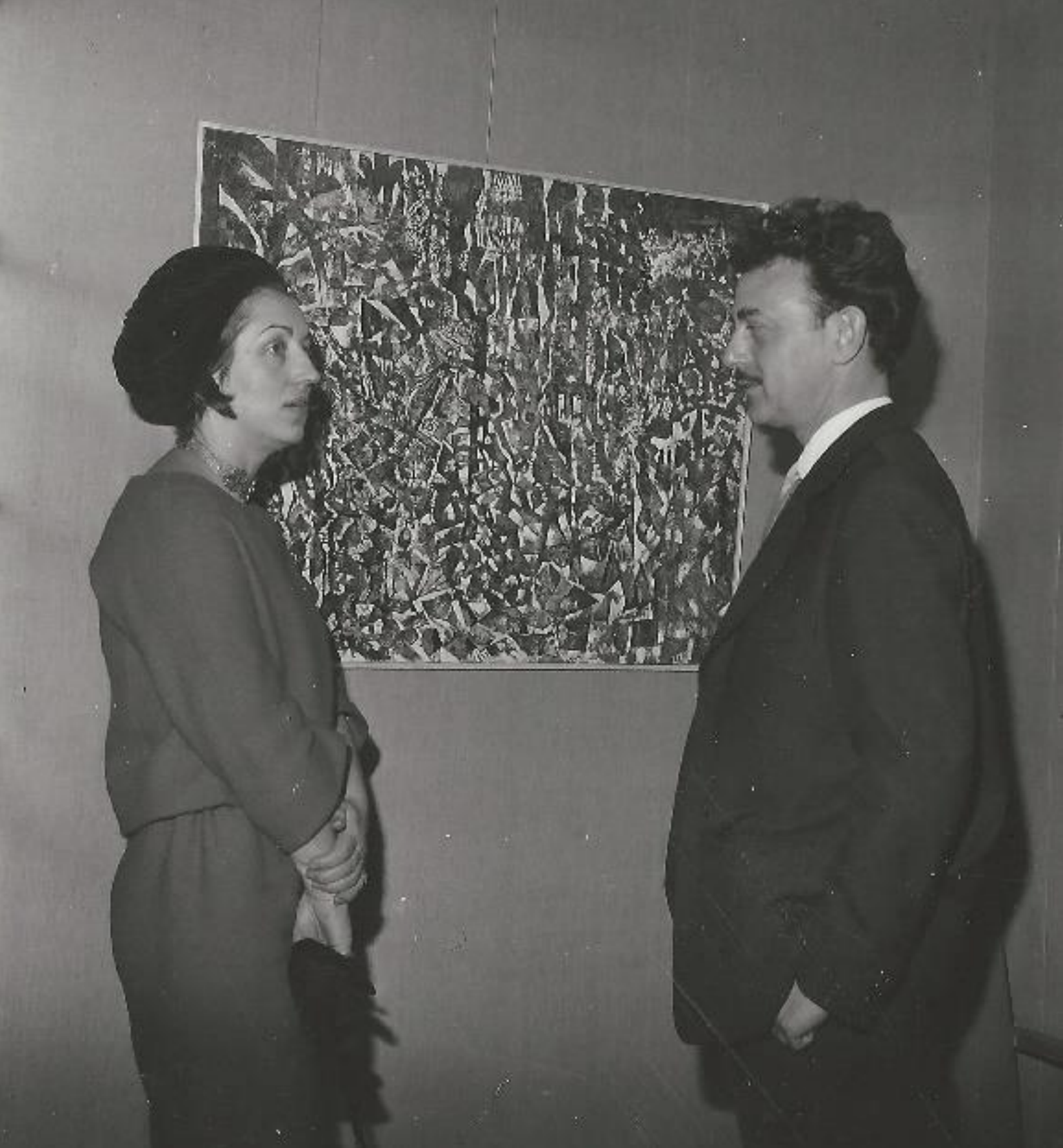
These publications and accounts, as well as the Copley Prize awarded to Rozsda in 1964 (and of which one of the most important aspects lies in the fact that several of those who had awarded him the prize, then already quite independent of Breton, had also attended the birth of surrealism – so Marcel Duchamp or Max Ernst indeed carried a different "surrealist gaze" on the laureate) seem sufficient to consecrate serious attention to Rozsda's surrealism and its importance – especially in the light of certain statements of the French group –, based first of all on this temporal section 1957-1965 mentioned earlier. Taking up Breton's thought, it is necessary to decipher the very essence of Rozsda's entire perception to be able to understand why his activity, his art, had such an interesting scope in the eyes of the surrealists: Rozsda embodied – even despite himself – some of the "criteria" stated as revolutionary about forty years earlier by a certain group in the will to apply the method aiming to liberate human existence and consciousness.
Tracing
Two almost inseparable notions are at work in Rozsda's thought and creative approach: time and dream. Two notions that unite to form only one dimension intertwining with reality, and which can nevertheless function in parallel and in a permeable manner to each other.
I dream myself alive in a world where I can walk on the dimension of time, forward, backward, upward, downward; where I can walk, as an adult, in a time when I was in reality a child. [...] I capture sounds, I weave multicolored threads to catch them and I listen to their calls. I jump here and there, brush in hand, busy quickly fixing the past(14).
Although we can see these paintings, imprinted with fleeting adventures, how to conceive this capacity of Rozsda to "walk in time"? He certainly did not exercise it in the physical sense of the term. Meditation: it is passing into another dimension (another psychological field), that is the result of the oneiric state to which Rozsda attains "consciously". The journey is therefore the consequence of an intellectual activity, that is a state reached through the process of creation. "It is the material that creates the mental surface from which I can set out in search of time"; the phrase echoes. For Rozsda, the dream – as unconscious cerebral activity – was not only graspable by sleep, since he was capable of triggering this process in a waking state when he painted. The journeys taking place psychically, his encounters engendered with the past (through acquaintances, strangers, historical events and places) indeed cut him off from reality but they crystallized into "real" memories. This state was therefore constantly available to him, just as much as the freedom of "time travel". Interestingly, Rozsda's first observations in the field of dreams stem from experiences lived as a young man, however he consciously aspires to open new dimensions. Françoise Gilot recalls the artist's beginnings:
I am always surprised by biographies because it actually started in 1942. [...] It was progressive, [...] like something that came from the side and gradually eliminated his previous period, [...] a rather metaphysical motivation. [...] He said all the time that he wanted to put himself in a dream state, that is to say precisely to proceed as the surrealists did who wanted to no longer reason with reason but on the contrary [to use] the unconscious. [...] It is somehow through drawing that he veered, that he went towards this much more surrealist aspect, [...] faster than [in] his painting(15).
Without taking into account, therefore, the "prophetic" childhood visions recounted by Rozsda several times, nor his relationship to painting which had revealed itself very early(16), the painter lets himself be absorbed by the rediscovery of his method, forgotten after tender age, during his first stay in Paris, and even, rather towards the end of this period, creating himself the possibility of being able to insinuate himself into another reality: following the morning awakening, he consciously lies down again to dream, and then attempts to capture in his own pictorial language what he had seen. This method has doubtless strongly contributed to Rozsda being able later to dissolve his formal universe thanks to his own vocabulary.
In his work published in 1974, Sarane Alexandrian examines the relationship of "surrealism and dream", in "knowledge of the unconscious"(17). The singularity of Alexandrian's volume lies in the fact that it completes through accounts, events and unpublished or still unexamined documents the first steps of the surrealist group – from the history of dream research, through the beginnings of Breton's career (how the neurology assistant of the army psychiatric center becomes a few years later the elaborator of the automatic writing technique and the creator of the surrealist group and its manifesto) –, all this within the framework of an enterprise attempting to clarify the network of almost inextricable interconnections between surrealism and dream. Thanks to this work, the relationship of the surrealists to the dream and the role that it occupied within all their initiatives becomes evident. The automatic writing technique elaborated at the beginning is the recording, the very tracing on paper of the influx of images accumulated in the unconscious, a source still uncontaminated by the necessity of meaning, that is exempt from all control, from all aesthetic or moral preoccupation(18). Surrealism was born above all as a method influencing existence and thought in their entirety: automatic writing therefore rather served the recording of an unconscious state at a linguistic level and not its representation. Breton precisely feared seeing drawing fix dream images in "trompe l'œil" (that is to make duplications, copies that could in no case be original transcriptions)(19). From the year 1922, we see multiplying experimental sessions, during which several of the group's members access a second state, a sort of hypnosis: these exclusive meetings in the group's life, which wished to elucidate the unconscious by plunging deeper and deeper into it, became absolutely decisive. Simone, Breton's first wife, future owner of the Furstenberg Gallery(20), is a regular at these sessions. The periodicals published by the group, increasingly important and regular, record the different experiences and their results, as well as the relationship of the surrealists to the dream which progressively affirms itself: they had then already largely surpassed the (scientific) conceptions existing until then on the role of the dream and had formally contributed to the "revolution" of thought on the dream. The periodical that appears from 1930, Le Surréalisme au service de la Révolution, clearly placed the emphasis, for example, on the constant analysis of sleep and the dream phenomenon, method by which the surrealists increasingly sought to achieve the unconditional liberation of the human mind(21). Following always Breton's reasoning, by the fact that the dream is the perfect internal emancipation even, the dream remains thanks to this pure essence superior to automatic text, as well as to the process of recording the unconscious. The dream must however be isolated from memory which is its enemy. In relation to Breton's extremely firm criteria, this last mentioned criterion proves distant from Rozsda since in his art and in his thought, (the ivy of) memory, memories played a principal role (as raw material); on the other hand, Rozsda's "journeys" with the help of (lucid) dreams, that is the approach of his reflection and his creative method were far from negligible for a surrealist mind.
Surrealism has always lived in relation to what we have called the marvelous. This marvelous was claimed very precisely in the 1924 manifesto where it was said that the marvelous is beautiful, there is even only the marvelous that is beautiful. We have always manifested the greatest curiosity for oneiric activity and the explorations that could be reported on them, and this marvelous side in the dream has always held and solicited us(22).
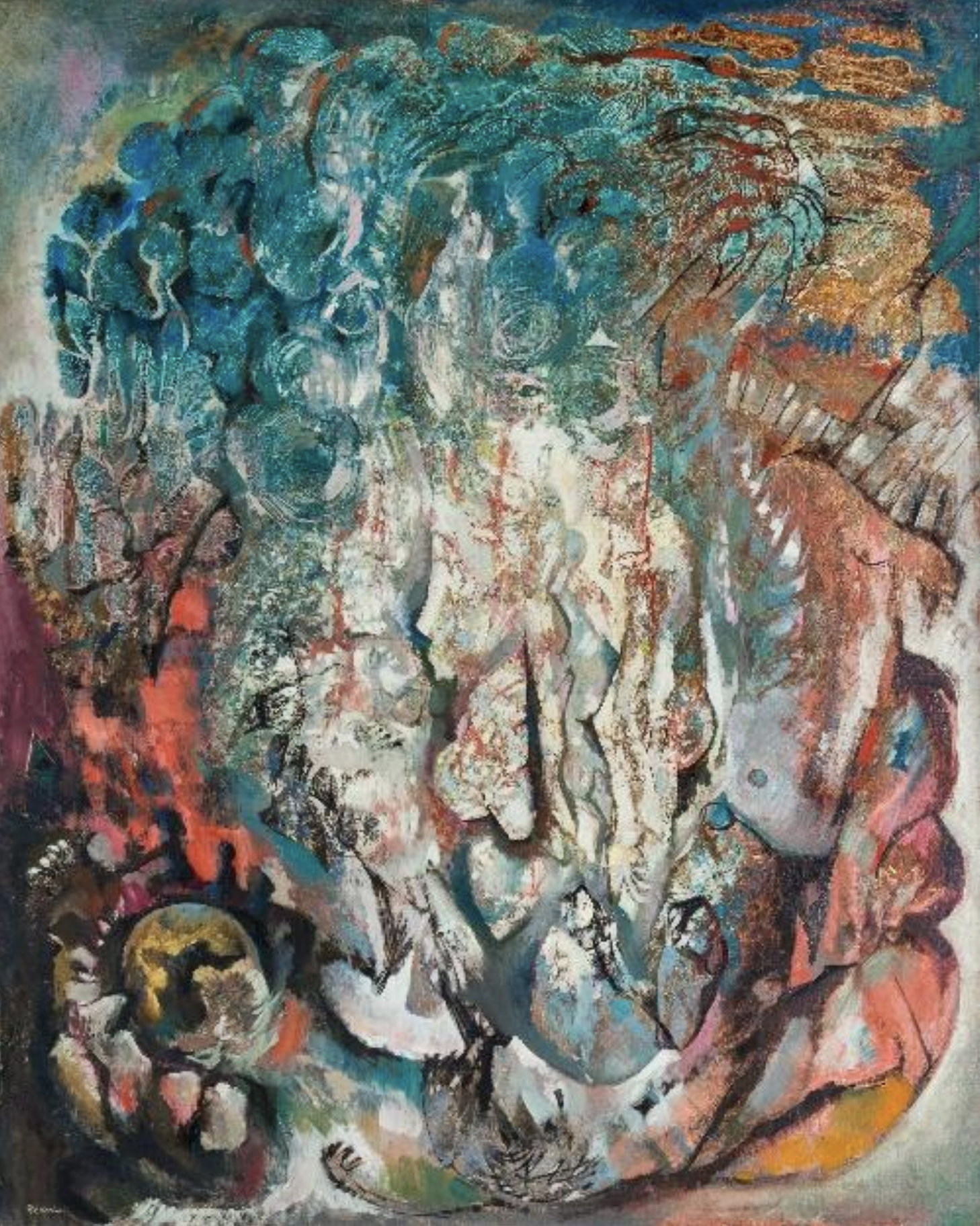
One of the criteria indicated by the special issue project mentioned above, characteristic of the "dreamer" painter is "dissolution in sleep", which in Rozsda's case is quite conceivable. The "space and time negation" is only partially valid in Rozsda, since it was not a question of negation in the proper sense of the term with him: it was rather a sort of transvaluation taking into account the manner in which he used, conceived space and time in relation to the general definition of these two terms. These latter therefore formed a separate dimension where he could move at will. "Fusion with natural forces": thus, in Breton's text (1957), as in that of Joyce Mansour published in 196123, and in many other documents published on Rozsda24, there is question of the universality of Rozsda's painting, of the force of his materials incorporating so to speak the cosmos itself (it is interesting on this point to refer to Rozsda's technique of integrating imprints of various [organic] objects in his works). "I am often told that I build my paintings. It is not the question, because it is the painting that builds me. It transports me in such a manner that I am different in finishing a canvas from what I was in beginning it."(25) Rozsda's technique appears even more captivating in the light of Breton's statements:
[the painter's hand] is no longer the one that traces the forms of objects but well the one that, enamored of its own movement and of it alone, describes the involuntary figures in which experience shows that these forms are called to reincorporate themselves(26).
The mechanism of Rozsda's painting is therefore produced by this state of "lucid dream" examined above. Thus can one consider his works as the direct tracings of his "psychic journeys". The term automatism proves on the other hand excessive in the present case, since Rozsda did not seek to find a second or ecstatic state, he did not aspire to extract from the "raw matter" of his unconscious; still it is that Breton's affirmation remains valid: "A work can only be held for surrealist insofar as the artist has endeavored to reach the total psychological field (of which the field of consciousness is only a weak part)"(27). Rozsda's memories become raw material and Rozsda's paintings stories, but in vain does one seek the narration since what was for him ineffable by the way of speech, that is to say his responses to the world, Rozsda formulated them through lines, colors, forms that condensed into a dense fabric the flow of images crossing the painter's mind. "I am the Parca who weaves the thread of time, who creates things, but not the one who finishes them"(28).
Stratification
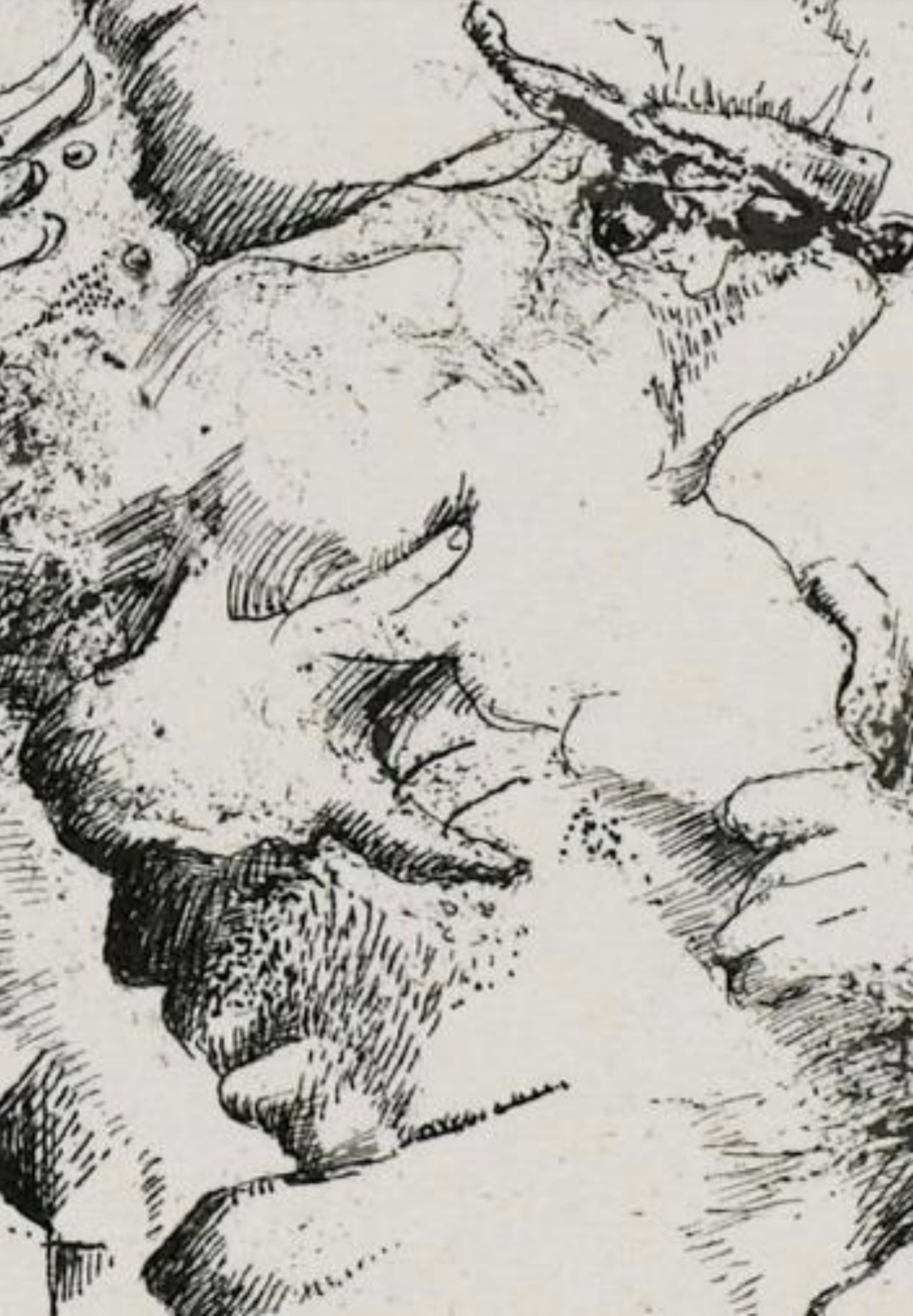
Let us therefore follow the advice, the solicitation of Rozsda: let us immerse ourselves in his canvases, let us walk in his paintings. It emerges in an apparent manner, as much on his works on paper as on his paintings, the use of imprints of various objects. This doubtless began during the years following the Second World War when, in the evolution of the painter entering his thirties, the painter Marcel Jean, "ambassador" in Hungary of French surrealism, was able to play an intermediary role. Jean maintained good relations with Rozsda at this time(29), it is therefore not improbable that the use of the decalcomania technique (or transfer) comes from him(30). Rozsda must have used it as a starting point for some of his works on paper after 1945: paint spread by a sheet of paper and by manual pressure. This technique, alongside the frottage initiated and used by Max Ernst, operated on the artist as a sort of stimulating force, or more specifically, it opened the possibility of proceeding to free association. On the other hand, the technique that Rozsda used most frequently afterwards, almost until the end of his life, does not belong to surrealist pictorial techniques in general. It is probably the term "object imprint" that describes it best. These imprints become an integral part of the creative technique and the work itself as abstract "stains" (textures) fixed. It is difficult to define within Rozsda's works on paper which ones could have been realized at the same time as paintings such as The Tower, My Grandmother's Lorgnette or Sacred Love, Profane Love; these paintings preserve in any case the imprint of certain elements. Moreover, on Perpetual Ghost – although it is doubtless a somewhat later work – Rozsda employs, although moderately, the method consisting of splashing paint on the surface of the canvas. On some of his paintings, he develops these spread points by linking them, evoking spider webs or astronomical constellations. Object imprints (hardly identifiable) appear manifestly around the 1960s and continue, particularly on his works on paper made with India ink: sponge, lace, crumpled fabric, leaf, feather, etc. combine with his extremely fine pointillist technique to create an indissoluble entity. "I lie down in the grass and watch the clouds coil; I look for the giraffe, the fish, the galloping horses."(31) The stains function most of the time as a game of associations, but in some cases, it seems that the work builds itself in this way, like an "exquisite corpse" played by a single person: at each turn occurs a new imprint and a new supplement until the last stroke has found its place(32). Rozsda associates and links forms, strokes and figures with unbridled freedom, amusing himself to move between figurality and total abstraction. One of these works, entitled The Dream (cca. 1960), is part of the permanent collection of the Pompidou Center, National Museum of Modern Art(33).
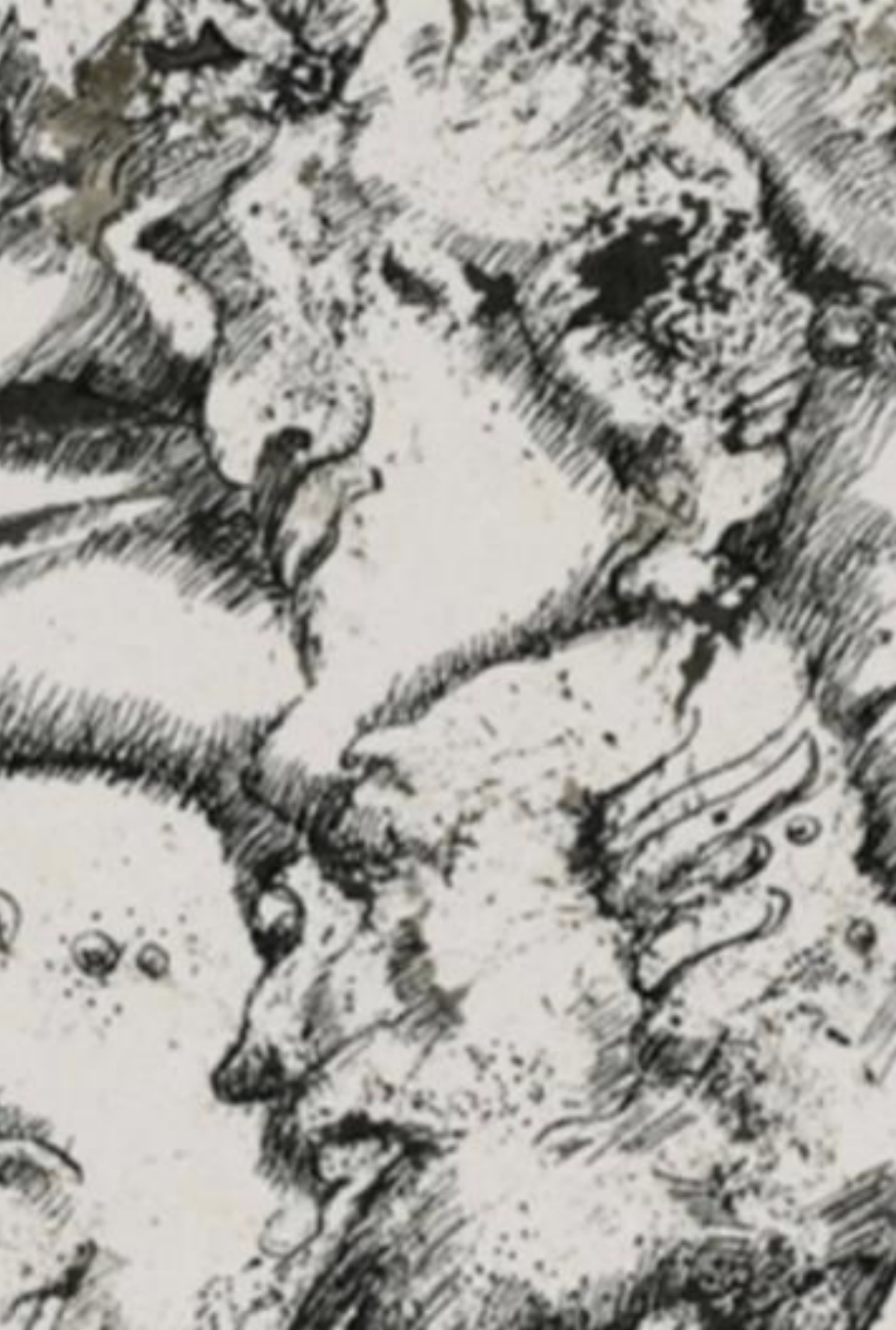
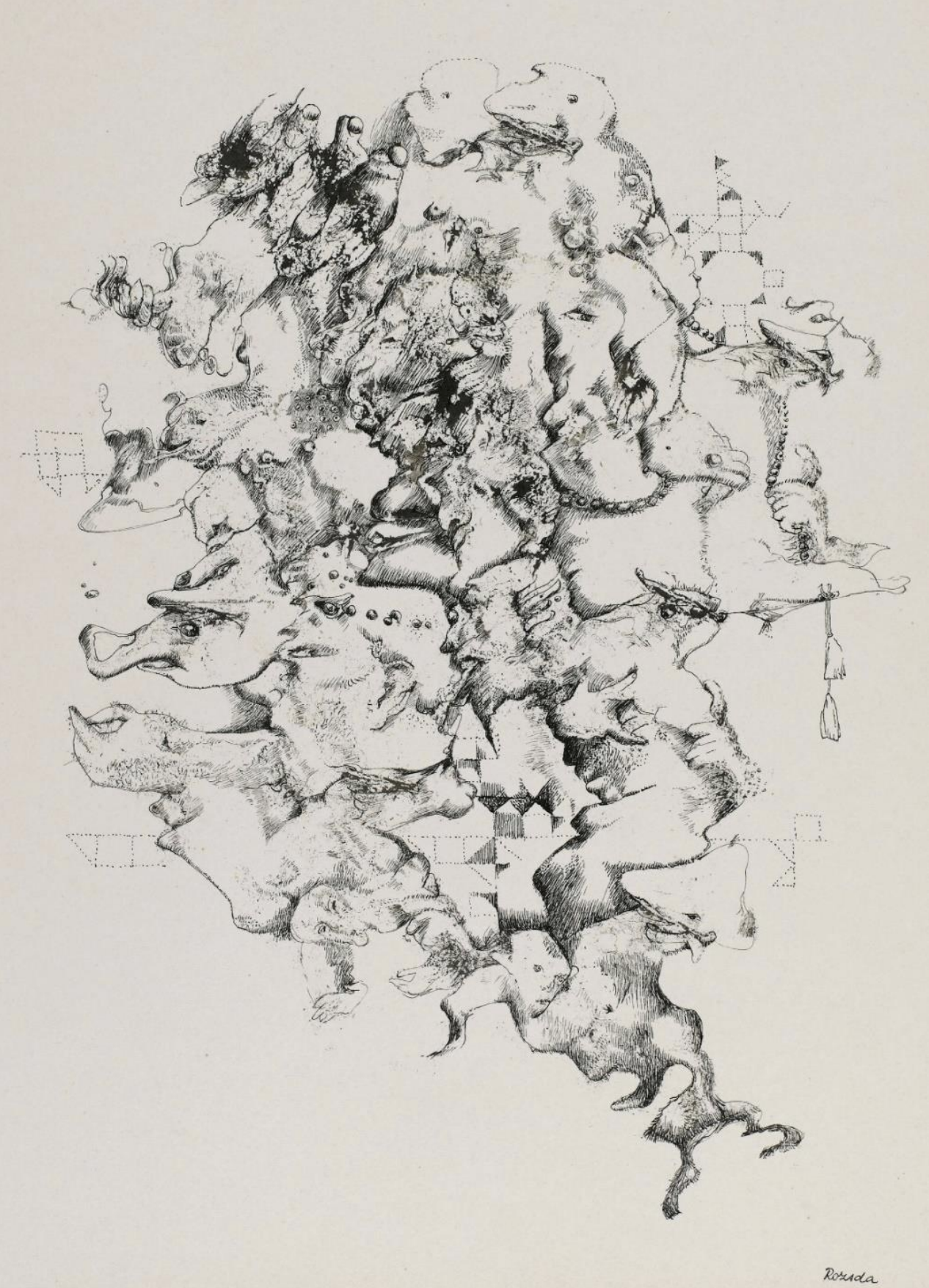
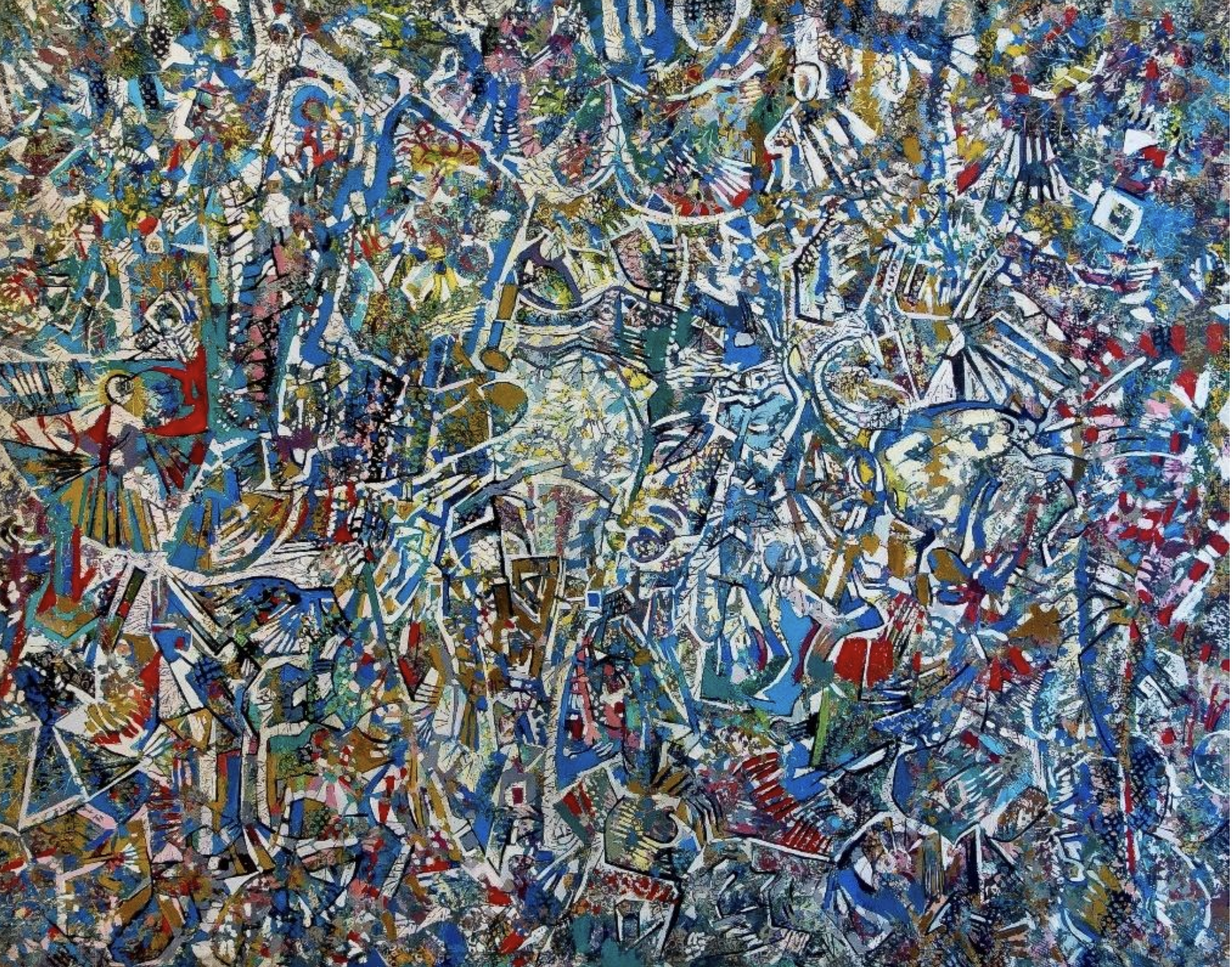
The principles of Rozsda employed in his paintings remain the same as those serving his works on paper, but to these are added the vibrant universe of his colors, as well as his method consisting of turning his works during the creation phase until they find their appropriate direction. And even, until – according to Rozsda himself(34) – they become independent entities, which exist by their own sovereign destinies. The imprints superimpose in his paintings like archaeological strata, they juxtapose to his formal universe, creating a fabric imbued with light (Babylon, Symmetry is Broken). The different imprints often serve as starting points, transforming into a sort of "self-generating" surface: during a new painting, Rozsda began by eliminating on the canvas everything that was white to create a new troubled surface and build a new personal order there. Sometimes, on the surface of his paintings, a sort of scraping technique becomes perceptible, which evokes the experience of the adolescent Rozsda with the painters of his native town of Mohács: according to Rozsda, the artists restoring frescoes "scraped" the surface to repaint them – the layer thus emerging reflected both the previous ones and those that were subsequent to it, also bringing to light the starting point of the work. After the period of the European School, in a context where free creation was not obvious, and that the artist's equipment did not shine by its abundance(35), Rozsda willingly used colored pencils to realize his works on paper. The dimension of Rozsda's technical arsenal used for the establishment of painted surfaces becomes easily conceivable just by advancing some of these solutions: splashing, scraping, stratification, recording of imprints (capturing the cosmos) of (organic) objects... He used particular solutions in his photographs too, like double exposure – obviously still thanks to an analogous technique –, through which he superimposed different shots, and without subsequent laboratory work, he arrived at compositions completely escaping reality and yet fully using real elements. Rozsda, faithfully following his inner voice, progressively discovers the path that leads him towards his specific surrealism without him necessarily having wanted to be "welcomed", consciously by the group.
Exploration
A copy of a letter draft is preserved in the Archives of the Rozsda Studio, at the Bateau-Lavoir (Paris): Simone Collinet writes to a distant friend. The letter dates from March 1980, without mention of the exact day – Collinet died that same year, on March 30. It is only a question of Rozsda's art throughout the two and a half pages. She seeks there the reason why Rozsda's art had not yet been attributed until then the merit that should have been due to it and the fact that he was not celebrated as he should have been.
If one compares him to those who benefit from current successes, one is seized with a revolting injustice. [...] a master has the right to be recognized. And he is a master: by the force of his personality, by his talent as a colorist, by his inventiveness, by his technical knowledge which allows him to save his art that so many others currently lead to shipwreck. I speak of it with assurance, because all the painters in whom I have been interested have known more or less glory. Although one must too often apply Jacques Villon's saying: 'The hardest are the first seventy years!'. [...] Making Rozsda known would amount in my opinion to making him admired, making him admired, to making him appreciated.
Collinet had been a witness to the first years of the surrealist group, she was quite aware of what the group "demanded" of a so-called surrealist mind. She believed in Rozsda and during the "post-bretonnian years", thanks to her gallery, she endeavored to offer the possibility to the Hungarian painter to "take off".
Rozsda would have been one hundred years old on November 18, 2013. During the thirty years that have elapsed since Collinet's letter until this date, Rozsda's art has progressively distinguished itself from its usual course to reach and conquer increasingly distant spaces. The exploration of his work takes us through multiple strata, contributing to making particular memories resurface, long closed by the amber of memory, to finally be publicly exposed.
The present essay was written on the occasion of the series of exhibitions accompanying in Budapest the centenary of Endre Rozsda, within the volume published by the Várfok Gallery: Rozsda100 // A Párka fonala | Le Fil de la Parque | The Parca's Thread included texts by: Péter Esterházy, Françoise Gilot, Sándor Hornyik, Borbála Kálmán, József Készman, Arturo Schwarz. Várfok Gallery, Budapest, 2013.
- István Szakály, Róbert Római and Gyula Stenszky: unpublished film – Interview with Endre Rozsda, Paris, 1991, 53 minutes.
- Endre Rozsda: "Meditations", in: Endre Rozsda – Retrospective. Exhibition catalog, under the direction of David Rosenberg, Műcsarnok, Budapest, 1998, p. 61.
- For more information on Arturo Schwarz: cf. p. 17., in: Rozsda100 // A Párka fonala | Le Fil de la Parque | The Parca's Thread – included texts by: Esterházy Péter, Françoise Gilot, Hornyik Sándor, Kálmán Borbála, Készman József, Arturo Schwarz. Várfok Gallery, Budapest, 2013.
- Mostra internazionale del Surrealismo, Galleria Schwarz Milano, May 1961, inside cover.
- Artists participating in the exhibition: J. Benoît, G. J. Bodson, A. Dax, Y. Elléouët, E. F. Granell, R. Lagarde, Y. Laloy, Le Maréchal, E. L. T. Mesens, J. H. Moesman, P. Molinier, M. Oppenheim, W. Paalen, M. Parent, E. Rozsda, F. Schroeder-Sonnenstern, M.-W. Svanberg, Toyen.
- José Pierre: The Despair of Gardeners or Surrealism and Painting since 1950, Ibid., p. 1.
- Breton returns from the United States in May 1946, after having traveled across the American continent while continuing unfailingly his work accompanied by others and surrounded by serious attention; he meets a French scene where the majority of artists, having lived the trauma of war, feel the necessity of making a clean slate and goes so far as to question the foundation of the plastic arts. Breton attempts to pursue his own reasoning on a (surrealist) plateau increasingly in disagreement and where certain tensions (of political and artistic character) surface, but which will nevertheless remain more or less concealed until his death. The last years of the surrealist group are recapitulated by the following work: Alain Joubert: The Movement of Surrealists or The End of the Story: Death of a Group, Birth of a Myth. Paris, 2001. Joubert's synthesis, formerly a member and witness of events, expressly employs a personal tone and aims to lift the veil on the "self-dissolution" of the surrealist group in 1969. Joubert presents for example José Pierre's activity following Breton's death under a rather unfavorable angle; however the objectives of the group still navigating in the same boat in 1961 seem to fully concur and can thus serve as a starting point.
- Mostra Internazionale..., op.cit., p. 4. The evocation of Hantaï on this point is not surprising if one takes into account Pierre's position: in the middle of the fifties, serious debates broke out among others because of the different provocative statements emitted by Hantaï within the group. The loss of his faith in surrealist methods and perception leads Hantaï to consider the dissolution of the surrealist group as the only perspective, and that is moreover what he proposes to Breton. The latter's followers, in a "comprehensible" manner, consider inadmissible this way "of arriving and leaving".
- Ibid., p. 3.
- The text has been published several times, e.g. in: Rozsda – Retrospective, Műcsarnok, op.cit., p. 52.
- That is: "dissolution in sleep – loss of the feeling of identity; fusion with natural forces – space and time negation; vision of the unknown". Source: [http://www.andrebreton.fr/fr/ item/ ? GCOI=56600100742020#] (September 2013). The issue did not finally appear. In detail: Borbála Kálmán: Time in Images – The Work of Endre Rozsda, MA thesis, PPKE-BTK, Piliscsaba, 2011, pp. 61-62.
- Júlia Cserba: Rozsda és a bronz [Rozsda and Bronze], In: Új Művészet, 1995/5, p. 56.
- André Breton: Surrealism and Painting, Gallimard, Paris, 1965, p. 249.
- E. Rozsda: Meditations, op. cit., p. 61.
- Interview of Françoise Gilot and Borbála Kálmán, unpublished, June 12, 2013, Paris.
- As what was happening on the painting interested him much better than what was happening in life; he "walked in the paintings" for hours, sitting in an armchair, looking at the canvases hung on the wall, In: Rozsda: "Memories", Rozsda - Retrospective, Műcsarnok, op.cit., p. 57.
- Sarane Alexandrian: Surrealism and Dream, Gallimard, coll. "Knowledge of the Unconscious", Paris, 1974. Alexandrian was also a close member of the late branch of surrealism. He contributed to the catalog of Rozsda's exhibition at the Museum of Fine Arts of Budapest (Szépművészeti Múzeum, 2001) with a text in which he emphasizes that he was surprised to notice the similarity of the drawings of Victor Brauner's first period that he knew so well and Rozsda's drawings of the 1950s.
- Ibid., III. Psychogenesis of Automatic Writing, pp. 71-102.
- Rosalind Krauss: "Photography in the Service of Surrealism", In: Explosante-fixe. Photography and Surrealism, under the direction of: Dawn Ades, Rosalind Krauss and Jane Livingstone. Centre Georges Pompidou, 1985, p. 20. "I have always been very cautious in the appreciation of [what is said to be surrealist painting], because at the origin we had thought that there could not [be] surrealist painting. The material that is employed in painting lending itself very badly seemed then to the automatism that we wanted to promote for example in matters of language. [...] It is only perhaps at the time of the last war that this sort of handicap bearing on automatic painting was lifted. It was lifted by elements of the kind of Jackson Pollock and it practically gave existence to all this movement said lyrical abstraction". In: Interview of André Breton with Judith Jasmin, 1961. The program (Premier Plan) had been realized for Canadian television. [http://archives.radio-canada.ca/emissions/568-14416/] (September 2013).
- Simone Collinet organized several exhibitions for Rozsda in her gallery, the Furstenberg Gallery: in 1957 and 1963 individual exhibitions, in 1965 she presents some of his new works. Collinet closes her gallery in 1965 for personal reasons.
- Alexandrian: V. The Key to Surrealism, op.cit., pp. 133-148.
- Interview of André Breton with Judith Jasmin, op.cit.
- Joyce Mansour, In: Mostra Internazionale..., op.cit.
- Rozsda – The Eye in Celebration, under the direction of David Rosenberg, Somogy Art Editions, Paris, 2002.
- E. Rozsda: "Meditations", op.cit., p. 61.
- A. Breton: Surrealism and Painting, op.cit., p. 68.
- Ibid, p. 70. It is interesting to note that some drawings by André Masson, notably those of the 1930s, therefore dating from a much later period than the first automatic drawings, show a remarkable similarity with certain works on paper by Rozsda, realized with India ink.
- E. Rozsda: "Meditations", op.cit., p. 61.
- Interview between Antal Székely, Borbála Kálmán and Krisztina Kovács, unpublished, Várfok Gallery, Budapest, 2009. Jean worked for the Goldberger textile factory; it appears that he had helped Rozsda in Hungary, as a French citizen, to hide his paintings during the war. It was he who had inaugurated the exhibition of Rozsda and Lajos Barta in 1948 at the Artists Gallery (Művész Galéria) (In: Péter György –Gábor Pataki: Az Európai Iskola és az Elvont Művészek csoportja [The European School and the Group of Abstract Artists], Corvina, Budapest, 1990, p. 154.)
- Surrealist Vision and Technique – Drawings and Collages from the Pompidou Center and the Picasso Museum (Paris) – exhibition catalog, under the direction of and written by: Clark V. Poling, Michael C. Carlos Museum / Emory University, Atlanta, 1996, p. 46. According to Poling, the decalcomania technique initiated by Oscar Dominguez then developed with Marcel Jean had been placed by Breton in the context of "delirium of interpretation", Breton even cites it in relation to "objective chance", since the figures drawing from the stains are in fact considered as "found objects".
- E. Rozsda: "Meditations", op.cit., p. 61.
- We have no information concerning the moment of application of the imprints, if Rozsda applied them at once or if he integrated them into the work little by little. He "stained" his works most of the time by soaking the objects in paint then imprinting them on the surface, but on some works, the objects are imprinted in layers of paint already applied.
- According to the institution's register accessible on its site [www.centrepompidou.fr], this work had been acquired by the State in 1960 (Inventory number: AM 2551 D). The genre of surrealist drawing is strongly represented within the graphic works department of the collection.
- Rozsda: "Thoughts", In: Rozsda – Retrospective, Műcsarnok, op.cit., p. 59.
- Cserba: Rozsda és a bronz, op.cit., p. 56.