ENDRE ROZSDA, PAINTER OF MYSTERY
par Alba Romano Pace
March 1, 2015
Endre Rozsda, Painter of Mystery, by Alba Romano Pace, published in Mélusine numérique journal n° 1
This text is devoted to surrealism, abstraction and biomorphism in Endre Rozsda's post-war art, to this period where his work, secret and mysterious, oneiric and visionary, resorts to the language of the unconscious. This art is inscribed in a precise historical moment and defines itself as the unique expression of a vocabulary of freedom. Éric de Chassey, curator of the important exhibition Starting from Zero(1), where Endre Rozsda figures among the exhibited painters, notes:
The solution of tabula rasa was formulated from the pooling of two formal vocabularies – that of abstraction and that of surrealism – which the interwar years had violently opposed, which the end of the 1930s had begun to reconcile under the species of biomorphism, and which the opposition of Nazi and communist dictatorships to all formal modernism had combined from the beginning of the 1940s as the very vocabulary of freedom(2).
When Rozsda arrives in Paris in 1938, the International Exhibition of Surrealism at the Beaux-arts gallery, rue du Faubourg-Saint-Honoré, has just closed its doors. For the occasion, Breton and Éluard have written, as a catalog, an Abridged Dictionary of Surrealism, where all the key objects and figures of the movement are listed. Did Rozsda have knowledge of this publication? This is probable, because, as Simone de Beauvoir remarks, the exhibition was "the most notable event of the winter(3)". If Endre Rozsda only meets André Breton in 1957, during his second stay (this time definitive) in France, the painter already approaches surrealist thought and art between 1938 and 1939: "What interested me in surrealism at this initial stage was its surprising, provocative aspect(4)", he writes later. Once settled in Paris, Rozsda and his friend, the sculptor Lajos Barta, organize an exhibition in their apartment on rue Schœlcher. This event allows them to meet the artists of Montparnasse and especially their compatriot, the painter Árpád Szenes and his companion Vieira da Silva, also a painter, with whom a friendship is established. It is therefore possible that it is thanks to these two artists that Endre Rozsda begins to frequent the Jeanne Bucher gallery of which Szenes and Viera da Silva are very close. It is in this gallery that Rozsda declares having discovered the first surrealist paintings. Françoise Gilot, future wife of Picasso, whom Rozsda meets at this same time and to whom he gives painting lessons, also remembers "the evenings spent with Endre in the gallery's basement discovering the surrealist paintings of Yves Tanguy, Miro and Max Ernst(5)". The basement of the Jeanne Bucher gallery must then have housed the surrealist collection coming directly from the Gradiva gallery, directed by André Breton between 1937 and 1938. On April 2, 1938, André Breton leaves with his wife Jacqueline Lamba for Mexico where he is invited to give lectures and where, especially, Léon Trotsky is located. Having left precipitously, Breton charges Yves Tanguy with transporting the collection to the Jeanne Bucher gallery. Rozsda becomes acquainted with surrealist painting at the moment when a deliberate return to automatism is taking place. In continuity with Rozsda's quest for an expression of feelings through abstraction, the young generation of surrealist artists born, like the Hungarian painter, between 1910 and 1915, finds in a new interpretation of surrealist automatism the method that best explicates the relationships to the unconscious in this extremely troubled historical era that precedes, if only by a few months, the explosion of the greatest world conflict. In the September 1939 issue of the journal Minotaure, André Breton writes an important article on "The New Tendencies of Surrealist Painting", where he relates how surrealism, through the young generation of artists who join the group from 1935, moving away from trompe-l'œil painting represented by Salvador Dalí's oneiric images, approaches more and more the mysterious biomorphic figures of Yves Tanguy:
Surrealist painting, in its manifestations of the freshest date, in men young enough not to have, on the artistic plane, to account for their personal antecedents, operates a marked return to automatism [...] Already the deep, the true monotony lurks Dalí's painting. [...] If, on the contrary, Tanguy's star rises ever higher, it is because he is ideally integral and intact, [...] Tanguy's painting has hardly yet delivered anything but its charm: it will later deliver its secret(6).
Thus emerges a new type of surrealist painting that wants to explore non-Euclidean geometry, the third and fourth dimensions, as well as the so-called fractal geometries that are found in nature (and of which the Musicalistes group, affectionated by Rozsda, already spoke). The Chilean painter Matta, who theorizes in 1938-1939 this new tendency of surrealist painting, will give it the name of "psychological morphology". Matta as well as the cited young surrealist artists meet in the summer of 1939 in the Château de Chemillieu around Breton, strongly impressed by Yves Tanguy's work, biomorphic, enigmatic and with ancestral forms. From this same period dates Rozsda's first surrealist work, Disheveled, from 1939.
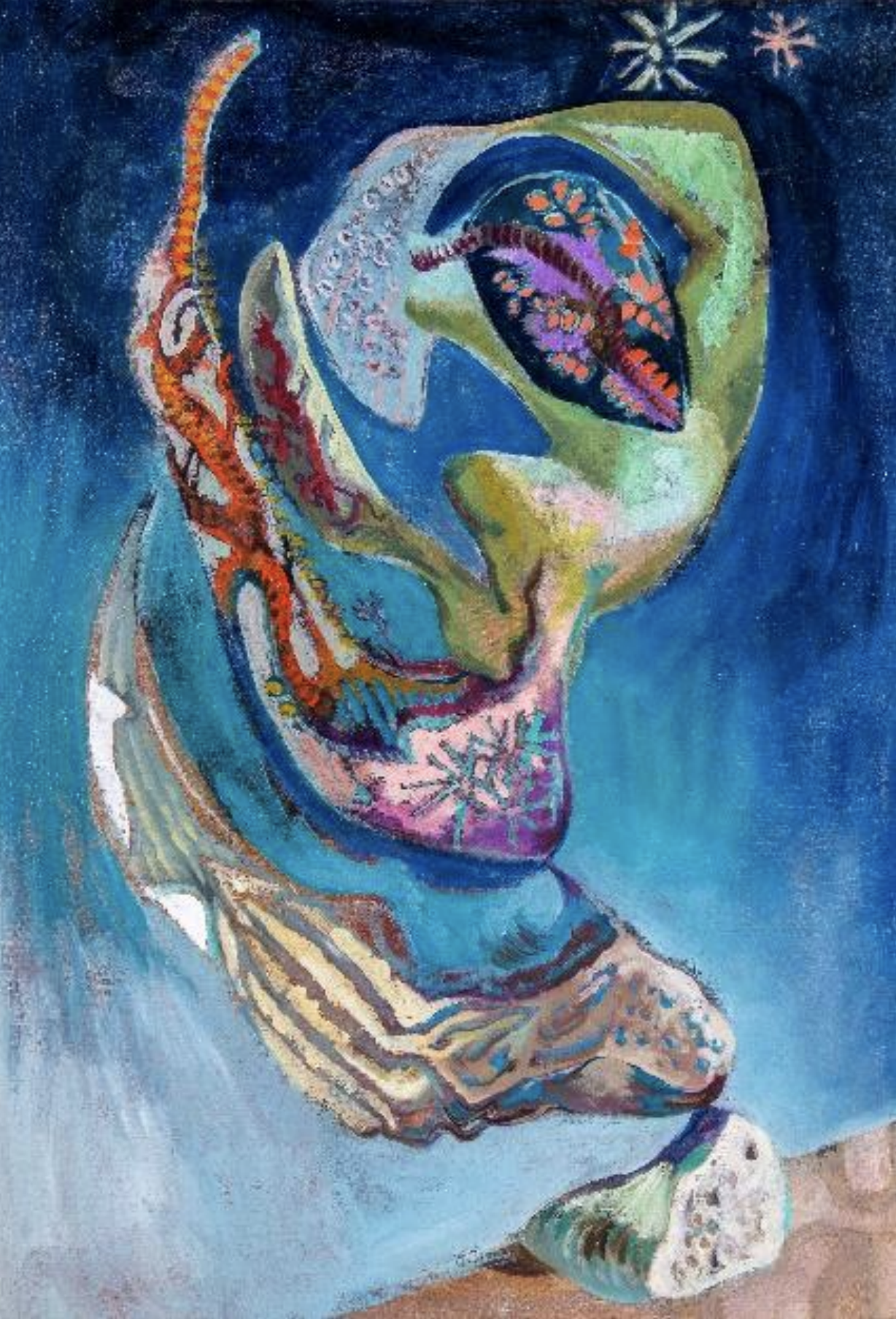
In this painting, Rozsda paints a totally abstract figure that develops in a liquid or aerial space. Is it a totem, a biomorphic being, an oneiric object? The form painted by Rozsda evokes a painting by Kurt Seligmann, whom the artist very probably met in 1938, before Seligmann left France, because of the war, to settle in the United States. Kurt Seligmann was a friend of Le Corbusier and Giacometti, he had studied at André Lhote's studio where Brassaï came, and he frequented the Montparnasse district assiduously. It is very probable that Rozsda and Barta made his acquaintance through Brassaï or Giacometti, who were their friends. All the more so since Kurt Seligmann had also been part of the Abstraction-Création group in which Rozsda had been interested. Moreover, Seligmann had had his first exhibition at the Jeanne Bucher gallery in 1932 and, following his meeting with Breton, had officially entered the surrealist movement. Rozsda, for his canvas Disheveled, could therefore have been inspired by Seligmann's forms which, emerging like totems, develop in height in space. These forms seem like aerial roots or, as the title of a Seligmann painting(7) posterior to Rozsda's says, like chrysalises. The abstract geometries of nature are thus called to express themselves in a new form of painting which, as Matta explains, approaches architecture and proposes to build the painting according to construction laws. Rozsda, to advance in his art, takes the same path as the artists of his age, living the same exigencies dictated by his era. An era where the desire for freedom and love becomes stronger and stronger as war approaches; an era of scientific discoveries, especially in the field of mathematics, chemistry and even more of physics. With the invention of the atomic bomb, during the Second World War, it is an entire system of values that is called into question. The surrealist artists become the spokespersons of this rupture which is at the same time renewal. The vision of art for Endre Rozsda has moreover completely changed since the discovery of the surrealist movement. As he will say himself later:
I place in parallel the discovery of light with my arrival in Paris. When I discovered the surrealists. [...] both changed my life. In both cases I felt that it was a matter of an enlarged point of view. [...] I kept silent I was careful and I watched(8).
Obliged to return to Hungary, a country still free, after France's entry into war, Rozsda and Barta decide to present their new creations in Budapest. On the occasion of their exhibition at the Alkotas Muveszhaz (House of Artists), Rozsda's work is the subject of laudatory criticism:
His personality is extremely sensitive and reacts with ardor and force to the sorrows with which our era is so charged. [...] According to us this method of deconstruction of forms is not the search for a new world but the result of the decomposition of the old one. [...] this time of fear has created this art of flight, we must recognize the honesty and inner force of the artist's expression(9).
At the arrival of war, artists react to the idea of destruction by opposing to it that of "creative chaos". They paint a universal entropy where fears and hopes mix. They express the ambient instability through the use of indefinite forms, dense colors that create clusters of matter in germination and perpetual metamorphosis. The composition expresses a new universe in gestation in which the impulses of life and death fight each other, exploding in space. The canvas is prey to convulsions that emerge through the use of strong tonalities, mixed with others almost fluorescent. The line no longer exists. One remembers that Breton had written in Nadja: "Beauty will be convulsive or will not be(10)". In 1934, in "Convulsive Beauty", text published in Minotaure, n° 5, then reprinted in Mad Love, he specifies: "Convulsive beauty will be erotic-veiled, exploding-fixed, magical-circumstantial or will not be(11)". Through this series of oxymorons, Breton explains the new characteristics of convulsive beauty made of movement and mystery. In The King of Truth of 1942, Rozsda paints two black clusters on a background composed of large blue, brown or incandescent red streaks. Inside these dark masses, ample touches of vivid colors emerge. One finds oneself facing a primordial landscape where water, fire, earth and air attempt to unite to give life back to a world now destroyed. The large black stains of the foreground can symbolize death and ash; the red expanse evokes the flaming volcanic lava spread on the earth that has just burned, the white signs are similar to the vapors that rise from the ground.
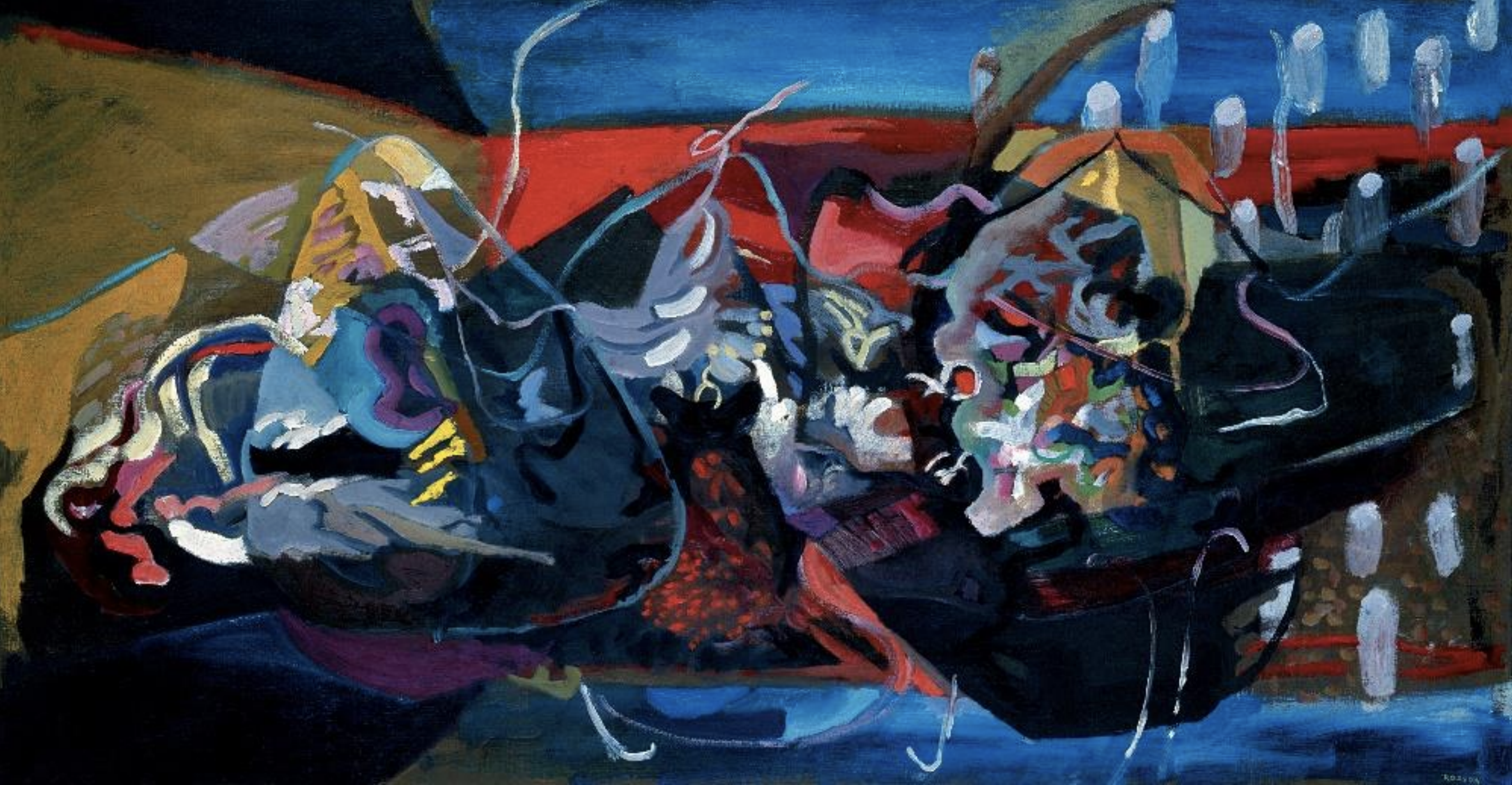
Death and regeneration emblematized in this canvas become the mirror of the historical time lived by the artist:
[...] during the war, I was afraid and I painted that (fear). I got drunk in streets of overturned piano keyboard in the colors, where flames ran. Heads rolled and shadows lengthened enormously. It was not for nothing that I was afraid, because then I was engulfed by the horrors of war. But these horrors resembled nothing like my paintings. I saw disgusting and base things. People who descended to the most ignoble filth. Crime, murder, blood. Of course, even in this awful world there was light – love – and humor – laughter – and one sometimes even forgot the end. The war and the period that followed completely shook my materialist faith. I began to learn to think again. The system of values of things changed and everything appeared in a new light(12).
The artist sublimates the trauma of the lived through the force of color and light. His positive personality makes painting, as he says himself: "an insurance against death, against disappearance(13)".
The painting becomes for him a casket of memory and especially a non-place where space explodes in a dimension without continuity, full of energies and sublimated desires. The forces clash to give life to what is no longer. If one evokes the definition of automatism in the 1924 Surrealist Manifesto, one finds very strong links with the Hungarian artist's painting:
Surrealism is pure psychic automatism by which one proposes to express either verbally, or in writing, or in any other manner, the real functioning of thought. Dictation of thought outside of all control exercised by reason, outside of all aesthetic or moral preoccupation(14).
One can verify this association when in 1944 at the Tamás Gallery in Budapest is inaugurated the New Romanticism exhibition, which initially should have been called: Hungarian expressionists and surrealists(15). It is in this spirit that in 1945, in the apartment of the couple Béla Tábor and Stefánia Mándy, poet and art historian, Pál Kiss, Ernő Kállai, Arpad Mézei and his brother Imre Pán16, found the Európai Iskola (European School) group that Rozsda joins shortly after. Born from a need for hope in a Europe in ruins, but in reconstruction after the war, in 1948, the European School experience closes because of the communist dictatorship and chooses to end its activity with an exhibition by Lajos Barta and Endre Rozsda(17). It is the 31st exhibition of the European School organized at the Muvesz gallery; the catalog is prefaced by Arpad Mezei(18). Krisztina Passuth reports on this occasion: "Marcel Jean declares Rozsda more modern than his Parisian contemporaries(19)."
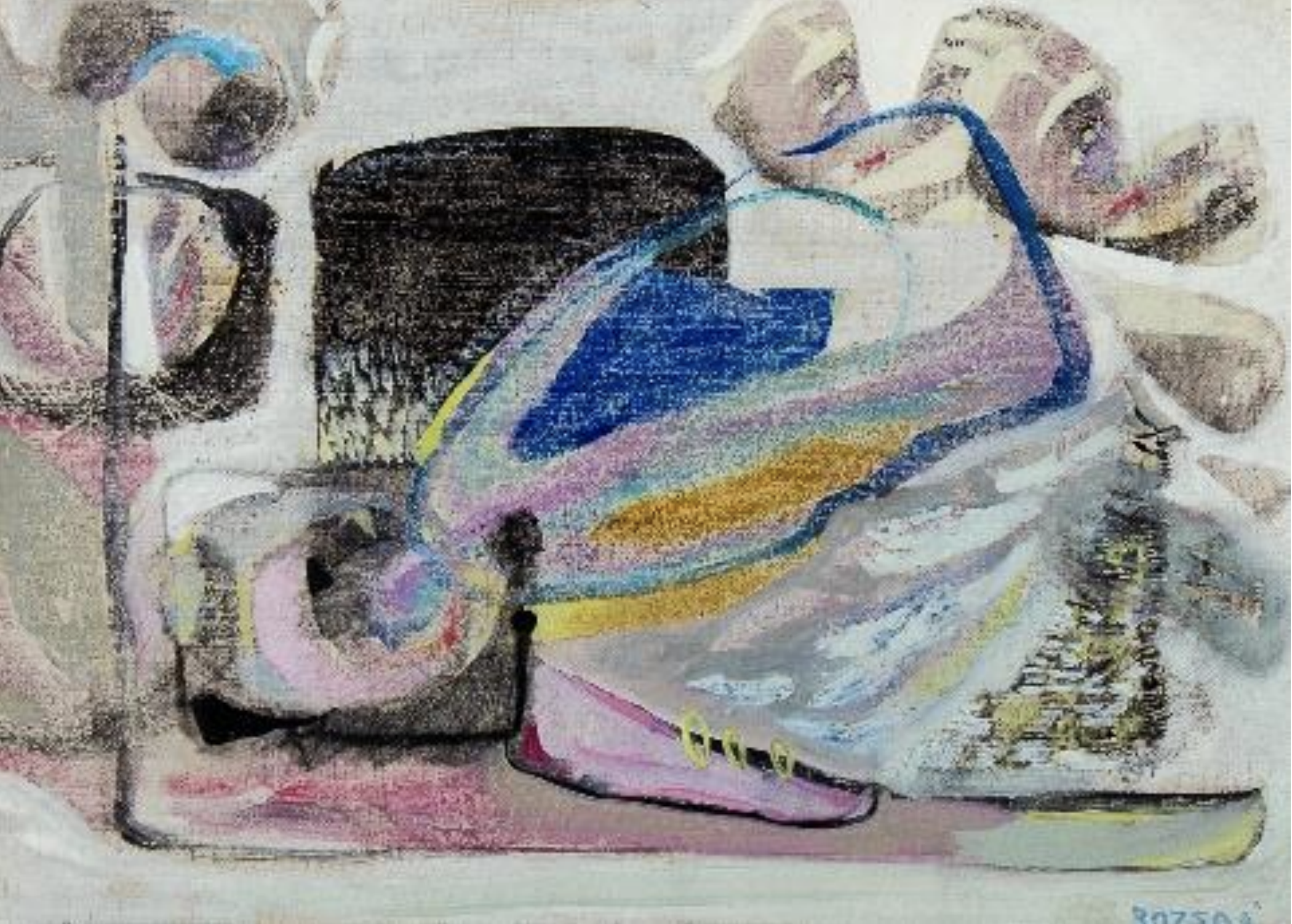
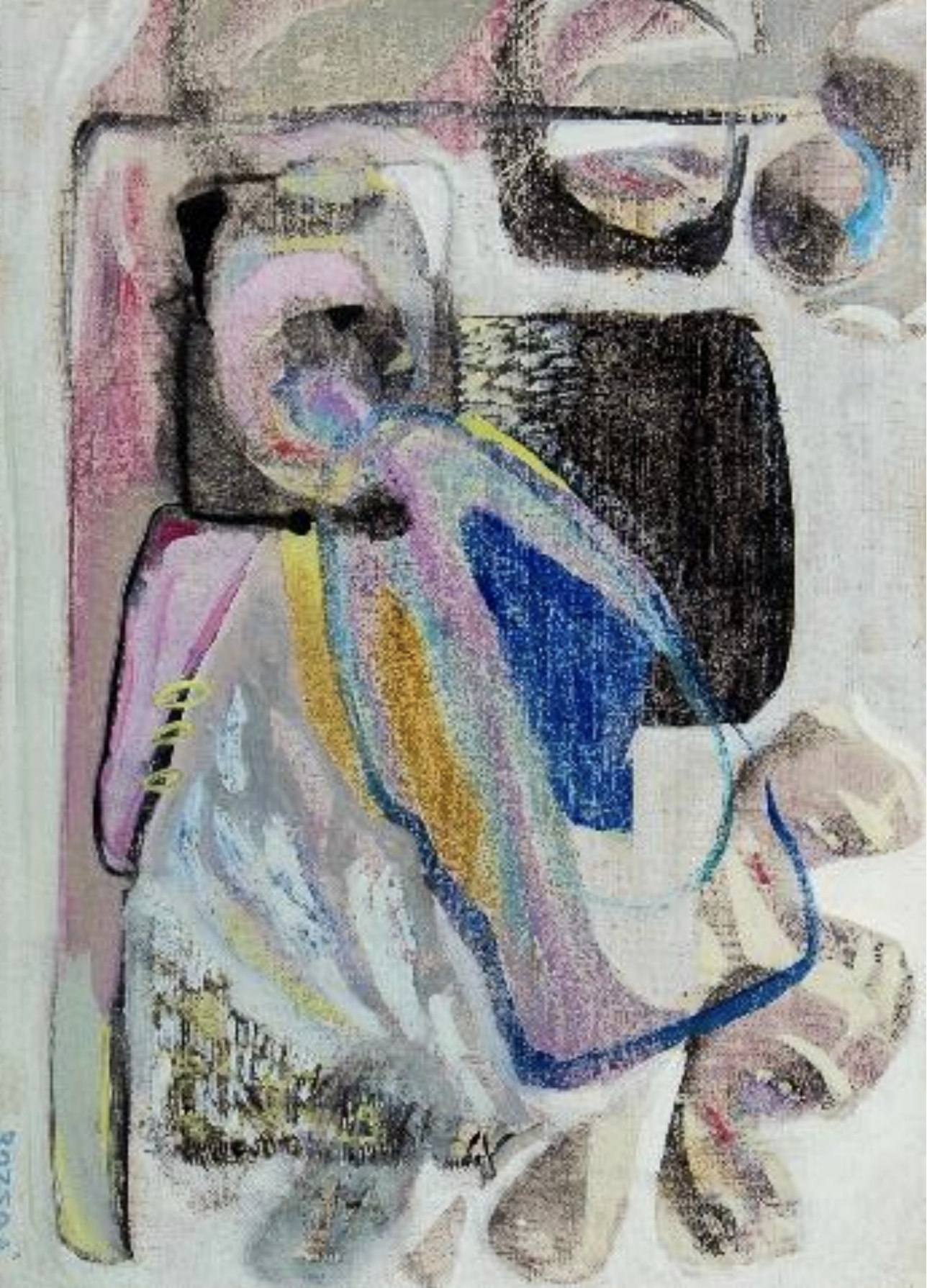
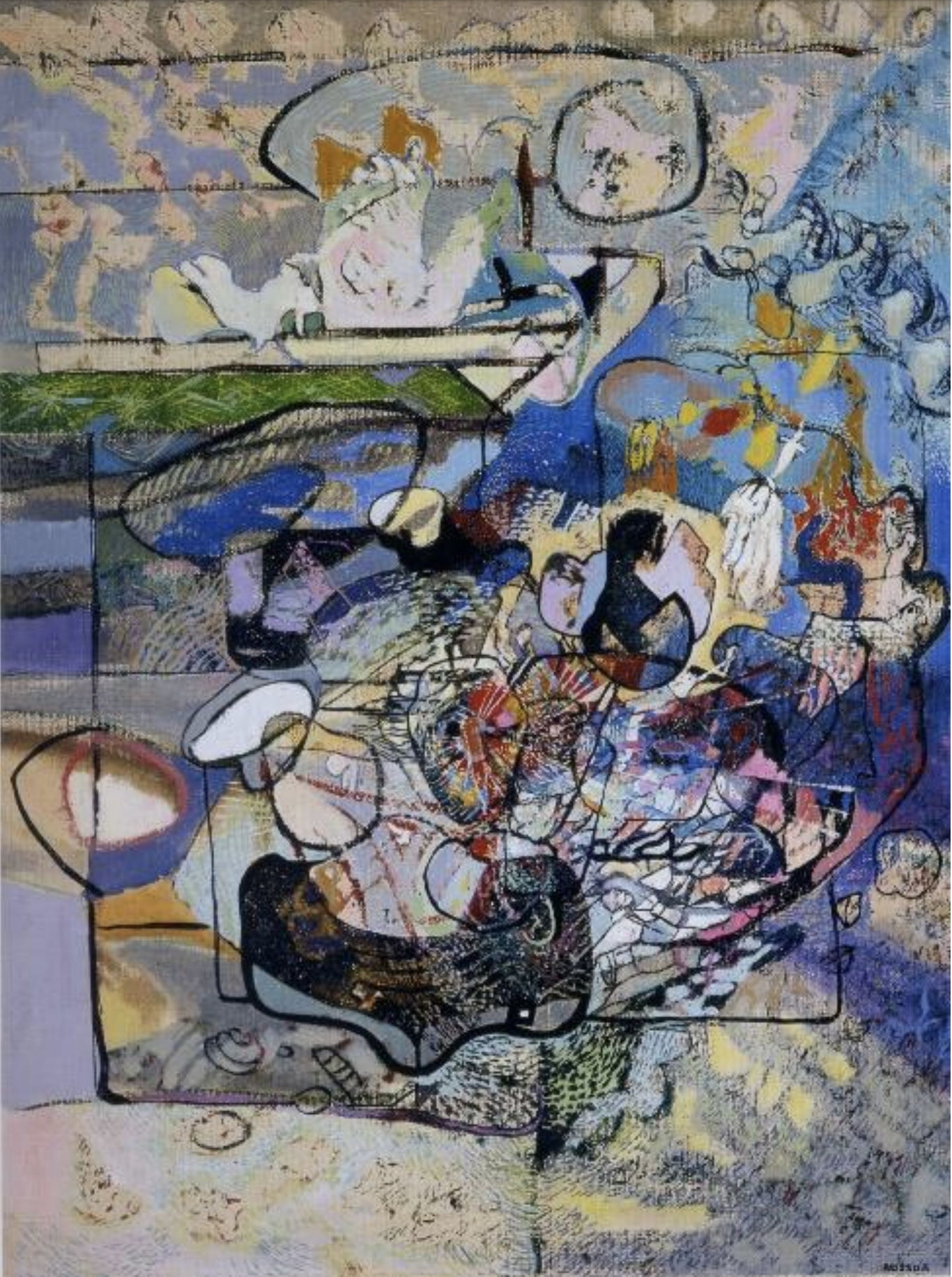
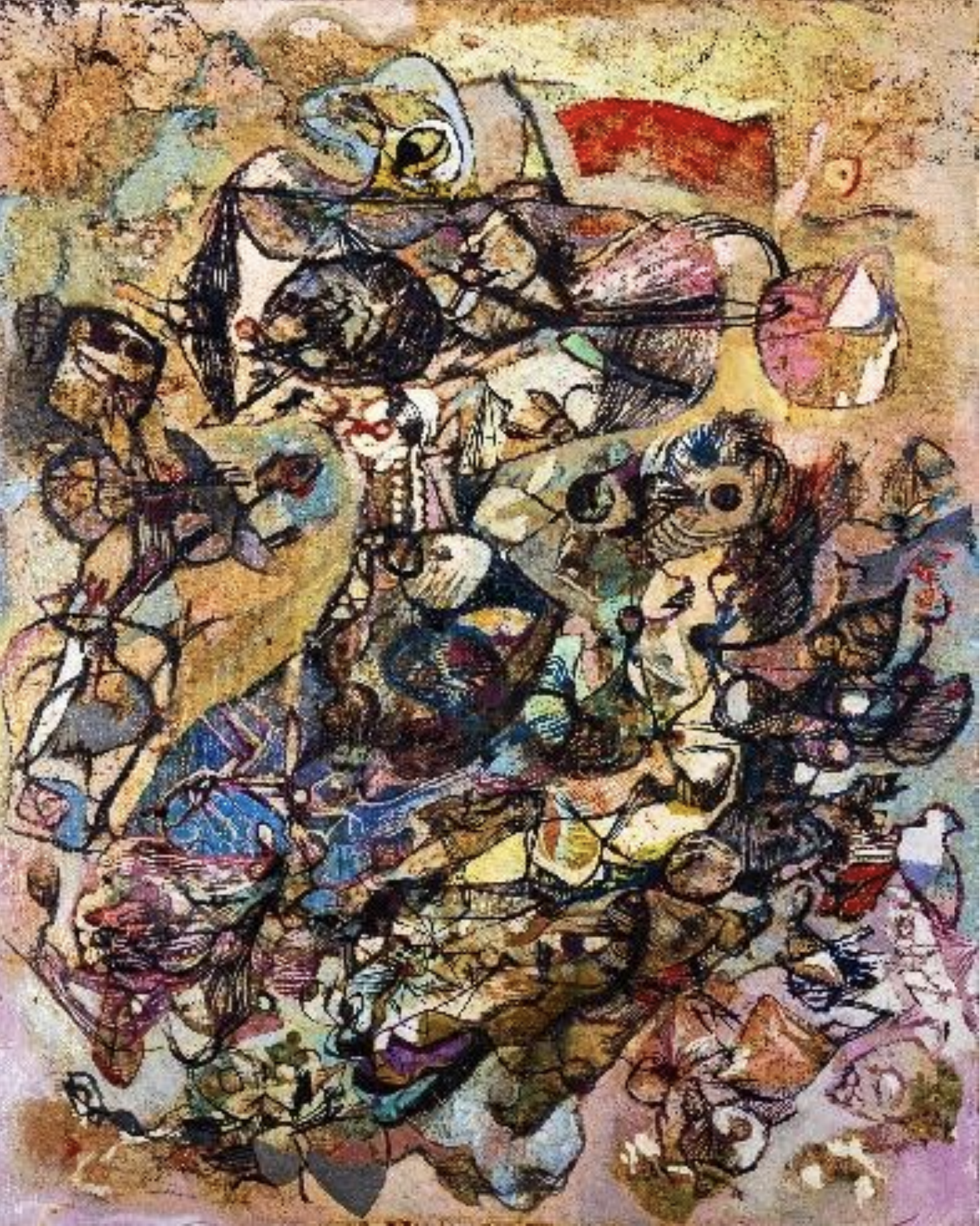
Rozsda has forged a surrealist practice that is his own, which he calls "reiterated automatism". He paints in an automatic way then extracts parts that will give birth to a second canvas and so on until finding the definitive composition. Sacred Love, Profane Love, chosen by Breton to illustrate Surrealism and Painting, is thus the synthesis of two quite different paintings, but which, if one turns them over, show a similar composition, with identical forms that repeat themselves. Certain forms express Rozsda's feelings better than others. These are the round forms, the amalgams made of superposed layers of dense and brilliant paint. The composition thus becomes a gelatinous ensemble that calls for touch in an erotic movement of flow. Rozsda tells David Rosenberg that he likes to turn and turn over the paintings "until the painting no longer returns my gaze(20)". The same process is used for My Grandmother's Lorgnette, from 1947, of which one preserves an example, a sort of study of the painting that reveals the artist's humor. If one turns over the canvas, it replicates the same drawing as the study: a skull, a pig's nose, glasses. In My Grandmother's Lorgnette, colored aggregates, where navy blue prevails, mix their drawings, hiding and confusing them in masses that seem to move on the canvas to give birth to a new being. It is an aquatic spring, a dive into the depth of the sea. The tints of his paintings are sometimes fluorescent, sometimes dark with a strong presence of black, as in Danse Macabre, 1946-47 (Figure 1) or again in Full Flight, from 1946 (Figure 2). The memory of war is very present here, as Kállai writes:
One finds oneself facing a modern form of catacomb art. We see fantastic hieroglyphs, dark memories emerge. Something is happening in this Europe with a troubled soul(21).
Rozsda's painting is an example of art that plunges into History. His canvases are the expression of an impulse of love, revealed by surrealist art from 1939, elevated against hatred, against war, dictatorships, fear. André Breton will not delay in recognizing it and inscribing Rozsda among the surrealist painters. In Surrealism and Painting, he links the Hungarian painter's art to history, to the telluric forces of nature that resonate with the invisible energies of the human psyche:
Here are measured the forces of death and love: the most irresistible escape seeks itself from all sides under the magma of leaves turned black and destroyed wings, so that nature and spirit renew themselves by the most luxurious of sacrifices, that which spring demands to be born(22).
- Starting from Zero, as if Painting Had Never Existed (1945-1949), Museum of Fine Arts of Lyon, October 2008 – February 2009. Exhibition curator Éric de Chassey in collaboration with Sylvie Ramond.
- Éric de Chassey, op. cit., p. 28.
- Simone de Beauvoir, The Prime of Life, Paris, Gallimard, 1986, p. 127.
- Ibid.
- Interviews of Françoise Gilot with the author, Paris, June 2009.
- André Breton, "Of the Most Recent Tendencies of Surrealist Painting", in Minotaure n°12-13, May 1939, and Surrealism and Painting, op. cit. p. 524.
- Kurt Seligmann, Isis, 1944, http://www.artnet.com/artists/kurt-seligmann/isisc7OudqB_Dv0z4KyZrRsgtQ2
- Endre Rozsda, Unpublished Writings, in Rozsda Studio Archives.
- Anonymous press clipping, in Rozsda Studio Archives.
- André Breton, Nadja, in Complete Works, op. cit. tome I, p. 753.
- Idem, "Convulsive Beauty", in Minotaure, n°5, Paris, May 1934. This text will become, in 1937, the first chapter of Mad Love.
- Endre Rozsda, Unpublished Writings, in Rozsda Studio Archives.
- Ibid.
- André Breton, Surrealist Manifesto, in Complete Works, op. cit., vol. I, p. 810.
- Cf. Gabor Pataki, "From Minotaur to Minotaur", in Mélusine: Cahiers du Centre de recherche sur le surréalisme. N° XV : Ombre portée : le surréalisme en Hongrie, op. cit. p. 201.
- One remembers that in 1924 Imre Pán is the founder of the dadaist journal IS.
- Cf. Krisztina Passuth, "Endre Rozsda: biography of the artist until 1957", in Endre Rozsda, op. cit., p. 22.
- See above pp. 164-165.
- Krisztina Passuth, "Endre Rozsda: biography of the artist until 1957", in Rozsda Endre, op. cit., p. 22.
- David Rosenberg, Interview with Rozsda, op. cit.
- Ernő Kállai cited by Gabor Pataki, Art under dangerous constellation the so-called "New Romanticism" as a Special Form of Escapism in Central-European Art during World War II, op. cit.
- André Breton, "Endre Rozsda", Surrealism and Painting, Gallimard, Paris, 1965.