ENDRE ROZSDA AND MUSIC
par François Lescun
March 1, 2015
Endre Rozsda and Music, by François Lescun, published in Mélusine numérique journal n° 1
I would first like to clarify: I am not a musicologist, but simply a passionate music lover since my earliest childhood. A few years of piano, one year of harmony, numerous concerts and above all records, many records, about 5000 CDs all listened to 6 or 7 times, and some much more. A graduate in classical literature, for 32 years at the University of Paris-X-Nanterre I mainly taught French and comparative literature, but also, for the last eleven years, music history at the art history department and at the free university of Saint-Germain-en-Laye. I am also not an art critic or a specialist in Rozsda's work like David and Alba present here. One day in 1978, I discovered two paintings by him at a friend's house that immediately fascinated me. Soon after, I was able to meet the artist in person and this was the beginning of a friendly relationship that allowed me to better know this man of genius, familiar, often mischievous, but still intimidating. After his death, I wrote a poem largely inspired by his work which appears in my book Réfractions and which you can also read in the work Rozsda l'œil en fête from Somogy editions. To establish or attempt to establish a relationship between Rozsda's pictorial work and music, it seems to me that three questions arise: Was Rozsda a "musician" and what place could music have held in his life and in his creation? Then, are there paintings that at least by their title make reference to music? Finally, we will look at these paintings together to see how music is evoked there... if it really is. Rozsda loved music, that's undeniable. All his friends assure it. An imposing stereo system reigned in his apartment at the Bateau-Lavoir and I sometimes listened to recordings there while dining with him. He had a real musical culture, but, I believe, without having practiced an instrument, as an enlightened amateur. His favorite authors seem to have been Mozart, Beethoven, Debussy and Bartók, especially Bartók, his brilliant compatriot. Did he listen to music while painting? My colleague and friend Danièle Sallenave confided to Jacques Chancel that, to write her novels, she would play a record on loop, for example a Haydn quartet with no connection to what she was writing, to create around her a climate of beauty and harmony. Well, with Rozsda, nothing like that: he would turn on France Culture and surround himself with a flow of indifferent words, a murmur, a protective and isolating wall of voices. He listened to music at night at home, when he returned from his studio. I hope he had understanding neighbors! It's true that they were artists; we can therefore assume they were music lovers. Well, let's assume so. He also sometimes went to concerts or the opera. I met him there at least once with José, they were performing Bluebeard's Castle. But... You're probably expecting it: there was a thunderous encounter with music in his life, the story is well known – an encounter that did not determine his vocation (from the age of 14, the fury of painting had already seized him), but which revealed to him a new, radical, determining requirement for the rest of his artistic life. He tells it to David Rosenberg in the long and fascinating interview he grants him at the end of his life:
Just one year before my departure for Paris, I met by pure chance a couple of painter friends. (...) They then invited me to a concert at the Academy of Music. Bartók will play tonight, they told me.
Until then, he didn't even know Bartók's name. But after a first part devoted to Bach and Beethoven, I continue here with the text of the interview:
Bartók performed with his wife a personal work, Sonata for Two Pianos and Percussion which is in my opinion one of the most important works of the 20th century. It was the world premiere. I had sat in a place where I could see Bartók's hands. I was dazzled. I had never thought about what music could be beyond Bach, Mozart, beyond Mussorgsky. I was absolutely drunk with this music.
So it's a real artistic coup de foudre for this young man of 24 or 25. We understand that the pianist-composer's hands could have given new itches to the still-beginner painter. Rozsda will be fascinated all his life by hands, which he never stops drawing. And here is the conclusion of this story:
I understood at that moment that I was not the contemporary of myself. (...) I thought I was a good painter, but in fact my painting could exist without me. I thought: If I die, nothing is missing. It's a little color that goes away.
We obviously think of Rimbaud's exclamation in the last poem of his Season in Hell: "You must be absolutely modern!" Not the toy of ephemeral artistic fashions, but the inventor of a radically new language, because radically original, a language "of oneself", an irreplaceable language.
This artistic "road to Damascus" has sometimes been contested. Certainly, the famous Sonata for Two Pianos and Percussion was not premiered in Budapest, but in Basel where the patron and conductor Paul Sacher officiated, the work's commissioner, and this premiere took place on January 16, 1938, therefore shortly before Endre's departure for Paris, and not, as he says, "one year before". Small inaccuracies that do not seem to call into question this still ardent memory of an encounter then more than 50 years old. It is very likely that this Basel premiere was followed shortly after by a Hungarian premiere in the first months of 1938, because Bartók was then a discussed but very famous composer. So, just before Endre's departure for Paris. That Rozsda was fascinated by Bartók's hands cannot surprise from a painter, but it also proves the young man's musical intelligence. Indeed, one of the most revolutionary contributions of Bartók's music and playing (for he was also a recognized virtuoso) is that he restored the piano to its natural role as a percussion instrument, both in his writing and in his playing style. Percussion instrument, like the xylophone, celesta or cimbalom, which Bartók also favors, and this while the entire evolution of piano making and music written for it tended to make it, like the voice, organ or violin, a melodic instrument, thanks to the legato pedal. Chopin wanted to rival at the piano with Bellini's sublime arias, and Liszt transcribed for his keyboard lieder by Schubert, Schumann or himself. Thus, Rozsda immediately grasped, even if he doesn't make it explicit, the radical novelty of this sonata: the two pianos are percussion instruments, like those, numerous and varied, but complementary, played by the two percussionists. Here is a brief sound illustration of this modernity: the assai lento (very slow) introduction and the departure to the fulgurant rhythm of the first movement of this sonata, otherwise very classical in its formatting in three movements fast slow fast, with a first movement in sonata form, bithematic, like all sonatas written since Carl-Philip Emmanuel Bach. We listen to this beginning in the recording by Heisser and Pludermacher, pianists, Cipriani and Perotin, percussionists.
I now come to the indications given by the titles. Ah! Rozsda's titles! what an adventure, and what a fascinating question! It's one of the traits by which he most clearly connects to Surrealism. The title with him never makes pleonasm with the image, but almost always it is worth itself, and its relationship with it generally constitutes a mischievous wink or an enigma to decipher. Such examples also abound among surrealist poets: the title, far from announcing the subject of the poem, is rather there to open other paths, or even to confuse the paths. A first reason is that, since the appearance of abstraction in painting around 1910, the work ceases to want to represent reality – if indeed it ever had such a prosaic goal... Until then, the painter started from a concept: a religious scene (for example the Nativity) or mythological (the birth of Venus) or historical (the massacres of Scio) – or else from an object to represent, with more or less fidelity. Re-present, propose a new image of it. Hence the art of portraiture, landscape, still life. From now on, I quote the answer that Rozsda makes to David Rosenberg:
Stupidity is asking the question: What does it represent? It represents itself. No one asks a mountain what it represents and why it is so high. A flower, it looks like itself.
So, you will tell me, why give titles? Why not title his paintings, like Kandinsky does, improvisation 1, 2, 3, 4 and so on, or declare them, like so many contemporary artists do, untitled? Because, precisely, it quickly became a fashion, and if Rozsda, since the discovery of Bartók, wants to be resolutely modern, it's in relation to himself; and nothing bristles him more than fashions in painting (in modern there is mode). The spectacle of current painting often proves him right. Thus, in all his work, I only note three paintings entitled Untitled and two, Composition. Yet these are paintings full of precise details that could have called for a title! Because Rozsda does not completely break, in 1938, with the figurative of his beginnings which is often found in the details. He tells David: "In my painting exists and subsists this will to make details". According to the proverb, "the devil is in the details" – the devil, or rather figuration, which, more or less allusive, continues to secretly nourish his painting. Rozsda's canvases make me think of a dense forest. At first glance and at respectful distance, it's a compact wall of forms and colors, like the forest seen from an edge: vertical axes, tree trunks, caught in a tangle of curves and volutes, the foliage. But with Rozsda, there are almost never verticals or truly geometric forms like with Mondrian. Rozsda is a baroque, he resolutely turns his back on classical rationality. And then, if we advance little by little, a depth emerges, the painting hollows out, comes towards you, and as when we plunge into a forest, a swarm of details appears, birds in the branches, lichens on the trunks, flowers, mushrooms, what else do I know? This is moreover what Endre tells us himself: "I found walks in paintings much more pleasant than walks in nature". So Rozsda almost always indulges in the little game of more or less enigmatic or disconcerting titles. Some appear as real mischievousness. Thus, this small square painting, the smallest he has made, on a handkerchief, he calls it: The Sunday Clothes of a Fly. I challenge you to find anything that looks like a fly or clothes. In the masterpieces of the years 1942-1948, this game of equivocal titles reaches its fullness: why this canvas saturated with blues, pinks and greens where one can glimpse mossy corals, octopuses and jellyfish, is it amusingly entitled My Grandmother's Lorgnette? Why does this other one, which clearly shows a flamboyant decapitated duck, bear the name Erzsébet's Walk? And the one entitled more classically The Tower might well hide a much more erotic subject. The Tower of Babel, on the other hand, does not represent a tower at all, even one as fantastic and gigantic as Breughel's. The title could rather evoke the confusion of languages, or why not? the labyrinthine library imagined by Borges. There are doubtless still more secret correlations between these titles and the paintings, relating to associations of intimate memories that the painter preferred to keep to himself: his painting flees anecdote and especially autobiography. Sometimes he has opened a window for us on these secret networks. Thus the painting entitled Saint Sophia vaguely presents a concave architecture like the interior of the famous basilica built by Sinan in Constantinople, but the artist confided to José Mangani that he first had in mind the royal crown of Hungary offered by Charlemagne to Saint Stephen, set with precious stones in their raw state; and behind all this, perhaps the face of his mother, if we believe another confidence, made to David Rosenberg. Besides, he writes: "I am often told that I build my paintings (...). No, it's the painting that builds me". Some titles orient us towards a symbolic reading of the painting, especially after his entry into Freemasonry: Initiation, More Light, Hermetic Symbol, Eternal Mystery of Existence, and even God and Death. Others, numerous, fall under intertextuality and reveal the artist's rich and diverse culture: homage to masters of the past, the Venetians especially whom he adored: thus, in 1944, Sacred Love, Profane Love – but we are hard pressed to find there the two allegorical figures of Titian; as for Tintoretto, his idol, if no title designates him, the magnificent painting In Carousel Towards the Light (1975) obviously remembers the rose window of saints swirling in concentric petals in his Paradise. We also note a Homage to Rubens from 1956, of which he told us that it was secretly doubled by a homage to Françoise Gilot, his first Parisian student and his best friend. Or again the two versions, moreover very different, of Explosion in the Cathedral which salute this strange French visionary of Neapolitan Baroque, Monsù Desiderio, Monsieur Didier. Other titles refer us to cinema that this photography enthusiast adored: City Lights, Bicycle Thief, Metropolis, we can make worse choices... Others invoke architecture: the "Towers" already named, and also Baroque Ceiling, The Arcades or Cathedral. Or again art objects: Icon, Flying Carpet or Oriental Fabric to Cover Twilight – a title that is already a whole poem, like this other one, so delightful: Genealogical Tree of a Nymph. Music, as expected, is also present, at least in the titles: I have noted nine or perhaps ten occurrences. So, in chronological order, Danse Macabre (1947) which takes up a subject obsessing the 15th century and up to Holbein the Younger, after the Great Plague that ravaged Europe, but also, I think, the grating homonymous symphonic poem by Saint-Saëns. Then, in 1969, The Magic Flute, Mozart of course, and two titles suggesting more imprecise musical works: Concerto for My Birthday, and another, Animated and Rhythmic, which seems borrowed from a tempo indication frequently found at the head of a score. New group in 1976, with Sky for Mozart, Homage to Stravinsky and Song of Light for Béla Bartók. Finally, crowning this entire period, the monumental Bluebeard's Castle on which Endre worked for fourteen years, from 1965 to 1979. Also from 1979, Mask and Bergamasque. Although this title is curiously in the singular, it obviously refers to the second verse of the liminary poem of Verlaine's Fêtes galantes, Clair de lune:
Your soul is a chosen landscape Where charming masks and bergamasques go.
But this poem already so charged with music has aroused the emulation of musicians: Fauré sets it to music very early, then titles his Orchestral Suite Op. 112, at the end of his life, Masques et Bergamasques, while Debussy, after having also written a sublime melody on this poem, later adds a piano suite entitled Suite bergamasque. A remarkable absence, that of Beethoven – unless Fortress for Élise (1981-82) contains, under its architectural mask, an allusion to that Letter to Élise that every beginning pianist has had to drone. Nine or ten titles, out of barely more than a hundred catalogued paintings, is not negligible. And to make us feel the deep understanding that Rozsda had of music and its resemblances with painting, I will quote again what he says to David Rosenberg:
If everything is perfect, it becomes imperfect. There must be moments of emptiness. It's the moments of emptiness that give the painting, like silence in music.
It's time now to question these few works and see if their musical titles have enlightened us, or on the contrary mischievously misled us.
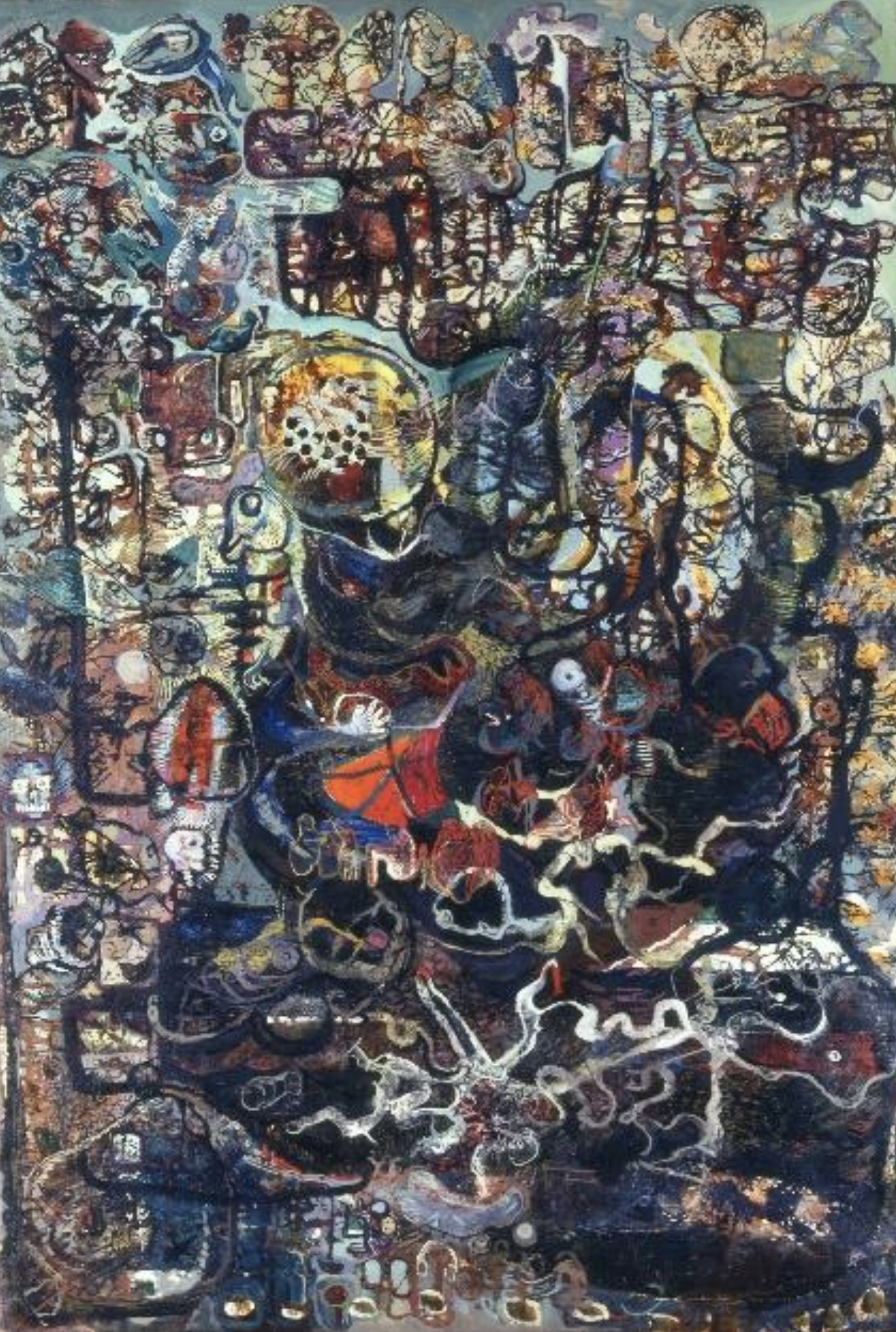
1 – Here first is the impressive Danse Macabre of 1946-47, which reflects the horrors of the war still burning like the Great Plague in the paintings and engravings of the 15th and 16th centuries that treated this subject. This tragic masterpiece, dominated by red and black, blood and smoke, one of Rozsda's darkest, is also one of the clearest examples of these figurative details that gradually emerge from the confused and entangled forest of forms and colors. Two skulls in the lower left quarter, one full face, another, more towards the center, in profile. A skeletal hand, right in the middle. Finally, on the right, a gangly skeleton that seems to dance a frantic jig. Perhaps snakes in the lower register, and in any case, a bird's head à la Chagall, dominating the two skulls, as if to leave a chance for hope. Tragic painting, symbolic too, like the works of the same title by Otto Dix or Claudel and Honegger; but I cannot help seeing something burlesque there, if only by the unusual figurative precision, here almost caricatural. And that's what makes me think that the famous, too famous, Danse Macabre by Saint-Saëns (1874) with that frantic and derisive trembling of the xylophone from the first measures, like bones clashing together, must also have inspired him.
2 – The Magic Flute, one of the works of 1969, is obviously a more serene painting. Can we recognize there, always in the details, some allusions to Mozart's magnificent testamentary opera (1791) which is at once a grand Masonic mass in an entirely symbolic Egypt, and a delightful popular comedy with the airs of a fairy tale, – but Richard Strauss said that such music could only have been brought to earth by angels? The painting belongs to what we could call Rozsda's "blue period", like The Eyes or Saphirogram. And blue is for him the color of Mozart's music, that of a beautiful spring morning. The composition, very complex, is marked by a set of vertical or slightly curved axes, perhaps the pillars of the temple, or the very "Age of Enlightenment" wisdom of the High Priest Sarastro. We also guess some Masonic symbols, like this candelabra hoisted to the top of the composition. Should we go further? See, in these two large forms facing each other, the very decomposed silhouettes of Sarastro and the Queen of the Night, symbols, which will reverse throughout the work, of Good and Evil? I'm not sure.
3 – Dating from the same period, Concerto for My Birthday refers to a very widespread form of classical music, opposing a solo instrument to the rest of the orchestra.
4 - The allusion to music is more readable in this other painting from 1969, Animated and Rhythmic. This is again a work from the "blue period", of complexity at least equal to that of the previous one but like it harmoniously ordered. There is a resemblance to The Magic Flute, with these two tall silhouettes facing each other, but the relationship that the title establishes with music is quite clear: the multiplication of vertical lines which often open into diamonds or explode into fans give the work an animation and rhythm worthy of a musical scherzo.
5 – Seven years later, Rozsda returns to his dear Mozart, but this new painting, entitled Sky for Mozart, falls under symbol rather than allusion. We find there, a little darkened, the Mozartian blue, but also white, ocher, red, in fine strips that could evoke piano keys, and above all a lot of white, the "silence" proper to painting according to Rozsda. And this profuse ensemble is animated by a vast rotary movement clockwise around a central octagon where white asserts itself. At the bottom of the painting appears clearly the Masonic triangle.
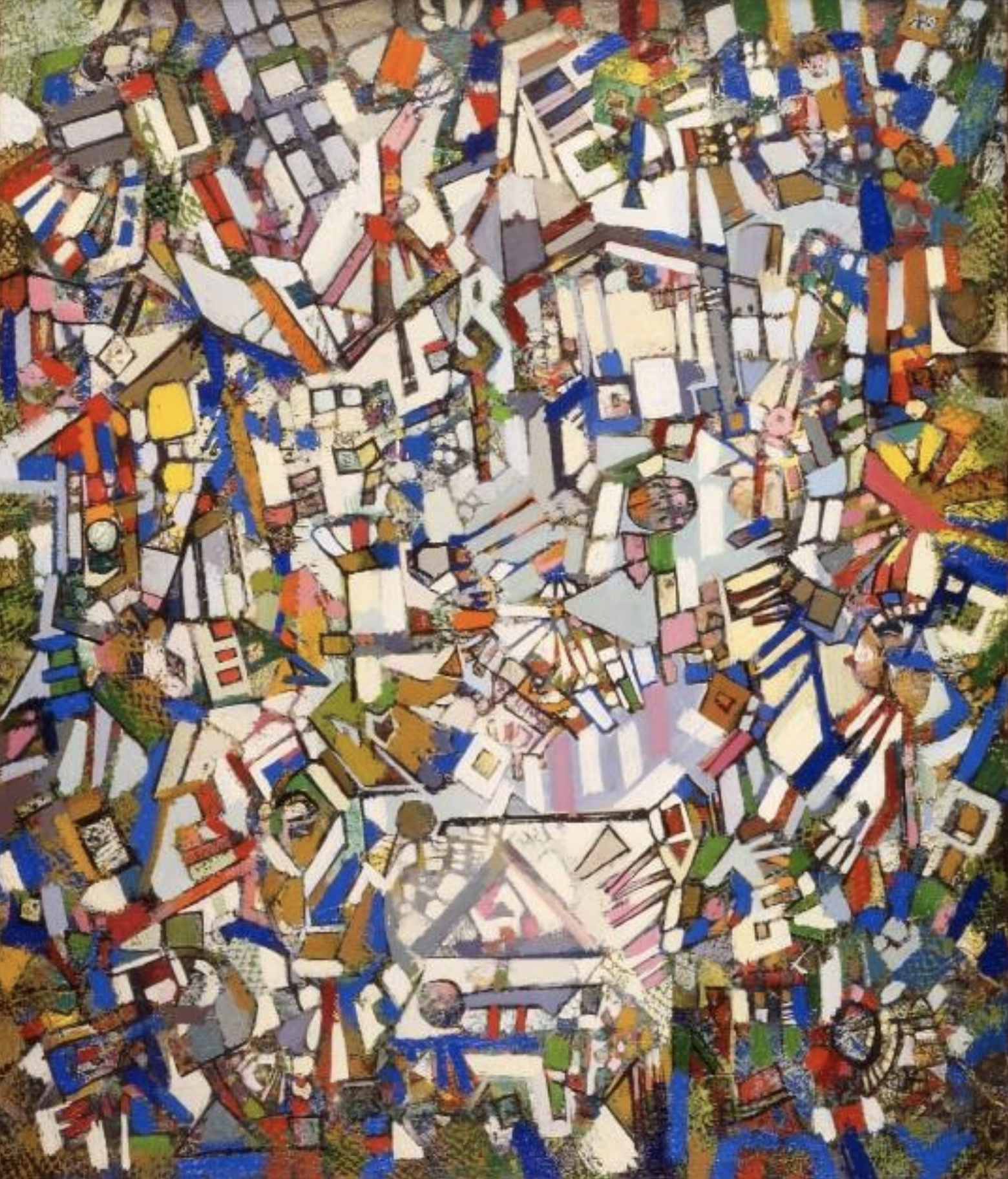
6 – From the same year, Homage to Stravinsky is, in my opinion, one of Rozsda's most sumptuous masterpieces. Here it's red that dominates, with a fulgurant intensity, barely contrasted by a little yellow and blue. Perhaps the scattered feathers of The Firebird, the famous score that reveals this Russian become Parisian and who triumphs at Diaghilev's Ballets Russes in 1911. But I especially believe that, like blue for Mozart, red is for Rozsda the color of Stravinsky's music and that he symbolically represents here the frenzy of the scandalous Rite of Spring of 1913, with its frantic and barbaric rhythms and the resplendent colors of its very rich orchestration.
7 – Bartók could not miss the call. Well, here he is a first time in this canvas, from 1976 always, entitled Song of Light for Béla Bartók. This "for" expresses the intention of fervent homage to the genius initiator, without precise allusion to one of his works. The composition where red still dominates, but this time aerated with white as in Sky for Mozart, seems to superimpose askew rectangles and diamonds which are as many small paintings in
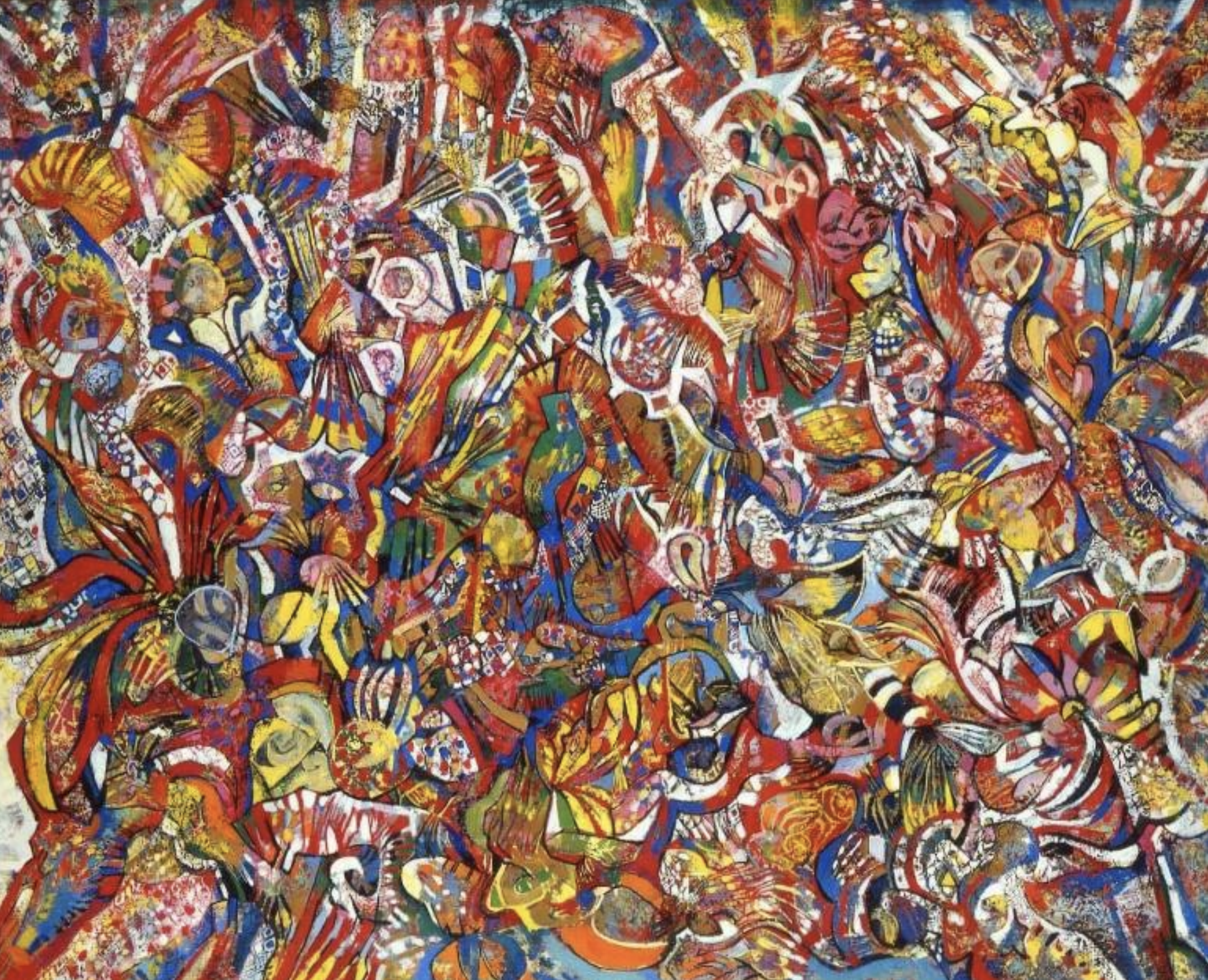
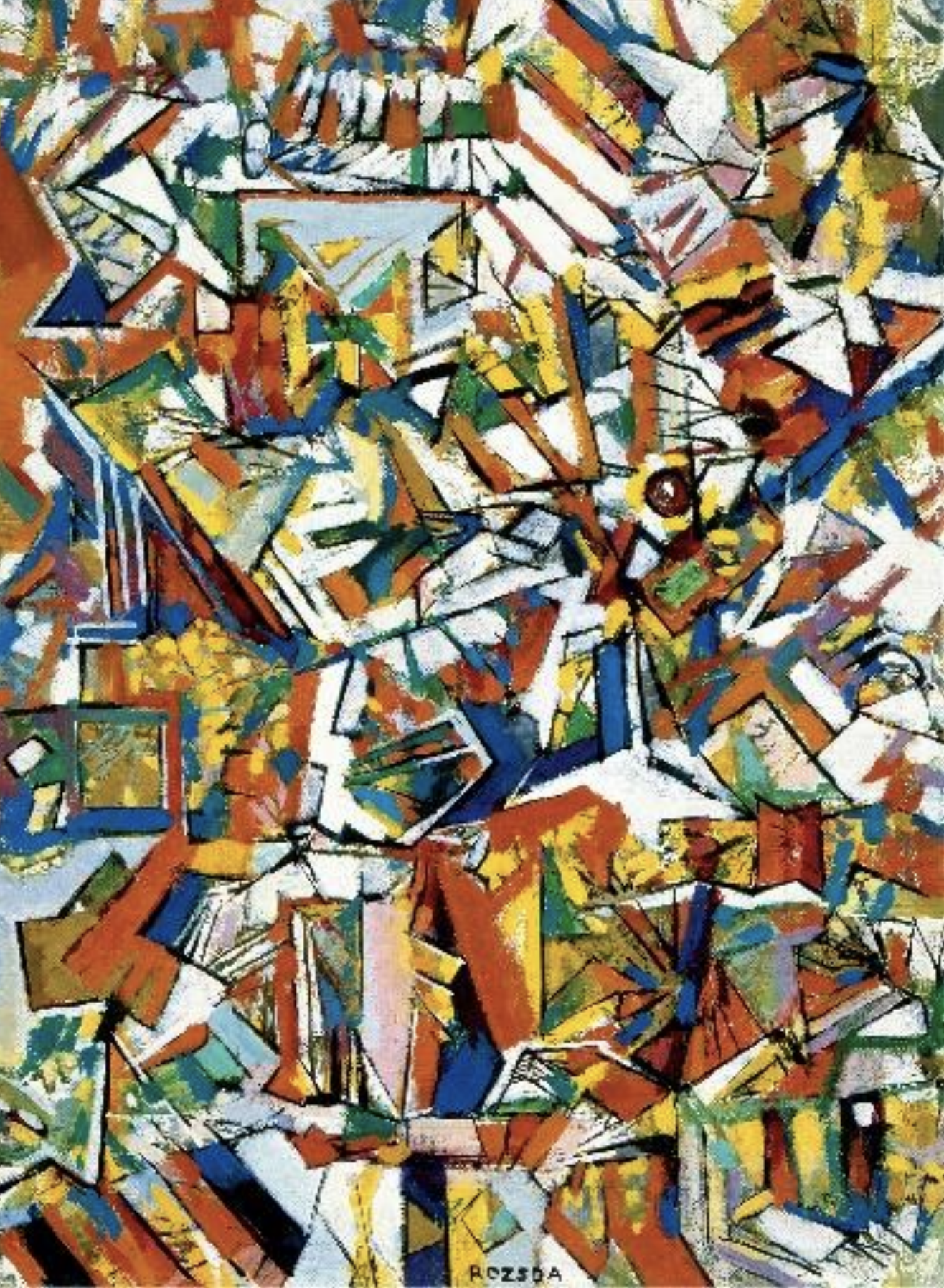
miniature, but very little figurative. Celebration, perhaps, of the genius synthesis operated by Bartók between elements from his initial training, Wagner, Debussy and especially his great compatriot Liszt, then elements borrowed, but very freely, from the folklore of Hungary, Transylvania and Romania that he had collected and studied during his young years, and finally revolutionary novelties in rhythm, with his odd and changing measures, in harmony – the famous second and seventh chords – and in orchestral timbres, with the important role of percussion, gongs, celesta, cimbalom and, I remind you, the piano itself.
8 – But the painting that most explicitly refers us to Bartók's work is of course Bluebeard's Castle, which obsessed Rozsda for so long. This unique opera by Bartók, completed in 1911, but refused as "unplayable" by the Budapest Fine Arts Commission, was only premiered in 1914 and its relative success was brief, because war broke out and the government of the time was shocked by the text as by the music. The beautiful libretto by Béla Balázs obviously draws inspiration from the popular tale widespread throughout Europe, but gives it a personal, oneiric, Freudian and poetic version. The dark colossus Bluebeard introduces his new wife Judith into the vast cellars of his castle. A creature of light and love, she believes she can save the dark soul of her husband whose darkness she barely suspects. But Bluebeard opens seven symbolic doors for her, that of his torture chamber (his sadism), that of his armory soon streaming with blood (understand his will to power), that of his treasure (the appetite for wealth), that of his secret garden, first flowered with tenderness, but which also becomes bloodied; then, on a sumptuous brass chorale, the door to the outside, opening onto his lands extending as far as the eye can see (his pride); a sixth door, the most pathetic, from which gushes a deluge of tears (his despair). There is only one door left to open, and it is Judith herself who must open it: it conceals his four previous wives. Judith persists in believing them still alive, but she must resign herself to her defeat and lets herself be locked up with them. "From now on, nothing but shadow... shadow... shadow" murmurs Bluebeard in a dying voice. I would have so loved to let you hear at least some extracts from this prodigious work! Alas, it would take too much time to give even a small idea of this fabulous kaleidoscope constantly changing and contrasted, but where the darkest colors of Bartók's orchestral palette dominate. And this is exactly what we find again in Rozsda's monumental composition, the largest he has painted and the longest carried and reworked.
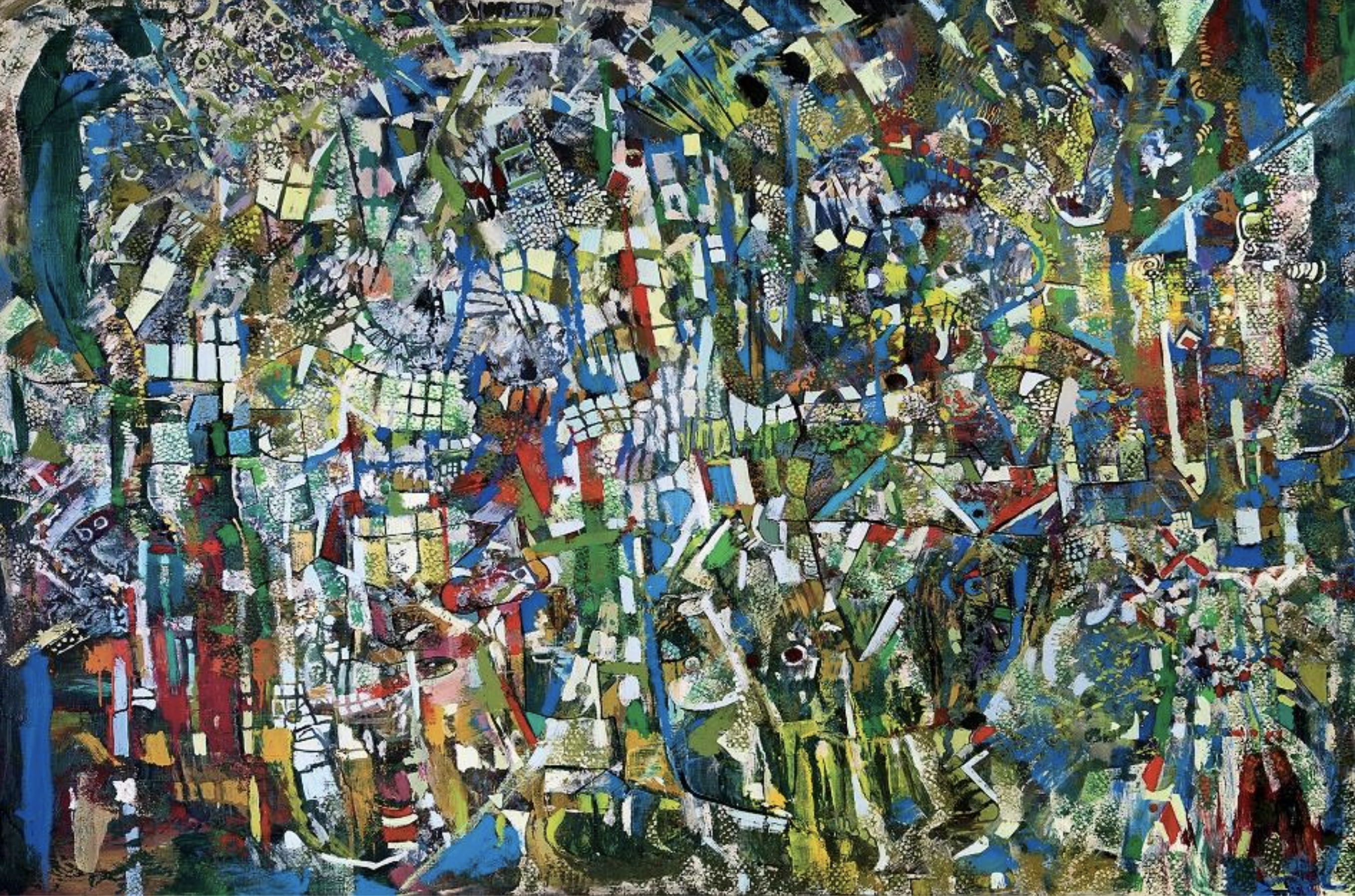
We guess, in the upper part, ogival vaults, perhaps also doors, barely two or three, but above all we are struck by the extreme diversity of colors used which perfectly responds to Bartók's orchestral imagination. An owl, in the lower left quarter, stares at us with his desperate eyes, he has Bluebeard's gaze. Perhaps we can see, once again, two tall silhouettes confronting each other around the white that asserts itself in the center of the painting, Bluebeard on the left with his heavy stature, and on the right, Judith, all light and sweet, all in curves. Perhaps...
9 – Finally, here is Mask and Bergamasque, from 1979. I have already mentioned the probable intertext of this painting. In this extraordinary proliferation of details, we can distinguish, of course, masks, numerous and diverse, perhaps also bergamasque dancers, this typical dance from the Bergamo region. We also see many rhyming effects, like that, so amusing, of the second verse of Clair de lune, in the forms and colors that sometimes respond symmetrically, but this falls under an interpretative approach, therefore necessarily subjective, but legitimized in advance by Rozsda himself. There you go. I have tried, very subjectively, I grant you, to illuminate this mysterious relationship of painting and music in Rozsda's work, which joins that, no less strange, of titles with paintings. I'm not sure I succeeded. May Rozsda forgive me! It seems to me that he has already done so in advance when he says to David, and I see his mischievous little eyes sparkling here:
Often, I think that instead of speaking a comprehensible language, I speak gibberish. As if I had thrown the key into a lake, and no one could decipher what is written.
I have doubtless not fished out this key, but I hope to have shown that painting like music, each with its own language, meet in the same quest, which is poetry, in the etymological sense of the term, creation. Creation of a world – or rather of a multitude of worlds, capable of rivaling the real world, and perhaps of consoling us a little for its disorders and sadness. And we, poets, with the instrument that is ours, language – a common good to all, but debased, ignored, an underestimated treasure, – we also try to paint pictures with our images, to compose music with our rhythms and sonorities, to make our words sparkle like a rediscovered treasure.