IN SEARCH OF THE BEYOND TIME: ENDRE ROZSDA AND THE FIGURE OF MARCEL PROUST
par Patrice Conti
March 1, 2015
In Search of the Beyond Time: Endre Rozsda and the Figure of Marcel Proust, by Patrice Conti, published in the digital journal Mélusine n° 1
This investigation (1) found its impetus in the title chosen by the curators of the retrospective of Rozsda"s work held in Budapest in late 2013: Endre Rozsda – Time Regained. Through this title, which echoes that of the last volume of Marcel Proust"s In Search of Lost Time, the exhibition curators had chosen to highlight the themes of time, memory, and remembrance that are at the heart of Endre Rozsda"s work and reflection. There was undoubtedly also the desire to celebrate the coincidence, within a few days, of the centenary of Rozsda"s birth with that of the publication of the first volume of the Search. The Rozsda retrospective was indeed inaugurated on November 18, 2013, exactly one hundred years after the artist"s birth, one hundred years also after the publication of Swann"s Way on November 14, 1913. Other clues seemed to legitimize an investigation into Rozsda"s connection to the figure and work of Marcel Proust. Rozsda mentioned the author of the Search in his interviews. His close friends and commentators report his statements about Proust"s work, the impression it made on him, but also the connection his mature work maintains with the great themes developed by the writer.
I have chosen to rely here mainly on a set of documents bearing traces of Endre Rozsda"s words. These are texts written and published by Rozsda in the 1960s and 1970s, interviews (filmed or published) conducted in the 1980s and 1990s, as well as an unpublished document written after 1975. These are therefore late texts, belonging to maturity, the moment when the artist takes a retrospective look at his entire work. This choice was reinforced by the fact that, as Françoise Gilot indicates, from 1957 onwards and in the following years, we witness in Rozsda "a fragmentation of sensory space whose progressive replacement by an existential and personal space-time certainly makes one think of In Search of Lost Time" (2). For his part, David Rosenberg (3) has shown that "memory and memories play a predominant role" in Rozsda"s work from the late 1950s onwards, and that the question of time becomes central in his work from 1969 onwards. In his text entitled "Meditations" (4), Rozsda compared himself to "the Fate who weaves the thread of time." In echo to this image, I would like here to pull threads to see how Proust, his figure and his work, could have captured Rozsda"s attention, and could also allow us to read his work and his creative approach. To do this, I will focus on factual evidence attesting to Rozsda"s interest in the writer, as well as some Rozsda themes echoing Proustian themes.
The "Meeting" with Proust, in a Dream
What about Rozsda"s interest in Marcel Proust"s work and figure? To find out, it is essential to go through the references contained in the writings and interviews available to us. The Rozsda studio archives house an unpublished typescript containing the account of a dream in which Rozsda meets Marcel Proust. This document is not dated, but could only have been written after 1975 since it mentions the Carte Orange, a monthly Parisian transport pass created on July 1, 1975. What is this dream narrative entitled "Meeting" about? Wanting to go to an appointment, Rozsda takes the bus. After being checked by a conductor, the passengers are invited to get off the bus. It is then, the text tells us, that:
At the first stop, I met a friendly face. It was Proust. Where had I known him? I couldn"t remember. He was leaning towards me to question me gently... coughing a little.
The text continues and ends thus:
Afterwards everything became softer, whiter. The wrinkles of the street were smoothed out. The worries flew away. Everything became pleasant, pleasant. – What was my appointment about? What did I want to discuss? – I can"t remember anymore. (5)
Here we find the opposition between an "appointment" and a "meeting." An "appointment," scheduled in time, which one anticipates by projecting oneself into the future so as not to miss it, and a "meeting" which, for its part, arrives without being expected. The meeting that Rozsda makes with Proust transports him into pure happiness. And this absolute happiness is then concomitant with a failure of memory (he no longer remembers the nature of his appointment) and an exit from what Rozsda calls elsewhere "clock time" (6). The erasure of the street"s wrinkles – wrinkles being the sign of the passage of time – indicates here the abolition of time, of a time conceived on the model of the linear succession of events.
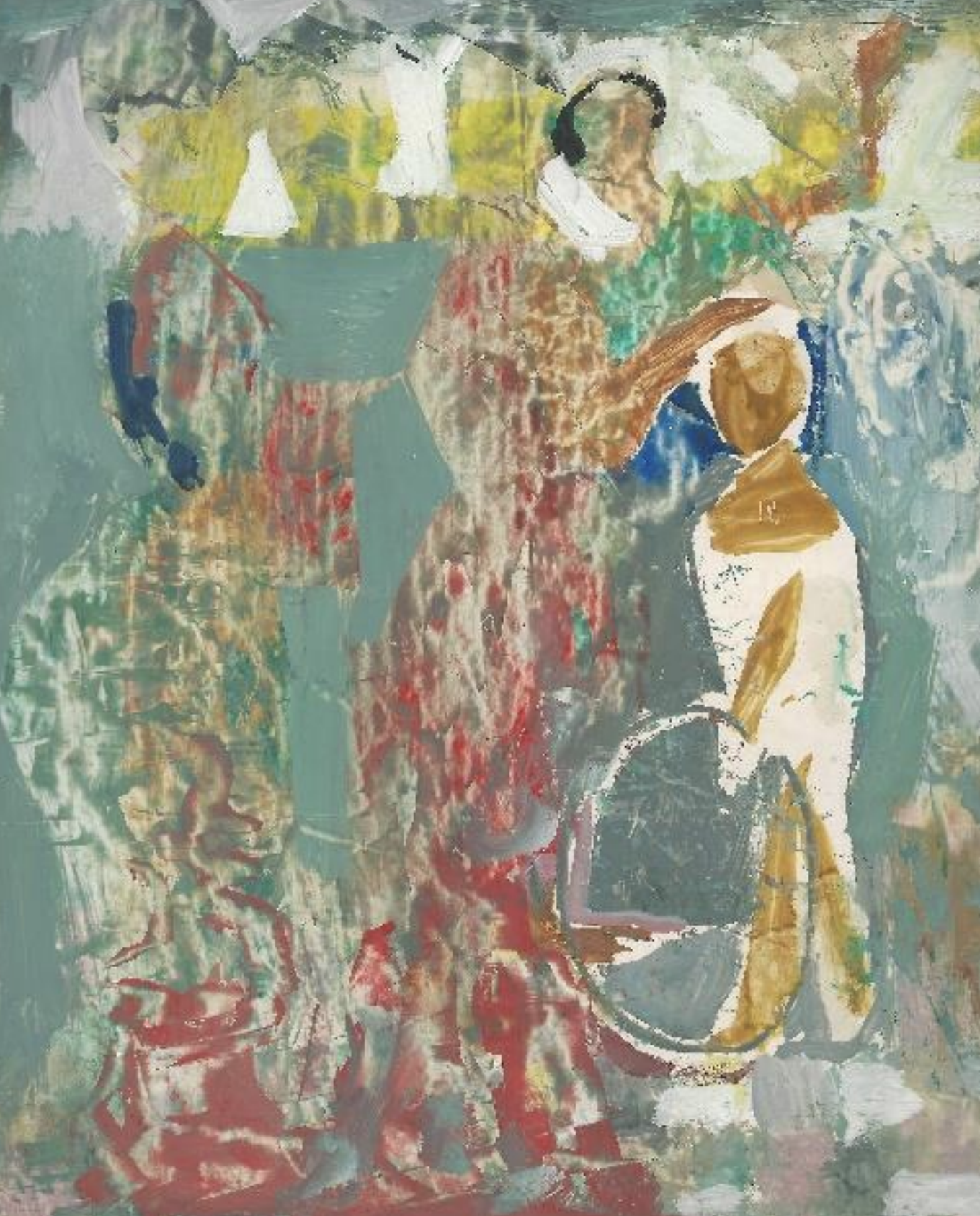
Meeting Proust through Reading
If Rozsda met Proust in a dream, he probably also met him through reading, as attested by two of his interviews. In the film dedicated to him by Andras Solymos (7) in 1985, Rozsda declares: "My own paintings allowed me to understand Freud and the writers I was reading: Proust, [...]Meeting" and the books preserved in his library attest to Rozsda's interest in Proust and his work. Additional information on this subject can be found in the 1987 interviews with David Rosenberg. In these interviews (12), after describing the transformation that the work provokes in its viewer or reader, Rozsda distinguishes between "false painting, banalizing, decorative" and "real painting." Rozsda then declares that he was never pictorially seduced by decorative art, but that he was seduced as a child "by everything that surrounded this superficial art." To illustrate this type of painting and what surrounded it, Rozsda then refers to the mondain painter of Hungarian origin named László (13). Rozsda then indicates:
Proust spoke of him. Proust lived among extremely refined people, and it was the height of chic to have one's portrait painted by [László] Fülöp.
As he indicates here, Rozsda discovered in Hungary this painter whom he admired in his youth. However, it is unlikely that the anecdote associating Proust with László could date back to Rozsda's youth. The association of these two names could more plausibly be linked to a late rediscovery of László's paintings. For example, in The World of Marcel Proust which Rozsda owned, in which André Maurois evokes "Countess Greffulhe, in whom Marcel Proust glimpsed the future Princess of Guermantes" (14), and where a portrait of her by László is reproduced. Rozsda then indicates how, seduced as a child by László's legend, he took this painter as a model. But he also declares having abandoned "this dream of a sixteen-year-old child to be László," and that "this ideal was supplanted by another ideal." The abandonment of his childhood dream of being a mondain painter is made in favor of another ideal leading Rozsda to what he calls here "real painting." The path followed by Rozsda is not without evoking the story of the narrator of the Search or the legend of Proust himself, both succumbing to the attractions of mondanity before finally withdrawing from the world to write. Rozsda's biography (15) attests, for its part, to the artist's withdrawal from the artistic scene from the 1970s onwards. Rozsda would then have withdrawn from the world as if to escape from "measured time," from "artificial time, which is a perfect fiction" (16) and to, in this way, devote himself fully to his work and creation.
Painting as Proust Wrote
I would now like to dwell on remarks by Rozsda that were reported to me by José Mangani. According to the artist's legatee, "Rozsda said: 'I paint as Proust wrote'" (17). José Mangani also pointed out to me during this interview that a parallel could be drawn between Proust's writing method and Rozsda's working method. Speaking of his "working method" in these interviews with David Rosenberg, Rozsda declares: "Now, I paint six to eight paintings a year. Each painting represents an enormous amount of work" (18). The change in method would have occurred in Rozsda after the Second World War. From this moment on, the execution of a painting absorbs Rozsda and takes all his time. The time of the work's execution sometimes stretches over several years, in the manner of a Proust devoting long years to writing the Search. But, as José Mangani suggested to me, a parallel can also be drawn between the paperoles added by Proust to his manuscripts, and the thickness of the oil layers superimposed one on top of the other, covering each day what was painted the day before, sedimenting on the surface of these paintings executed over several years. The paperoles are these long sequences of pieces of sheets glued by Proust end to end on the Search manuscripts. These paperoles contain modifications sometimes written with "an interval of several years" (19). Unfolded, they can reach up to two meters and manifest in space the time of writing. In Rozsda, the time taken by the execution of the work is then materially translated in the thickness, the superposition of layers of paint on the surface of the canvas. Thickness nevertheless invisible to the naked eye and which, as José Mangani then indicated to me, would require radiographing one of these canvases to be verified. As Françoise Gilot emphasized: "From 1957 onwards [...] the explosion of Euclidean space is an accomplished fact" (20). The lengthening of the work's execution time is therefore concomitant with the definitive abandonment of perspective representation. Depth then gives way in Rozsda to the superposition of layers of paint which wants to be a sign, an announcement of another depth, that of the thickness of time sedimented in the work. Just as Rozsda said he painted as Proust wrote, it is possible to say with J-B. Pontalis that, for his part:
[...] the Search [...] evokes the work of the painter who, layer after layer, repentance after repentance, although operating on a flat and delimited surface, manages, forgetting the preparatory sketches, to give to his canvas better than depth: the thickness of time. (21)
The Kaleidoscope
Françoise Py indicated that in Rozsda:
Time of the gaze, time of execution (sometimes several years), multidimensional time of thought militate in favor of a "perpetual present". (22)
We have just seen how, after the Second World War and more precisely still after 1957, Rozsda works on his paintings for several years. I would now like to focus on what Françoise Py calls here "time of the gaze," by relying for this on the theme of the kaleidoscope common to Proust and Rozsda.
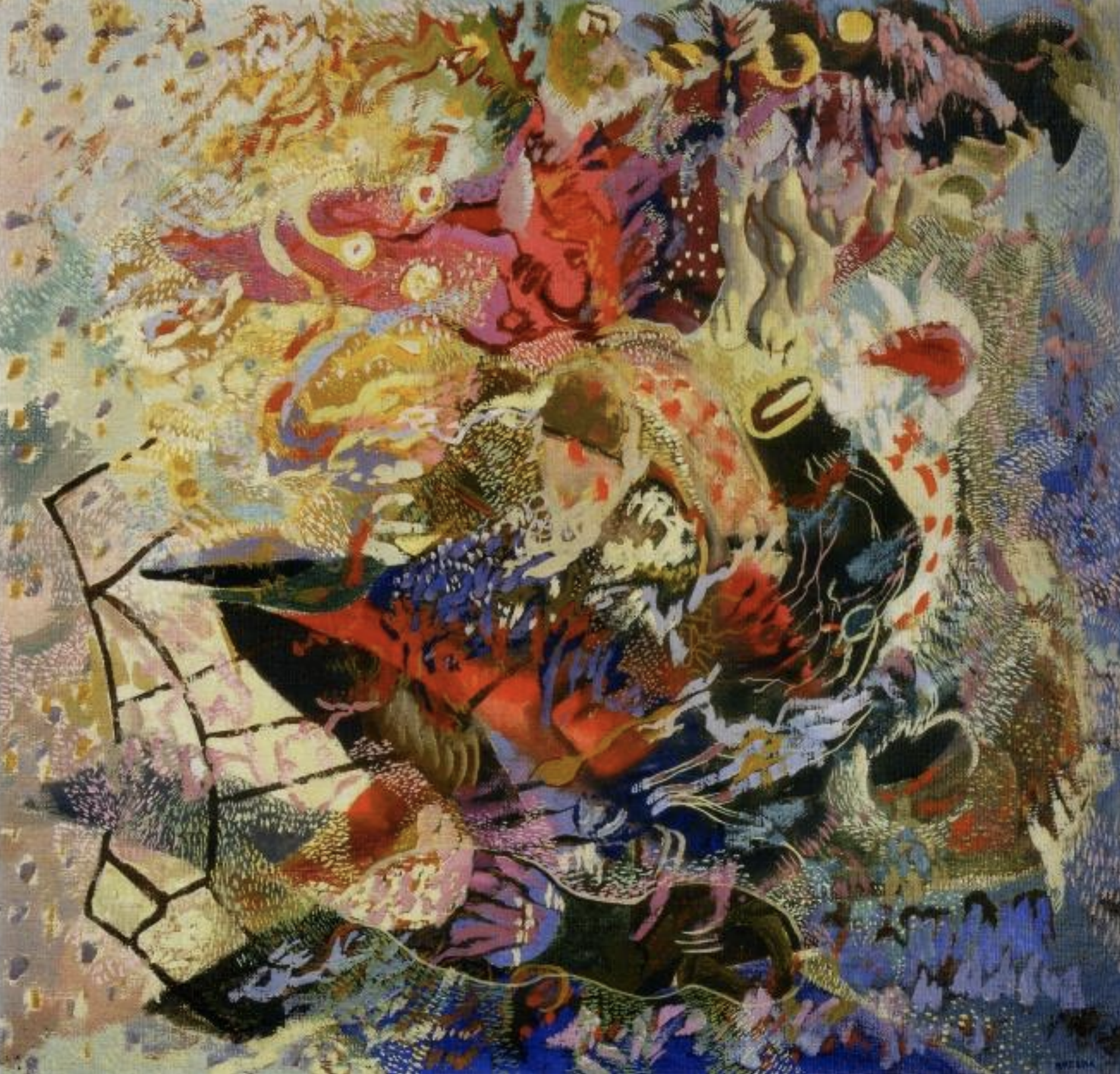
Rozsda did not speak of the kaleidoscope, but it is a theme often present in Rozsda criticism. Several commentators have discussed the kaleidoscopic aspect of his paintings. This is how, to cite only two of them, Édouard Jaguer declared "that this kaleidoscopic aspect cannot escape most viewers" (23), while for his part, Tamás Ónody emphasized the "deceptive character of this comparison" (24). The paintings of Rozsda's maturity, and in particular those of the last years, evoke the fragmented image of the kaleidoscope and, at the same time, depart from it by the absence of symmetry and repetition of the forms and colors arranged on the canvas. What could therefore account for the resemblance of Rozsda's works to the kaleidoscope? In his interviews, Rozsda indicates that from 1946 onwards he took the habit of turning his "paintings continuously until [he found] the side by which [he was going] to finish them" (25). And he links this practice to one of the experiences that led Kandinsky to abstraction. Kandinsky who understood that "objects" harmed his painting one evening when, returning home, he suddenly saw on the wall "a painting of [his] that had been hung upside down," a painting in which he saw at that moment only "forms and colors and whose content remained incomprehensible to [him]" (26). It seems to me that in Rozsda, the method of turning canvases could receive at least three meanings. First, the rotation movement described by the canvas on the easel, like that of the kaleidoscope, evokes, by analogy with the rotation of the hands on the clock face, the passage of time. And we could then imagine Rozsda turning the canvas counterclockwise, in order to rewind time. Then, following Kandinsky's model, the turning of the canvas and the rotation of the kaleidoscope cylinder give to see an image presenting new "relationships of forms and colors between them" (27). We could hypothesize that this practice contributes in Rozsda to produce this "troubled surface" on which, as he says in "Meditations," he can "start searching, groping, for a certain order which, degree by degree, modifies the previous order and creates another disorder" and, thus, "set out in search of time." Finally, as Sándor Hornyik has shown (28), the practice of turning the canvas during execution "partially annihilates the illusion of depth" and produces an effect of "disorientation." I would add that everything then happens as if the centrifugal force resulting from the rotation contributed to making the Euclidean space explode. One might be struck here by the resemblance of the themes identifiable in Rozsda's working method, with the opening of the Search. The book opens with the whirling of the narrator's dream visions who, during a sleepless night, explores the rooms of his childhood. The "hallucinatory experience" through which one enters the novel, this "opening in the confusion of space and time," thematizes, as Antoine Compagnon has shown, the "question of getting lost and recognition" (29). The same is true of Rozsda in whom, to the painter's disorientation during the execution of the work, responds the viewer's confusion who, contemplating the canvas, is led to identify, to recognize, to search, to orient himself. Rozsda's canvases present images that are at first glance non-figurative (some of which can moreover be seen in all directions), images that oblige us, as the painter invites us, to "find the path that leads to it and allows one to walk there" (30).
Photography
To this first movement of the wandering eye walking on the canvas in all directions is superimposed another movement, that of recognition and identification. Thus, stopping and focusing on a part of the painting, the eye can focus (31) and see emerge, only to disappear as soon as it resumes its journey, figures and memories from the thickness of the magma of forms and colors. Second movement that the viewer reconducts there again, for himself, on the model of what the painter experienced during the elaboration of the work because, as Rozsda indicates:
During the work, sometimes, a beam of light illuminates one of these masses that emerges from the penumbra. Faces from the past light up. (32)
This movement precisely describes the mechanism of accommodation of the eye allowing us to perceive clearly an object seen up close. This movement is also that of adjusting the focus of the photographic lens. Rozsda, painter and draftsman, was also a photographer. The rapprochement of the visual mechanism that allows us to recognize figures, to see memories or thoughts emerge in his paintings, with the optical mechanism at work in photography, will doubtless not have escaped him. And indeed, as José Mangani indicated to me:
What fascinated Rozsda was the appearance of the image at the moment of development. It's like a memory that came back up. (33)
Had Rozsda sensed in Proust the importance of photography and the possible correspondences between "the functioning of involuntary memory" and "the stages of photographic production" (34)? Brassaï, a photographer of Hungarian origin, will not hesitate for his part to emphasize:
[...] the deep affinity between the developer bath which restores an image from the past integrally and these other "developers" that are the madeleine and the cup of tea, the uneven paving stone, the starched napkin, the boot, the spoon hitting a plate, the book of François le Champi, all capable of making distant reminiscences appear. (35)
The Beyond-Time
This double movement of traversing the canvas, during which figures, thoughts and memories emerge, introduces painter and viewer to a time other than that of the chronological and linear succession of events. As the image of the walk or journey in time indicates to us, Rozsda conceives time in a spatialized manner (36), in the form of a space-time, a time that has incorporated the characteristics of space. In his interviews with David Rosenberg, Rozsda indeed declares that he evolves within what he calls a "global time constituted by the past, present and future" (37). Thus spatialized, time no longer presents the fundamental characteristic of irreversibility, and it then becomes possible to come and go within this "mixture of different times" (38). Conceived on the model of space, the time of which Rozsda speaks is therefore characterized by the simultaneous presence of all its different parts, and presents itself as a medium in which no privileged direction is distinguished.
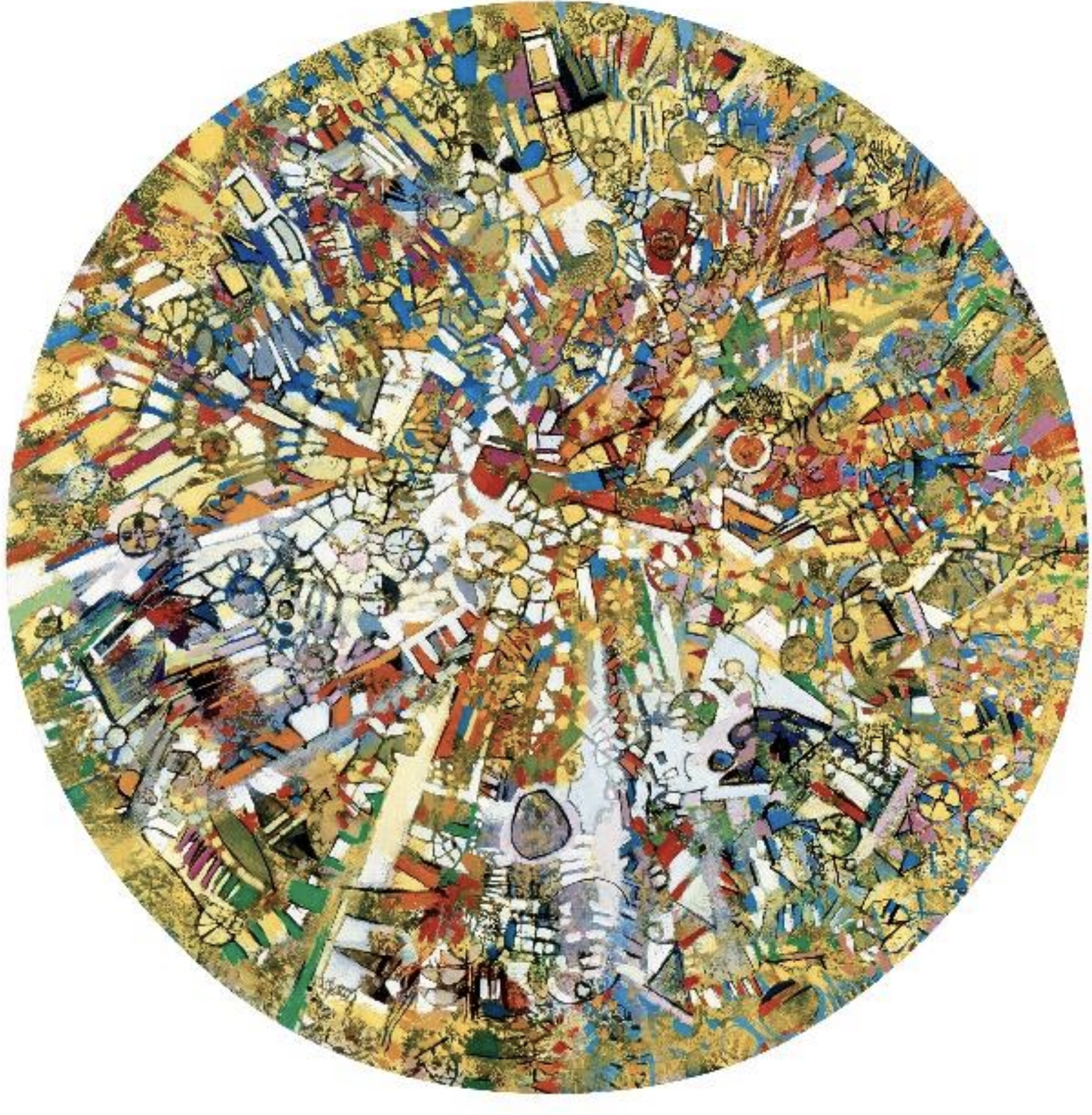
The paintings of Rozsda's last period seem to me precisely to be marked by this absence of privileged direction, by an absence of meaning assigned to the work by the painter. Rozsda indeed prescribes no order of traversal, the works of his maturity can be seen and traversed in all directions and all directions. These paintings also present no meaning, no final meaning that we could find behind what the painter gives us to see. Before his works, as Tamás Ónody has shown, "each of us receives projections from that other world that is his memory" (39). Through his method, Rozsda therefore opens his canvases to the plurality and infinity of meaning produced by subjective paths, by the paths that those who contemplate his paintings realize. Rozsda's painting gives us access to a space-time, a global time allowing comings and goings, movements within the different moments of time. The description that Rozsda gives of what he also calls "perpetual present" (40) is not without evoking the space of the dream which, too, mixes different times that the dreamer can traverse in all directions (41). Space of the dream where (I take up here the images used by Rozsda in his text entitled "Meditations") it is possible to "walk, as an adult, in a time where [one was] in reality a child" and to "awaken the dead." Armed with this working method, Rozsda manages to and allows us to open time and, leaving the course of time, to reach the beyond-time. Everything then happens as if, practicing a painting "based on the journey of memory in [him]" (42), painting allowing him to open onto the beyond-time, Rozsda found through the means of his art the results to which Proust and Freud had arrived for their part. Proust and Freud who, as Jean-Yves Tadié has emphasized (43), through involuntary memory and dream memory, arrived at a domain where there is no more time.
I will finish, as I began, by evoking Klôthô, the Spinner, the one of the three Fates to whom Rozsda identified himself in his text entitled "Meditations." Comparing himself to "the Fate who weaves the thread of time," Rozsda then made the distaff containing the fibers and the spindle that serves to spin the analogues of the painter's palette and brush. A painter who "jumps here and there, brush in hand, busy quickly fixing the past," who "weaves multicolored threads" from "cottony time," who weaves together the associative threads of his thoughts, of his memories that intersect infinitely to compose the canvas. The work in Rozsda then becomes similar to a fabric or, as in Proust (44), to a tapestry.
- I would like to thank the organizers of this study day, Henri Béhar and Françoise Py, for inviting me to present the first results of research on what connects Endre Rozsda to Marcel Proust. I also want to thank José Mangani. This work owes much to our exchanges, to the accounts of his memories, as well as to the trust with which he allowed me access to the archives he preserves and values. Finally, my thanks also go to Marc Kober who, like José Mangani, was kind enough to reread a preliminary version of this work.
- Françoise Gilot, "A Painter for Painters," Rozsda 100 – The Thread of the Fate, Budapest, Várfok Galéria, 2013, p. 23.
- Endre Rozsda: Time Regained. Retrospective, edited by David Rosenberg and Róna Kopeczky, Budapest, Hungarian National Gallery, 2013, p. 117 and p. 137.
- Endre Rozsda, "Meditations," Rozsda, the Eye in Feast, edited by David Rosenberg, Somogy éditions d'Art, 2002, p. 82.
- Unpublished, Rozsda Studio Archives.
- David Rosenberg, "Interviews with Endre Rozsda," Endre Rozsda: Time Regained. Retrospective, op. cit., p. 35.
- Endre Rozsda, documentary film by Andras Solymos, 1985
- David Rosenberg, "About Endre Rozsda," Endre Rozsda: Time Regained. Retrospective, op. cit., p. 17.
- I found traces of Albert Gyergyai's translations of Swann's Way and In the Shadow of Young Girls in Flower: Proust, Az eltűnt idő nyomában : Swann, Budapest, Grill, 1937; Proust, Az eltűnt idő nyomában : Bimbózó lányok árnyékában, Budapest, Grill, 1938.
- Unpublished interview with José Mangani (02/02/2018).
- Claude Mauriac, Proust by Himself (1953), éditions du Seuil, coll. "Écrivains de toujours," 1957; André Maurois, In Search of Marcel Proust (1949), Hachette, 1985; André Maurois, The World of Marcel Proust, Hachette, coll. "Tout par l'image," 1960.
- David Rosenberg, "Interviews with Endre Rozsda," op. cit., p. 23.
- Philip-Alexius de László de Lombos (1869-1937).
- André Maurois, The World of Marcel Proust, op. cit., p. 32.
- Cf. Róna Kopeczky and Borbála Kálmán, "Rozsda and His Time. A Backstage History," Endre Rozsda: Time Regained. Retrospective, op. cit., p. 69.
- David Rosenberg, "Interviews with Endre Rozsda," op. cit., p. 35.
- Unpublished interview with José Mangani (17/07/2017).
- David Rosenberg, "Interviews with Endre Rozsda," op. cit., p. 19.
- Marcel Proust Dictionary, Honoré Champion, coll. "Champion Classique Dictionnaire," 2014, p. 718.
- Françoise Gilot, "A Painter for Painters," op. cit.
- J-B. Pontalis, In the Margin of Nights (2010), in Literary Works, Gallimard, coll. "Quarto," 2015, p. 948.
- André Breton Dictionary, edited by Henri Béhar, Classiques Garnier, 2012, p. 899
- Édouard Jaguer, "Endre Rozsda, Archaeologist of the Gaze," Rozsda, the Eye in Feast, op. cit., p. 90.
- Tamás Ónody, "The Eye of God," Endre Rozsda: A Painter Photographer, Budapest, Hungarian Museum of Photography, 2004, (2nd edition, 2009), p. 17.
- David Rosenberg, "Interviews with Endre Rozsda," op. cit., p. 33. In the film Painting – Life. Endre Rozsda, La Sept-Arte, Metropolis, 1999, Rozsda declares about Erzsébet Promenade (1946): "This is the first painting that can be seen as it is, but it can be turned."
- I rely on the presentation and citation given by Dora Vallier in Abstract Art, Le Livre de poche, 1967, p. 67. Rozsda owned this work in which Dora Vallier (whose friend he was) compares Regards sur le passé (1913) to the Search, and maintains that Kandinsky in this account "tells his life in the manner of Proust," cf. pp.56-58.
- David Rosenberg, "Interviews with Endre Rozsda," op. cit., p. 33.
- Sándor Hornyik, "Sacred Love, Profane Love. Endre Rozsda and Surrealism of the 1940s," Rozsda 100 – The Thread of the Fate, op. cit., p. 52.
- Antoine Compagnon, Proust in 1913, Course at the Collège de France (29/01/2013) https://www.college-de-france.fr/site/antoine-compagnon/course-2013-01-29-16h30.htm (accessed 07/03/2018).
- Endre Rozsda, "Memories," in Endre Rozsda: Time Regained. Retrospective, op. cit., p. 77.
- I rely, for the distinction between global vision and focal vision, on an unpublished article by Claude-Luca Georges, "The Happy Contradiction of Endre Rozsda."
- Endre Rozsda, "Thoughts," in Endre Rozsda: Time Regained. Retrospective, op. cit., p. 151.
- Unpublished interview with José Mangani (17/07/2017).
- Marcel Proust Dictionary, op. cit., p. 766.
- Brassaï, Proust under the Influence of Photography, Gallimard, 1997, pp. 169-170.
- József Készman gave an analysis of the time of which Rozsda speaks, based on the artist's texts and statements, in: "The Dream of Time. In the Weaving of the Fates: a Painting Made of Time?!" Rozsda 100 – The Thread of the Fate, op. cit., pp. 66-90.
- David Rosenberg, "Interviews with Endre Rozsda," op. cit., p. 37.
- Ibidem, p. 35.
- Tamás Ónody in La Cause freudienne, Revue de psychanalyse, n° 39, 1998, p. 2
- Endre Rozsda, "Meditations," op. cit.
- I rely here on J-B. Pontalis, "The Season of Psychoanalysis," This Time That Doesn't Pass (1997), Gallimard, coll. "Folio essais," 2005, p. 17.
- David Rosenberg, "Interviews with Endre Rozsda," op. cit., p. 39.
- Jean-Yves Tadié, The Unknown Lake. Between Proust and Freud, Gallimard, coll. "Connaissance de l'Inconscient," 2012, p. 84.
- Cf. Marcel Proust Dictionary, op. cit., pp. 987-989.