CARL EINSTEIN AND SURREALISM
par Klaus H. Kiefer
May 7, 2016
Carl Einstein and Surrealism ‒ Between the Fronts and Above the Fray (Bataille, Breton, Joyce)
1. Philological Problems
While hoping to make myself understood in your beautiful language, I wonder if my expatriate compatriot, so difficultly repatriated, spoke French better than I do, since at the bottom of all the problems I will discuss lies language, whether maternal or foreign, and ultimately language always remains "foreign" to us. In this regard, let us also think about the language of literature and painting, barely translatable one into the other as Einstein had to finally recognize; let us also think about the "language of flowers" – and of bodies – that Georges Bataille studied in Documents directed by Carl Einstein[1]. National language marked and still marks the difference between European civilizations among which two fatal "clashes" occurred during our author's lifetime. Yet, in the context of the 20th century avant-garde, there were also other clashes no less hostile: for example, his "primitivism" presupposes – to quote Einstein – "the terrible shock of colonization" (Ger. BA 2, 401). But history doesn't stop there. I quote Einstein again: "Europe colonizes and Europe is colonized." (W 4, 286) Today it is terrorized...
Given the historical dynamism and complexity of relationships, research cannot be content with the biases of a single person, e.g., André Breton[2], to determine who is surrealist and who is not[3]. The list is floating and heterogeneous, we know; moreover there are "partial surrealists" and there have been some of all times. It's a whole "history of oracles" to use Fontenelle's phrase. Instead of deceptive interpreters, it's up to us to discuss, and in principle infinitely, what "surrealism" is... The methodological problem is the following: can one use a term created by an individual or a group as a technical and global term that always remains only a synecdoche, a part of the "impossible" whole.
2. Contacts – Multiple and Missed
After frequenting Paris since 1905, Carl Einstein settled there permanently in May 1928. Given this date, one cannot speak of emigration, and that's why specialists of "Exilliteratur" very often ignore Einstein, but he, like Walter Benjamin and quite a few other German intellectuals and artists of Jewish origin or "degenerate," already suffered in the 1920s from attacks by the Nazis who were preparing their seizure of power. In Paris, Einstein resumed his multiple contacts and enthusiastically pursued a project that he specified in August 1928 in a letter to Dr. Reber, industrialist and collector (of whom he was the advisor): Documents; to Ewald Wasmuth he says: "my journal"[4]! Unfortunately the genesis, rise and end of this legendary journal have been distorted, notably by its very collaborators, Georges Bataille and Michel Leiris, and their credulous followers although Denis Hollier[5] apparently reconsidered thanks to the research of Liliane Meffre[6] and mine. It was to Carl Einstein that Georges Wildenstein had entrusted the direction of the journal, and it was also Carl Einstein who marked it with his aesthetic and ethnological imprint, including his "ethnology of the white man[7]". Apparently, conflicts with the young wolves of the "Documents" team, such as Bataille, made him retreat, and it was Wildenstein who suspended funding in the face of the economic crisis. So, contrary to what Leiris insinuated, Bataille neither "made" nor "unmade" Documents[8].
The question arises too quickly: was Documents a surrealist journal[9]? According to my preliminary reflections, it's not a question of yes or no. Without any doubt, its scope was on the one hand broader, more academic, therefore less "revolutionary" in appearance; on the other hand, Bataille's "materialist" dissidence was becoming increasingly noticeable, so that Breton feared losing the "copyright" of the movement. It's therefore a war on three fronts: Einstein versus Bataille, Bataille versus Breton and Breton versus Einstein. A fourth front will be added later.
Yet, everything had started so well. It was, at the latest, upon his arrival in Paris that Carl Einstein sent a copy of his Negro Sculpture to rue Fontaine, dedicated: "To André Breton – courageous colleague who leads his friends far[10]." (ill. 1)
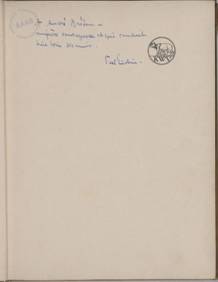
But Breton did not deign to respond to this contact, although he had obtained, we don't know when, the Europa-Almanach, moreover bilingual[11], edited by Carl Einstein and Paul Westheim in 1925, which counted among its contributors nine "surrealists",[12] surrealists before the letter since the preparation of the yearbook had begun much earlier than the "official" foundation of the movement which coincides with the first "Manifesto".[13]
Nico Rost testifies that Carl Einstein knew the first issues of the "Surrealist Revolution" which appear from December 1924. We can believe that he also knew the first Manifesto, published a month earlier, although Einstein only "cites" it in his "ethnological study" on André Masson in 1929 (in Documents) perhaps on the occasion of the second edition: "It is with great timidity that we begin to appreciate the imaginary as dominant." (BA 3, 26) which echoes Breton's reflections:
It is by the greatest chance, in appearance, that a part of the intellectual world was recently restored to light, and in my opinion by far the most important, about which one affected to no longer care. [...] Imagination is perhaps on the point of regaining its rights. (OCBr 1, 316)
Why is this approach rarely explicit in Einstein? In the famous letter to Daniel-Henry Kahnweiler of June 1923, where Einstein sketches his "cubist" aesthetics (to apologize for a bad commercial maneuver) he is always in search of "psychic equivalents" (EKC, 48 = Ger. 139) in order to anchor art in social life. Breton's idea of an "interference" (OCBr 1, 318) between dream or madness and the waking state, fruit of his discovery of Sigmund Freud, was apt to explain the production of non-imitative and protean works in Picasso, Braque and others. "To repeat or invent – one had to decide." (K 3Me/St, 95 = Ger. K 1, 56) writes Einstein in "The Art of the 20th Century". His affinities with "the romantic generation" – we will see – will multiply, but also differentiate[14].
Regarding Einstein's proximity to surrealism, I add a little-known anecdote. Returning from London (probably) via Paris, Einstein had visited Joan Miró's exhibition (whom he knew well) at the Pierre gallery in June 1925. Let's quote a contemporary review: "The two rooms of the archipleines gallery had overflowed into the street. Champagne was being drunk on the sidewalk. All the surrealists were there [...]",[15] followed by the names of Aragon, Breton, etc. Einstein personally named figures among the 500 visitors; yet we don't know if the surrealists and Einstein greeted each other.
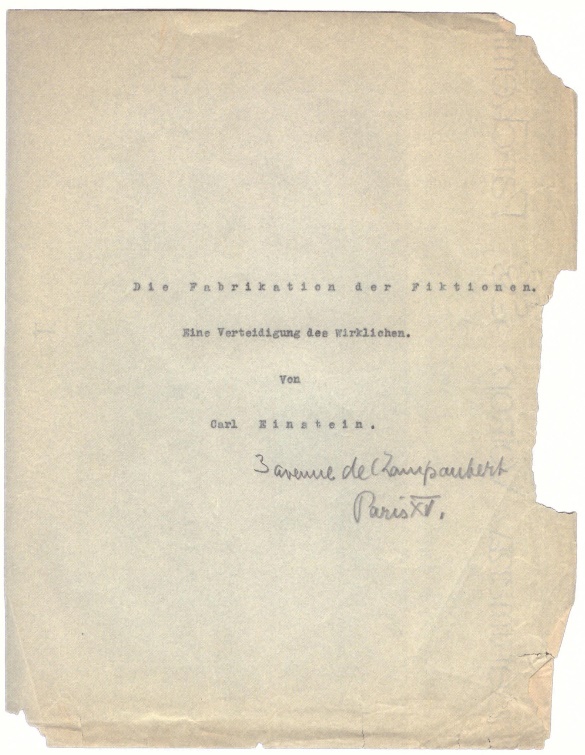
Einstein, who, in 1926, had the audacity to decree what 20th century art would become in the wake of revolutionary cubism, had been enthusiastic since the early 1920s for an artist on the sidelines whom the surrealists only discovered as one of their own three years later: Paul Klee. How could the fervent partisan of cubism that Einstein was at the time appreciate this "prodigy child" ("Märchenknabe")?[16] Yet, it is precisely the creative imagination dear to Breton that makes in Einsteinian reflection the missing link between the antipodes Picasso and Klee[17], between cubism and surrealism. Yet neither the monograph nor the article on Klee planned for Documents were realized, but it is fascinating to see how, in the three editions of The Art of the 20th Century, Einstein's commentaries on Picasso and Klee compete to arrive at what should be, according to Einstein, the "leading" aesthetics of the 1930s. Yet, the dating has a fatal meaning since the National Socialist regime calls into question modern art; Goebbels had declared himself "expressionist" in his autobiographical novel Michael. Einstein, exiled from one day to the next, then makes a clean slate of the entire avant-garde, including surrealism of course. His "Fabrication of Fictions" is a furious polemic against avant-garde artists and intellectuals who had not known how to face triumphant fascism. This attack amounts to a veritable "suicide" since it was indeed he, Einstein, who had "made" 20th century art, that is, he had contributed remarkably to its international success.
Nonetheless, one recognizes in this posthumous and little-known work a common ground with Einstein's "surrealist" writings, in particular his "Georges Braque" (ill. 2) which appears in 1934 in French translation and with the critical remark "written in 1931-1932".
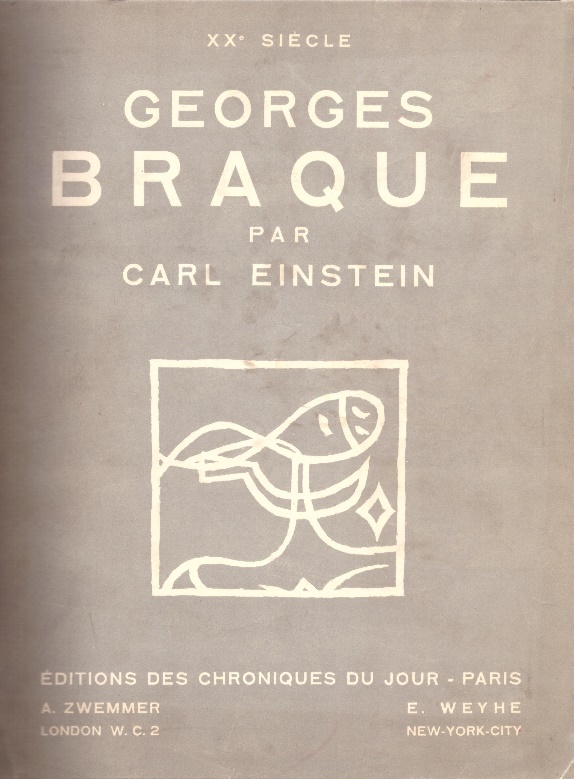
So the author distances himself from his own work too "idealist" and "subjective", and the "Fabrication of Fictions" elaborated no doubt after 1933 and before Einstein's departure for Spain during the summer of 1936 to fight against fascism alongside anarcho-syndicalists (ill. 3), in the famous Durruti column, appears as a dialectical negation of the avant-garde.
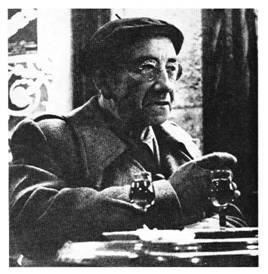
Unfortunately it was not given to the author to form a synthesis, although the idea of synthesis was not at all in the taste of the critic, always "at the head" of movements, as his friend Benn wrote later[18]. Einstein, released from the Bassens camp in 1940 with the approach of German troops and the Gestapo, committed suicide shortly after in the Gave du Pau. It is possible that he tried to reach the Côte d'Azur, still in the free zone, either to join his brother-in-law Gabriel Guévrékian, the architect of the famous cubist garden of the Noailles villa, who had settled in Saint-Tropez, or in the hope of taking the last boat from Marseille to the United States.
3. Theory – Texts – Images
Despite his efforts to mark 20th century art with his imprint, even to "direct" it in the good path of Picasso or Klee, Einstein did not have the ambition to found a "school" although he liked to surround himself in his Paris studio with artists, intellectuals and young people, such as Michel Leiris, who speaks of him in his Journal[19], and Georges Bataille, who on the other hand says nothing about it. Leiris, Kahnweiler, Masson, Klee and others discuss and approve Einstein's ideas[20]. He shares with André Breton the knowledge of the greatest part of avant-garde painters and sculptors, of whom I content myself with citing, among others, Hans Arp, Juan Gris, Picasso, and Masson and Miró already named, to whom he devotes profound studies in Documents. Yet, it is an integral "surrealist" aesthetics that Einstein elaborates in his Georges Braque. Despite this title, it is not at all a "book about Braque", as Einstein himself confesses to Wasmuth in 1932 (Ger. DLA). Why this misleading title which prevented precisely from taking knowledge of this book, moreover badly translated into French? Certainly, Braque was an intimate friend of Einstein, witness to his marriage with Lyda Guévrékian in 1932, but perhaps the provisional titles to which Einstein alludes in his letters, "Reflections" or "Aesthetics",[21] appear too vague for the publisher in the manifest economic crisis of the early 1930s. (Other French and English publishers flatly refuse his projects; the American version of "Georges Braque" will not appear because of a fraudulent publisher.)
Indeed, one finds in Georges Braque a problem of Einsteinian writing since Negro Sculpture: the lack of concrete, analytical relationships between text and image. In Georges Braque, the artist is only an example for Einsteinian ideas based of course on a rich aesthetic experience. As much as one can consider Negro Sculpture as a cubist manifesto, Georges Braque would be akin to a surrealist manifesto. I don't doubt that it is painful for some specialists of surrealism to see that the most elaborate theory of contemporary avant-garde is not found in Breton and his friends, but in Carl Einstein, and certainly not in Walter Benjamin whose contribution to the interpretation of the movement in question appears largely overestimated.
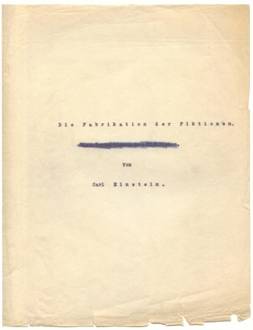
Yet Einstein only speaks of surrealism, in Georges Braque and elsewhere, in a rather contemptuous way: "Wort von verkrachtem Idealismus übersonnt" (BA 3, 324) which has posed quite a few problems for French translators. I quote Jean-Loup Korzilius: ""surreal" (term sunned by a failed idealism)" (GBKo, 86; cf. GBZi, 70). In agreement with Kahnweiler, Einstein blames the "Kasernenorganisation" (EKC, 159 = Fr. 75), the "military discipline" of the group, and still mocks in January 1939, in a letter sent from Spain, what would be well "sur" or well "sous" reality (EKC, 107).[22] Let's note in this context that the subtitle of "Fabrication of Fictions", crossed out in some of the preserved copies (ill. 4), is "A Defense of the Real" (ill. 5), where the word "real" of course alludes to "surreal".
Where it would have been necessary to say "surrealism" justly, Einstein frequently replaces the word with a term forged by him: "romantic generation", and he even conceives a "romantic interval" in the political tendencies of the time. "Georges Braque" concludes with a surrealist credo par excellence: "The myth has been reintegrated into the real, and poetry becomes the original element of reality." (GBKo, 164).[23]
The awakening must have been terrible if one reads this passage and quite a few others in the light of the events of 1933 and following. I quote another passage from the last chapter of Georges Braque which appears as a "bad message" (title of Einstein's only drama of 1921):
The romantic accentuation of the irrational implies a regression towards a primitive state and even, if one wants, towards a state of barbarism. Finally we no longer content ourselves with sublime deductions and an excessively cultivated superstructure which excludes the fundamental forces of man and events. A need for destiny and obsession carries us again. (GBKo, 164)
From this point of view, the aberrations of a Benn or a Heidegger in the face of National Socialists seem less surprising. Einstein's "we" is fatal, but it is still before 1933 that he took his distances from the biologism ("medizinerei")[24] of his Berlin friend while considering at the same time the philosopher's recent publication, "Vom Wesen des Grundes"[25], as a word game empty of meaning. But did he really avoid the ideological trap with his appeals to intellectuals and artists to submit to political "constraints" – too vaguely defined as "mythical" or "totalitarian"? There too, the "Fabrication of Fictions" is rather a continuation of Georges Braque than a well-intentioned rupture[26]. The attempt to assert grandiose and "Latin" fascism against stupid and "Nordic" Hitlerism on the occasion of the Paris exhibition of Italian art in 1935 – a year after Benn's famous welcome speech on "his excellence" Marinetti (SW 4, 117ff.) – reveals all of Einstein's dilemma.[27] He had no choice but to leave for the anti-fascist armed struggle in Spain – and, I quote him, – "without saying a word" (EKC, 106). It's up to us to discuss to what extent the "collective myth" (OCBr 2, 439), whether romantic or communist, propagated by Breton still in 1935, is involved in this sinister horizon. Couldn't one suspect European dictatorships, including the Soviet Union, of having done in their way what the surrealists and Einstein only dreamed of? The myth was not liberating – "the myth lied" ("die Mythe log", SW 1, 205), thus "spoke" Benn in 1943, and let's remember Fontenelle...
Alongside "myth", there are a good dozen other keywords of surrealism such as, for example the famous "psychic automatism" that Carl Einstein appropriates. These words too are most often translated by Einstein into German and integrated into his own discourse which however evolves in a different direction than that of the surrealists, that is, towards an integral cultural history, leaving polemics aside: the aggressor places himself above the fray. Through this transfer, the keywords of the surrealist movement obtain a broader, universal dimension[28]. "The art of the 20th century [therefore not only surrealism] has been dominated by passive automatism." (FF, 140) In an analogous way, the rather dilettante discovery of Negro art in 1915 had led to the revaluation of all primitive arts, that is, a rupture with the classical canon. This reversal is reflected in Dr. Reber's collection where Picassos neighbor with Cycladic art works: "Reber considers modern art sub specie aeternitatis." (BA 3, 122) There was already, the entire thematic range of Documents.
Thousands of notes, drafts, presentations, both in German and French, are found in Einstein's so-called "Parisian" fund, hidden at Braque's during the Occupation. Neither the "Art Manual", with a "Dictionary of Technical Terminologies", nor the "History of Art" nor the "Treatise on Vision" were realized. It goes without saying that Carl Einstein, who disappeared at the age of 55, still had much to say. – Let's return to the revealing example of surrealist discourse, that of psychic automatism (OCBr 1, 328) to highlight the Einsteinian definition. He agrees to elevate automatism "to the rank of essential means [but not absolute!] of research and invention" (K 3Me/St, 199 = Ger. K 3, 124) and, like Breton, he judges risky, even masochistic, what Baudelaire already evokes in "The Flowers of Evil": "To plunge to the bottom of the abyss [...] to find something new" (OCBau 1, 134). For Einstein, the artist traverses nolens volens this "drama of metamorphosis" (BA 3, 223) and returns to the "surface" of consciousness, so to speak, thanks to tectonic censorship; he creates a "Gestalt" and by that can communicate with the public. Einstein unites in the term "tectonic censorship" the influence of his former art professor Heinrich Wölfflin and Sigmund Freud, this "old romantic" (BA 3, 643), to whom he reproaches his negative attitude (BA 3, 382) not only towards the unconscious full of repressions, therefore of misfortunes, but also towards censorship itself which installs or reinstalls the reign of conventional logic in an innovative dynamism[29].
Let's move from art theory to Einstein's literary practice through a term no longer created by him, but defined in his way: that of "psychogram" (in French and German); synonym of "spontaneous writing" (BA 3, 27), therefore very close to psychic automatism. Breton did not limit, it is true, this mental function to a particular art (OCBr 1, 328); in Einstein however the component "gram" which means "graphic" even "literal" is noticeable since writing uses on the one hand arbitrary signs,[30] that it uses, on the other hand, to control the influx of hallucinations. The psychogram therefore describes a dialectic between "formless" and "tectonic", between "Dionysian" and "Apollonian" to use Nietzsche's famous opposition. From the start Einstein declares Braque "poet".[31] On the other hand he polemicizes against proper poets who "limp [...] lamentably in the wake of painting" (EKC, 48 = Ger. 139). In his letter to Kahnweiler of 1923, already cited, Einstein himself declares himself confirmed by the cubists in the writing of "Bebuquin" which is born at the same time as the "Demoiselles d'Avignon".[32]
Then two questions arise: (a1) Should one speak in his case of cubist texts or surrealist texts? and (b1) what is Einstein's own literary style? Of course these two questions are badly posed. It's better to transform and restrict them. Let's first leave aside "cubist" literature which would lead to endless reflections, to arrive at the appropriate question (a2): what exactly does Einstein reproach surrealist poets and writers? And (b2) are there authors to whom one could associate Einstein, whom does he resemble? One could add two additional questions: What are the colleagues he esteems? In what milieu is he himself esteemed? To be brief, I limit myself to around 1930 since young Einstein's admiration for French literature and especially for André Gide is too vast. First of all, one must take into account what I have named "visuelle Wende" on the occasion of the Carl Einstein colloquium in Munich 2001.[33] This "iconic turn" of the young literary critic that Einstein was into art critic is explained thanks to the rise of cubist painting which had taken the lead of the avant-garde. Certainly Einstein must recognize that the material of plastic art is more "flexible", more "prompt" to innovation; yet he reproaches poets and writers – I return to question (a2) – for too much respecting grammar, for being slave to language which imposes its structures, its hereditary mass, its mortifying power. ("Lingua" is a leitmotif of "BEB II".[34]) One remembers how much Breton respected syntax throughout his life: "[...] I am extremely wary of everything that, under color of emancipation of language, prescribes rupture with syntax."[35] The only surrealist poet that Einstein names in The Art of the 20th Century is Benjamin Péret whose Le Grand Jeu he appreciates as "the most audacious enterprise" (K 3Me/St, 202 = Ger. K 3, 126) of the group.[36]
Yet, grammatical deviance is a bad criterion for judging the value of a literary work. Ungrammaticality, particularly regarding syntax "errors", is not the same in all languages. Without doubt French tolerance on this subject is rather weak compared to Germanic languages. In any case, there is an author on the sidelines of French surrealism whom Einstein appreciates without reserve, which is rare; it's James Joyce. Indeed, the only fragmentary sequel of Bebuquin published during the author's lifetime and whose title L. Meffre doesn't even dare translate the provocative "Schweißfuß klagt gegen Pfurz in trüber Nacht" (which gives approximately: "Infected foot complains of Fart in the dark night")[37] resembles Ulysses or even Finnegans Wake in particular by the use of interior monologue, mythical allusions, word games, etc.[38] One cannot speak of influence since Einstein ignored English, and Finnegans Wake was still a "work in progress",[39] but the text appeared in several issues of the transition journal edited by Eugène Jolas, Einstein's friend and great admirer of Joyce[40]. Given the trilingual Jolas's enthusiasm for Finnegans' experimental writing[41], it is unimaginable that the two colleagues did not discuss Joyce's prose exhaustively during their meetings in Paris or Colombey-les-deux-Eglises where Jolas lived. Jolas not only adores German romanticism, but also linguistic experiments since expressionist "Wortkunst" and Dada. He writes himself texts that one could qualify as surrealist, "paramyths" full of often multilingual neologisms and grammatical transformations and he translates Bebuquin (chapter VI),[42] "Design of a Landscape"[43] and other texts by Einstein for transition.
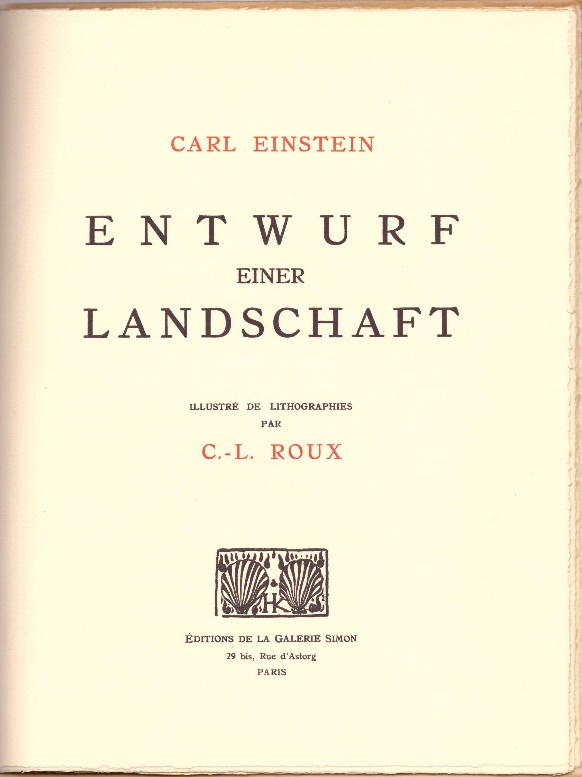
From 1927 the surrealists grant him the translation of a good number of their works so that "transition" – I quote Jolas – "became mistakenly known as the American Surrealist review".[44] On the other hand, relationships between Joyce and the surrealists were nil, even hostile.[45] So there is a fourth front opened by James Joyce against the entire surrealism. Jolas as reporter and editor is necessarily more generous: "I was a friend of some of the Surrealist poets and artists, but I never was an official adherent of their principles."[46] He believed he could distinguish his "white romanticism" "vertigralist" from Breton and his friends' "black romanticism". – Einstein, for his part, remained for Jolas always an "Expressionist writer".[47] To designate the Einsteinian style, it's a compromise at least debatable. Although Einstein had taken his distances from his expressionist colleagues – "lyrical shouters" ("lyrische Schreihälse" (BEB II, 35) – one cannot neglect this heritage. I would like however to characterize Einstein's "long poem"[48] "Entwurf einer Landschaft" (ill. 6, "Sketch of a Landscape") published by Kahnweiler in German in 1930 with a word that the author attributes to Benn in his benevolent critique made two years earlier: "hallucinatory egotism" (Ger. BA 2, 504).
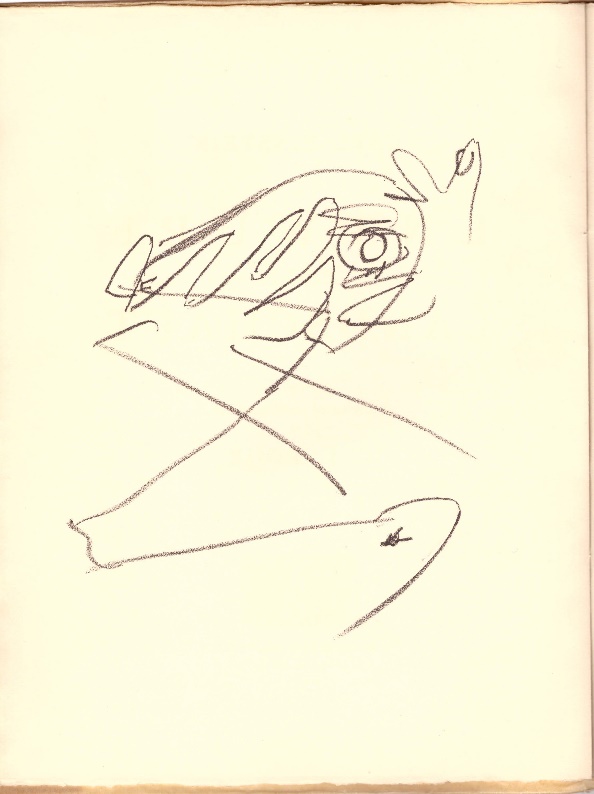
Is this surrealism or not? (ill. 7)[49] But one must bring Einsteinian prose closer to Joyce's side. Where he deforms and fragments, one could speak of "cubism" – Kahnweiler[50] does it –, but the barrier of plastic genre is even higher than that of language.
When the economic crisis and the Third Reich closed all doors to the exile, Einstein had to resign himself; he notes on February 18, 1933: "[...] I will never be at home in French poetry; for I dream and reason in German." (Ger. CEA) His mother tongue is missing to him "like bread".[51] Einstein never declared himself surrealist, and certainly he did not have Dalí's ambition to be "the most surrealist surrealist",[52] but as art critic and theorist he has assimilated as well, then transcended cubism as surrealism, so that one could well erect him "sit venia verbo" as "sur-surrealist"... B. J. Kospoth affirms: "People who are mystified by some modern books and pictures, such as James Joyce's 'Work in Progress' and Georges Braque's [surrealist] paintings, are advised to study Carl Einstein's philosophy of art."[53] "Georges Braque" and the unfinished works of the 1930s, and even the self-critical "Fabrication of Fictions", elevate the innovative provocations of the surrealist movement to the level of a general aesthetics, based on ethnology. So Einstein was neither surrealist nor rebel or dissident of surrealism in the narrow sense – which would presuppose moreover an "orthodoxy" –, he was simply "at the head" of the intellectual and artistic avant-garde of the 20th century to use Gottfried Benn's phrase.
Ludwig-Maximilians-Universität München
Abbreviations and sigla Ger. = German
BA 1, 2, 3 = Carl Einstein : Werke. Berliner Ausgabe, 3 vols., ed. by Hermann Haarmann and Klaus Siebenhaar, Berlin : Fannei and Walz 1994-1996
BEB II = Notes of the project of a sequel to "Bebuquin", CEA
CEA = Carl Einstein-Archiv, Akademie der Künste, Berlin
CW = Eugene Jolas : Critical Writings, 1924-1951, ed. by Klaus H. Kiefer and Rainer Rumold, Chicago/Ill. : Northwestern University Press 2009
DLA = Deutsches Literaturarchiv, Marbach/N.
EKC = Carl Einstein ‒ Daniel-Henry Kahnweiler. Correspondence 1921-1939, trans. and ed. by Liliane Meffre, Marseille : Dimanche 1993
FF = Carl Einstein : Die Fabrikation der Fiktionen, Gesammelte Werke in Einzelausgaben, vol. 4, ed. by Sibylle Penkert, Reinbek/H : Rowohlt 1973
FJD = Fonds Jacques Doucet, Paris
Fr.= French
GBKo = Carl Einstein : Georges Braque, ed. by Liliane Meffre and trans. by Jean-Loup Korzilius, Brussels : La Part de l'Œil 2003
GBZi = Carl Einstein : Georges Braque, trans. by M. E. Zipruth, Paris : Chroniques du jour, London : A. Zwemmer, New York : E. Weyhe 1934 (XXe siècle)
K 1, 2, 3 = Carl Einstein : Die Kunst des 20. Jahrhunderts, Propyläen Kunstgeschichte, vol. 16, Berlin : Ullstein 1926, 21928, 31931 (revised and augmented re-editions)
K 3Me/St = Carl Einstein : L'Art du XXe siècle [1931], trans. by Liliane Meffre and Maryse Staiber, s. l. : Chambon 2011 (Actes Sud)
OCBa = Georges Bataille : Œuvres complètes, 11 vols., Paris : Gallimard 1970-1988
OCBau = Charles Baudelaire : Œuvres complètes, 2 vols., ed. by Claude Pichois, Paris : Gallimard 1975-1976 (Bibliothèque de la Pléiade)
OCBr = André Breton : Œuvres complètes, 4 vols., ed. by Marguerite Bonnet et al., Paris : Gallimard 1988-2008 (Bibliothèque de la Pléiade)
OPC = Louis Aragon : Œuvres poétiques complètes, 2 vols., ed. by Olivier Barbarant et al., Paris : Gallimard 2007 (Bibliothèque de la Pléiade)
SW = Gottfried Benn : Sämtliche Werke. Stuttgarter Ausgabe, ed. by Gerhard Schuster, Stuttgart : Klett-Cotta 1986-2003
W 4 = Carl Einstein : Werke, vol. 4 : Texte aus dem Nachlaß I, ed. by Hermann Haarmann and Klaus Siebenhaar, Berlin and Wien : Fannei and Walz 1992
Illustrations Ill. 1 = Carl Einstein : Negerplastik. Mit 116 Abbildungen, München : Kurt Wolff 1920 (2nd ed.), dedication, in : http://www.andrebreton.fr/work/56600100586090
Ill. 2 = Carl Einstein : Georges Braque, trans. by M. E. Zipruth, Paris : Chroniques du jour, London : A. Zwemmer, New York : E. Weyhe 1934 (XXe siècle)
Ill. 3 = Carl Einstein on the terrace of the Palmarium in Perpignan (returning from Spain), in : Match. L'Hebdomadaire de l'actualité mondiale, n°33 (February 16, 1939), p. 34
Ill. 4 = Carl Einstein-Archiv, Berlin, n°167, p. 1
Ill. 5 = Carl Einstein-Archiv, Berlin, n°131, p. 1
Ill. 6 = Carl Einstein : Entwurf einer Landschaft. Illustrated with lithographs by Gaston-Louis Roux, Paris : Éditions de la Galerie Simon 1930
Ill. 7 = Gaston-Louis Roux : Illustration 1 ; association/subtitle by Carl Einstein : "C E plays football with his head" (Galerie Louise Leiris, Paris)
[1] Cf. Kiefer : Carl Einsteins "Surrealismus" ‒ "Wort von verkrachtem Idealismus übersonnt", Surrealismus in Deutschland (?), international conference, under the direction of Isabel Fischer and Karina Schuller, Münster: Kunstmuseum Pablo Picasso, March 3-5, 2014, in : Wissenschaftliche Schriften der Westfälischen Wilhelms-Universität Münster, series 12 : Philology (in press).
[2] In the discussion of my communication Henri Béhar rightly affirmed that the reduction of "surrealism" to André Breton's position is doubtful; yet Breton's ignorance of Carl Einstein seems intentional and personal, especially if one takes into account his "African refusal"(Vincent Bounoure, quoted Jean-Claude Blachère : Les totems d'André Breton. Surréalisme et primitivisme littéraire, Paris : L'Harmattan 1996, p. 34) inexplicable until now, but Negro art – that was "Carl Einstein".
[3] In June 1920 Aragon, Breton, Eluard, Fraenkel, Paulhan, Soupault and Péret distributed notes from ‒20 to +20 to judge the "greatest writers" of the world. Among the 200 names is also a certain "Einstein" who nevertheless obtains 10 points from Aragon and Breton. Although after Jean Paul, Einstein's name closes a scientific series; so it is very likely Albert Einstein (cf. http://www.andrebreton.fr/fr/item/?GCOI=56600100363020). Similarly in other contributions to the site it is the physicist, except of course "Negerplastik" and "Europa-Almanach". I don't believe that in the "Dream" manuscript Breton speaks of "a book" by Carl Einstein; "Einstein", it's always Albert (cf. http://www.andrebreton.fr/person/12007 and OCBr 1, 616, OCBr 3, 972, OCBr 4, 529).
[4] For sources, see Kiefer : Die Ethnologisierung des kunstkritischen Diskurses – Carl Einsteins Beitrag zu "Documents", in : Elan vital oder Das Auge des Eros. Kandinsky, Klee, Arp, Miró und Calder, ed. by Hubertus Gaßner, München and Bern : Benteli 1994, pp. 90-103; it's me (KHK) who emphasizes.
[5] Cf. Denis Hollier : The Question of Lay Ethnography. The Entropogical Wild Card, in : Undercover Surrealism. Georges Bataille and Documents, Hayward Gallery catalogue, London, ed. by Dawn Ades and Simon Baker, Cambridge/Mass : The MIT Press 2006, pp. 58-64.
[6] Cf. Liliane Meffre : Carl Einstein 1885-1940. Itinéraires d'une pensée moderne, Paris, Presses de l'Université de Paris-Sorbonne 2002, pp. 229 sqq.
[7] B. J. Kospoth : "A New Philosophy of Art", in : Chicago Sunday Tribune. European Edition, n° 4932 (January 18, 1931), p. 5 ; the term is also found in the Carl Einstein fund (CEA).
[8] Cf. Michel Leiris : De Bataille l'impossible à l'impossible Documents, in : Critique, year 15, vol. 19 (1963), n° 195/196 : Hommages à Georges Bataille, pp. 677-832, p. 693.
[9] Cf. the catalogue Dada et Surrealism Reviewed, ed. by Dawn Ades, Arts Council of Great Britain 1978, pp. 229-250 which affirms it, but which emphasizes Bataille and Leiris.
[10] http://www.andrebreton.fr/work/56600100586090.
[11] Cf. http://www.andrebreton.fr/work/56600100473831.
[12] Jacques Baron, Jean Cocteau, Joseph Delteil (whose excerpt from "La mort de Jeanne d'Arc", should particularly displease Breton), Yvan and Claire Goll, Max Morise, Benjamin Péret, Philippe Soupault, Roger Vi[l]trac – all, of course, surrealists of different colors. Einstein was necessarily in postal contact with all these colleagues – and with hundreds of others. As I am preparing an edition of Einstein's correspondence, I will be infinitely happy if some unknown letters are brought to my attention. Until now I only know of the authors named above one undated letter (1925/26 ?) from Cocteau to Einstein of which Sotheby's publishes an excerpt in 2013.
[13] Cf. the call for papers to Tristan Tzara of July 30, 1924 (FJD).
[14] It is through the intermediary of Paul Klee (K 1, 142 sq.) that the pejorative connotation of "romantisch" disappears from his discourse and becomes synonymous with "surrealist" (BEB II, 39 : "die SURR die sich immer mit sich selber, ihrem occulten leben befassen. also romantiker" [= the surrealists who always occupy themselves with themselves, with their occult life. So romantics]) to finally designate the attribute of modernity : "Diese Modernen waren Romantiker." (FF, 147 = These moderns were romantics.)
[15] La Boîte à couleurs, quoted in : Joan Miró, Ceci est la couleur de mes rêves. Entretiens avec Georges Raillard, Paris, Seuil 1977, p. 197. It's Osamu Okuda (Berne) who gave me this information.
[16] Einstein to Tony Simon-Wolfskehl, 1923 (CEA, 399).
[17] Cf. Christine Hopfengart : "Der Maler von heute" ‒ Paul Klee im Dialog mit Pablo Picasso, in : Klee trifft Picasso, ed. by Zentrum Paul Klee Bern, Ostfildern, Hatje Cantz 2010, pp. 32-63.
[18] Cf. Kiefer : Primitivismus und Avantgarde ‒ Carl Einstein und Gottfried Benn, in : Colloquium Helveticum, vol. 44 (2015) : Primitivismus intermedial, pp. 131-168.
[19] Cf. Michel Leiris : Journal 1922-1989, ed. by Jean Jamin, Paris : Gallimard 1992, pp. 137, 140, 164 ; e.g. September 15, 1929 (p. 202) : "Dined yesterday at Carl Einstein's with Zette [Louise Leiris] and the Bataille."
[20] Cf. Kahnweiler to Masson, November 7, 1939 and Masson's response the next day, in : André Masson : Le rebelle du surréalisme. Écrits, ed. by Françoise Will-Levaillant, Paris : Hermann 1976 (Coll. Savoir), p. 261 sq. ; cf. also Kiefer : Einstein in Amerika – Lebensbeziehungen und Theorietransfer, in: Carl-Einstein-Kolloquium 1994, ed. by id., Frankfurt/M. et al. : Peter Lang 1996 (Bayreuther Beiträge zur Literaturwissenschaft, vol. 16), pp. 173-184.
[21] Einstein to Sophia Kindsthaler, 1930 : "meine Aesthetik", and to Ewald Wasmuth, February 15, 1932 : "Réflexions" (Fr. ! ), both DLA.
[22] This pun has nothing in common with Bataille's critique regarding Bretonian feeling of superiority ; cf. OCBa 2, 93-109 : La "vielle taupe" et le préfixe "sur" dans les mots "surhomme" et "surréaliste".
[23] Already in 1925 Louis Aragon was more skeptical regarding the "collective illusions" of surrealism and he wonders how it could induce "an entire people to believe in miracles, in military victories" (OPC 1, 89 and 90), etc. Yet the "modern mythology" that Aragon elaborates in his "Paysan de Paris" is neither primitive in Einstein's sense nor at all modern. The places and objects he describes most often belong to the universe of the 19th century which is coming to an end. For comparison, the mythemes of Alfred Döblin's "Berlin Alexanderplatz" are quite anchored in modernity. Nothing surprising that Einstein esteems Döblin greatly, but finally prefers Joyce to him.
[24] Einstein to Ewald Wasmuth, September 24, 1932 (DLA).
[25] Martin Heidegger : Vom Wesen des Grundes, in : Festschrift Edmund Husserl zum 70. Geburtstag gewidmet, Halle a.d.S. : Niemeyer 1929, pp. 72-110. Given the bottomless "depth" of the title I don't translate it.
[26] Certainly, the "Fabrication of Fictions" "moralizes" the avant-garde (cf. Matthias Berning : Carl Einstein und das neue Sehen. Entwurf einer Erkenntnistheorie und politischen Moral in Carl Einsteins Werk, Würzburg : Königshausen & Neumann 2011 [Epistemata, vol. 734], p. 254), but doesn't escape ideological ambivalences.
[27] Unpublished article (CEA).
[28] Karlheinz Barck (Motifs d'une polémique en palimpseste contre le surréalisme : Carl Einstein, in : Mélusine, n° 7 [1985], pp. 183-204) doesn't discover this dialectic ; cf. Maria Stavrinaki : Le "Manuel de l'art" : vers une histoire "tectonique" de l'art, in : Les Cahiers du Musée national d'art moderne, n° 117 (2011), pp. 17-24 which confirms my hypothesis.
[29] Nevertheless on March 8, 1930 Einstein asks Freud (who owned "Negerplastik") for "a few lines" on Picasso for "Documents" given that Freud's works had exercised "an immense influence on intellectual youth". (Many thanks to German Neundorfer who made me aware of this letter from the Freud Museum London.) Freud's response is unknown.
[30] Since this 1930 Einstein is interested in semiotics since his reflections on the sign or signs multiply ; cf. Kiefer : Bebuquins Kindheit und Jugend ‒ Carl Einsteins regressive Utopie, in : Historiographie der Moderne ‒ Carl Einstein, Paul Klee, Robert Walser und die wechselseitige Erhellung der Künste, ed. by Michael Baumgartner, Andreas Michel, Reto Sorg, Paderborn : Fink 2016 (in press).
[31] "Braque the poet" (BA 3, 246-250) was translated from German by Bertrand Badiou and Jean-Claude Rambach, in : Avant-guerre sur l'art, etc., n° 2 (1981), pp. 9-14. Regarding the "poetization" of painting cf. Kiefer : Diskurswandel im Werk Carl Einsteins, p. 452.
[32] Like many others who were not part of the "Picasso gang" Einstein only saw the "Demoiselles" much later ; cf. Kiefer : "Mit dem Gürtel, mit dem Schleier…" – Semiotik der Enthüllung bei Schiller, Fontane und Picasso, in : id. : Die Lust der Interpretation – Praxisbeispiele von der Antike bis zur Gegenwart, Baltmannsweiler : Schneider Hohengehren 2011, pp. 127-145, p. 136 sqq.
[33] Kiefer (ed.) : Die visuelle Wende der Moderne. Carl Einsteins "Kunst des 20. Jahrhunderts", Paderborn : Fink 2003.
[34] Cf. https://archiv.adk.de, Einstein 4 sqq.
[35] Breton, quoted in : Actes du Xe congrès international de linguistique et philologie romanes du 23 au 28 avril Strasbourg 1962, ed. by Georges Straka, Paris : Klincksiek 1965, vol. 2, p. 444. On the other hand Aragon (Traité du style, Paris : Gallimard 1980 [L'Imaginaire], pp. 27-30) claims 1928 "to trample" syntax.
[36] It is indeed one of the rare examples where Einstein speaks expressis verbis of "surrealism" in a published text ; Liliane Meffre's negative hypothesis (K 3Me/St, p. 7) is therefore not correct ; moreover it is bizarre that in the index of the considered work, which Meffre only takes up incompletely, "Surrealismus" appears and not "Romantische Generation" ; Péret is also named there.
[37] Cf. Marianne Kröger : Carl Einstein und die Zeitschrift "Front" (1930/31), in : Carl-Einstein-Kolloquium 1994, ed. by Klaus H. Kiefer, Frankfurt/M. et al. : Peter Lang 1996 (Bayreuther Beiträge zur Literaturwissenschaft, vol. 16), pp. 125-134.
[38] There are also passages created apparently by automatic writing ; cf. already Einstein to Tony Simon-Wolfskehl 1923 : "Als ich Bebuquin publizierte hiess es ‒ ich schriebe das besoffen." (CEA, 377, "When I published Bébuquin they said I wrote it drunk."
[39] The accessible translations were : "Ulysses", translated into French by Stuart Gilbert and Auguste Morel, revision of the translation by Valery Larbaud, Paris : La Maison des Amis des Livres 1929 ; "Ulysses", translated into German by Georg Goyert, Zurich : Rhein edition 1930. With the author's assistance, a team of six translators, including the trilingual Jolas, deals with the French translation of "Anna Livia Plurabelle" [from "Finnegans Wake"] ; the text appears on May 1, 1931 in the "Nouvelle Revue Française" [year 19 [1931], n° 212, pp. 637-646 [preface : Philippe Soupault, pp. 633-636]].
[40] In this regard I only signal my two last complementary works : Dialoge – Carl Einstein und Eugene Jolas im Paris der frühen 30er Jahre, in : Carl Einstein et Benjamin Fondane. Avant-gardes et émigration dans le Paris des années 1920-1930, ed. by Liliane Meffre and Olivier Salazar-Ferrer, Brussels : P.I.E. Peter Lang 2008 [Comparatisme et Société, vol. 6], pp. 153-172 and Modernismus, Primitivismus, Romantik – Terminologische Probleme bei Carl Einstein und Eugene Jolas um 1930, in : Jahrbuch zur Kultur und Literatur der Weimarer Republik, vol. 12 (2008), pp. 117-137.
[41] An anonymous critic [quoted by Sam Slote : "Après mot, le déluge" 1 : Critical Response to Joyce in France, in : The Reception of James Joyce in Europe, ed. by Geert Lernout and Wim van Mierlo, London and New York : Thoemmes Continuum 2004, vol. 2 : France, Ireland and Mediterranean Europe, pp. 362-381, p. 368] expresses Einstein's affirmative vision : "[...] he [Joyce] treats the English language as plastic material, proceeding by shortenings and lengthenings, by deformations and solicitations, by ironic quotations and Nordic anticipations."
[42] Transition, n° 16-17 [June 1929], pp. 298-301.
[43] Transition, n° 19-20 [June 1930], pp. 212-217.
[44] Eugene Jolas : Surrealism : Ave atque Vale, in : CW, 228-237, 236.
[45] It's still Jolas who in 1928 evokes a common denominator between surrealism and Joyce, cf. The Revolution of Language and James Joyce, in : CW, 377-382, 378 sq.
[46] Id. in : Surrealism, p. 235 ; cf. his interview with Breton, in : CW, 102 sq.
[47] Id. : Man from Babel, ed. by Andreas Kramer and Rainer Rumold, New Haven and London : Yale University Press 1998, p. 123.
[48] Einstein to Sophia Kindsthaler, 1930 [DLA], Ger. "langes Gedicht".
[49] Einstein's subtitles to Roux's lithographs are found in the archives of the Galerie Louise Leiris, Paris.
[50] See Daniel-Henry Kahnweiler : Juan Gris. Sa vie, son œuvre, ses écrits, Paris : Gallimard 1946 [3rd ed.], p. 262.
[51] Einstein to Ewald Wasmuth, January 21, 1929 [DLA], Ger. "wie ein Stück Brod [sic]".
[52] Salvador Dalì : Comment on devient Dali. Les aveux inavouables de Salvador Dali, ed. by André Parinaud, Paris : Laffont and Opéra Mundi 1973, p. 146.
[53] Kospoth : A New Philosophy of Art, p. 5.