BRIDGES
par Jean Arrouye
May 23, 2016
In Nadja, the photographs have, according to what André Breton declares in his "Avant dire," the function "of eliminating all description – the latter struck with inanity in the Surrealist Manifesto"1. This amounts to resorting to photography to make it fulfill the function to which it is usually restricted, that of representation of the real. But in going through the book and observing what the photographs bring to the text, we notice that this is not their only utility. They also sometimes serve to make understood things that the author is reluctant to admit directly. Thus of the last photograph on which we see a sign bearing the inscription "LES AUBES" and, in the background, the Saint-Bénézet bridge of Avignon. As we know, it is a broken bridge, the floods of the Rhône having definitively carried away the major part in the 17th century, which therefore leads nowhere. This photograph summarizes the great change that occurred in Breton's life: it has been relatively long now that Nadja and he have admitted that their adventure would lead them nowhere and that he has resolved to break bridges. He now thinks of remaking his life with another woman (ready to divorce for this, which was never in question with Nadja) whom he loves passionately and in whose company he came to Avignon. The sign, close, is symbolic of the hope of this new beginning that it seems to announce, the bridge, distant, of the memory that moves away from the emotions experienced during his wanderings in Nadja's company.
This photograph is not the substitute for a description, attesting to the existence of what the text mentions and making it known with more detailed effectiveness than it could have done, as was the case for those of the façade of the Grands hommes hotel or the dovecote of the Ango manor. It figures, Breton writes, the "prolongation" of a "mental landscape"2; however, like the description-photographs, it draws its raison d'être from the narrative context. Its relation to the text is in fact dialectical. The latter provokes its presence and justifies the metaphorical interpretation that the reader is led to make of it; it, in return, actively contributes to the reader's understanding of the narrator's sentimental situation; it is like a symbolic confirmation of it.
When Nadja recognizes in certain of the works of art owned by André Breton emblematic figures of their adventure, baptizing "Chimène" a mask from New Britain, which suggests the existence of a Rodrigue, who could be the Easter Island fetish that "said to her: 'I love you, I love you'," or deciphering in Chirico's painting, The Anguishing Journey or The Enigma of Fatality, where she finds the hand of fire that she had seen "flambe[r] on the water" of the Seine on whose banks she was walking with André Breton, a premonitory representation of the future of this adventure of which she apparently wishes it to take on a loving dimension3, the photographs of these objects fulfill at the same time, like those of the hotel and the dovecote, a documentary function, giving to see the works (which, like any work of art, one could not describe) and, like that of the Rhône bank, a narrative function, giving to know Nadja's hopes and apprehensions. They draw their meaning from what the text, that is to say André Breton, reports. The subjects of all these photographs, sign and bridge, fetishes and painting, are therefore the object of an imposition of meaning that is justified by a particular character of what has been photographed, visible (the inscription on the sign, the haughty aspect of the mask, the iconography of the painting) or known (the interruption of the bridge).
Surrealist photography is most often thus the photography of an object encountered in the ordinary of life to which an unexpected meaning, foreign to the nature or uses that are usually recognized for it, is lent. Thus the subway and bus tickets mechanically folded then thrown by their users that Brassaï transforms into Involuntary Sculptures, the big toe photographed by Jacques-André Boiffard so that it appears a monstrous organ, the familiar objects of which Man Ray makes ectoplasms that will then be called Rayograms, the building entrances that, in Nadja, take on the aspect of dark porches leading to a mysterious world, or the wax figure from the Grévin Museum representing a woman fastening her stocking become the paragon of erotic provocation. The new meaning most often arises from a transformation of appearance, itself obtained by the skillful exploitation of a photographic procedure: macrophotography and controlled lighting in the case of involuntary sculptures, the choice of the angle of shooting and the restriction of depth for the toe, the contact recording procedure for rayograms, a contrasted print, transforming shadow into impenetrable blackness for building entrances, the angle of shooting and framing for the queen of desire's excitement.
For the Avignon bridge no need for photographic transfiguration for it to inscribe itself in the repertoire of surrealist objects. It escapes the dull realistic category of objects that only interest insofar as they properly fulfill the function for which they were designed: a bridge is made to pass safely from one bank to the other of a river or a fault; now this one only leads into the middle of the current, only takes its momentum to suspend it unexpectedly, only invites to borrow it to put in peril the one who risks it. It therefore belongs to these objects that fascinate André Breton because they combine opposite characters: the metallic mask found at the flea market, visibly protective without being able to understand what it served for, the bronze woman's glove that preserves the appearance of lightness and suppleness, but reveals the opposite of what it seems as soon as one takes it in hand, the inert mannequin that imitates life perfectly, and all these found objects that he collected, made of ordinary materials, but of strange forms of which one can imagine no use except that of "founding a true physics of poetry," as he says in 1936. All these objects possess from the start the ambivalent character (of a "golden scarab," admired in the Oberthur collection, André Breton writes: "what makes it so precious, it must be its ambiguity"4), if not, most often, contradictory, that surrealist photographers confer by their art to those that retain their attention5, certain in a recurring way: the human body that André Kertesz or Jindrich Heisler dehumanize at will, the mannequin, frequent subject of photographs by Alvarez Bravo and Henri Cartier-Bresson, the leashes of the sea and the street that Brassaï, Aaron Siskind or Richard Avedon collect, etc. Like all these objects, the Avignon bridge is at first sight seductive (the invitation to borrow it, and the promise of leading elsewhere are inseparable from the notion of bridge), but it is only with a delay time doubtless longer than for these that, if one is not already informed of it, one discovers its oxymoronic character, that it is without outcome, and therefore without use. Whoever does not share the surrealists' inclination for the incongruous can experience a disillusionment and feel the need to find another use for it. This is how a famous song affirms that one dances on the bridge, which is false, for one never danced on this one, but under it, on the Barthelasse island, at the time when it crossed it, which it no longer does for centuries. But the consolation remains all the more effective as it is imaginary, for an imaginary activity cannot, itself, be interrupted. Breton knows this well who, wanting to exploit the symbolic potential of the broken bridge, makes the gratifying legend the very cause of its reality, disappointing for some, fascinating for others, imagining that the "old bridge finally gave way under [the] childish song"6.
The bridges without outcome, and without beginning, either, that the photographs of Michel Rajkovic give to see do not have to fight against the legacy of history or that of legend to maintain manifest their strangeness, for they owe this only to their photographic elaboration.
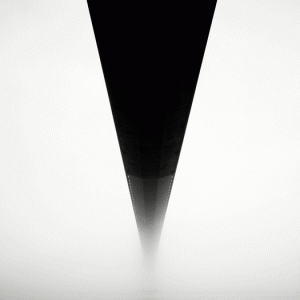
The first is seen from below (illustration 1). Its dark deck emerges from the middle of the upper edge of the photograph and plunges, in a sharp triangle that stands out against a light gray background, towards its lower edge which it would reach in its middle as well if it did not get lost in the mist as it approaches. This arrangement makes it that at first glance the geometric and contrasted composition (black median axis and symmetrical lateral surfaces, of same form, surface and gray tone) absorbs the gaze and that it is only with a brief moment of uncertainty that one recognizes the realistic subject of the photograph. As for the Nadja photograph of the sign on which LES AUBES is read, which in fact bore the inscription SOUS LES AUBES, name of a restaurant installed on the Barthelasse island, this momentary mistake results from the choice of a shooting angle and a framing that restrict or disturb the perception of reality to the point of preventing its exact recognition. The photographic then prevails over the photographed and the photograph ceases to be a means of reproducing what is, or, according to Roland Barthes' formulation, the "that has been,"7 to establish its capacity to compose illusory images, "lures," as Breton says about the photograph of the Grévin museum mannequin8.
But even once the nature of the photographed is perceived, the bridge identified, the photograph remains enigmatic. One does not know where this bridge leads, which gets lost in the indiscernible no more than from where it comes, since the edge of the photograph that separates the recognizable from the unknowable cuts it short. To tell the truth the unknowable is less troubling than the indiscernible, for nothing forbids imagining what, at the top of the photograph, the framing has excluded from our vision while, at the bottom, the bridge disappears under our gaze, gets lost visibly in the invisible, if one dares say, so that this loss, because manifest, becomes irreparable, an insurmountable reality imaginarily. With this paradoxical result that the non-visible, outside the frame, uncertain, can be attached to the real, by virtue of the postulate that photography records the existing, while the visible, what this shot shows in fact, indubitable, forbids such a supplement, except in the mode of reverie, which, André Breton observes "profits from nothing as well as from our moments of inattention"9 or our impediments to observe. So that this bridge which does not fulfill the functions that would make it truly worthy of this name can only be considered as such ideally, for example in the sense where André Breton says that "if [...], the primitives and children do not know these agonies that are ours [when we try to find again during waking life what our dreams have revealed to us, or that we seek to understand what this photograph really shows], it is that a bridge has not ceased for them to unite the two banks" of dream and reality, "this bridge that unites the external world to the internal world"10.
Another photograph shows an iron footbridge under a low and gray sky from which falls through a wide tear a wan light (illustration 2).
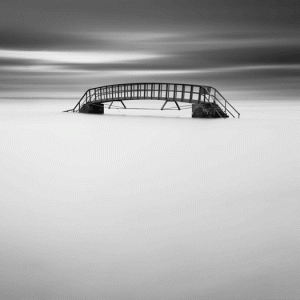
This time the two ends of the elevated footbridge are visible, as well as the flight of steps that, at each end, allows to reach the roadway or the path from which it rises. Roadway or path, we will not know, for the fog has accumulated on the ground over a great height (on the left, the footbridge railing disappears there progressively) and the two staircases are engulfed in its thick milky substance, which only seems so thick because the slow exposure, of three minutes, has transformed a light and mobile mist into opaque stagnant matter. The result is that it is impossible to know why this footbridge rises thus, what it allows to cross, the reason for its existence and the function it fulfills. Consequently its presence seems as little motivated as that of the bridge was.
Moreover it seems to float on this matter to which, in the end, one could not give a name, to be in unstable balance on its two bases which seem the ill-proportioned floats of a precarious vessel, threatened at any moment of capsizing or sinking, in short one of these "strange creatures that populate sleep," that André Breton evokes, of which one is happy to note that on waking they "sink precipitously into oblivion." But this one is of those "that linger"; it is that "the cutting passage from night to day" has not yet been accomplished, as one sees in this sky where the shadows linger, only clearing and fraying very slowly, and in this prolonged indistinction of the expanse where the arrived clarity does not manage to take form in familiar objects. The spectator of the photograph does not benefit, like André Breton, from Titania's company to "hear speak of all that is hidden" and Garo is not yet awake to report to him the chronicle of the everyday. He therefore remains constrained to let his mind "behave in a haggard manner"11 before a spectacle that seems the frozen image of a nightmare.
A last image belongs to this photographic discourse of little reality, which, if it is neither that of a bridge nor of a footbridge, however is still that of a place of passage: a metallic staircase of which one ignores again from where it starts and where it leads (illustration 3).

Jean Arrouye
Its disposition is singular and effective to transform its perception and interpretation. Singular, for the metallic staircase, seen in profile, emerges from a fog of the same nature as that which surrounded the footbridge at almost half the height of the photograph and approximately in the middle of its width, to then rise towards the right and disappear, cut by the framing. Effective, for this elevated position, which makes that as well the staircase seems to emerge from clouds, and its disappearance in the course of ascent, which allows imagining an unlimited pursuit of its elevation, contribute to making it a mysterious object that evokes more a modern variant of Jacob's ladder than an industrial instrument.
The double treatment, circumstantial, which makes that bridge, footbridge and staircase are unlocatable locally and temporally and therefore without imaginable use, and photographic, which mis-measures or transfigures them, makes that, in Michel Rajkovic's photographs, they fully participate in what, according to André Breton himself, is the principal character of surrealism, "operation of great scope bearing on language [...] whose elements [are] withdrawn from their [...] strictly utilitarian use, which was the only means of emancipating them and restoring to them all their power"12 poetic. This is what, mutatis mutandis, happens to them, indeed, thanks to the way in which the photographer treats them and the symbolic transformation that results from it. They thus satisfy the requirement expressed by Paul Valéry, that André Breton would not disavow, that "a work of art should always teach us that we had not seen what we believe we see"13.