BACHELARD AND SURREALISM (LAUTRÉAMONT, FLOCON, PAZ)
May 18, 2018
Bachelard and Surrealism (Lautréamont, Flocon, Paz)
When, in 1953, Gaston Bachelard met Jean-Clarence Lambert, the philosopher was a 69-year-old man, while the poet was only 23. Yet, the spark ignited between them and, as often happens, they esteemed each other.
Bachelard doubtless gives the young poet philosophical legitimacy, but Jean-Clarence Lambert offers our philosopher a world in its own right: the world of poetry, of reverie, of the surreal, to which Bachelard had been initiated, from the Thirties onwards, by Roger Caillois, whom he had met in 1934 in Prague, on the occasion of the VIIIth International Congress of Philosophy (it is not by chance that Bachelard is always initiated to surrealism by the young...!), and who had inspired him to compose Lautréamont (1939), up to the last poetics composed straddling the Sixties (Poetics of Space, 1957; Poetics of Reverie, 1960; The Flame of a Candle, 1961; Fragments of a Poetics of Fire, 1988), inspired precisely by Jean-Clarence Lambert, with whom he had maintained a moving correspondence, from 1953 until his death (October 16, 1962), through an important articulation: collaboration with Albert Flocon, the engraver close to surrealism, with whom he had created Landscapes (1950), a singular and magnificent work.
Let us proceed then in order, following first, Bachelard's initial approach to surrealism, from the late Thirties, as it developed through Lautréamont (1939)1, suggested to him by the young Caillois, a unique work in the Bachelardian poetic panorama; then, in the Fifties, Landscapes (1950)2, the work composed in four hands with Flocon, engraver close to surrealism; finally, admiration for the Mexican poet Octavio Paz, a reference running through the Poetics of old age. He had been initiated to it, as in the case of Lautréamont, by another young man, Jean-Clarence Lambert, who maintained with the philosopher a correspondence (1953-1961), a true exchange of reveries and poetry, which we had the honor and pleasure of translating and editing in Italian in 20133.
An engraver (Flocon), two poets (Lautréamont, Paz, both from Latin America...), two young brilliant minds (Roger Caillois and Jean-Clarence Lambert), who seduce Bachelard, projecting him toward a particular horizon, surrealist, close to surrealism, on the margins of surrealism, which Bachelard, an eminently "romantic4" philosopher, will traverse in a passionate and seductive way5.
- Lautréamont
The Songs of Maldoror by Isidore Ducasse, Count of Lautréamont6, analyzed by Bachelard in his Lautréamont (1939) but also in other works, are exemplified, by Bachelard, through the psychoanalytic definition of the "Lautréamont Complex," which stamps its seal on the bestiary that characterizes, with all its violence, cruelty, aggression, "the cruel blazon of the Count of Lautréamont7."
This is the case of the wide range of animals, classified by Bachelard with meticulous skill, of their "offensive organs," of their "animal means of aggression8," or "dynamic schema9," which define the animalism10 of Lautréamont, his animalizing phenomenology11 (see, for example, the tooth and the horn, the tusk, the paw, the sucker, the stinger, the venom; or, again, the jaw, the beak; or, finally, the claw and the sucker), corresponding – according to Bachelard – "to the double call of flesh and blood12," which invades his "kingdoms of anger13."
In short, not simply the animals, but above all their organs and their modalities of action – and aggression – define the cruel blazon of Lautréamont's bestiary.
And yet, the deepest meaning of Isidore Ducasse, according to Bachelard, is not limited to this list of animals and organs. What makes Ducasse's bestiary the cruel blazon of the Count of Lautréamont is not a thing, or an almost infinite set of things, but rather a precise modality of functioning of things: their continuous and dreadful change, their fusion, their mutation: what finally produces a device of metamorphosis – continuous, infinite, frightful.
"Of course, between species, there are contaminations. Thus the octopus takes wings and the winged octopuses resemble crows from afar [...] Conversely, in the enormous combat of the eagle and the dragon, the eagle, stuck to the dragon 'with all its members, like a leech, sinks its beak deeper and deeper [...] to the root of the neck in the dragon's belly'" – cites Bachelard, emphasizing the continuous metamorphosis – of animals, organs, gestures and movements or actions – which promotes, valorizes, enlarges, as in a sumptuous nightmare, cruelty. And he comments: "These interferences of the actions of the claw and the sucker show well, we believe, that the will to aggression keeps all its powers awake and that one would mutilate Lautréamontism if one polarized its violence in a single direction14."
Metamorphosis, typical of Lautréamont as well as medieval bestiaries and all classical mythology or teratology15, represents, according to Bachelard, the deepest meaning of Lautréamontism. A psychological, artistic, literary, aesthetic and therefore, if you will, philosophical device, which distinguishes Lautréamont with respect to other geniuses of cruelty: from Sade to Casanova, from Kafka to Latin poets16. Hybridization, variation, contamination, metamorphosis imposes itself in Lautréamont as a fundamental theoretical device, not only of Ducasse, but of surrealism as a whole, which the Count of Lautréamont precedes and prepares (testimony borne, among others, by the interest aroused by Lautréamont among the surrealists, starting with the painters who, numerous – starting with Magritte of the La Boétie Edition of the Songs of 194817 – will illustrate his characters and his stories).
A metamorphosing, dynamic, variational device, which, as a true tropology (from the Greek tropo/trepo, to vary, to transform), supports two principles that will be fundamental in Bachelardian poetics: imagination and reverie.
I refer to the faculty of imagination conceived by Bachelard as the power not simply to form images, but rather to de-form them; I refer to the metamorphosing power of dream and above all of reverie which poses itself, in Bachelard as in Lautréamont, as origin, variation, creation, emphasizing all its ontological, variational, poietic scope, in an infinite germination which, "language in flower18," transforms, renews and creates increasingly different images.
Imagination, first of all, on which Bachelard insists in the Conclusion to his Lautréamont, emphasizing "the line of force of imagination19" represented by Isidore Ducasse. A line that exalts "creative" and "vital" imagination20, according to a filiation that goes from Kant to Corbin21. At this moment, Bachelard borrows from two authors, explicitly named: Roger Caillois of The Myth and the Man and Armand Petitjean of Imagination and Realization22.
Caillois, the singer of stones and octopuses, taught him this "aesthetic effort of life23," which links together – in the manner of Lautréamont – biology, mineralogy and imagination more than one can imagine. Caillois, the passer-by from Argentina and Patagonia, passionate about stones and pebbles, who apprehends the demon of analogy, which traverses the world, enveloping it in a network of coincidences linking together the mineral, vegetable, animal kingdoms, and demonstrating that "the living being has an appetite for forms at least as great as an appetite for matter24," namely "a certain punctual correspondence between the various formal trajectories25," where the primary device of all imagination develops: metamorphosis26.
Petitjean taught him the vital and projective character of imagination, once again perfectly compatible with the aggressiveness of Lautréamontism. A dynamic, open, active imagination, which "develops projects in all directions27," and which, once again, emphasizes the force of metamorphosis, which confirms for Bachelard such a specific aspect of Lautréamont28.
Metamorphosis, therefore, as a specific device of imagination in Lautréamont, Caillois, Petitjean. A device that will also be confirmed as fundamental in another pivot of Bachelardian poetics, at this moment simply sketched: reverie, this "dream with open eyes," this "dream in the feminine," which, object of a poetics of old age, The Poetics of Reverie (1960)29, heir to La Fontaine, Chateaubriand and Rousseau, thematized at the beginning of the 20th century by Paul Souriau30, will indeed represent the triumph of metamorphosis, dynamic, tropological, variational, fixed, as it will be, on the principles of origin, variation, creation.
Lautréamont, therefore, dawn and aurora of surrealism, as inspirer of Bachelard, on the side of metamorphosis, imagination and reverie.
But Isidore Ducasse is not the only genius of surrealism frequented by Bachelard. He finds himself in good company, followed, as he is, by other great names of the surreal, often on the side of the arts: Albert Flocon, for example, the surrealist engraver with whom Bachelard writes in four hands, in 1950, Landscapes, a precious work woven with engravings and philosophical reflections.
- Albert Flocon
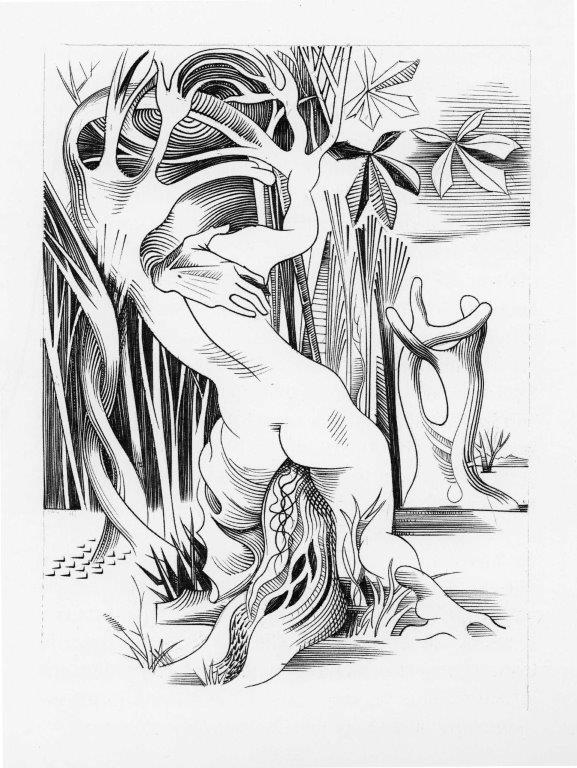
These are the 15 plates that compose Landscapes. Notes of a Philosopher for an Engraver31, the second expression of Bachelard's proximity to surrealism.
An engraver, Albert Flocon, whose real name was Albert Mentzel, a German refugee in France in 1933, who liked to confront himself with the writers and philosophers of his time (see, beyond Bachelard, his work with Éluard32) and who, "at the border between surrealism and metaphysical realism33," solicits in Bachelard striking reflections, once again centered, tropologically, on the notion of movement (quite similar, for several aspects, to the Ducassian concept of metamorphosis), declined as force, provocation, will.
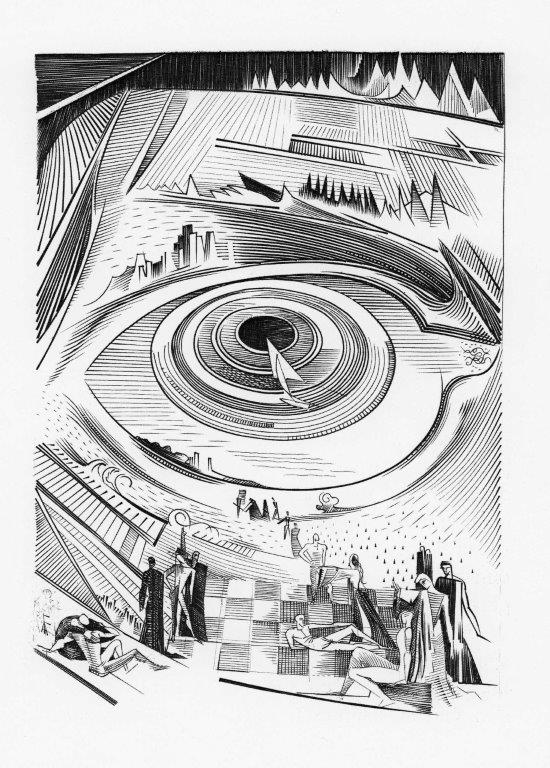
Movement
Movement, first of all.
"The engraver devotes himself to movement34." Thus, laconically, Bachelard defines the engraver's work. Inducer, thanks to its intrinsic dynamism, of imagination, dream and art, movement is primary movement, trajectory, energy –, capable of carrying masses, giving back to each form its own force, direction and dynamism. Energy, force, dynamism, engraving is, for Bachelard, expression of movement, and Landscapes configures itself as a true eulogy of movement.
"In losing color – the greatest of sensible seductions – the engraver keeps a chance: he can find, he must find movement. Form alone would not suffice. The passively copied form alone would make the engraver a diminished painter. But in energetic engraving, the line is never a simple profile, never a lazy contour, never an immobilized form. The slightest line of an engraving is already a trajectory, already a movement and, if the engraving is good, the line is a primary movement, a movement without hesitation or retouching. [...] Then the line carries masses, propels gestures, works matter, gives to every form its force, its arrow, its dynamic being. That is why a philosopher who has spent ten years of his life reflecting on the imagination of matter and on the imagination of forces delights in the activist contemplation of an engraver and allows himself to expose, on each engraving of the present work, his own reactions35."
A sort of psychic induction and coefficientization of materiality which, already thematized by Bachelard in the Tetravalent Doctrine of Poetic Temperaments under the form of Material Imagination – imagination of matter, of forces, of movement36 –, resolves itself, finally, in the Introduction to Landscapes ("Introduction to the dynamics of landscape"37), into force, provocation, will.
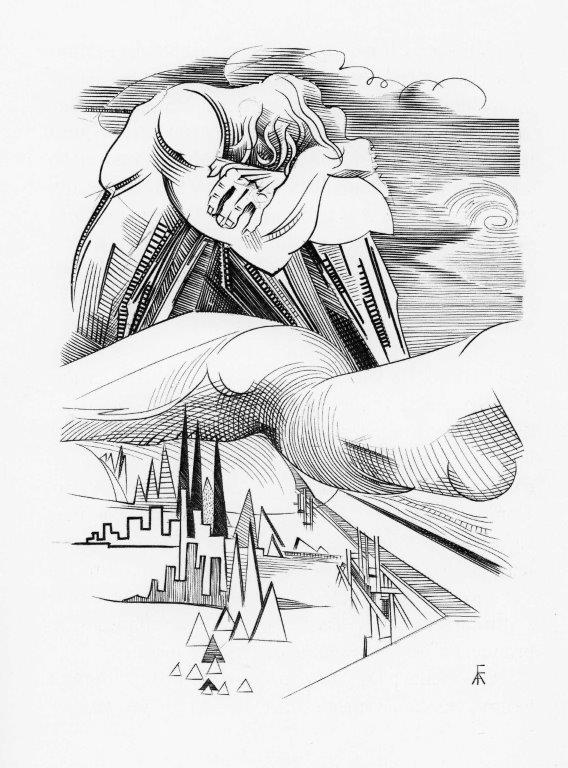
Force
Force, therefore.
"It is this intimate force discovered in things that gives the engraved object, the engraved landscape, its relief. [...] It is dynamometers that the engraver needs. More exactly, he is the universal dynamometer that measures the thrusts of the real, the uprising of terrestrial leaven, the opposition of the mass of objects [...] The engraver, indeed, allows us to rediscover values of force in the very style where the painter teaches us the value of a light [...] in forms inhabited by a superabundant movement, impatient to surge forth. [...] These virtues of the initial force, the energetic engraving does not lose them when it is laid on the white page [...] It has for the dreamer who accepts the solicitations of the image, for the one who wants to will in seeing, functions of stimulation constantly revived, [...] initiatory angers, [...] encouragements to will. [...] The engraved landscape puts us at the first day of a world. It is the first confidence of a creator. It is a beginning. Now to begin is the eminent privilege of will. Who gives us the science of beginnings makes us a gift of pure will38."
Initial and initiatory thrust that places us at the origins of the world, force configures itself here as the primary character of movement, claiming strong and irreducible ontological prerogatives, configuring itself as a principle of induction, coefficientization, production of meaning, inaugurating a sort of lexicon of the pro –: production, projection, provocation.
Force, in short, gives itself as provocation.
Provocation
"If the poet's landscape is a state of soul, the engraver's landscape is a character, a fury of will, an action impatient to act on the world. The engraver sets a world in motion, he arouses the forces that swell forms, he provokes the forces asleep in a flat universe. To provoke, that is his way of creating39."
Vector of induction, the engraver poses himself as expression of provocation, attributed sometimes to matter, sometimes to the subject – poet, artist, engraver: as if the relationship between man and nature, already treated by Bachelard in The Earth and the Reveries of Will40 under the conflictual sign of resistance (of matter) or aggression (of man)41, now imposes itself as brusqueness and cosmodrama, reviving the pomp of other philosophical references: Souriau's instauration42, Roupnel's instant43, and, above all, will, of Schopenhauer and Nietzsche.
Will
"But if engraving is, as we believe, an essential intervention of man in the world, if the engraved landscape is a rapid, furious mastery of the universe, the engraver will provide us with new tests, tests of will. Engraved landscapes are tests of enormous will, of will that wants the whole world at once44."
Will configures itself here as the deep meaning of engraving, of an engraver dominated, according to Bachelard, by a sort of "Jupiter Complex"45. Will which, strong already since The Earth and the Reveries of Will, in the sign of Nietzsche and Schopenhauer, imposes itself increasingly on the Nietzschean side, exalting the superman and the will to power, to deliver them to their own intrinsic creativity.
Force, provocation and will, Movement, the cipher of Flocon's engravings, represents the most authentic meaning of poetry, emphasizing the dynamism typical of Ducassian metamorphosis and confirming the equivalence, in Bachelard, between surrealism and tropology.
An equivalence accentuated, in the last poetics of the last years, through the relationship established by Bachelard with new artists, coming from the four corners of the world, who were presented to him, once again, by a new young friend: the poet and art critic Jean-Clarence Lambert who, known in the Fifties, initiates the philosopher to planetary surrealism.
- Octavio Paz
"Letters to a Young Poet"46, the delicate expression used by Françoise Py as an Introduction to Bachelard's Letters to Jean-Clarence Lambert, enlightens us about the new world that will open for the old philosopher thanks to his enterprising young friend.
We are in 1953, when, aged only 23, Jean-Clarence Lambert begins to send Gaston Bachelard the results of his poietic research: from Robert Lapoujade and Michel Carrade to André Pieyre de Mandiargues; from the Young School of Paris to the Cobra group, to arrive at Octavio Paz and Artur Lundkvist, poets close to surrealism, whom he had known and translated into French, giving the philosopher the possibility of benefiting once again from rich and seductive suggestions47.
It will be a breath of fresh air for Bachelard to read in French, from Swedish and Mexican, of eagles and sun, of fire against fire. A new flow of images, very intense and captivating, which ravish his imagination always thirsty for dreams.
And he writes, thanking his young friend for sending Fire Against Fire48 by the Swedish poet Lundkvist, in Letter n° 5 of March 11, 1959:
"Artur Lundkvist is a genius. His book is an explosion of poetry. He is from the land of dynamite and from all sides he projects stars." And, again: "You have rendered an extraordinary service to Poetry in transcribing such poems." And, finally: "Henceforth Swedish poetry belongs to you. You must night and day tell us what this land of stellar poetry is49."
And indeed the Swedish poet's verses will be cited by the philosopher in The Flame of a Candle, as "poetic images of the flame"50.
And again, in Letter n° 3 of May 22, 1957, referring to the sending of the French translation of Eagle or Sun?51 by the Mexican poet Octavio Paz, he exclaims:
"How many days have passed since that beautiful day when you sent me Eagle or Sun?!". And he adds: "And the book has not left my table since. And my letter will tell you badly all the happiness felt in reading these admirable pages. [...] In bad hours I reread Octavio Paz. And you help me to 'invent the Word'. That is essential when words press life ends." And he concludes, congratulating the translators Lambert and Charpier: "You render me great service in translating, without resting for an instant, from Paz. And I am happy that you work with Charpier. Together one goes three times faster52."
And Jean-Clarence Lambert, who then, responding to Bachelard's call, will translate more and more from Paz and Mexican poets, remembers having himself accompanied Paz to Bachelard's home, in Paris, rue de la Montagne Sainte-Geneviève, and having talked with him about poetry, adding:
"Era come se la lettura di una poesia sostituisse, per lui, la preghiera del mattino/It was as if reading a poem was, for him, the morning prayer53."
It is not by chance that Octavio Paz will be cited several times by Bachelard in The Flame of a Candle, as expression of "The verticality of flames," or of "The poetic images of the flame," or of "The light of the lamp"54, often under the sign of fusion and metamorphosis which restore to poetry its own original force55.
Not to mention a citation that is also present in Fragments of a Poetics of Fire, where Eagle or Sun? by Paz becomes Eagle and Sun, testifying, thanks to the synthesis of the two images, the force of poetic imagination56.
This is the last Bachelardian confrontation with surrealism. And Bachelard remains once again conquered. And no longer, simply, for the tropological, dynamic, metamorphosing power of poetic speech, as it was in the case of Lautréamont or Flocon, but, this time, for the so to speak radical power of poetic speech: for that which, in his last poetics, he will call ontology of poetic speech.
A sort of ontological torsion of his reflection on poetry, which will give him the possibility of envisaging, in poetic speech, the very root of being.
This certainly holds, according to Bachelard, for poetry as a whole. It holds above all for the speech of the surrealists, who, perhaps, more than others, play a fundamental role in the instauration and in poetic creation57.
Lautréamont and Flocon, Lundkvist and Paz: through the genius mediation of Roger Caillois/Lautréamont, Albert Flocon and Jean Clarence Lambert, surrealism has slipped between the folds of Bachelard's reflection, man of the theorem during the day, but man of the poem during the night, illuminating his dreams and giving him, until his end, the force of dream.
"Merita ciò che sogni/Deserve what you dream58," said Octavio Paz, as Jean-Clarence Lambert recalls: thanks to him, to Flocon, to Caillois, thanks to the images, engravings and words of the surrealists, Bachelard was doubtless up to his dreams.