"An unpublished portrait of André Breton", Mozaicul, Craiova, [Romania], new series, year XIII, nr. 6 (140), 2010, p. 3.
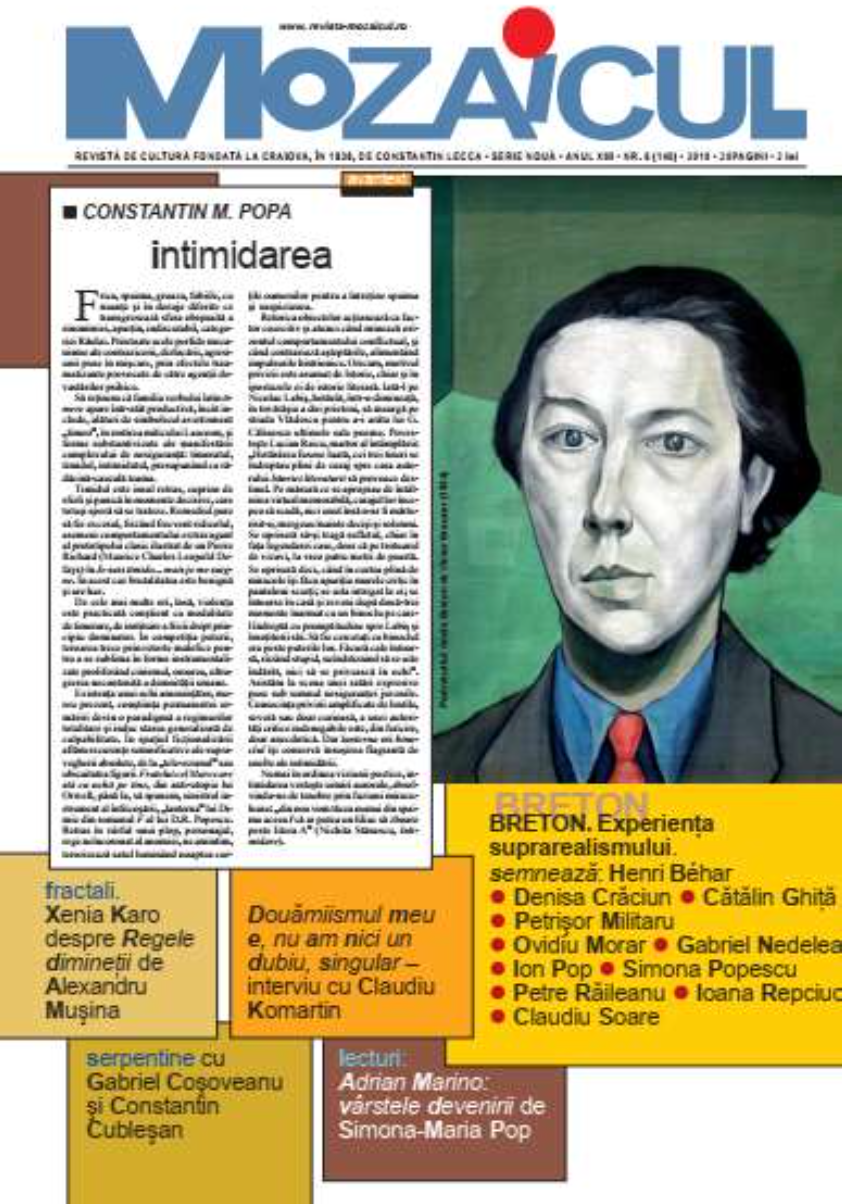
The cultural journal Mozaicul was founded in 1838 in Craiova, Romania. It resumed in 1997 in an original format and layout. Having decided to devote its thirteenth issue (New series) to André Breton. Informed of my biography published in 1990 with Calmann Lévy, and reprinted in 2005 by Fayard, it asked me, through Petre Raileanu, to entrust it with a brief portrait of the master. Here it is, in its original version.
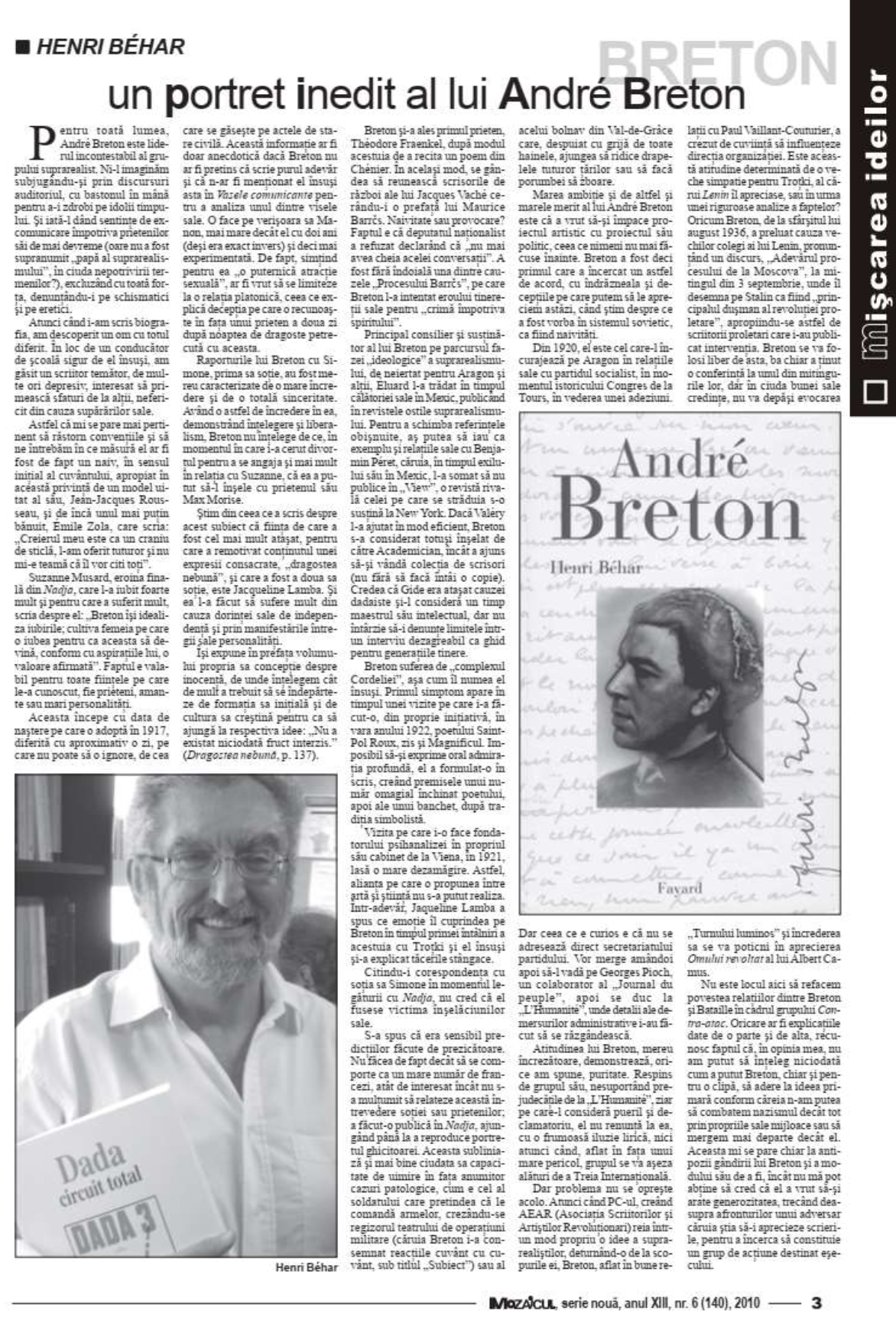
Original text in French: AN UNPUBLISHED PORTRAIT OF ANDRÉ BRETON By Henri BÉHAR
For everyone, André Breton is the undisputed leader of the surrealist group. One imagines him haranguing his troops, a cane in hand to break the idols of the day. And here he is fulminating bubbles against his friends of yesterday (has he not been nicknamed "the pope of surrealism" despite the incongruity of the terms?), excluding left and right, denouncing schismatics and heretics. Having had to write his biography, it is a very different man that I met. Instead of a self-assured school leader, I found a worried writer, often depressive, loving to take advice from one and the other, unhappy with his rages. So that it seems more pertinent to me to reverse the conventional images and to wonder to what extent he would not be a naive, in the primary sense of the word, close in this to one of his forgotten models, Jean-Jacques Rousseau, and to another even less suspected, Émile Zola, who wrote: "My brain is like a glass skull, I have given it to everyone and I am not afraid that everyone will come to read it." Suzanne Musard, the final heroine of Nadja, who loved him strongly and by whom he suffered much, wrote about him: "Breton praised his loves; he fashioned the woman he loved so that, conforming to his aspirations, she would become an affirmed value." This applies to all the beings he has known, friends, lovers or great figures. This begins with the birth date that he adopts in 1917, different by one day, he cannot ignore it, from the one found on his civil status papers. This information would be purely anecdotal if Breton did not claim to write the whole truth, and if he had not mentioned it himself in The Communicating Vessels to analyze one of his dreams. He gives his cousin Manon as two years older than him (when it is exactly the opposite) and therefore more experienced. In fact, feeling for her "a great sexual attraction," he would have wanted to stick to a platonic exchange, which explains the disappointment confided to one of his friends the day after his night of love. Breton's relations with Simone, his first wife, have always been marked by the greatest confidence and total frankness. Confiding thus to her, who shows understanding and liberalism, Breton does not understand, at the moment when he asks her for divorce to engage more with Suzanne, that she could have deceived him with his friend Max Morise. We know, from what he wrote about it, that the being to whom he was most attached, for whom he remotivated the content of a ready-made expression, "mad love" is his second wife, Jacqueline Lamba. She too made him suffer much by her will for independence and by the manifestations of her entire personality. He exposes about her his own conception of innocence, of which one imagines how much he must have stripped himself of his initial formation, and of his Christian culture to achieve it: "There has never been a forbidden fruit." (Mad Love, p. 137) Breton chose his first friend, Théodore Fraenkel, by his way of saying a poem by Chénier. In the same way, he thought to gather Jacques Vaché's war letters by asking Maurice Barrès for a preface. Naivety or provocation? The fact is that the nationalist deputy dodged by declaring that he "no longer possessed the key to this conversation." This will doubtless be one of the causes of the "Barrès Trial," that Breton will bring against the hero of his youth for "crime against the spirit." Principal advisor and support of Breton during the "ideological" phase of surrealism, pitiless for Aragon and the others, Éluard betrayed him during his stay in Mexico, by publishing in journals hostile to surrealism. To change from the usual references, I could also take the example of his relations with Benjamin Péret, to whom, during his exile in Mexico, he enjoins not to publish in View, a rival journal to the one he tries to animate in New York. If Valéry effectively helped him, he considers himself deceived by the Academician to the point that he sells the collection of his letters (not without having taken a copy). He believes Gide won over to the Dada cause and considers him, for a time, as his master thinker, but he is not long in denouncing his limits in an interview unpleasant for the guide of young generations. Breton suffered from the "Cordelia complex," as he himself called it. The first symptom appears during a visit that he goes to pay, of his own accord, to the poet Saint-Pol Roux, called the Magnificent, during the summer of 1922. Impossible to express orally his profound admiration, which he will formulate in writing, by arousing a tribute issue to the poet, then a banquet, according to the symbolist tradition. The visit he pays to the founder of psychoanalysis, in his own office in Vienna, in 1921, arouses great disappointment. In truth, the alliance he proposed between art and science could not be made. Finally, Jacqueline Lamba said what emotion animated Breton during his first interview with Trotsky, and he himself explained his awkward silences. Having read the correspondence he addressed to his wife Simone at the time of his liaison with Nadja, I do not believe he was duped by his wanderings. He has been said to be sensitive to the predictions of fortune tellers. He was only behaving like a great number of French people, with this difference that he did not content himself with relating this interview to his wife and friends; he let us know it in Nadja, going so far as to reproduce the portrait of the fortune teller. This emphasizes more his strange faculty of astonishment before certain pathological cases, such as this soldier who claimed to command the rockets, believing himself the director of the theater of operations (of which Breton will record the remarks word for word under the title "Subject"), or again this patient of Val-de-Grâce who, carefully stripped of everything, managed to make flags of all countries emerge or to make doves fly away. The great ambition, and also the great merit of André Breton, will have been to want to reconcile his artistic project with his political project, which no one had done before. Breton was therefore the first to attempt such an agreement, with a boldness and disappointments that one can all the more easily tax as naive that we know what to think, today, of the Soviet system. From 1920, it is he who leads Aragon to the socialist party, at the time of the historic Congress of Tours, with a view to membership. But the curious thing is that they do not address themselves directly to the party secretariat. They first go to see Georges Pioch, a collaborator of the Journal du peuple, then they go to L'Humanité where the detail of administrative démarches to join the party dissuades them. Breton's attitude, always marked by confidence, stems, whatever one may say, from purity. Rejected by his cell, not supporting the prejudices of L'Humanité, a journal that he finds puerile and declamatory, he nevertheless maintains, with a beautiful lyrical illusion that, faced with a grave danger, the group will side with the Third International. But the affair does not stop there. When the CP, creating the AEAR (Association of Revolutionary Writers and Artists) takes up an idea of the surrealists, diverting it from its goals, Breton, on good terms with Paul Vaillant-Couturier, believes himself able to influence the line of the organization. Whether it is by an old sympathy for Trotsky, whose Lenin he had appreciated, or following a rigorous analysis of the facts, the fact remains that Breton has, from the end of August 1936, taken up the cause of Lenin's old companions, delivering a speech, "The truth about the Moscow trials" at the meeting of September 3, where he designated Stalin as "the principal enemy of the proletarian revolution," approaching the proletarian writers who published his intervention. Breton will use it freely, he will even deliver a lecture at one of their meetings, but, despite his good will, he will not go beyond the evocation of "The clear tower" and his confidence will stumble on the appreciation of Albert Camus's The Rebel. This is not the place to remake here the history of Breton's and Bataille's relations within the Contre-attaque group. Whatever the explanations given on both sides, I admit that, for my part, I have never been able to understand how Breton could, even for a moment, adhere to the primary idea that one could only combat Nazism by its own means, or by going even further than it. This seems to me so much at the antipodes of André Breton's thought, and of his way of being, that I cannot help believing that he wanted to show his magnanimity, passing over the outrages of an adversary whose writings he knew how to appreciate, to try to constitute an action group doomed to failure.