"Dada is a virgin microbe, psychoanalysis a dangerous disease", in Hypnos, aesthetics, literature and unconscious in Europe (1900-1968) studies gathered and presented by Frédérique Toudoire-Surlapierre and Nicolas Surlapierre, éditions l'Improviste, 2009, p. 191-212.
The advantage, when one can benefit from an active retirement, is that it is then possible to return to one's first works and examine their relevance fifty years later. Two young researchers, Frédérique Toudoire-Surlapierre, professor at the University of Limoges, and her brother Nicolas Surlapierre, then preparing a doctorate in art history, invited me to deal with Dada in its relations with psychoanalysis within the framework of a two-part colloquium. "Hypnos. Aesthetics, literature and unconscious". The first part took place from March 19 to 21, 2009 in conjunction with the Hypnos exhibition as part of the "Europe XXL" project of the Lille urban community. The second part took place in Mulhouse on November 18-20, 2010, it focused more specifically on the period 1968-2008, but I was not there.
Colloquium program: consult here
INTERNATIONAL COLLOQUIUM IN 2 PARTS HYPNOS. AESTHETICS, LITERATURE AND UNCONSCIOUS IN EUROPE
Presentation of my intervention: Communication: "Dada is a virgin microbe, psychoanalysis a dangerous disease" Before the flood of theses on Dada, I wrote about it that "The practice of incoherence forced the doors of the unconscious", thus calling for a psychoanalytic approach to poetry. However, this movement showed itself reserved, if not hostile towards the theories developed by S. Freud. I therefore consider questioning the concept and practice of incoherence within the Dada movement, and the judgment that resulted from the side of psychiatry. In a second time, I will examine the practices borrowed from this field by the poets (automatic writing, hypnosis, dream narrative). Finally I will try to explain the successive hostility of Tristan Tzara and André Breton towards Freud and his disciples. Hostility all the more paradoxical that the Dadaist negativity led to new poetic domains, left fallow before.
Collection: Hypnos: aesthetics, literature and unconscious in Europe (1900-1968), studies gathered and presented by Frédérique Toudoire-Surlapierre and Nicolas Surlapierre.
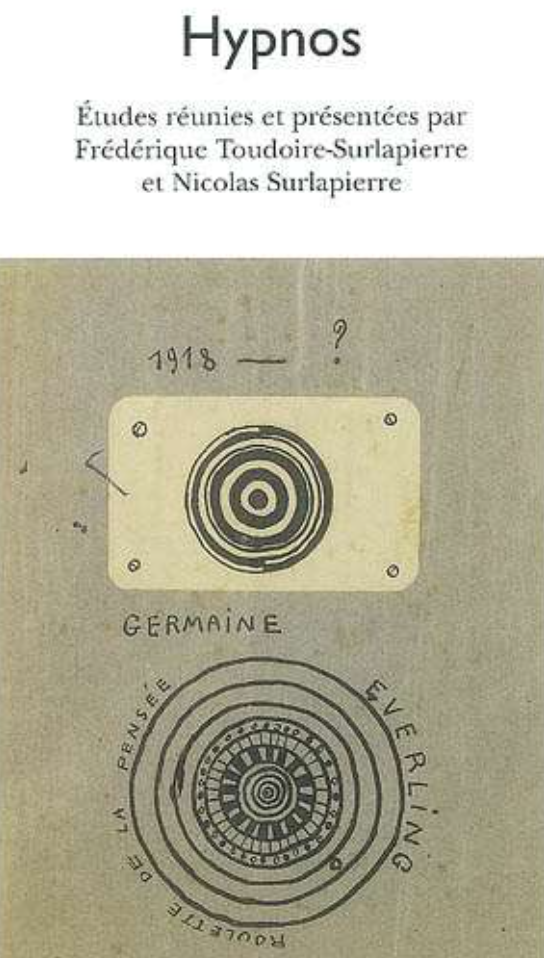
Toudoire-Surlapierre, Frédérique (1968-....). Publication director; Surlapierre, Nicolas (1971-....). Publication director Edited by L'Improviste - 2009
Back cover: "The interventions in this volume consider Europe in its plurality and, particularly, in its extension towards the East through the prism of the notion of unconscious. Its representations in literature and the arts between 1900 and 1968 allow us to grasp the stakes of the transformations and evolutions of Europe during this period. Manifestations as diverse as hypnosis, dream, sleep, extravagance, craziness, oddities, slips, failed acts or word games are so many modes of expression that artists, writers, thinkers or musicians have appropriated. Between wit, visual delirium or uncanny strangeness, these notions theorized by Sigmund Freud have federated what Jung will later call the "European unconscious". My article is also accessible in: H. Béhar, Ondes de choc, nouveaux essais sur l'avant-garde, Lausanne, L'Age d'Homme, 2010, pp. 71-100. Cf. H. Béhar, Ondes de choc (fabula.org)