"Nadja, marturia hazardului obiecti", Mozaicul, Craiova (Romania), new formula, XVIth year, No. 5 (175), 2013, p. 3.
Having reviewed in a previous issue the André Breton Dictionary published by Classiques Garnier, the editorial staff of this journal asked my permission to publish my article on Nadja which was done under the title: "Nadja, Witness of Objective Chance".
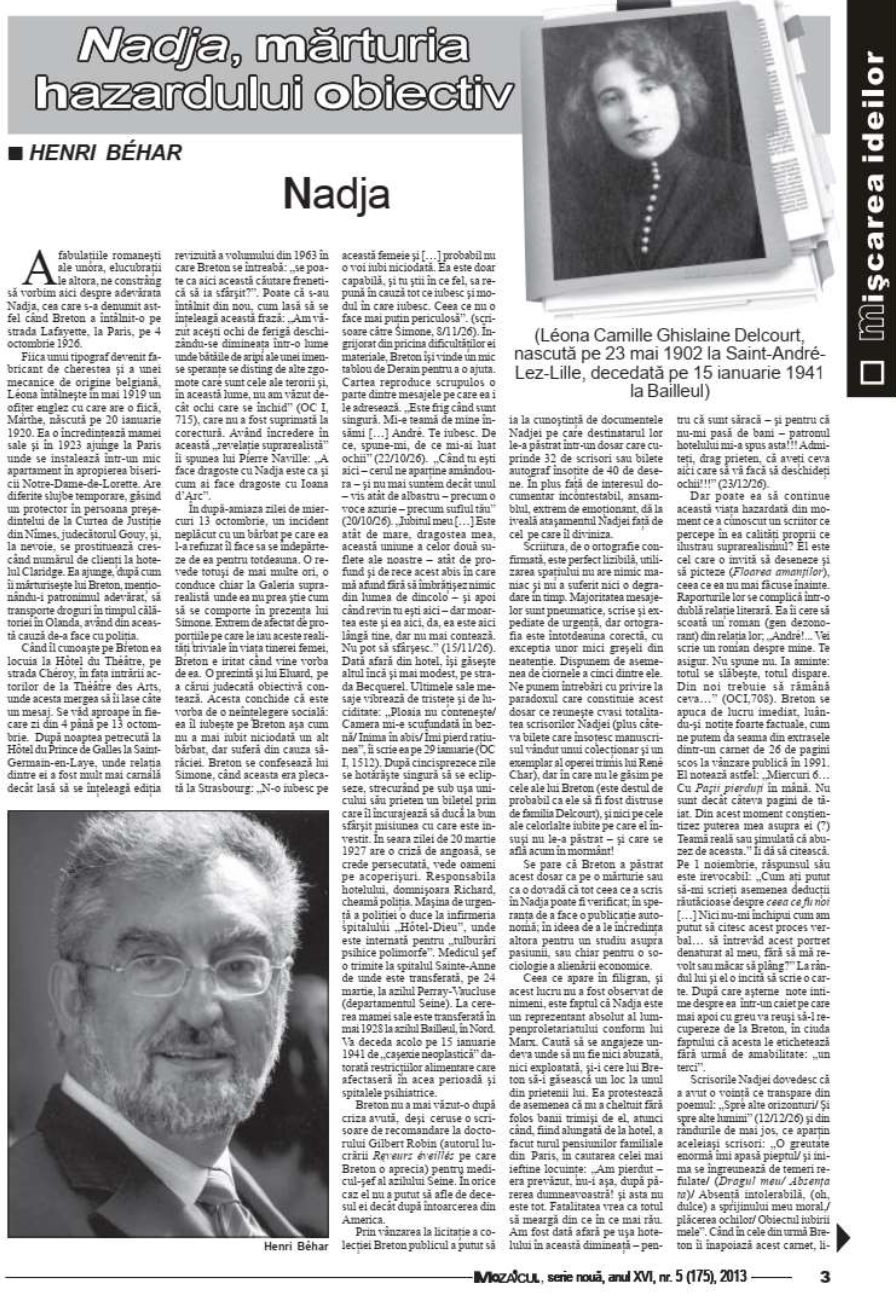
Original text in French:
NADJA (Léona Camille Ghislaine Delcourt) Saint-André-Lez-Lille, May 23, 1902 — Bailleul, January 15, 1941
The novelistic fabrications of some, the lucubrations of others compel us to deal here with the real Nadja, the one who called herself thus when Breton met her on rue Lafayette, in Paris, on October 4, 1926. Daughter of a typesetter who became a wood salesman, and a mechanic of Belgian origin, Léona meets in May 1919 an English officer with whom she has a daughter, Marthe, born on January 20, 1920. She entrusts her to her own mother, and, from 1923 onwards, goes to Paris, where she settles in a small apartment near the Notre-Dame-de-Lorette church. She practices various odd jobs, finds a protector in the person of a president of the Nîmes assize court, Judge Gouy, and, occasionally, indulges in prostitution by picking up a client at the Claridge. It happens to her, as she confides to Breton while mentioning her real surname, to pass drugs during a trip to Holland, for which she has dealings with the police. When she meets Breton, she stays at the Hôtel du Théâtre, rue Chéroy, opposite the artists' entrance of the Théâtre des arts, where he will go to leave her a message. They see each other almost every day from October 4 to 13. After the night spent at the Hôtel du Prince de Galles in Saint-Germain-en-Laye, where their exchanges were more carnal than the 1963 revision of the volume suggests, Breton wonders: "can it be that here this desperate pursuit comes to an end?" Perhaps they united again, as suggested by this phrase "I saw her fern eyes open in the morning on a world where the wingbeats of immense hope are barely distinguishable from other noises which are those of terror, and on this world, I had only seen eyes closing." (OC I, 715) which was not suppressed in the correction. To Pierre Naville, taken into confidence about this "surrealist revelation", he will say: "With Nadja, it's making love like with Joan of Arc." On the afternoon of Wednesday, October 13, the account of a misadventure with a man to whom she refused herself almost drives him away from her forever. He sees her again "many times" however, takes her to the Surrealist Gallery where she doesn't quite know how to behave in Simone's presence. Terribly affected by the proportions that trivial realities take in the young woman's life, Breton becomes irritated about her. He has her meet Éluard whose judgment seems objective to him. The latter concludes to a social misunderstanding: she adores Breton as she has never loved any man, but she suffers from her poverty. Breton then turns to Simone, who has left for Strasbourg: "This woman, I don't love her and [...] probably I never will. She is only capable, and you know how, of calling into question everything I love and the way I have of loving. No less dangerous for that." (letter to Simone, 11/8/26). Concerned about her material difficulties, Breton sells a small Derain painting to help her. The book scrupulously reproduces part of the messages she sent him. "It's cold when I'm alone. I'm afraid of myself [...] André. I love you. Why do you say, why did you take my eyes." (10/22/26) "When you are there – the sky is ours – and we are no longer but one – dream so blue – like an azure voice – like your breath" (10/22/26) "My beloved [...] It's so great my love this union of our two souls – so deep and so cold this abyss where I sink without ever grasping anything of the beyond – and then when I come back you are there – but death is also there, yes it's there behind you, but what does it matter. I cannot finish". (11/15/26) Thrown out of her hotel, she finds an even more modest one on rue Becquerel. Her final messages are poignant with distress and lucidity: "It's still raining/ My room is dark/ The heart in an abyss/ My reason is dying", she writes to him on January 29 (OC I, 1512). Fifteen days later, she decides on her own to fade away, slipping under the door of her only friend a note where she encourages him to carry out the mission with which he is invested. On the evening of March 20, 1927, she has an anxiety attack, believes herself persecuted, sees men on the roofs. The hotel manager, Mme Richard, calls the police. The Police rescue van takes her to the special infirmary of the depot at the Hôtel-Dieu, where she is committed by order for "polymorphic psychic disorders". The chief physician sends her to Sainte-Anne hospital from where she is transferred, on March 24, to the Perray-Vaucluse asylum (Seine department). At her mother's request, she is transferred in May 1928 to the Bailleul asylum, in the North. She will die there on January 15, 1941, of "neoplastic cachexia", due to food restrictions affecting psychiatric hospitals at the time. Breton never saw her again after her crisis, despite the letter of recommendation he had requested from Dr. Gilbert Robin (the author of The Awake Dreamers that Breton had appreciated) to the chief physician of the Seine asylum. In any case, he could only learn of her death upon his return from America. With the Breton Sale, the public was able to become acquainted with Nadja's documents that their recipient had carefully preserved in a file of 32 autograph letters or notes and the forty or so drawings attached. Beyond its undeniable documentary interest, the whole, extremely moving, brings out Nadja's attachment to the companion she deifies. The writing, with an affirmed graphology, is perfectly legible, the use of space has nothing manic about it, and no degradation is perceived over time. Most of the messages are pneumatics, written and sent in urgency, but the spelling is always correct, with a few carelessnesses. We also have the draft of five of them. We wonder about the paradox constituted by this bound file where almost all of Nadja's letters are found (besides a few notes that accompanied the manuscript sold to a collector and a copy of the work given to René Char), while we don't have Breton's (probably destroyed by the Delcourt family), and that he himself has not kept those of his other lovers – they are in the tomb! It seems that Breton kept this file as testimony or proof in order to prove that everything he writes about it in Nadja is verifiable; in the hope of making an autonomous publication of it; with the idea of entrusting it to others for a study on passion, or even a sociology of economic alienation. For what appears in filigree, which no one has noticed, is that Nadja is an absolute representative of the lumpenproletariat according to Marx. She seeks to be employed, without being abused or exploited, and asks Breton to find her a place with one of his friends. She also protests that she doesn't waste the money he gave her, going around the boarding houses in Paris to find lodging at the lowest cost, when she is chased from the hotel: "... I have lost – it was foreseen, wasn't it – according to you! and that's not all. Fate wants it to go from bad to worse. I was thrown out of my hotel this morning – because I am poor – and that I care too little about money – it's the hotel owner who told me that!!! Admit dear friend that there's enough to make you open your eyes!!!" (12/23/26) But can she continue her hazardous life once she has known a writer who perceives in her qualities proper to illustrate surrealism? It is he who invites her to draw and paint (The Flower of Lovers), which she had never done before. Their relationship becomes complicated in a double literary relationship. She asks him to draw a novel (hated genre) from their relationship; "André!... You will write a novel about me. I assure you. Don't say no. Beware: everything weakens, everything disappears. Something must remain of us..." (OC I, 708). Breton tries it immediately, taking very factual notes, as can be judged from extracts from a 26-page notebook that went to public sale in 1991. He notes thus: "Wednesday 6. ...The Lost Steps in hand. There are only a few pages cut... From this moment consciousness of my power over her (?) Real or simulated fear that I abuse it." He has her read it. On November 1st, her response is final: "How could you write such wicked deductions of what was us [...] How could I read this report... glimpse this denatured portrait of myself, without revolting or even crying?" (OC I, 1 505). For his part, he himself incites her to write a book. On which she would in turn have thrown notes concerning her in a notebook that she will not cease to recover when Breton will have judged it without amenity: too "pot-au-feu". Nadja's letters prove that she had the will of the poem: "Towards other horizons/ And towards other lights" (12/12/26) or further down in the same letter: "An enormous weight oppresses my chest/ and my heart grows heavy with refuted fears/ (My beloved, your absent one)/ Intolerable absence, (oh, sweet) of my moral support,/ pleasure of the eyes/ Object of my love". When finally Breton has this notebook returned to her, soothed she slips under the door of his apartment a final message: "Thank you, André, I have received everything. I have confidence in the image that will close my eyes. I feel attached to you by something very powerful, perhaps this trial was necessarily the beginning of a superior event. I have faith in you – I don't want to break the momentum diminish the love I have for you by absurd reflections. I don't want to make you lose the time necessary for superior things. Everything you do will be well done. Let nothing stop you... There are enough people who have the mission to extinguish the Fire [...] you have nothing to forgive me tear out the letters that have pained you, they must not exist. Each day the thought renews itself. It is wise not to abstain on the impossible. [...] André, despite everything I am a part of you. It's more than love. It's Force and I believe." Breton had not abandoned the idea of making known her plastic realizations by announcing a project of "Snowball by N.D." announced in The Surrealist Revolution. He had suggested to her to indulge in this kind of activity as a means of occupying herself in her empty days and to make her project her anxieties, a form of art therapy perhaps? One thing is certain, it is that he always appears there in majesty, so to speak, ready to destroy the serpent of Evil. No one has claimed that these allegorical works revealed artistic competence, but they belong to what will later be called art brut, the art of one who doesn't know how to paint. Do they manifest a form of alterity characteristic of the expression of madness? in other words, are they proof of schizophrenia? Only the psychiatrist could decide, if he ignored the destiny of their author! In any case, they confirm the feeling given by reading the letters: Nadja had an obvious tendency to mysticism, as if she had read Teresa of Avila and Saint John of the Cross in her expression of love: "I close my eyes. What a beautiful country – verdant meadows and golden apples perhaps the serpent hides to better tempt – and you are there – near me – I feel you – your pretty gaze surprises me." (11/23/26) "Come my dear lover – for my soul worries and turns in all directions to find the fire..." (12/01/26). "My Darling/ the path of the kiss was beautiful, wasn't it – and satan was so tempting..." (12/02/26) She experiences the attraction of the void, "The consciousness that surrenders to nothingness." (ibid.) "...you are as far from me as the sun, and I only taste rest under your warmth [...] I preserve your breath, the one that groans, the one that doesn't die, and it will follow me everywhere it will be my perfume." (01/03/27) Certain phrases clearly belong to the book project aroused by her lover, who may have whispered to her the Nervalian image of the hand of fire. But her Mélusine attitudes, her representation of the duality of the celestial world, the malefices attributed to Satan are characteristic of her very popular culture. Will we qualify as Baudelairean this double postulation: on the one hand she aspires to divinity, on the other she shows herself playful like a child, even in a final message, while she knows Breton detached from her: "You are sometimes a powerful magician more prompt than the lightning that surrounds you like a God. [...] We will never be able to forget this... understanding, this union [...] I have only one idea, only one image. It's you. I no longer know. I can no longer. Always your name holds me back like this same sob that grips me... and I feel lost if you abandon me [...] everywhere wolf maws open threateningly... and devouring eyes, I try in vain to push away this vision... tell myself that I'm mistaken, immediately I have proof that it's quite true, and I tremble with fright. I am like a dove wounded by the lead it carries within. [...] Alas you only came 2 times, and my poor pillow knows many bitterness, dried or repressed tears, calls, groans - no - Perhaps you are really cured of me. I was told that love was a disease? [...] Life is stupid, you said, during our first meeting. Ah, my André, believe that for me everything is finished. But I had you, and it was so beautiful. [...] Look, I'm still a little girl, to give you big kisses in your neck under your fine ear." (01/30/27)? Let's emphasize her quality as a literary critic that Breton confers on her in the narrative, at the reading of an obscure poem by Jarry (OC I, 689). She doesn't fail to exercise this sensitivity towards Breton's own books: "If you were here... but I have your book [Earthlight]... it's you all the same isn't it - and it understands me well - when I hold you./ Sometimes, it whispers a good thought to me. You would have done better to entitle it 'Lightning of my features'. When I hold you thus against me, I evoke the powerful image of our meeting [...]. I see you walking towards me with this ray of sweet grandeur hooked to your curls – and this godlike gaze [...] I was worth you when I pushed you away, but now by this morning so clear of hopes – I can only cry." (01/20/27) H.B.
Biblio: Hester Albach, Léona, Heroine of Surrealism, translated from Dutch by Arlette Ounanian, Actes Sud, Arles 2009. I Have Many Things to Tell You... The Letters of Nadja to André Breton. Edition established, presented and annotated by Her de Vries, Labyrint, HC, 2010. It's Not Images That I Lack... The Drawings of Nadja. Edition established, presented and annotated by Her de Vries, Labyrint, HC, 2010.

PRESENTATION Four decades ago, after having engaged in a general examination of the various attempts of the time to facilitate knowledge of literary works, we proposed the elaboration of author dictionaries, whether digital or paper (1).
While presenting their entries in strictly alphabetical order, they were to contain three types of knowledge: the encyclopedic, defining geographical terms, historical terms, the names of characters, real or fictional, appearing in the work of the studied author; the other linguistic or lexicographic, bearing on the specific vocabulary of the writer, his poetic form-senses, his images, his glossary so to speak; an ideological dimension finally, bringing out the key concepts developed in the work, their philosophical and political ins and outs. In continuity with these reflections, the present André Breton Dictionary strives to unite these three orders at the service of a global approach to the work to enlighten a reader desirous of knowing its specificity, its incomparable character. As for a biography, an author dictionary proceeds from a perfect knowledge of the treated author and his entourage, of his integral work, of the studies and commentaries it has aroused, of the questions the public asks about them, from which the list of entries is drawn up. However, current technologies come to assist a sometimes failing memory. To ensure our purpose, we were able to offer all the collaborators of this dictionary a digitized version of the complete works of Breton, which allowed them to bring out the most salient forms, and above all provided them with a series of contexts that facilitated the writing of the entries by scanning the totality of the work. As well, the apparently most abstract terms are systematically given in their environment, and with their particular use in Breton. We have not contented ourselves with multiplying citations, we give their exact references in the Complete Works published in the Bibliothèque de la Pléiade, these seeming to us the most stable. Indeed, we could have referred to the various pocket format editions, but, alas, their pagination varies from one printing to another! In the same way, we were able to benefit from the digitized version of surrealist journals and tracts offered by the Center for Research on Surrealism, and on the same Mélusine site of the "Surrealists of all countries" database, providing, in a homogeneous manner, the dates of individuals' belonging to the group. Let's add that the site maintained by the André Breton Workshop Association, resulting from the very controversial sale of his collection, allowed us to verify what Breton had actually had in his hands. Soon fifty years after his death, the enthusiasms and polemics he may have aroused have undoubtedly calmed down, and, far from being in the purgatory of writers, here he is more alive, agitating still current ideas, debating taste and moral principles without which no society could subsist. Let it not be said that this approach goes against the author and the work whose access we claim to facilitate. The "Dictionary" article says enough about Breton's taste for this type of work that he aroused, to which he himself indulged, in various forms, from the Abridged Dictionary of Surrealism to the Succinct Lexicon of Eroticism... By its encyclopedic ambition, the present dictionary differs from the Thoughts of André Breton edited by our Center for Research on Surrealism in 1988 and still available (Éditions l'Âge d'Homme). This volume had a double ambition: to bring out the gnomic formulas that run through Breton's writings, reflecting a singular thought; to put into perspective what could be qualified as André Breton's doxa through citations from his work in popularization works. Without opposing it, the dictionary completes the Thoughts not only by the diversity and quantity of entries, but also by the content of the entries which proceed to a quasi-exhaustive examination of the texts. Despite the large number of poets, artists, plastic artists who belonged to the surrealist group who are treated here, this dictionary does not claim to compete with the dictionaries of surrealism current on the market (to which several of us have collaborated). Indeed, the names of personalities who appear here have only been retained insofar as they had an explicit relationship with André Breton, accompanying him in his approach, or, conversely, because he attached himself to enlightening theirs. It is customary to indicate that an author dictionary is addressed to students, amateurs, the enlightened public. Let us be allowed to insist on this last adjective: the prejudiced reader, seeking to find his preconceived ideas will never be welcome! For it is often an unexpected André Breton that one will discover here, a fine scholar, concerned with preserving the literary heritage of the past, a shrewd art critic, creator of concepts destined to last in the aesthetic domain, a constant friend beyond his mood swings, and above all a man curious about the most diverse knowledge, to such an extent that he could be classified in the category of the Initiated. By definition, such a dictionary lends itself to infinite navigation, from one entry to another. But it cannot close in on itself, arranging stops in various islets that are Breton's texts. At the moment of leaving Nadja, the latter observed "the additional attraction exerted by The Embarkation for Cythera when one verifies that under various attitudes it only stages a single couple". May this dictionary offer such an additional attraction!
Henri BÉHAR