"Tristan Tzara, forerunner of futurism", Futurismi, edited by Giuseppe Barletta, Bari, ed. BA Graphis, 2012, p. 69-89.
Invited by Bruno Pompili, a fine connoisseur of surrealism, I must say the intense pleasure I had in meeting the various connoisseurs of Italian futurism and, more globally, European futurism. Once again, an intervention during a colloquium abroad, where French was understood and practiced by all, while I could not grasp in detail the remarks of the speakers... Fortunately for me, they had serious criticisms towards the person targeted by my remarks.
Certainly, as time passes, I agree that it would have been more important to treat the subject I had announced, and which still requires clarification. But I had to first recall the requirements of research.
Colloquium program:
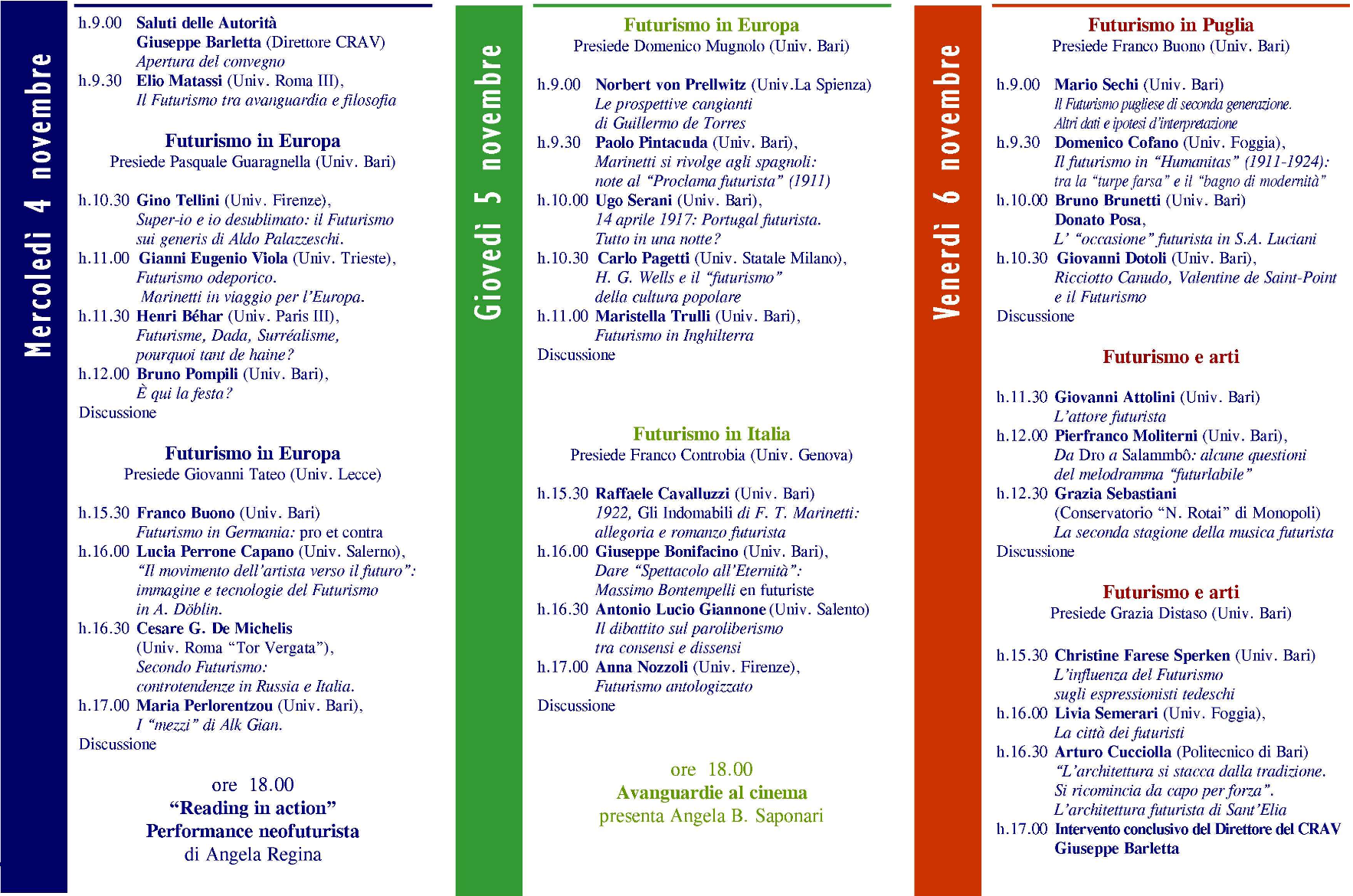
Text of my intervention:
TRISTAN TZARA FORERUNNER OF FUTURISM
Ladies and Gentlemen, illustrious colleagues,
I owe you apologies: although I have prepared all the materials for the announced intervention, "Futurism, Dada, Surrealism, why so much hatred?", I will not be able to treat it. It is not only a question of time, for I am convinced that one can always reduce to a few minutes a general remark. The truth is that in taking up the question from the beginning, I noticed that futurist-inspired criticism, if I may say so, was spreading inaccurate and malicious remarks about one of the protagonists of the affair, so that it seemed necessary to me to make a clarification today.
Indeed, the catalog of the exhibition Dada e surrealismo riscoperti, which is currently being held in Rome, contains this affirmation by Paola Decima Lombardi, which seems to me to accumulate at accelerated speed all the characteristic falsehoods as soon as one touches on the history of avant-gardes:
Regarding the paternity of Dada, and the importance exercised by futurism, many people have denied Tzara, starting with Huelsenbeck, and moreover at least two letters to Marinetti testify that if Tzara in 1915 asked him for verses for the Dada Anthology, and if he invited in 1917 the futurist artists to the first Dada Exhibition Galerie Corray in Zurich. But in vain, because they are all at the front. His precision about Dada, in any case is the first of a series of claims of his role, contradictory with his attitude, and which will be the reason for future conflicts.
Far from discussing this lapidary execution, I will take it as a pretext to show how much Tristan Tzara was the forerunner of futurism, that is to say, in good French, the one who announced it in Zurich during the war, before turning away from it for essentially poetic reasons. But first, I would like to return to questions of principle:
- whether he appreciates the productions of futurism, dada or surrealism, the critic, the historian of avant-gardes does not have to take sides for one or the other movement;
- dealing precisely with "movements" and not fixed aesthetics, determined once and for all, he must take into account, more scrupulously than elsewhere, the variations, even the contradictions assumed by these movements in the course of their evolution;
- here more than ever, one must rely on irrefutable documents, submitted to the most rigorous material criticism;
- finally, one cannot sufficiently warn researchers against anachronism, this "unforgivable sin," condemned by Lucien Febvre.
I. A bad quarrel
A misinterpreted document
It will soon be forty years since an article by an author, "de cuyo nombre no me quiero acordar," as Cervantes said, appeared in Paris, which brought us a surprising revelation, destined to revolutionize the history of the avant-garde, and particularly the relations of Dada and Futurism. It was nothing less than a letter from F.T. Marinetti to Tristan Tzara, revealing unsuspected relations between the leaders of these two movements that had become rivals. Very discreet about his sources, the author of the said article did not say from which archives this handwritten missive dated July 5, 1915, came from. If, among the still living witnesses and specialists, no one doubted that the Dada Movement, even before its advent, knew Futurism and referred to it both in its artistic practice and during its public manifestations, no one had indeed thought that Tzara could have corresponded so early with Marinetti, a year before the publication of Cabaret Voltaire, two years before that of the journal Dada, while the name-case of the "child horse movement" had not yet been found!
Two remarks immediately came to my mind, which I shared with the author of the article after going myself to the Jacques Doucet Literary Library, where this document is located, for a quick verification:
- on the date in question, the young Tristan Tzara, whose pen name had never yet appeared in this form (it will only be printed in October 1915 in the journal Chemarea), was still living in Romania, where he was studying philosophy and mathematics.
- The envelope accompanying this autograph handwritten letter, with Futurist Movement letterhead, apparently addressed to Tristan Tzara in Zurich, was to say the least surprising. Materially, its paper, its dimensions did not suit the support of the message (the error coming from the conservators of the Doucet Fund; it has since been repaired).
The polemicist did not hide his intentions. Indignant at the favorable opinion movement towards Dada since the defense in Sorbonne of a thesis on the subject (1), he wanted to remind French public opinion that it should feed on Futurism, from which all avant-garde came, and notably Dada, which, except for photomontage, owed absolutely everything to it. What better argument could one find in support of this thesis than a letter from the founder of Futurism addressed to that of Dada?
Moreover, in his neophyte ardor, the Marinettian defender went so far as to deny any personality to Tristan Tzara, writing this, which was worth definitive condemnation: "Tzara was sincere when he said that dada had no program. When he has one of his own, it is still with the futurist verb that he will make system. Either by adopting the Marinettian imperatives, or by rising against them, it is always from futurism that Dada has fed." and, further on: "It is always with the help of futurism that Tzara worked for his glory. (2)"
In good logic, no one should add anything to that. However, one could hope that the futurists' archives, and particularly those of Marinetti, would allow supporting this judgment without appeal. For, finally, the only material proof of epistolary contact between the two leaders of the two now opposed movements came from Tristan Tzara's archives alone. It is as if, wanting to make the history of diplomatic relations at the time of Italy's entry into the war, in 1915, one stuck to the only documents provided by the English! Would there not be, in Italy or elsewhere, the counterpart of this Marinettian correspondence, which our all-out inventor would have made it his duty to publish with the same luxury of epithets?
The centenary of Futurism has rung, and I still have not seen anything arrive. Curiously, nothing has come out of Marinetti's archives or those of his companions that could specify the content of the letters that Tristan Tzara addressed to him, and especially the tone used towards him. No doubt he was very deferential, as was the epistolary custom of the time.
Text explanation
One must stick to the facts: the letters from Marinetti preserved by Tzara, and read them methodically, I mean with the method that our masters have taught us in the field of literary history, and not hagiography.
First, here is the raw document as it has come down to us thanks to Tristan Tzara himself, who took care to preserve it, despite the vicissitudes of his own existence, until it entered the collections of the University of Paris Library.
In this regard, I who have provided Tzara's complete works, I must say, not only how much I am indebted to him for his concern for the archive, but especially for his objectivity, since he has preserved all the pieces that one finds in the Doucet Fund, whether they are favorable to him or not. The same liberalism characterizes his son Christophe, an internationally recognized scientist, who has always favored work on his father's work, without the slightest exclusivity, without ever making the slightest objection to the most far-fetched theses!
On paper with Movimento Futurista letterhead, here is therefore the autograph handwritten piece signed by F.T. Marinetti, cataloged TZR C 2531, dated from Milan, July 5, 1915:
My dear colleague, Here are futurist poems among the most advanced. We cannot give you free verse, given that free verse no longer has any reason to be for us today. I therefore send you words in freedom (parole in libertà), absolute lyricism, delivered from all prosody, from all syntax. I absolutely insist that futurism be represented in your interesting lyrical anthology by truly futurist works.
All my anticipated gratitude and the expression of my lively sympathy.
F. T. Marinetti
Who was this addressee to whom Marinetti addressed himself with such civility, in quality French, as was his habit? The document being in Tzara's archives, and for lack of a more precise address, we must admit that it was intended for him.
Tzara was exactly twenty years younger than Marinetti (but I doubt that he made known his youth to his interlocutor: in general, one likes to age oneself when entering active life). Some of his poems had appeared in November and December 1912 in the journal Simbolul [The Symbol] that the high school student at Milhai-Viteazul had founded with his classmates Ion Vinea and Marcel Janco. He had just reached sixteen! If the fateful year 1914 was devoted to preparing for the baccalaureate, the following year saw him devote himself again to poetry, and seek the means to publish a journal of wider audience.
At the end of June, he had just published a Romanian poem [Cousin, intern at the boarding school] in the Noua Revista Romana in Bucharest, signed "Tristan," simply. He was still looking for his name, if not his way. He was going to opt for the pseudonym "Tristan Tzara," carried on a mockup project for the translation, in his way, of a very Laforguian-looking Hamlet.
Where did he live in July 1915? As I said above, it could only be in Bucharest, where, to the great chagrin of his parents, he was more concerned with literature than with his university studies, waiting for the end-of-year exams. Once poetry embraces its man, it does not let him go. All those who have animated an artistic publication know how to proceed: one begins by soliciting some personalities of renown, who will sponsor, so to speak, the first issue, by giving it the tone and attracting the customer, at the same time. One had to aim wide, to show one's open-mindedness and to win over the public favorable to new ideas.
Everything leads one to believe that in June, Tzara addressed a certain number of famous writers, in Romania and abroad, to announce to them that he was preparing an anthology of the most advanced poetry, free verse for example, and that he would receive their contributions with pleasure.
This is at least what is suggested by Marinetti's letter responding all the more willingly to a poet as he is the citizen of a country that has reserved the best welcome to futurism, since its advent. Need I recall, indeed, that on February 20, 1909, in Craiova, the journal Democraţia published the Futurist Manifesto, the same day therefore as Le Figaro in Paris? And since then, the echoes on his movement have not ceased to multiply in the Romanian press, just as his works and those of his disciples have circulated there, both in Italian and in French and Romanian, as the recent compilation by Emilia David shows very well (3).
The founder of futurism takes advantage of this to set the record straight a bit: free verse is no longer in use, since the battle has been won for a long time. On the other hand, one must now break lances for "words in freedom" (his book on the question appeared in 1913, in French, at Poesia editions), carefully defined and illustrated by the attached pieces.
The attached pieces
Unfortunately, these have been separated from the correspondence. It does not take a dark lantern to locate them in the Tzara collection. They are not in Chemarea [The Call], the new journal animated by the same trio as [The Symbol], with Ion Vinea at the helm, who formulates quite vigorous ideas there, and who, in October, finds himself quite alone since Marcel Janco has gone to pursue studies at the Polytechnic Institute of Zurich, soon joined by his friend Tzara. [The Call] therefore has only two issues, October 4 and 11, 1915. Since these contributions wanted to be representative of futurism are not published there, it is that Tzara will have taken them with him. They are found, indeed, in Cabaret Voltaire, "literary and artistic collection" launched by Hugo Ball on May 25, 1916, announcing an international journal that will bear the name DADA. Now, where can the contributions of Marinetti, Cangiullo, Buzzi come from, if not from the documents entrusted by Tzara to Hugo Ball, received since the previous year? It suffices to browse the table of contents of this unique issue to be convinced that, far from hiding it, the movement in gestation claims all European avant-garde, both Expressionism and Futurism and the New Spirit. The same observation applies to the first two issues of the journal Dada, published in Zurich in July and December 1917.
One must be blind or of a singular bad faith not to observe, as all historians and all commentators have done, except the exclusive agent of Marinetti, that Dada is, at its beginnings, a melting pot, that it intends to welcome in its ranks all the representatives of the various tendencies of modern art, whether they reside in a neutral country like Switzerland or belong to one of the belligerent nations. This was moreover its principal objective in the eyes of Hugo Ball, declaring at the threshold of Cabaret Voltaire: "Today and with the help of our friends from France, Italy and Russia, we publish this little notebook. It must specify the activity of this Cabaret whose goal is to remind that there are, beyond war and homelands, independent men who live other ideals."
II. An editorial strategy
The conquest of the world by journals
The matter is settled: no more than his accomplices, Tzara wanted to hide the presence of futurist works during the first dada manifestations, quite the contrary. It is he himself who published in original language the poems of his Italian correspondents in the journal that he now directed alone, in order of appearance: Franceso Meriano, Alberto Savinio, Nicola Moscardelli, Maria D'Arezzo, Gino Cantarelli, Bino San Miniatelli. It is also he who wrote advertising notes on the numerous journals he received, where he was moreover published himself: Le Pagine, La Brigata, La Diana, Italia Futurista, Noi, Procellaria...
All this was done in the spirit of modern, young, avant-garde art, with the concern to make known the creative activity of one and the other in the widest space of a Europe which, let us recall, was at war, in the most concrete sense of the words. The future had nothing cheering for the young exiled Romanians who immediately set their minds on getting themselves reformed.
Tzara was therefore designated by his companions to lead an all-out correspondence campaign, as evidenced, among others, by a letter that Ball addressed to him on August 16, 1916, explaining to him why the journal Neue Jugend could not print his Dada manifesto in French, and proposing to him, on the other hand, to publish there as well as in Die Aktion, some of his poems that he would take charge of translating, in return for a publication of his own in France (4). The same strategy is deployed towards Italian futurists (or assimilated) from the autumn of 1916. To be brief, I mention here only the correspondences of the last quarter of 1916, and, among the letters received and preserved by Tzara, this one, which seems to have escaped the annotators. Handwritten, in French, it is from Giorgio de Chirico (5):
Ferrara 17-12-1916
Dear Sir,
I received yesterday your express, to which I hasten to reply. To my great regret it is impossible for me to send you xylographies [sic], I myself do not make any and am moreover opposed to this art, I find that for truly modern painting what is best for reproduction is photography. I thank you all the same for having thought of me and am delighted to have made your acquaintance. I know your journals, your enthusiasm for the new spirit, your original and profound poems. I am very happy that you reproduce some of my paintings in "the Anthology." Savinio has gone for a few days to Florence. From there he will send you photographs of futurist and modern paintings in general. He will also speak of you and your journals to the young people there and especially to Papini and Soffici who are the best. Thank you for what you tell me about my paintings. I must add that I have commitments with Paul Guillaume that prevent me in a certain way from exhibiting on my own account. You would have to address yourself to him: 16 avenue de Villiers, Paris. I hope that now you have received my drawing. If it does not spoil too much I beg you to keep it as a souvenir of me. Write to me when you can. I shake your hand. Thank you courage and forward!
G. de Chirico
A great reader of Apollinaire's Soirées de Paris, Tzara knows perfectly how to situate his correspondent in the avant-garde. From this message, it emerges that he has hastily asked him for his collaboration both for the journal Dada, in preparation, and for the exhibitions announced in Zurich under the same banner. Having already published a booklet of poems illustrated with woodcuts by Marcel Janco, The First Celestial Adventure of Mr. Antipyrine (probably attached to his missive), it is for him, as for the expressionists and a good number of his comrades, an old technique perfectly proven and brought back into fashion in avant-garde artistic publications (moreover Dada 1 will contain a woodcut by Prampolini). One sees that he is here surpassed by De Chirico, for both technical and ideological reasons, the latter wishing to adapt to the reproduced object, just as he intends to put him in contact with the true Italian artistic youth, in this case the animators of the journal Lacerba. If he declines the offer to exhibit his paintings in Zurich, insofar as his exclusive contract with Paul Guillaume does not authorize him to do so, he has nevertheless offered him a drawing, as a testimony of the esteem in which he holds him for his activity and his poetic productions (6).
As in Marinetti's letter, the notion of anthology reappears, which seems to please Tzara enormously. What does he designate by that? By definition, it is a collection of quality poems, representative of the new tendencies that Dada, as a "movement," could federate, without anyone losing their personality. This is, it seems to me, what emerges from Tzara's various epistolary solicitations, as well as from the announcement made in Cabaret Voltaire. I will give only one proof of what I advance here: the card (unpublished) received by Tzara on February 24, 1917. It is addressed spontaneously "To the director of 'Cabaret Voltaire'," which means that at the time he has indeed taken over from Hugo Ball, who has moved away from Dada for reasons related to his own mysticism.
Mantua 24-2-1917
I learned from the Italian journal Avanscoperta (from Rome) the edition of "Cabaret". I would be very obliged to you if you would send me a copy, also indicating the association price: if you can, send the anthology of modern poets against reimbursement, not knowing at present its price. I am an intimate friend of G.F.T. Marinetti and I belong to the futurist movement. I wait (7)
Premature announcement, which will be taken up in Dada 1: "THE DADA ANTHOLOGY appears in autumn under the direction of Tr. Tzara.", while the said anthology will see the light of day only on May 15, 1919, in Zurich. It will be followed by a certain number of others, Tzara not tiring of this type of collection.
In fact, he will respond to this solicitation, by sending the new journal as soon as it appears, for which he will receive Procellaria, inaugurating a permanent exchange of journals and texts that will be published in both countries.
All this clearly falls under a veritable editorial strategy, particularly adapted in wartime since Zurich remained a hub of exchanges between belligerent or non-belligerent countries, and that the journal Dada, directed by Tzara, had simultaneously a German and a French edition. The misfortune is that no one has yet thought to study it from a mediological point of view. The height is that one can reproach Tzara for his internationalist activism, he who could have contented himself, like so many others, with cultivating his vices! That he derived advantage from it on the level of notoriety seems to me a natural counterpart.
Personal glory
The fact is that the young Romanian poet had just reached his majority when he published, in less than a year, in the Italian poetic journals of Naples (Le Pagine, La Diana, Crociere barbare), Mantua (Procellaria, Bleu), Rome (Noi, Cronache d'attualità), Ferrara (Arte nostra), Catania (La Fonte). This gives him incontestably a quite personal notoriety (from which Dada benefits in passing), without however alienating him to futurism. At bottom, it is because they want to, and because they derive a certain pleasure from it, that the responsible parties of these organs, poets themselves, give to read these examples of dadaist deconstruction, there again in original language.
In passing, this lets us understand that the readership (real or supposed) was favorable to the French language, and that, seduced or not by what he read, was fond of this kind of new poetry, since he was given more of it! That this aroused some hostile reactions, such as that of Mario de Leone reviewing The First Adventure..., is not surprising: one finds this kind of verse in the oldest nursery rhymes, he declares (8)!
The exchanges of conversation with the Italians, and especially of poems or paintings, the prospect of publishing this anthology which will bear the title "Manifestations of new art and literatures" (sic) in a volume abundantly illustrated with 160 pages in the format of Cabaret Voltaire sufficiently exalt Tzara to lead him to ask Meriano to find him a printer for a volume of Negro poems in preparation, that he would like to see printed in the same collection as his Equatore notturno (9). This is to say how far his confidence goes, not to mention the epistolary formulas by which he puts himself at the disposal of his interlocutors to disseminate their futurist works. In this, he had much merit, for his Zurich companions did not spare him warnings.
Much merit
Let us not be Manichaean: if nascent Dada holds contradiction as a vital principle, one must not refuse it to defend certain arguments of Futurism while rejecting its global theses concerning the future. This coherence in incoherence led Tzara to maintain for a long time still his contacts with the Italians whose plastic and poetic works he could appreciate without however subscribing to their ideology. On this plane, he had much to do for his own friends, won over to expressionism or cubism, were not very favorable to futurism, like Apollinaire or Cendrars. A reflection by Marcel Janco, a few days after the first dada evening, gives the tone. He reports to Tristan Tzara on his activity in Zurich, while his correspondent, exhausted from nervous tension, has gone to rest in the mountains: "I have had here several times terrible discussions in which I defended myself but with more difficulty for you because there were French people who said that futurism is a misfortune (10)." Let us understand that it was relatively easy for the plastic artist to defend the presence, on the walls of the cabaret, of futurist paintings, while the arguments in favor of words in freedom and especially the Marinettian theses on war "only hygiene of the world" and other remarks of the same ilk passed very badly.
This did not prevent them from maintaining, if not seeking contact with the Italians because, once again, strategy commanded to receive information and works from all belligerents and to send them, in return, Dada 1.
In this regard, one of the rare notes from Marcel Janco to his accomplice informs us about the true nature of the relations between the different artists of Zurich:
Jules wrote to you that two futurists looked for me. I had barely arrived yesterday and they came again to my house. Only one of them is a futurist. It's a certain Bino friend of Prampolini. He sends you his compliments. He stayed a short time. He told me that they published a journal "de avanguarda" and with avant-garde artists. He showed it to me and there you also publish "Cold light" it seems to me, but they published it with many mistakes. A woodcut of mine is again very badly reproduced. I learn there that I exhibited something in Palermo. The whole journal is mixed Avanscoperta format with a text, 2 columns like sensational novels, and collaborators like Pramp., Bino, Galante, Meriano, Tzara etc. etc. I don't think you are so fond of seeing it and with reason. Bino is a type of futurist who "precisely because he is a futurist necessarily teaches." Talkative, one day he insults everyone, even Prampolini, he doesn't even know Meriano and he doesn't like cubism. Finally I behave with him in a haughty way and gave him to understand that he is still a little boy. We see each other again at the café Friday, from where I will write you with him a postcard.
Follows, on the scheduled date, the announced card: Here we are in the midst of fervent discussions on futurism as formerly in Paris. I salute you boldly. Your M. Janco, Bino Miniatelli, V. Berardi (11).
From this report, it results that the futurists (besides their permanent representative in Zurich who is Alberto Spaini) circulate in Switzerland, even during the war and that they always try to establish the superiority of their movement over all avant-garde manifestations. They quickly execute the promises made to their correspondents, without sending them proofs, which makes them rather suspect. Perhaps it is this casual behavior that made Tzara write, in his facetious letter to Jacques Doucet to accompany the sale of the manuscript of Twenty-five Poems: "I was bombarded with letters from all parts of Italy. Almost all began with 'caro amico', but most of my correspondents called me 'carissimo e illustrissimo poeta'. This quickly decided me to break off relations with this too enthusiastic people." (OC I, 642) Not all words are to be taken literally. And if a poet does not lie, he tells his own truth! At least he expresses a tendency: compared to relations with German artists of Die Aktion, for example, those of the Italians, scattered, diverse, even contradictory, became tiresome. All the more so since one had to oppose a certain sentimentalism, as we will see below.
III. Tzara's personal poetics Tzara rejects futurism before Dada
It is therefore clear that Tzara was not acting for his own account, associating Marcel Janco with his missives, and, when he could, Hugo Ball, Hans Arp or Mopp, seeking above all to spread avant-garde works in Switzerland and, through this means, to all of Europe. He had much merit since he himself had questioned the main futurist theses, from 1916 and not only from the "Dada Manifesto 1918" (published in December 1918) that everyone agrees to consider as an act of absolute rupture with all previous schools.
It is in the first "Manifesto of Mr. Antipyrine," declaimed during the first Dada Evening on July 14, 1916 (note the symbolic date for the French) and published immediately after in The First Celestial Adventure of Mr. Antipyrine, that one hears this refutation of Marinetti's proclamations: "Dada is life without slippers or parallels; who is against and for unity and decidedly against the future [...] We declare that the car is a feeling that has caressed us enough in the slowness of its abstractions..." (OC I, 357) Much later, Tzara himself will explain to the listeners of French radio, in 1950: "The manifesto [...] takes position against futurist modernism which it puts on the same plane as bourgeois sentimentalism and also against the dogmatism of doctrines wanting to enclose art in narrow categories" (OC V, 508). Founded on his own experience, the criticism bears as much on the theoretical proclamations too well known for me to return to here (speed, the new beauty of the automobile) as on poetic practice. Very explicitly, Tzara will see himself obliged to refuse to insert in the journal Dada a poem by Binazzi that he finds very beautiful but whose pathos and overall tone do not suit the general line of the collection in preparation. He then writes to Meriano: "If you want therefore to send me small poems by authors who have really surpassed the scientific monochrome futurism, the sentimental moment, or the romantic and busy display in conjectures, I will publish them with great pleasure (12)..."
In short, Tzara's rupture with the futurists takes place on strictly poetic bases, since in 1919 he still declares himself disposed to publish poems coming from Italy, provided that they join his vitalist options. It is the eternal conflict of art for life or life for art that resurges here. And we know on which side Dada leaned. A few months earlier, Tzara had magnificently signified: "We have had enough of cubist and futurist academies, laboratories of formal ideas".
There was no longer any reason to return to it.
His poetry owes nothing to futurism
And if, from 1916 to 1919, Tzara had worked for a large representation of futurist works, as an astute director of a small poetry journal, if even the Dada manifestations did not ignore futurist dramaturgy, did his own poetics belong to futurism, in one way or another? It would take glasses of a particular tint (that of paranoid obsession) to show it.
Wanted notice
However, I could not conclude this intervention on Tristan Tzara's relations with Italian futurists without launching a wanted notice!
Indeed, the redresser of wrongs mentioned at the beginning makes mention of a mysterious journey that Tzara would have made to Ferrara and Rome during the summer of 1916. He relied on a living testimony and also on an affirmation of a contemporary art critic.
In the series of articles "Dada a Roma. Contributo alla partecipazione italiana al dadaismo", Enrico Crispolti wrote, at the beginning of the section entitled "Prampolini e la prima serie di Noi": "Prampolini conosce Tristan Tzara a Roma, nell'estate del 1916 (13)", without however citing any source attesting to this information. Then he added: "Tzara si era recato a Ferrara, ed era di passaggio per Roma. Cercava a Ferrara Savinio e De Chirico? Certo i suoi interessi erano anche per l'area futurista, almeno in poesia" (ibid.).
Allegation to say the least surprising: besides the imprecision and the absence of any document concerning the date of this journey, it should be noted that it would have taken place at the very moment when Romania, by a sudden reversal of alliances, had declared war on Germany, on August 28, 1916!
Now, I have found nothing that alludes to this journey. Not that it was impossible for a Romanian citizen to cross the Alps at this time (the Italians were coming to Switzerland!), but he would have had to make démarches that would have left traces in administrative documents, or again in his correspondence. François Buot, his biographer, neither (14). It is all the same surprising that his closest friend then, Marcel Janco, never alluded to it!
Moreover, I will cite, to finish, two unpublished pieces by Alberto Savinio (among the eight preserved at the Doucet Library) from this summer of 1916. They show that contact was established very warmly, but that there is never any question of an upcoming visit.
The first is an autograph postcard in French, dated 11-07-1916:
Sir (15), I have received your kind letter; I thank you for your very beautiful notebook "Cabaret Voltaire". I will put you in touch with my friends from Florence, Bologna and even Ferrara! They will be able to launch Dada in Italy. I will send you some of our manuscripts. Are they for the Cabaret V. or will they wait for the birth of Dada? You will soon have news from me: as soon as there is something done. Very happy to have made acquaintance with you, I shake your hand with much cordiality.
A month and a half later, the second is still a postcard sent from Ferrara on 26-8-1916:
Dear Mr. Tzara (16), I have delayed in answering your kind card, for I have been quite ill lately, and I have had on the other hand to struggle among a thousand difficulties that military life makes me endure. I had the greatest pleasure in reading the celestial adventure of Mr. Antipyrine. I find your poem pregnant with a completely new, fresh poetry, full of clarity and finesse. I have retained by heart several passages. Certain episodes and certain characters – such as the photographer priest – are particularly exquisite. Send me therefore the second booklet. Very pretty Janco's drawing. Tell him from me my joy at having entered into relation with such valiant artists. I neglect myself for the useful side: I wrote the other day to several of my friends. You will soon have the addresses that you asked me for; you will thus be able to enter into relation with them. I hope to send you soon something for your modern art anthology. I shake your hand very amicably.
As for Marinetti's initial letter, one would have to engage in a textual analysis showing the exact state of relations between the two artists who then placed themselves under the sign of modernity and not of a partisan label. There would still be much to say about the whole of their relations, up to the odious nationalist, racist, anti-Semitic article that Savinio was going to devote to Dadaism in Il popolo d'Italia three years later. But I would not want to tire your attention and prevent you from hearing the surprising revelations of our friend Bruno Pompilli, in Italian, of course.
Appendix
Here, proving that Tzara has indeed received, preserved and increased the shipments of Italian futurists mentioned during this intervention, an extract from the catalog of the sale of his library in Berne on June 12, 1968 by Kornfeld & Klipstein (French transcription): 114 — Futurism, lot of 8 manifestos:
- MARINETTI. Manifesto of Futurism. Published by Le Figaro on 20.2.1909.
- PRATELLA. Manifesto of futurist musicians. 15.5.1911.
- BOCCIONI. Technical manifesto of futurist sculpture. 11.4.1912.
- MARINETTI. Technical manifesto of futurist literature. 11.5.1912.
- MARINETTI. Supplement to the Technical Manifesto of futurist literature. 11.8.1912. 6. JOLY. Futurism and philosophy. (French and Italian). July 1912.
- RUSSOLO. The art of noises. 11. 3. 1913.
- MARINETTI. Wireless imagination and words in freedom. 11.5.1913. 115 — Lot of 9 manifestos.
- APOLLINAIRE. The futurist anti-tradition. Manifesto-synthesis. Paris, 29.6. 1913.
- CARRA. The painting of sounds, noises and odors. 11.8.1913.
- MARINETTI. The Music-Hall. 29.9.1913.
- MARINETTI. Down with the Tango and Parsifal! 11. 1.1914. 2 p.
- MARINETTI. Geometric and mechanical splendor and numerical sensibility. 11.3.1914. 6. MARINETTI. Against English art. Read at the Doré Gallery. London, 11.6.1914. 2 p.
- MARINETTI. The futurist dance. July 1917.
- MARINETTI, SETTIMELLI, CORRA. The synthetic futurist theater... 11.5.1919.
- MARINETTI. Tactilism. Read at the Théâtre de l'Œuvre, Paris... 11.1.1921. with Apollinaire's Manifesto "The futurist anti-tradition". 116 — Marinetti, F. T. "Dune. Parole in libertà". Futurist poems, Tinte, 7 p., 31x21 cm, by the poet on edition sheets, 93.5x65 cm, mounted. Contains the manuscript of the original Italian version of the poem "Dune", composed in 1912. Published in French in: Marinetti, Les mots en liberté futuriste, 1919. Pages 1-6 and 9 (end) of the poem. Page 9 of the poem, "signed F. T. Marinetti futurista ", at the bottom left again large blue pencil, signed "F. T. futurist Marinetti". The missing pages 7-8 were reprinted in: Cabaret Voltaire, 1916, p.22-23. As well as: BUZZI, Paolo. "L'Ellisse. Conditional liberation in libertà". Arch, 65:50 cm, with 4 raised edges (4 Futurist Calligrams) from his book L'Ellisse e La Spirale, 1915, p. 234, 330, 332, 342. Govoni, Corrado. Arches, 50x65 cm. With 3 signed futurist calligrams. As well as 3 futurist documents. Unique. 117 — Les Mots en liberté futuristes. Milano, Edizioni futuriste di Poesia, 1919, 19.3x12.8 cm, 114 p.... The article, reworked, was published in: Futurismi Italian edition by Giuseppe Barletta, Bari, B. A. Graphis, 2012, 592 p. Reprinted in H. Béhar, Ondes de choc, p. 23-35.
- See: Michel Sanouillet, Dada à Paris, Pauvert, 1965. Numerous reissues.
- G. Lista, "Prampolini, Tzara, Marinetti, inédits sur le futurisme", Les Lettres nouvelles, op. cit., p. 123 and p. 126.