"The New Scientific Review, Surrealist Magazines and the Key Concept of Science", in: Tania Collani and Noëlle Cuny, Scientific Poetics in European Modernity Magazines (1900-1940), Classiques Garnier, pp. 157-165.
As will be seen below, the scientific approach to surrealism has always preoccupied me, in the same way that the surrealists sought to bring together the new sciences with their poetics. I have explained this several times, both in the Mélusine magazine and during the presentation of a Dali collection or in the contribution mentioned here. It must be said that since my entry into high school, I have always been considered a "modern", which means that, just like Breton for the previous generation, I entered a so-called modern class, the only one at the Lycée Charlemagne at the time, and thus I climbed the degrees up to the baccalaureate, with the same companions, without learning Greek or Latin. If I did not neglect classical literature, my readings were rather of a scientific nature, and I regularly informed myself of new developments in a natural sciences magazine, in the plural. The drift of continents was then more familiar to me than that of ideas, and I knew more about the hypothesis of launching an interplanetary rocket than about the grammar of texts. So much so that when I chose to enter philosophy class instead of continuing in "elementary math", I was considered original...
International Conference
Scientific Poetics in European Modernity Magazines, from 1900 to 1940
Organized by ILLE,
with the participation of INTERMAG and OudM
Mulhouse Campus,
June 16-18, 2011
Proceedings published in this volume:

Scientific Poetics in European Modernity Magazines (1900-1940), collective, under the direction of Collani (Tania), Cuny (Noëlle), Paris, Classiques Garnier, 2013, 461 p., Collection Rencontres, n° 54. Presentation: This volume brings together multidisciplinary work around literary and artistic magazines published between 1900 and 1940, converging on a federative thematic axis: science. While Planck was highlighting energy quanta, Rémy de Gourmont was opening the field of "little magazines", where the beginnings of a radical overhaul of taste and writing modes were being played out. In the first decades of the century, many European magazines, large and small, responded to the new solicitations of science and technology. What was the degree of distortion with which writers and artists welcomed the buzz coming from the scientific sphere of knowledge? What were the aesthetic and poetic products?
TABLE OF CONTENTS: Tania Collani and Noëlle Cuny. Preface Tania Collani. Wonders of Science. Little and Big Magazines of Modernity Part One. Modalities of an Encounter Hugues Marchal. Crossed Paths. Literature in the Mirror of Scientific Magazines Ion Pop. The Romanian Avant-garde and the "Industrial Activist Phase" Noëlle Cuny. Virtues and Vices of Scholarly Discourse in English Modernist Magazines: From One War to Another Part Two. "The Modern Synthesis": Technicism, Mechanicism and Revolution Gérard-Georges Lemaire. Italian Futurism: Machines Against Science Serge Milan. "Scientists Overtaken by Poets": Sciences in Futurist Avant-garde Magazines Astrid Starck-Adler. Apocalypse and Clash of Worlds in Di Khalyastre [The Gang], Yiddish Magazine of the Twenties Florin Oprescu. The Romanian Avant-garde and the Synthetist Challenge Emilia David. Scientific Borrowings of the Italian and Romanian Avant-garde: From Primitive Man to Mechanical Man Part Three. Surrealism, Science and Man Henri Béhar. The New Scientific Review. Surrealist Magazines and the Key Concept of Science Jean-Claude Marceau. Psychoanalysis in the Mirror of Surrealist Magazines (1924-1933): Reflections and Diffractions Klemens James. Between Alchemy and Epistemology: The Concept of Caput Mortuum in Documents and Minotaure Graziella-Foteini Castellanou. The Surrealist Movement, Greek Surrealism and Τα Νέα Γράμματα [New Letters (1935-1944) Part Four. Scientist Utopias? Aleksandra Krasovec - Biocosmist Periodicals and the Russian Avant-garde of the Twenties Cathy Margaillan. L'Italia futurista (1916-1918): Between Occultist Tradition and Modernity of Psychological and Scientific Research Eleonora Di Mauro. Verhaeren or the Tumultuous Forces of a Religious of Science Part Five. Territorial Demarcations, Methodological Wars Peter Schnyder. On Some Coquetries of La Nouvelle Revue française and André Gide Towards the Avant-gardes Anne-Marie Havard. The Grand Jeu's "Experimental Metaphysics" Project Jennifer K. Dick. Pierre Albert-Birot's Magazine. SIC Takes the Extreme Point of the Avant-garde During the First World War Part Six. Magazines and Sciences, Forms of Cultural Renewal Céline Mansanti. The Encounter of Modernism and Physical Sciences in the Interwar Period. Sciences at the Service of a Neoclassical Cultural Refoundation Ulrike Stroeder. The Theory of Evolution, Foundation of Progressive Ideas in Documents du progrès, International Magazine Peter André Bloch. The Four Regions of Switzerland. Their Avant-garde Magazines in Search of Identity S. Romi Mukherjee. Roger Caillois and Inquisitions. Political Diversions of Science and Poetry in the Interwar Period Part Seven. Science, Foundation of an Aesthetic Nicolas Surlapierre. Opioids: Scientific Time in the Magazine Ça ira! Sonia de Puineuf. "The Beauty of Mathematics and the Machine": Vilém Santholzer and Czech Magazines Pásmo and Disk Roxana Vicovanu. Purism or the Malaise of Modernity: Amédée Ozenfant and Le Corbusier vs Jean Epstein Documents – Unpublished Translations T.S. Eliot, "Current Events" (1918) Aleksandr Svjatogor, "Biocosmist Poetics" (1921) Filippo Tommaso Marinetti, "Imaginative Qualitative Futurist Mathematics" (1941) List of Illustrations Table of Contents Download my article.
Original Text: Mulhouse Conference: The New Scientific Review Surrealist Magazines and the Key Concept of Science By Henri BÉHAR
[The organizers of the conference "Scientific Poetics in European Modernity Magazines" having done me the honor, doubtless by right of seniority, of giving me the floor first, after the solemn opening remarks, tired of hearing texts intended for publication recited, I endeavored to use the new technologies at our disposal, by presenting a 35-image color slideshow, organized with PowerPoint, which I commented on orally as I went along. Since writing does not (yet) support the simple transcoding of this illustrated medium, I am therefore constrained to awkwardly transpose what emerged from orality. May the reader kindly forgive me for this exercise so little artistic.]
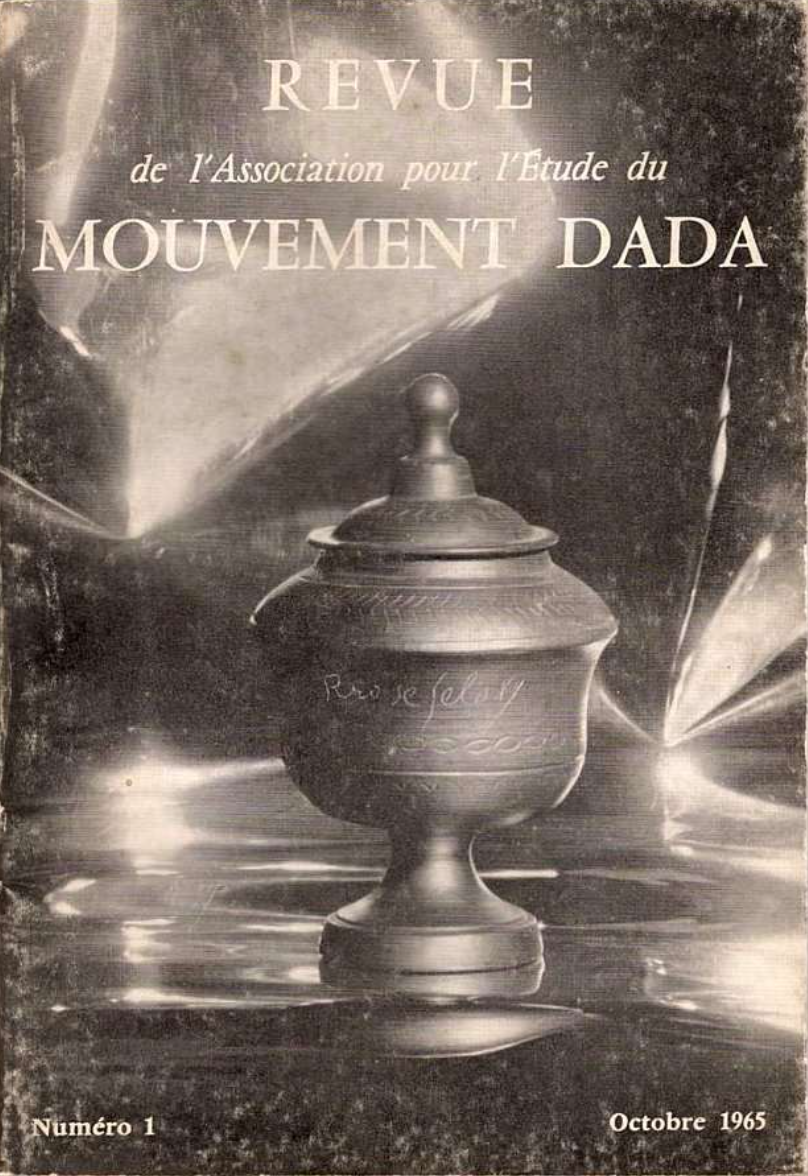
It has been 45 years since, in the first magazine I directed and produced from beginning to end, I published the embryo of a research program on avant-garde magazines. It was composed of a programmatic article by Michel Décaudin, and was to be followed by a descriptive sheet of the magazines Aventure and Dés, which, at the time, were accessible only in rare libraries or with collectors. For lack of space, this sheet established by myself was postponed to the next issue which, in the meantime, had changed publishers.
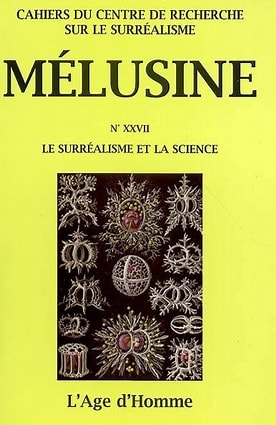
Then, and very recently still, I organized an issue of the Mélusine magazine subtitled "Surrealism and Science".
This is to say how much this conference called for an intervention on my part, both to recall the principles of a science of ephemeral magazines and to study their scientific policy, based on a precise methodology, lexicometry or textometry.
I. A Science of Magazines
Formulated succinctly by Michel Décaudin, then professor at the University of Toulouse, the initial program, "Proposals for a Corpus of Magazines", Revue de l'association pour l'étude du mouvement dada, n°1, October 1965, p.19-21, proposed three sections:
I. Descriptive Sheet II. Tables III. Historical and Critical Study
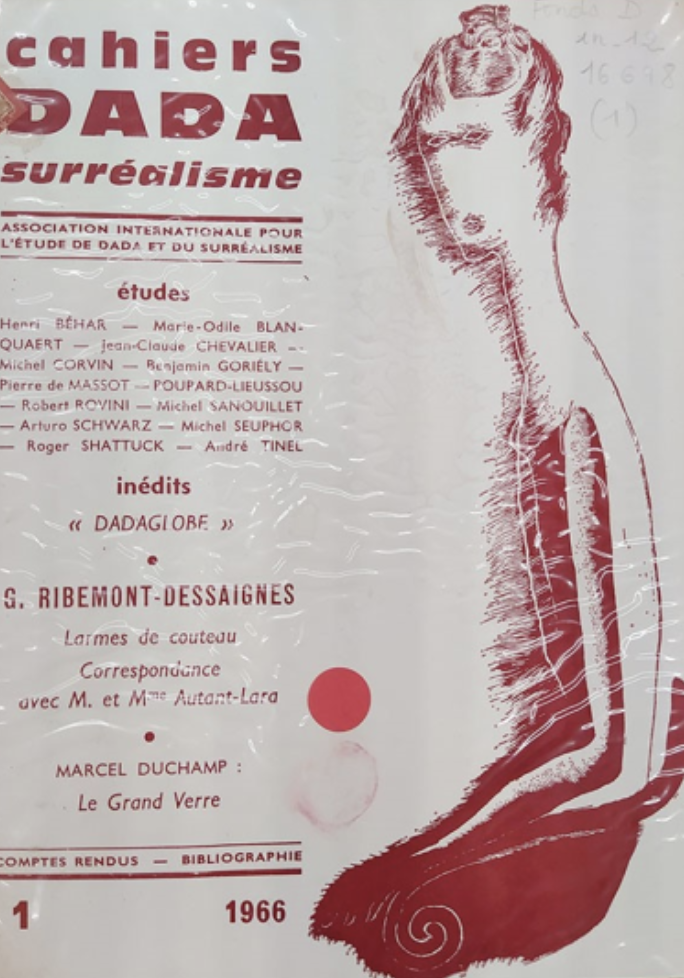
It was already, in itself, the fruit of the work and reflection of a small team of researchers, which, at the time, was considered a novelty, so much did literary scholars work in isolation. Despite, or because of its brevity, this project had quite a wide impact since I remember being contacted by the National Library and by the director of the Sainte-Geneviève Library to establish cooperation with their respective institutions. From this was to be born a program of reprinting and study of ephemeral magazines from the beginning of the 20th century, first realized in the form of microfilms, then reprints. I pass over the details of our negotiations, to arrive at this simple observation that no one would have the in-depth knowledge of surrealist magazines that we can achieve today if there had not been this initiative, taken up by an adventurous publisher. For my part, I strictly applied the stated program to the study of two magazines founded and directed (from afar) by Roger Vitrac, whose complete work and archives I had explored for my first thesis. My article, "Aventure and Dés", Cahiers Dada Surréalisme, n° 1, 1966, p.92-108, emphasized, not the scientific character of the remarks made by the young poets friends of Dada and future surrealists, but the technical procedures and skills required of the printers I had found.
II. A Scientific Methodology or the Hubert de Phalèse Method
It is not a question here of retracing the steps which, from studies bearing on the first companions of surrealism, notably through their ephemeral magazines, led me to launch a research project bearing on surrealist language and especially its vocabulary. My refusal of the reigning impressionism in our discipline led me to approach certain CNRS teams who, on the one hand, were elaborating the Trésor de la Langue française (TLF), whose primary virtue was to constitute a digital corpus of French literature, and, on the other hand, those who were laying the foundations of lexicometry. My team sharing the same methodological considerations was therefore integrated into the Institut National de la Langue française (INaLF), a CNRS laboratory, before becoming autonomous within the University of Paris III under the name of Hubert de Phalèse, famous factor of biblical concordances. One will find in La Littérature et son golem (éd. Champion) the principles of the method that I summarize here in four points for what concerns the little magazines:
- Exact and complete digitization of each magazine: the beginnings of computing imposed an economical capture, in other words a selection of texts, a bit like for surveys. This is not relevant for the literary text, just as one could not exclude citations within the article or notes, as the TLF did.
- Without lemmatization or personal coding: each commentator dreams of a personal tool, responding to their own views, so that they are the only one who can use it. However, the collective research that we postulate implies universal tools (or the most general possible) and above all the absence of individual marking. This will not prevent the subsequent use of syntactic software, coming in addition to a lexicometric treatment.
- Automatic processing: we then use a lexicometry software such as Hyperbase (1) or Lexico3 (2), which will give us different lexical or quantitative indications. It should be noted that they do not count exactly the same units, so that the numerical outputs are never identical. But the proportions remain relevant!
- Interpretation and systematic return to the text: I have scruples about repeating this evidence that the machines that serve us to process masses of texts, to formulate hypotheses, to make observations, in no way replace the interpretation carried out by the researcher himself, and that it is appropriate to always return to the text, if only to disambiguate certain terms. A precision in passing: I call key concept a form that can cover a whole series of terms expressing the same idea, the same concept.
Digitized Corpus (1920s-40s)
My double interest in a scientific approach to the text on the one hand, for surrealism on the other, led me to digitize over the years the following corpus of surrealist (or almost) magazines published during the period 1920-1940, characterizing the historical movement and the extreme dates initially provided by the organizers of this meeting: Littérature I and II: Paris, 1st series, n° 1 to 12, March 1919 to August 1921, directors: Louis Aragon, André Breton, Philippe Soupault; new series, n° 1 to 13, March 1922 to June 1924, director: André Breton. La Révolution surréaliste: Paris, n° 1 to 12, December 1, 1924 to December 15, 1925, directors: Pierre Naville and Benjamin Péret (n° 1 to 3), André Breton (n° 4 to 12). Le Surréalisme au service de la révolution (SASDLR): Paris, n° 1 to 5 and 6, July 1930 to May 1933, director André Breton. Bulletin International du Surréalisme (3) (1935-36): n° 1, Prague, April 9, 1935; n° 2, Santa Cruz de Tenerife, October 1935; n° 3, Brussels, August 20, 1935; n° 4, London, September 1936. (La Brèche): I indicate in parentheses the last magazine directed by André Breton, which falls outside our temporal framework, and to which I will refer as a witness mound. It was published in Paris, from n° 1, October 1961, to n° 8, November 1967.
Made Available to the Public
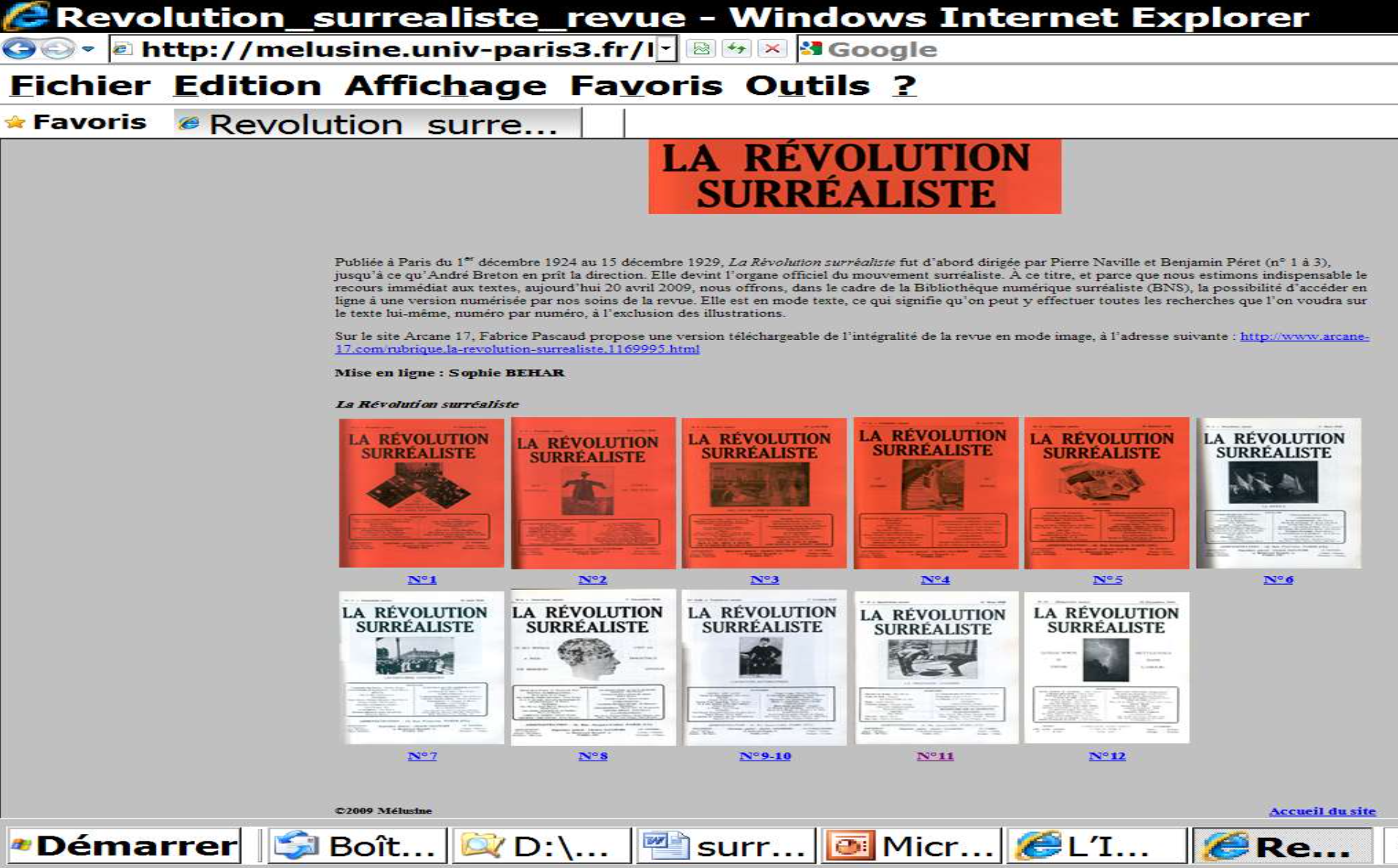
Most of these magazines have become extremely rare, fortunately, there are a number of identical reprints available. But, as far as investigation is concerned, nothing beats digitization, which we have insisted on making available to any public, after having provided the files to INaLF which integrated several of them into its Frantext database. They are directly accessible, without any restriction, registration or advertising, on the Mélusine/Center for Surrealism Research website at the University of Paris III. The image capture below shows its structure better than a long speech.
Automatic Processing
Equipped with the necessary tools, I therefore proceeded to the lexical processing of my magazine corpus. In a first step, it was a question of searching for the use of the key concept "science" in each of the enumerated series. Here is a graph that gives a fairly telling representation of the use of the term itself in La Révolution surréaliste, with its (relative) excesses and under-uses (just as relative):
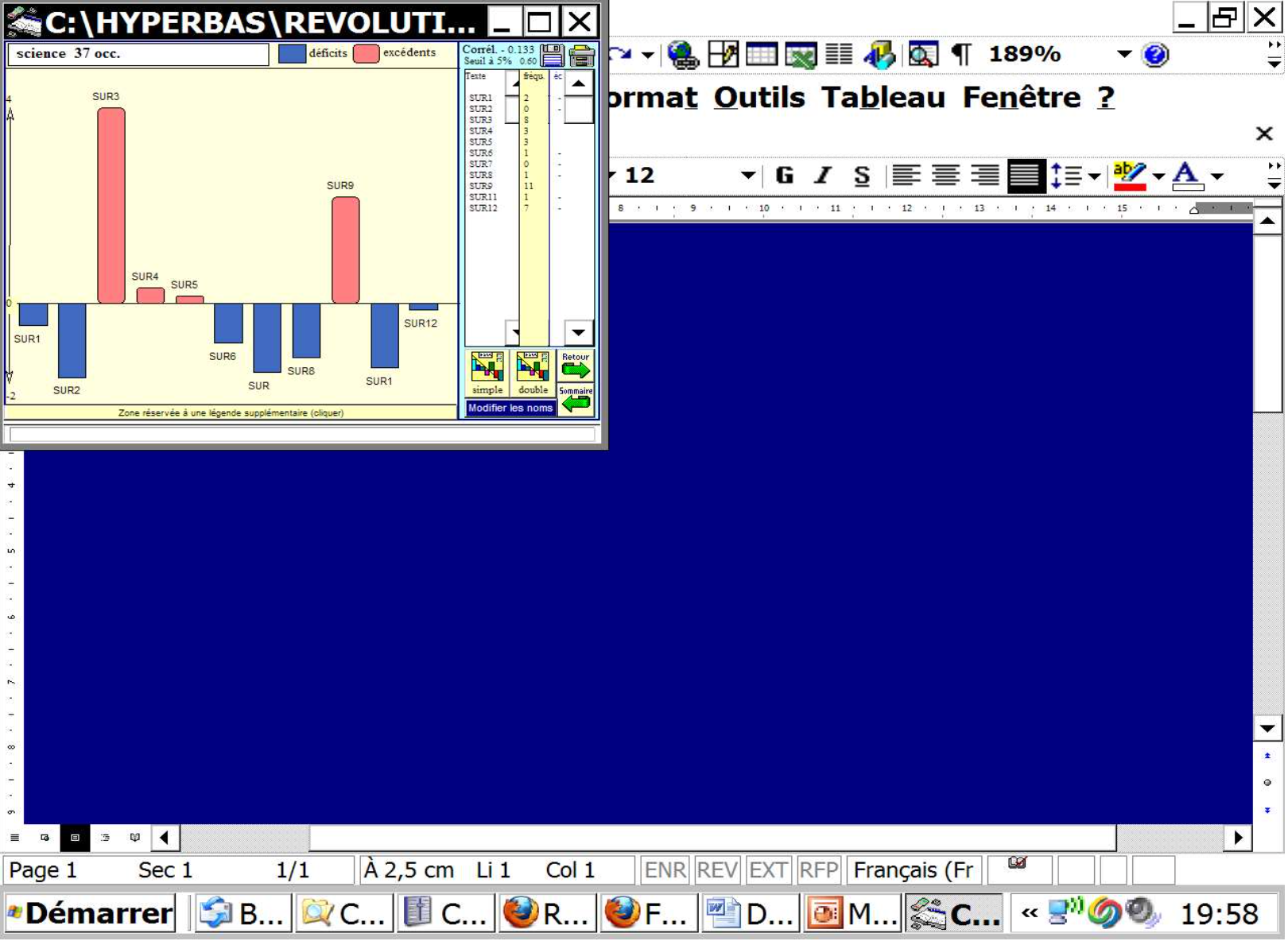
It is not a question of drawing any reflection from it without returning to the context of each occurrence, and I would even say to the textual whole. It should be noted that the same query can be performed on the Frantext database, available in all subscribing university libraries (but the graphical representation there is very simplified).
III. Surrealism: A Scientific Poetics
A. The Layout of La Révolution surréaliste as a Model of Poetic/Political Revolution
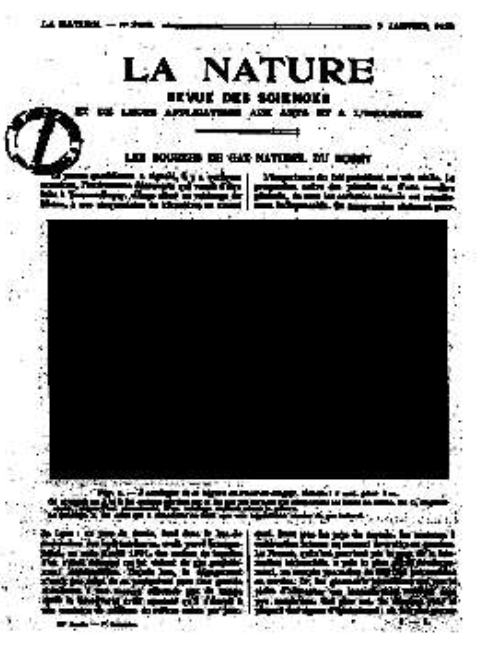
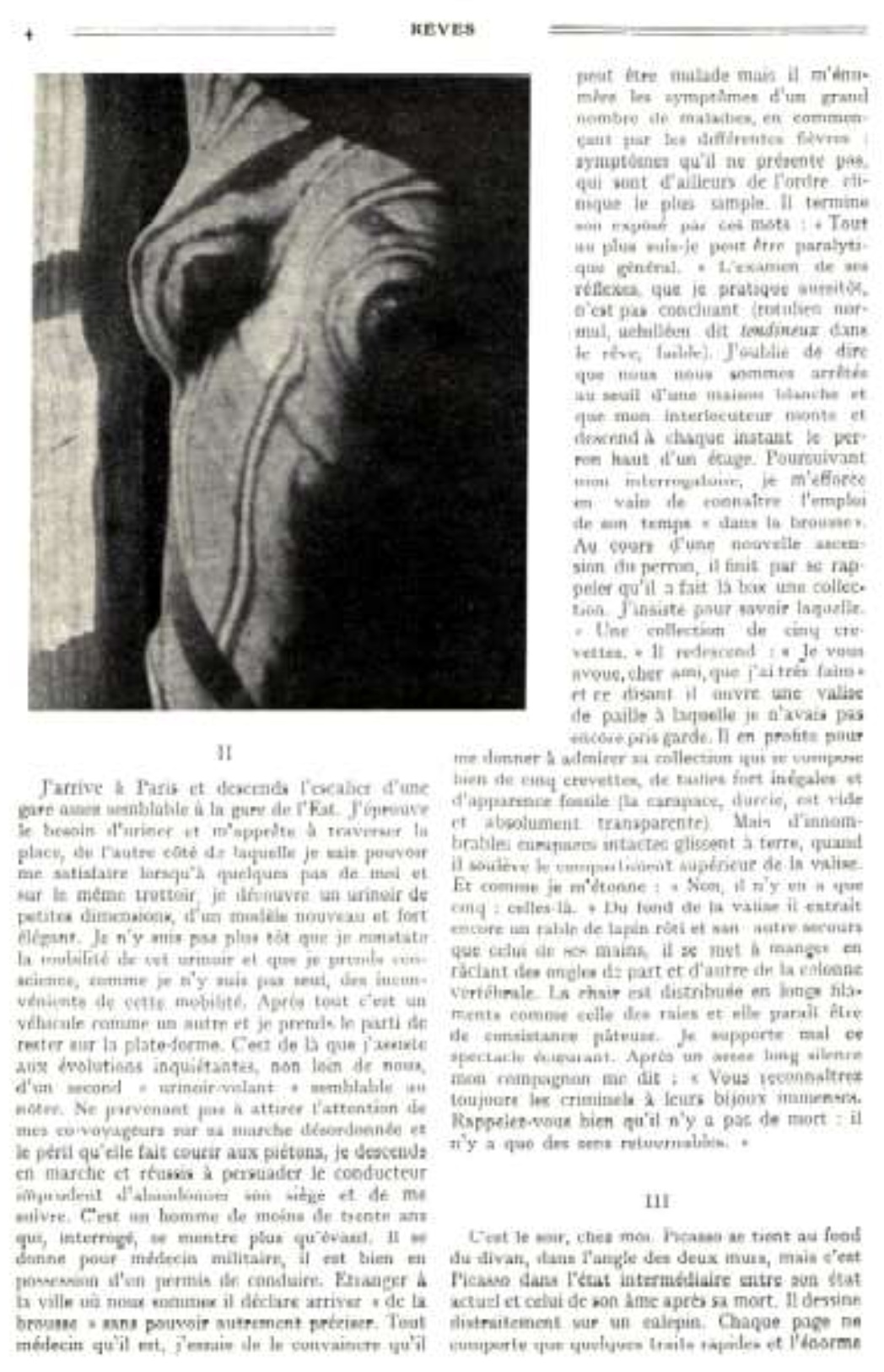
The animators of the movement's first magazine insisted that it take on the appearance of a scientific publication. So they turned to a printing house in Alençon, the same one that had been printing the magazine La Nature since 1873. This is to say that they intended to shock no one, while slipping, like the hermit crab, into the layout established for this scientific weekly. A well-known technique of plagiarism or collage, which they had integrated into their poetic material since their (re)discovery of Isidore Ducasse's Poésies. One could multiply the examples, both for the full pages on two columns, and for the black and white illustrated pages. Here is a simple example:
The Time of Negation
This reference to Ducasse is all the more imperative since Breton went to copy at the National Library the Poésies which survived in a single copy, to publish them in the third issue of Littérature. Surrealism was not yet born, despite the historical refection that the same Breton wanted to impose. It had to go through a phase of negation, which takes on its full importance in these three citations, which it does not seem necessary to me to comment on further:
- "The science I undertake is a science distinct from poetry." (I. Ducasse, Poésies II). Text published for the first time in Littérature, n° 3, p. 19.
- "Science repels me as soon as it becomes speculative-system, loses its character of utility — so useless — but at least individual." Tzara
- Dada means nothing but freedom, emancipation from formulas, independence of the artist, abolition of the "brain drawers": philosophy, psycho-analysis, dialectics, logic, science. Dada demands "strong, straight works, forever misunderstood". Tzara's manifesto deserves to remain among these works that do not reach the "voracious mass", but will survive by their energy. Littérature, n° 1, p. 24.
Surrealist Science
If we believe these surrealist magazines, the movement, which was never reduced to poetry or art, was the bearer of a new science, or, more precisely, of a new approach in matters of science. For him, it was not conceivable, after the immense massacre to which these young people had witnessed, having observed the abyss where civilization had sunk, it was not conceivable to take refuge in the famous ivory tower of poets. So they wanted, with more or less debatable success, to transpose the result of recent scientific discoveries into the domain of what was not yet called the human sciences, and even more into artistic and poetic creation.
A. A New School in Matters of Science
- "A new science will be discovered which will be to science and art what poetry is to everything." Aragon, "Introduction to 1930", RS, n° 12, December 15, 1929, p. 58
- "I believe in miracles, in opportunities, in occult sciences, in science, in soap, in the generosity of the heart, in social devotion." Éluard, Littérature, n°15, p. 8.
The remark may seem derisive: it nevertheless bears traces of the poet's concerns.
B. Psychoanalysis The most novel contribution from Breton and his friends obviously bears on this science of the depths, which they did not invent, which they were not the first to make known in France, but of which they immediately saw the advantage they could draw from it for creation and, more so, for the knowledge of the mechanisms of the mind. Of course, they were not unaware of the warning that Dada had addressed to them in its Dada Manifesto 1918: "Psychoanalysis is a dangerous disease, lulls man's anti-real tendencies and systematizes the bourgeoisie, there is no final Truth." (Tzara, Dada, n°3). But, past the review, to say the least casual, of a visit to Freud, Breton was keen to have Freud himself read, by publishing his article "The Question of Analysis by Non-Physicians" in La Révolution surréaliste, n°9-10, in 1927, and by conducting the "Research on Sexuality" of which only a part appears in RS, n°11, p. 32 sq. If it is not a question of reducing it to particular techniques, nor even of believing that they invented them, belong properly to surrealism:
- Automatic writing
- Dream narratives
- Simulation of delusions, paranoia-criticism: Dali, The Rotten Donkey, SASDLR, n°1, p.9), The Immaculate Conception (SASDLR, n°2, p.10).
- Experimental production, up to the found object.
C. Marxism as Scientific Method: Dialectical Materialism In this domain too, the surrealists, and their magazines in the first place, were certainly the first of their kind to introduce dialectical materialism and a Marxist vocabulary into a discourse of a poetic order or, at least, relating to artistic creation. To meditate on the following two fragments:
- "the data of surrealism have the value of experimental scientific data and if these data must one day in becoming be confronted with something, it is doubtless with culture and not with proletarian literature and this in the very measure where this culture will take account of materialist science. One cannot deny that all literature is the expression of a culture", Aragon, SASDLR, n°3, p. 7
- "it is a question [...] of separating good coal from slag, by the only light that current science puts at our disposal: dialectical materialism (the help of psychoanalysis will be of more efficacy when it comes to explaining poetry, subjective phenomenon)." Tzara, "Essay on the Situation of Poetry", SASDLR n°4, p.15. NB: It should be noted that, for Tzara, the third stage of thought, after poetry activity of the mind and poetry controlled by reason, will indeed be "poetry knowledge", dialectical surpassing of the two previous ones. And Crevel continues (4):
- "Materialist science, for its psycho-dialectics, needs detailed, precise, complete monographs." Crevel, "Notes Towards a Psycho Dialectics", SASDLR, n°5, p.51. To finish on this point, let us mention the article (in English) published by a real Oxford scientist, Sykes Davies, "Biology & Surrealism" in the British issue of BIS in 1936, of which one will find a pertinent analysis by the late Jean Vovelle in the Mélusine issue devoted to science. May I be allowed to step out of the prescribed framework for a moment, to give a quick overview of the surrealist position towards science after Hiroshima:
- "Einstein's Universe recedes, Freud is surpassed, and a new language must be invented. Poetry, within its symbolism not being able itself to account for the image in what it has paradoxical, science not being able by its logic to reach what atomism has paradoxical, a new language must be used, which drawing from science its rigor and taking from poetry analogy, would give like a poetic science alone capable of penetrating both into the domain of the image and into that of the phenomenon, and by this explicating creation." La Brèche, n° 1, p. 39. Incorrigible optimists, the surrealists? To conclude, I will recall, by simple evocation and without further demonstration:
- Place made for human sciences, if not for science, in surrealist magazines
- Permanent scientific concern, search for a poetry-science (and not a scientific poetry)
- Evolution of the magazine of scientific appearance towards more artistic formats
See: Mélusine, n° XXVII: Microsoft Word - Science_derni.re.doc (melusine-surrealisme.fr)
TABLE OF CONTENTS
Dossier Surrealism and Science