Preface, in: Stephen Steele, New Perspectives on Ivan Goll in Exile with a Selection of his Letters from the Americas, Narr Verlag, Tübingen, 2010, p. V-VII.
Stephen Steele is a professor at Simon Fraser University, in British Columbia (Canada), but I have met him several times at conferences organized in France or Europe on Apollinaire, Aragon, etc. He became interested in Louis de Gonzague Frick (1883-1958), Apollinaire's friend, and even more so in Ivan Goll (he chose to write Ivan rather than Yvan, both forms being used by the author). As an attentive reader of my articles on this poet, he asked me for a preface for his collection resulting from his original work. In this regard, it is surprising that Claire Goll, who had worked so hard for the publication of all her late husband's works, did not have the idea of collecting these letters of exile which make us well understand the courage and virtue of hope of Goll during his American stay.
Read the presentation, including my preface, in pdf: New Perspectives on Ivan Goll in Exile with a Selection of his Letters from the Americas (pageplace.de)
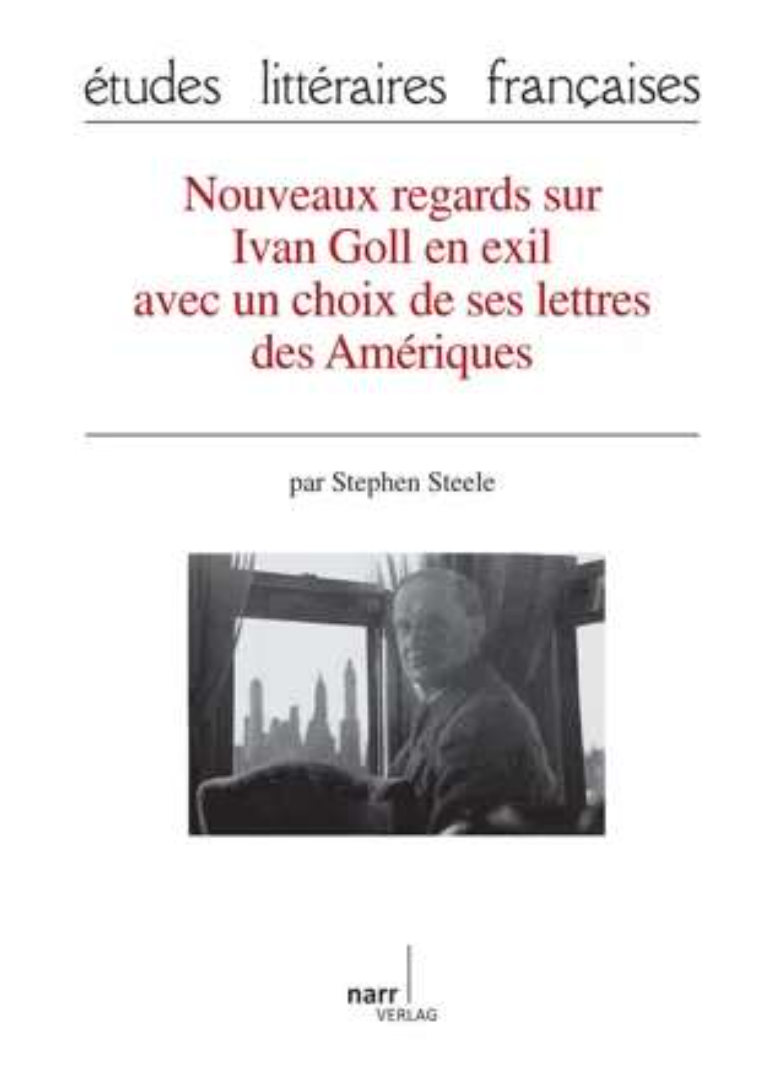
Stephen Steele, New Perspectives on Ivan Goll in Exile with a Selection of his Letters from the Americas, Narr Francke Attempto Verlag, Oct. 6, 2010, 113 p.
Presentation:
This work fills a gap in the recent historiography of the American exile, during the Second World War, of French writers, where the name of Ivan Goll is often absent or reduced to a simple mention. Goll sometimes finds himself attached by the work of Exilforschung to German-speaking emigration, at a time when he was nevertheless abandoning German in favor of French and even English. Drawing from some twenty archival collections on both sides of the Atlantic, the research conducted has made it possible to place Goll alongside American poets and surrealists exiled in New York, in his attempts to establish connections with publishing apparatuses and New York literary life. Among the unpublished letters selected for reproduction at the end of the study are those sent during Goll's stay in Havana in 1940 to William Carlos Williams and Louise Bogan, where Goll's poetry (Parmenia, Jean sans Terre) and his correspondence complement each other in contact with "fruits" "full of surprise" and "succulent women", not without suggesting the existence of sex tourism on the island.
Preface by HB:
He was part of all the avant-gardes. Present at every good opportunity, always ready for the good fight. Here he is in Berlin in 1913, at the heart of expressionism. In Geneva in 1914, among the pacifists. In Zürich, he is the contesting witness of Dada. In liaison with Ljubomir Micic of Zagreb, he is associated with European Zenithism. In Paris, he is the first to launch the Surrealism journal in 1924, in the wake of Apollinaire, and boxes with André Breton. We think he is in Paris, he is in London, Rome, Zurich, Brussels, Berlin. In New York in 1939, he arrives just after the declaration of a war that he foresees as worldwide again. He learns English and composes in this language. During a brief stay in Cuba, he sings of the Cuban Venus. In New York again, it's the Elegy of Ihpetonga in honor of the first inhabitants. In Quebec, he is struck by The Myth of the Pierced Rock. Before leaving the United States, he launches into hermetic poetry and the Kabbalah. Jean sans Terre, this new Wandering Jew, is of all places, of all innovations. This poem of humanity in the 20th century should be recited in all schools. A poet of dual nationality, Lorrain born in France, educated in German Moselle, perfectly bilingual, of Jewish culture, assimilated, he will have occupied an essential position as a bridge between nations, between civilizations. And here it is that every year, we must take up his pilgrim's staff in favor of poetry, explain why Yvan Goll is one of the greatest unrecognized figures of our literary history. The best minds have attached themselves to him, have published and commented on his collections, his discoveries, his advances. But his Complete Works remain forever unfinished. Each work devoted to him remains confidential. A fate seems to be relentlessly pursuing his work, his reputation, like a foehn wind effect on the Alsace plain, drying up everything in its path. For some, he belongs to German literature, for others to French literature, and finally, instead of multiplying his gains by two for the future, here he is reduced to the bare minimum. Ah! men don't like to be reminded too much of who put their foot in the stirrup, who made them known beyond borders. This New Orpheus will have spent his time, exhausted his energy, conceiving anthologies of poetry from the five continents, translating, directing collections, setting up journal projects, of which the most successful will remain Hémisphères, published in New York. Men will not be grateful to him for it.
A literary game, would you like?
Who wrote: International Elegies? — Rainer Maria Rilke. — No, Yvan Goll. Who wrote The New Orpheus? — Apollinaire. — No, Yvan Goll. Who wrote: The Panama Canal? — Blaise Cendrars. — No, Yvan Goll. Who wrote La Chaplinade? — Philippe Soupault. — No, Yvan Goll. Who wrote: Methuselah? — Bertolt Brecht. — No, Yvan Goll. Who wrote: Malay Songs? — Évariste Parny. — No, Yvan Goll. Who wrote: Love Poems? — Paul Eluard. — No, Yvan Goll. Who wrote: Jean sans Terre? — Tristan Tzara. — No, Yvan Goll. Who wrote: Elegy of Ihpetonga? — Benjamin Péret. — No, Yvan Goll. Who wrote: The Myth of the Pierced Rock? — André Breton. — No, Yvan Goll. Who wrote: The Triumphal Chariot of Antimony? — O. V. Milosz. — No, Yvan Goll. Who wrote: The Dream Herb? — Jean-Hans Arp. — No, Yvan Goll.
And the game could continue infinitely, so much does Yvan Goll partake of our literature, so much does he often precede it, so much has he inhaled its principles and evolutions. By dint of jumping from one country to another, from one continent to another, perhaps he will have lacked one thing, if we believe the ironic Baudelaire of the Fusées: establishing a cliché. There is no Yvan Goll cliché. It is time now to return to his poetry in its raw state, or still adorned with the illustrations of painter friends, and to consider null and void the quarrels of a bygone past, aimed at positions of intellectual power. Today, Stephen Steele has decided to fill a gap by showing us the poet grappling with daily life during his American exile. We must follow him in detail to understand how the poetic fire transcends all obstacles, all catastrophes. Each time, the human triumphs. This is perhaps the profound lesson that emerges from this book of pure erudition.
Table of Contents a prologue 1 II Installation in New York 1939-1940 12 III The trip to Cuba spring 1940 38 IV Scenes of New York life 55 V Note on correspondence and acknowledgments 69 VI Goll's correspondence 1939-1947 70 Complementary list of collections 104 Index of Goll's works mentioned 110 Table of contents 112
See my articles on Yvan Goll:
"Perspectives on Yvan Goll and the avant-gardes", in: Yvan Goll (1891-1950) situations of the writer, studies gathered by Michel Grunewald and Jean-Marie Valentin. Bern, Berlin, Frankfurt, New York, Paris, Vienna, Lang, 1994, pp. 83-99.
And here: Jean sans Terre, or the controversial wandering Jew, Europe n° 899