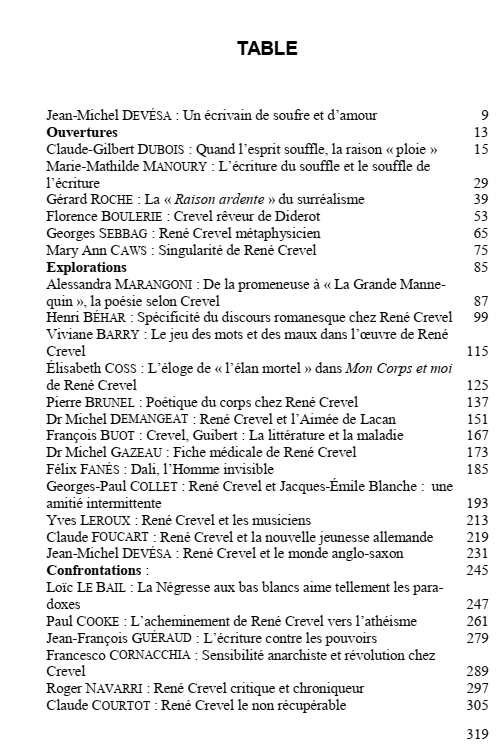
Specificity of the Novelistic Discourse in René Crevel, Mélusine, No. XXII, 2022, pp. 99-113
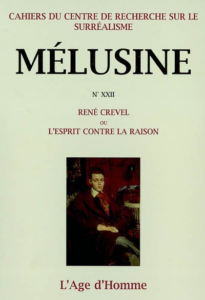
This 22nd volume of Mélusine published the proceedings of the colloquium organized in Bordeaux by Jean-Michel Devesa: René Crevel or the Spirit against Reason, Bordeaux, November 21-23, 2000.
René Crevel (1900-1935) crossed existence as a rebel. The one without whom "one of its most beautiful volutes would have been missing from surrealism" often appears as an irregular of the movement founded and animated by André Breton: his novels and his declared love for boys, his friendships and his frequentations, his appetite for life and his escapades have indeed given to think that Crevel had only been surrealist by chance or from afar. The attentive reading of his books, that of his correspondence, the study of his personal journey, the analysis of his interventions and his commitments show on the contrary a permanence: despite the suffering inflicted by illness and the vicissitudes of time, René Crevel never ceased to pursue the same ideal of love, poetry and freedom. Without dispelling the legend, a better knowledge of his literary production is now likely to establish the importance of his participation in surrealism: at the origin of "the period of sleeps", René Crevel is also the one who, first, understood Salvador Dali's painting and the interest of his paranoiac-critical method; he is moreover one of the surrealists who approached psychoanalysis with the most depth. The author of My Body and Me, The Difficult Death, Babylon, Are You Mad? and Diderot's Harpsichord, to cite only a few of his major works, was not only a "trembling being" (Philippe Soupault). This endearing author, who "did not have all the defects, […] but all the qualities, even beauty" (Paul Eluard), is on the way to recognition. He deserves it because his outbursts of voice have not finished resounding in the world that is ours, this world prey to the vertigo of information and technology tending, under cover of rationality and efficiency, to deny the prerogatives of the Spirit. (Jean-Michel DEVESA)
to my knowledge, there are no other text analyses of Crevel's works.
Do not confuse with René Crevel (1892-1971) painter architect decorator!
see also Crevel on Wikisource
J.-M. Devésa: René Crevel and the Novel, 2004.