"FIGURES OF THE CROSS-CHASE", MÉLUSINE, N° XVII, "TZARA-BRETON CROSS-CHASE", 1997, P. 9-31
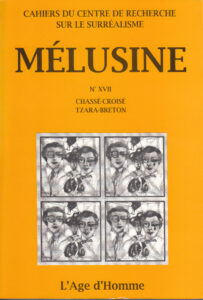
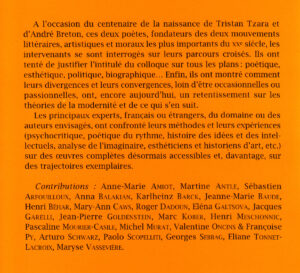
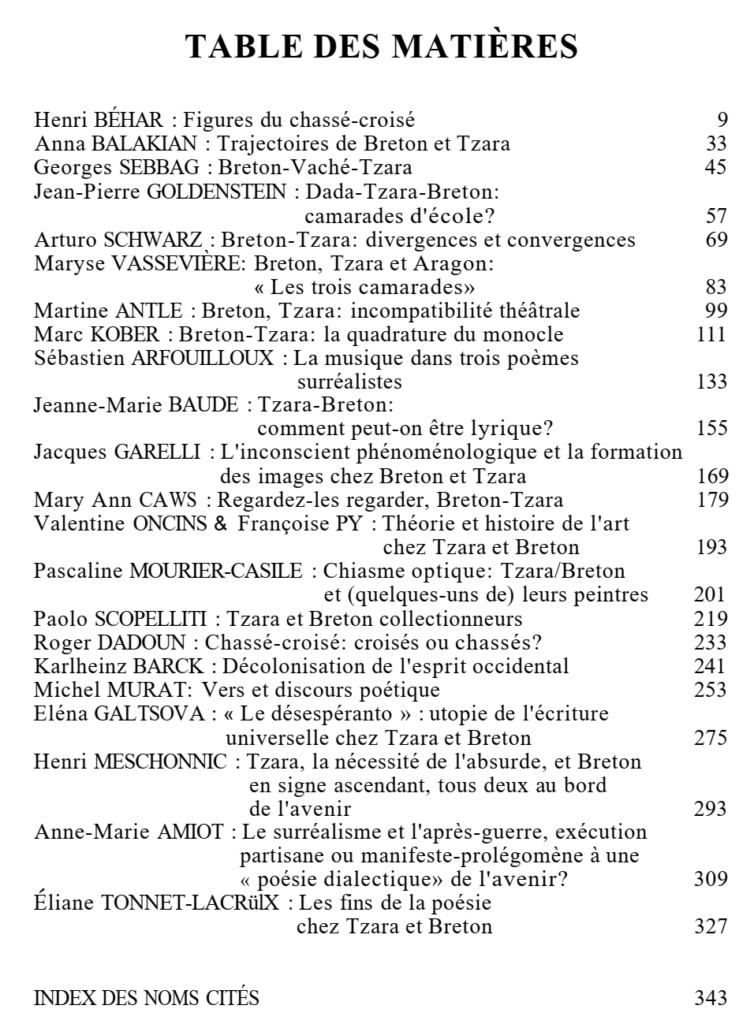
This issue of Mélusine recorded the proceedings of the conference organized on the same subject at the Sorbonne on the occasion of the centenary of each of the two poets.
During the conference, Monique Sebbag's students unexpectedly performed part of the Dada Trial. The surprise was total and welcome.
In the same way, but this was on the program, the director Sylvain Dhomme gave Tzara's The Gas Heart, in a room at the Censier Center, with the students of Paris III University; a show that he reprised shortly after in the city, which was reported by the newspaper Libération.
Review: https://www.liberation.fr/culture/1996/05/24/theatre-grace-a-sylvain-dhomme-redecouverte-a-paris-de-coeur-a-gaz-une-piece-du-roumain-dada-tristan_170831/
THEATER. Thanks to Sylvain Dhomme, rediscovery in Paris of "Gas Heart", a play by the Romanian Dada Tristan Tzara, whose characters (Nose, Eye or Mouth) work brilliantly in the absurd and nonsense. Tzara's Dada is back on its feet. Gas Heart, by Tristan Tzara, dir. Sylvain Dhomme, from May 27 to 31, 9 p.m., at Confluences, 190, boulevard de Charonne, Paris.
By Jean-Pierre THIBAUDAT
published on May 24, 1996 at 5:13 a.m.
"MOUTH is above the stage, NOSE opposite above the audience.
All other characters enter and exit ad libitum. The heart heated by gas runs slowly, great circulation", says enigmatically a Romanian eccentric, on a stage on the right bank, in June 1921.
The man is 25 years old, he arrived in Paris the previous year and speaks with an accent that surprised those who knew him through his writings, his name is Tristan Tzara. He animates that day a "Dada evening" and continues the prologue of his play Gas Heart: "It is the only and greatest swindle of the century in 3 acts, it will only bring happiness to industrialized imbeciles who believe in the existence of geniuses. The performers are asked to give this play the attention due to a masterpiece of the force of Macbeth and Chantecler, but to treat the author, who is not a genius, with little respect and to note the lack of seriousness of the text which brings no novelty to the technique of theater." The spectators are warned. Enter the performers among whom Soupault, Ribemont-Dessaignes and Aragon. Part of the audience seems to have left the room as soon as Tzara's introduction.
A second performance will take place in July 1923 at the Michel theater with costumes by Sonia Delaunay, professional actors and staging. The budding surrealists came to fight. "André Breton, cane in hand, led his squad. In two waves, they went to assault the stage. Breton broke Pierre de Massot's arm, Paul Eluard slapped Tzara and Crevel. There was police intervention, prefectural ban on the second performance, exchange of blue papers", recounts Sylvain Dhomme. He wasn't there, but it's all the same.
Since then, the play has been vegetating in French in its rare edition illustrated by Max Ernst. Here and there, some (Belgians, Swedes) ventured to stage it, Andy Warhol with others did a reading in New York. In recent years, one could find it in Tzara's complete works (Flammarion) due to the good care of Henri Béhar. Now here is that, jointly, the latter publishes Gas Heart with other texts in pocket in Dada is tattooed everything is dada (GF Flammarion) and that Sylvain Dhomme resurrects the play with a band of very spirited young actors from the XYZ group (Chérif Daara, Jean Duprat, Mélanie Elsner, Frédéric Jaubert, Isis Peyrade, Jean-Jacques Verger).
Who is Sylvain Dhomme? A jack-of-all-trades, but not just anything. The first director of Ionesco's Chairs at the Théâtre de Lancry in 1952 with, already, Tsilla Chelton, it's him. From Le Figaro to Libération (the other), a scathing review. When the play meets success four years later in Jacques Mauclair's staging (who plays it in tandem with Chelton), the most clairvoyant critic of the time, Jacques Lemarchant, pays tribute to Sylvain Dhomme, "perspicacious inventor and director as subtle as he is courageous". His present alert staging of Gas Heart proves that this is still the case.
In the meantime, Dhomme has staged many shows, broadened his range to cinema (he signed one of the sketches of The Seven Deadly Sins, rubbed shoulders with Orson Welles and made a bunch of educational films), television (he filmed remarkably several shows including Ionesco's Lesson that we saw on Arte), radio (with Pierre Schaeffer), etc. He also wrote a big work, Staging from Antoine to Brecht, which reads like a novel and would amply deserve to be republished.
Two years ago, at Robert Cordier's school, he was piloting a workshop for young actors. "One day, I threw them a piece of Gas Heart telling them, I'll be back in half an hour. I came back: lots of things were happening." The desire to make a show came thus.
And, as we celebrate this year the centenary of Tzara's birth, the show became a highlight of the "Tzara-Breton Cross-Chase" conference, co-organized by the New Sorbonne; Dhomme was able to collect 5,000 francs, enough to pay some expenses, because, in the surprising but true story of Gas Heart, no one is paid, especially since everyone gives their all without counting. Sylvain Dhomme in the lead: "I feel like I'm living an adventure like I never even experienced when I was a young director." At reading, the play (whose "characters" are named Nose, Mouth, Eyebrow, Eye, Ear) seems unplayable, which is always a good sign. On stage, Dhomme and his young actors, convinced of its obviousness, make it transparent. "The great secret is there: thinking is done in the mouth", writes Tzara in one of his manifestos, and, in others, he says he hates "common sense" and wants, among other delights, "to shit in various colors to adorn the zoological garden of art with all the flags of the consulates".
The proof by Gas Heart. "Hey, over there, man with mollusc wounds wool chains, man with various pains and pockets, man tart to geography, where are you from?", asks Nose. And, after Eyebrow says: "Once a day we abort from our obscurities", Eye will let go: "The conversation becomes boring isn't it." Most Dada and crazily of today. "Your play is charming, but we don't understand anything in it", Nose will specify, for all intents and purposes.
Let us add that putting this text on track long after Ionesco's theater leads one to think that the latter must have read, in his youth, this play by Tzara, Romanian like him, before writing The Lesson or The Bald Soprano. Logically, beyond the years, the curious career of Sylvain Dhomme throws a bridge between the two jokers.
Extensions:
Jean-Pierre Lassalle, "Catalogue Cross-Chase Dada-Surrealist 1916-1969", Cahiers d'Occitanie, new series, n° 50, June 2012. See the review by Georges Sebbag
See:
Cerisy conference 2016: Poetry and Politics
Resulting from the work of the international conference organized in Cerisy-la-Salle in July 2010, Poetry and Politics in the 20th Century sheds new light on the relationships of French-language poetry to the historical and political events that have traversed and informed this tragic and troubled century. Closely examining the eternal and universal character of the ethical and philosophical questions that the event raises, this work offers current perspectives, detached from the simple circumstances of the moment. It is a question of questioning a traditional conception of poetry as a simple aesthetic and formal expression of man and his language. Through the study of modernist or avant-garde movements, from Dada to surrealism to situationism, emerges the determining importance of the poet's commitment to the community. The close and complex relationships of personalities such as Tristan Tzara, André Breton, Paul Éluard and Benjamin Péret to the idea of poetic revolution are here considered as exemplary cases. The investigation extends to the journey of singular figures, from René Char to Francis Ponge via Aimé Césaire. All have accompanied in a radical and existential way the actions of resistance to Nazi occupation or the struggle of third-world peoples for their independence. Beyond that, we examine the political expression of contemporary poetry in the wake of May 68 (like that of the TXT journal), that of Jean-Clarence Lambert and even the playful formal research carried out by the Oulipo. Finally, a special place is given to poetry from francophone cultures outside the hexagon, from Quebec to Haiti.
Florian Cunière: "Tristan Tzara. For a Poetics of Knowledge (1925-1937)" Thesis, 2023
Summary by the author:
This thesis proposes to return to a pivotal period of Tristan Tzara's work (1925-1937) to highlight the role played by scientific knowledge in his writing. Marked by a succession of intellectual revolutions in multiple disciplinary fields, the first third of the 20th century is indeed the witness of new paradigms that endorse an unprecedented approach to the human being and the cosmos. Desiring to free themselves from systems of thought (positivist, rationalist, capitalist and ethnocentrist) that they consider obsolete, literary and artistic avant-gardes take note of these philosophical and scientific upheavals. Animated by boundless curiosity and influenced by the research carried out by the surrealist group to which he rallied from 1929 to 1935, Tristan Tzara, still too often considered from the angle of the Dada movement alone, himself seized on these new issues, which have durably inflected his imagination and artistic practice. Through various modes of reappropriation and hybridization such as collage, rewriting or even the recovery of specialized vocabulary, his theoretical and poetic writings thus testify to his will to elaborate a new method of knowledge in which art, science and politics now work in concert.