"Roger Vitrac: the return of the crank", in Films and pens, proceedings of the 14th Invalides colloquium, texts gathered by Jean-Jacques Lefrère and Michel Pierssens, Du Lérot publisher, 2011, pp. 81-83.
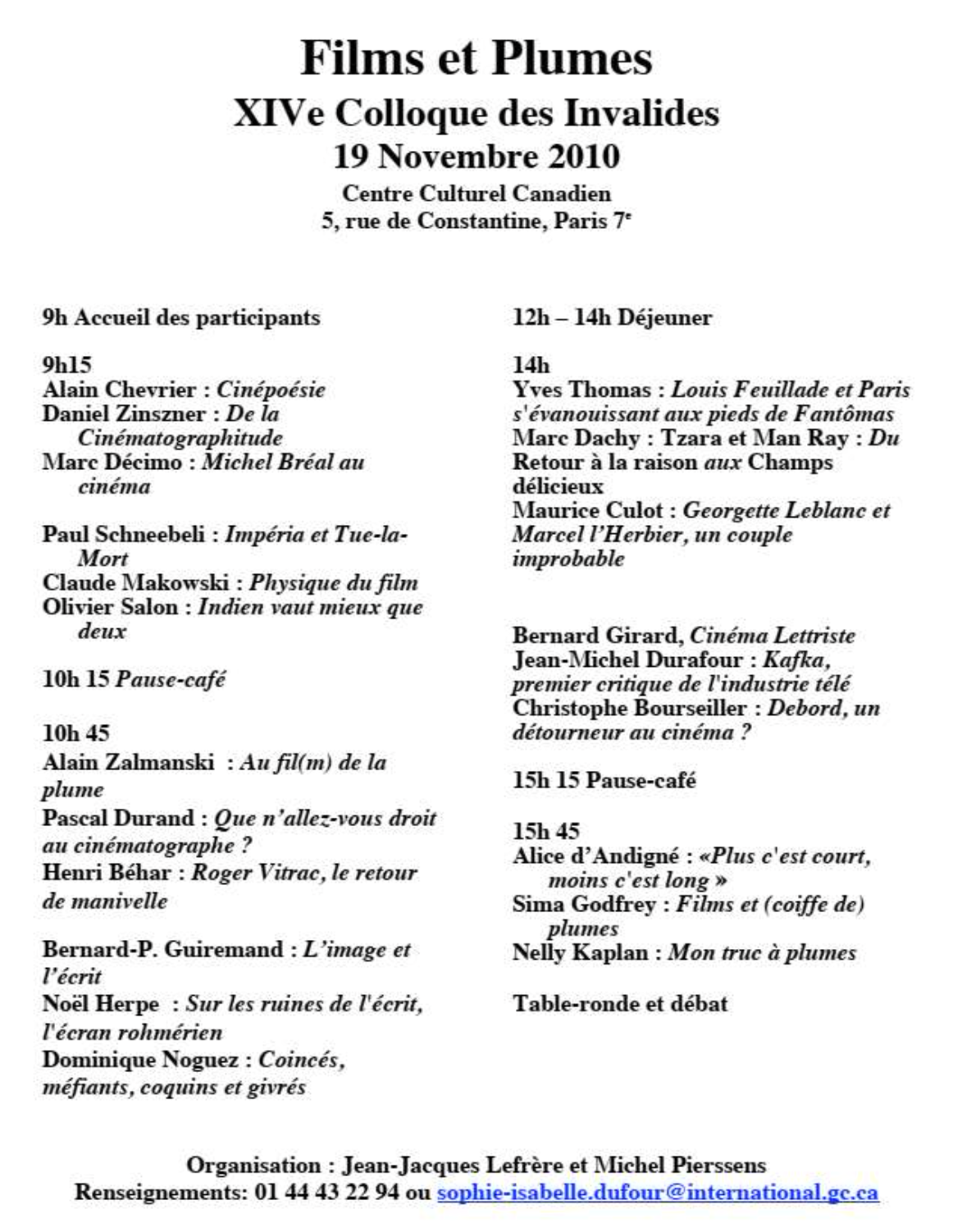
Although, or because they were unusual, I very much liked the meetings and confrontations provoked by Jean-Jacques Lefrère and his accomplice Michel Pierssens, especially those that only accorded five minutes to each speaker... This one proposed to examine the relations of the pen with film. The organizers generously accorded ten minutes, debates included, to each speaker. The program below largely indicates how this relationship, generally occulted, could be understood. For my part, I saw in it the opportunity to speak about Roger Vitrac, who was not only the dramatist of surrealism. In truth, he ensured his existence through his various functions in cinema, which, let us not forget, only became talking after the creation of Victor or The Children in Power (1928). In the room, Nelly Kaplan and her husband, the producer Claude Makovski, were happy to hear me evoke Max Morise as well as Vitrac, whom they had not known since he died in January 1952. Given the brevity of the presentation, I left for other occasions the systematic analysis of the passage from pen to cinematographic film, and its effects on the public. And I relied on research carried out previously for the intervention on "Roger Vitrac's Cinema", in Französische Theaterfilme – zwischen Surrealismus und Existentialismus, Transcript Verlag, Bielefeld (Germany), 2004, pp. 17-38. See the text in German: Roger Vitrac's Cinema (degruyter.com) See the original text above:
Collective publication: Films and Pens, fourteenth Invalides Colloquium, November 19, 2010, [Canadian Cultural Center, Paris]; texts gathered by Jean-Jacques Lefrère and Michel Pierssens. Tusson: du Lérot, impr. 2011, 1 vol. (167 p.): ill. in black and color, cover ill. in color; 23 cm, Collection: En marge.
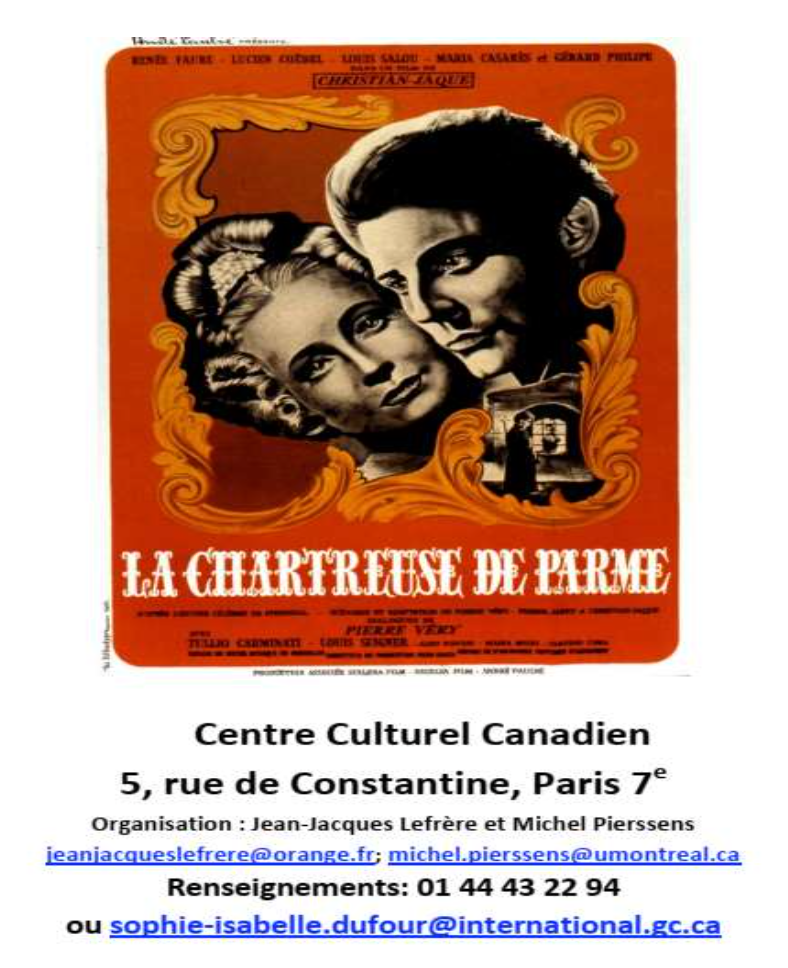
Colloquium poster:
Colloquium program:
Text of my article
Roger Vitrac, the return of the crank
I would like to evoke the problem encountered by the film industry when it found itself confronted with the generalization of talking pictures, illustrating it with the example of Roger Vitrac, this well-known dramatist, one of the few theater authors who survived from the surrealist era. On the level of writing, this industrial art suddenly needed numerous personnel, both for the writing of original scenarios and adaptations, as well as dialogues, even their transposition into French. I remember meeting Max Morise about fifty years ago, a surrealist of the first rank, who earned his living by writing the French version of American dialogues. He liked that, he told me, because it was like marquetry work! It was a matter of finding the word whose pronunciation stuck as closely as possible to the movement of the actor's lips. It is no coincidence that his friend Roger Vitrac, whose notoriety had been established from the Alfred-Jarry Theater, was solicited by the 7th art, where he ensured tasks of scenarist, dialoguist and critic. Contrary to what I once maintained, it seems to me that it was not only, for him, a bread-and-butter task. Besides ensuring his material needs, as they say, he found in it a certain pleasure, of a nature to satisfy his modest literary ambitions. In the summer of 1934, Metro Goldwyn Mayer asked him for his manuscript of The Trafalgar Shot to make a film from it. Which was not done. On the other hand, he was called the following year to work in Berlin at U.F.A. with Raoul Ploquin, for whom he wrote the dialogues of the film Light Cavalry and made an adaptation of Victorien Sardou's Fly Legs for Jean Grémillon. In 1939, he transposed to the screen Maurice Dekobra's work: Macao, Hell of Gambling, directed by Jean Delannoy. I was able to read the dialogues he wrote for Macao and for Pierre Véry's The Assassin is Afraid of the Night, the same year he completed Sacred Fire with Viviane Romance. Vitrac provided a lively dialogue there, peppered with wordplay, witty reflections. It is not always easy to adapt this tone to action films! In 1945, short of money, he forms various projects, in particular that of a cinematographic adaptation of Sentimental Education and an original scenario, Women Never Lie, which recalls the true Vitrac, humorous and fanciful, kind, tender and cruel at the same time. What role did he play in the fifteen or so films to which he collaborated? He could suggest the choice of the work to the producer or director, put his hand to the scenario, indicate such and such a stage play, and above all bring his spirit, his wordplay, his puns, to often dull works. No material trace of his contributions has been kept. He was notably called to the rescue to replace Armand Salacrou whose director was not satisfied with the adaptation of a Pirandello novel, The Late Mathias Pascal, projected under the title The Man from Nowhere (1936). "Pierre Chenal's Pirandellian games, enhanced by Roger Vitrac's poetic and sarcastic dialogues, constitute, for those who have not known them, a famous surprise..." wrote Jacques Siclier in Le Monde, during its television broadcast. Vitrac did the same for The Chess Player (1938) shot by Jean Dreville. It is always risky to try to distinguish what belongs to one or the other in a collective work, but I do not think I am mistaken in attributing these lines to him:
"The Director: Thank you. Vullen: You're welcome. Director: Thank you, you hear. That means I'm kicking you out."
Further on, a pun close to Camelot: "Why do you crumple the bills? — I despise money, so it gets wrinkled." Finally, a line in the direct line of The Trafalgar Shot: "But my dear, if you give to us, you know very well that you will give yourself. Give and take, as you say." He also contributed to the dialogues of Jacques Becker's first film, Cristobal's Gold. Unfortunately, in the middle of filming, the producers went bankrupt. Vitrac was amused that the collaborators were paid with bronze coins that were supposed to represent the pirate ship's gold. Vitrac was also a scenarist. We note: The Cyclades (1), an updating of ancient myths, as in his unpublished scenario of Phaedra; and Passage de l'Opéra, which owes more to the dramatist's imagination than to Aragon's surrealist gaze. Skillfully carrying theater to the screen, the scenarist retains the essential phases of the myth, while incarnating it in our time, among believable beings. It is a very personal Vitrac who writes the short notes of L'Écran Français, a weekly film journal that then gravitated in the communist orbit. Under the general title "Return of the crank", throughout the year 1946, he defended a spirit freed from routine: the Charlots, of course; the Marx Brothers; Nosferatu the Vampire, and the great films released during the Occupation, the Carné-Prévert: The Evening Visitors, The Children of Paradise, a Cocteau: The Eternal Return; despite its clumsiness, Yves Allégret's The Demons of Dawn; Raymond Rouleau's An Ideal Couple; finally a Jacques Becker film, Falbalas. As in theater, Vitrac defends humor and irony. He regrets that French cinema does not know how to handle the gag and he opposes to current production, "dream, premonitions, mystery, humor, the doubling of personality: so many themes that were dear to us in the heroic times of surrealism". In summary, Vitrac defends in cinema the two aesthetic principles that governed his own dramaturgy: life as it is and metaphysical vaudeville (2). I will end with an anecdote that Max Morise told me and which, in my eyes, depicts both the character and the milieu in which Vitrac had to evolve. One day when a producer was complaining in front of him about not having a good subject, "I have one" Vitrac said to him, "but I know you, you're going to take my idea, and pay nothing". Stung, the other protested his good faith, and accepted the deal that Vitrac proposed to him: he slipped three 100 FF bills into an envelope which he handed over in exchange for an envelope containing Vitrac's project. He opened it, and could read "Joan of Arc". Furious at having been cheated, he wanted to take back his money. "Well what," Vitrac said to him, still as nonchalant, "isn't it a good idea (3)?" Henri BÉHAR
See an expanded version of this talk on "Roger Vitrac's Cinema" in H. Béhar, Shock Waves, New Essays on the Avant-garde, Lausanne, L'Age d'Homme, 2011, p. 159-177.
On the film The Journey to Greece, see the Eli Lotar retrospective at the Centre Pompidou: Greece, first journey - Centre Pompidou and The double journey: Paris-Athens (1919‐1939) - The Journeys to Greece of photographer Eli Lotar - French School of Athens (openedition.org)
- I take advantage of the wide audience of the Invalides Colloquium to launch a wanted notice: who will put me on the trail of this film, otherwise entitled Journey to the Cyclades, shot on location by Eli Lotar, of which Nino Frank gave an account in the magazine Pour vous in May 1931?
- The reader interested in this cinematographic adventure will find a detailed version of this talk, supported by as precise a filmography as possible, in my new essays on the avant-garde, Shock Waves, L'Age d'homme, 2011, p. 159 sq.
- This anecdote was told to me by the journalist Henri Philippon, familiar with Vitrac in the thirties. If Joan of Arc is the heroine of about twenty films since the advent of cinema, there were no more than five at the time.