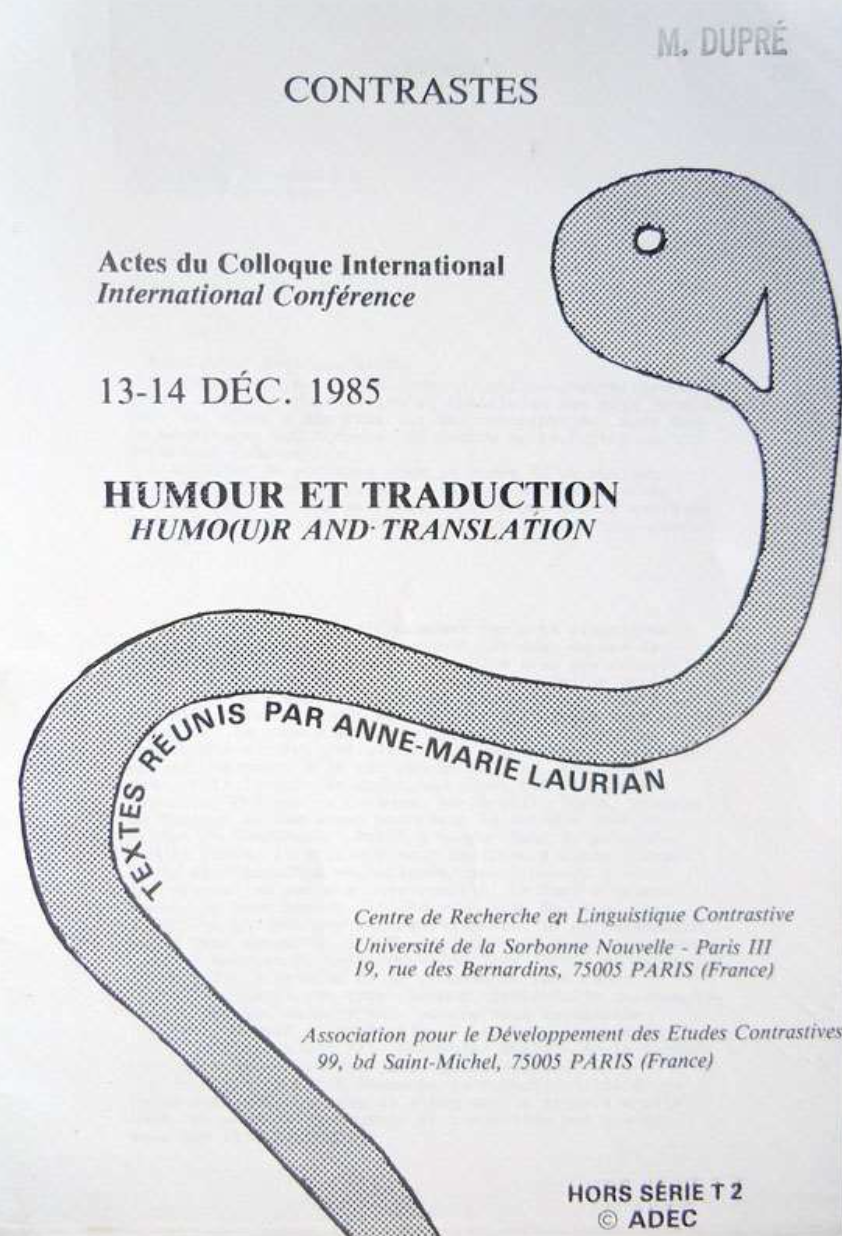
"Opening Remarks", Contrastes, special issue, vol. 2, 1986, pp. 17-21, Proceedings of the international colloquium "Humor and Translation", Paris, December 13-14, 1985.
I do not know if it is in the definition of the functions of a university president that he must open the various meetings and colloquia organized by the research units composing his establishment. The fact is that, during the five years that I exercised this role, I endeavored, formidable honor, to speak first to present the university to our guests coming from all continents, while enunciating the reasons that justified a meeting on a subject always very specialized. Concentrated on disciplines of a literary, linguistic and civilizational order, the Sorbonne Nouvelle addressed themes that largely exceeded my competences, despite the information provided to me by the promoters of these meetings. In any case, I felt obliged to sketch some of the difficulties presented by this colloquium of linguists and translators (not to be confused with interpreters)! And I am pleased to make reappear, among so many others, this very brief speech that the editors of the journal Contrastes were kind enough to publish.
OPENING REMARKS
My dear colleagues, What competence does a University President have to open a colloquium like yours, I ask you a little, a lot? Elected by the entire university community to represent it and to manage an establishment whose complexity increasingly resembles that of a national enterprise, he is rarely asked to have humor in the daily exercise of his functions. I would even say that if, sometimes, he is gifted with this 6th sense, very particular, it is better that he does not make it known, and that he hides it shamefully, at the risk of being quickly condemned by his peers for his blunders.
On the other hand, the said university community can testify to its humor by electing, from within, the professor least worthy of exercising this function, the least representative, the least competent. This is why I am accustomed to saying that the University of Paris III Sorbonne Nouvelle does not lack humor, and that it proves it.
It was therefore perfectly designated to host the annual meetings of ADEC and CRELIC on the theme Humor and Translation.
There is a second reason, more serious, that Anne-Marie Laurian will explain to you shortly, of which I would like to touch on a word at this moment when you are finishing taking your places, feverishly perusing your program, checking the time of the appointment you made to have lunch with your Parisian publisher.
This major reason, here it is: the Sorbonne Nouvelle can be defined mathematically as the L2 C2 5C University (literature, languages, cultures and civilizations) of the five continents.
This is to say that problems of communication, exchange, inter-linguistic contacts are primary there. All the more so as they crystallize in one of our specialized units: ESIT.
Given the original constitution of Paris III, it was therefore normal that the two organizing associations of the colloquium were born here, and that the Scientific Council of the University that I chair grant its support to your meeting.
But this still does not justify my preliminary intervention since alone, among you, teacher of French literature, I have nothing to do with translation, the latter being banished from our field of intervention. However, as you well understood by registering for this international colloquium, the important point is the and articulating the two names composing the title.
I could speak to you about the humor of such and such a French author, that of Diderot in Jacques the Fatalist, that of Alfred Jarry in his Speculations of the Green Candle; of Proust's sarcastic humor in the totality of In Search of Lost Time, of black humor conceptualized by André Breton, the being least gifted with humor that exists. This black humor, let us recall it at the threshold of our work, for you will be led to refer to it, designates not a macabre comic but a grave and desperate manifestation ('the extreme expression of a convulsive inaccommodation") in a pleasant form. Referring to Hegel and Freud, he makes it the expression of subjectivity through objective forms of the external world, the triumph of the superego which thus mocks contingencies (I quote here the Larousse Dictionary of Literatures, all the more freely as the notice is from my pen).
But, you will object with good reason, it is not a question of translation. Off topic, eliminated. Unless, being demanding beyond what is proper, you ask me to speak to you about the humorous or humoral traits that every French reader should note in the translations as long as your two days do not go there, I prefer to remain silent on this point. Imagine me as a mute and translate me into all the languages that you practice.
But have you ever met a truly mute person, who tells you absolutely nothing? And a President or a Frenchman (it's the same thing, since all Frenchmen are presidents) who remains silent when he has been given the floor?
I cannot remain silent because your subject fascinates me, and that its title offers, to itself, the subject of a communication for linguists that you are. Is not the term Humor already a translation of the French Humeur that, finding it in English, the original language has taken back without modification other than intonation. But you suspect that during this back and forth over the English Channel or French Channel, this term has been charged with spray.
Originally referring to the medical theory of humors, it now designates a form of mind, perhaps even of civilization, to such an extent that an individual without humor is now perceived as a cripple and as a boor.
But humor is also an atmosphere, an impalpable gas, an attractive force particularly at work in printing workshops. How many signs become monkeys, storms orangized under the pressed fingers of the keyboardist!
Of this involuntary humor in the text and translation we will be spoken shortly.
Other questions, ontologically determining, arise for the researcher and theorist of translation. How to render, in various languages, compound words such as piebald horse. One immediately imagines a chimera, part bird, part quadruped, when it is a question of the equine's coat. And the game can continue about coat leading to a whole reverie on the outfits of our noble conquest. You suspect that translation does not systematically foil such traps.
The trap of language is sometimes happy. You know that in 1942 a meeting was to be held at the White House, between Truman and Churchill. Admiral Canaris's intelligence services got wind of it, but the information, passing through Spain, located the meeting in Casablanca. So that Churchill crossed the Atlantic quietly while German submarines were watching for him on the Moroccan coasts.
We see how much the context of enunciation can be determining in this case. Allow me a very recent personal anecdote, which has no reason to be except that it happened abroad, I mean during a meeting of foreigners seated abroad speaking various languages but especially French. One of them explained, not without pride, that he was the grandfather of a little black child. His neighbor, just as young as he in appearance, declared himself immediately grandfather of a little Scot. Concerning colors, I could not help asking to which clan he belonged, and in which direction were the stripes... You linguists, have pity on false friends!
It is time to finish my rambling remarks. I will do so by pointing out a phenomenon of objective chance. Two days ago, opening another international colloquium on the Hungarian writer Dezsö Kostolanyi, I inquired about his work translated into French, and fell upon a very recent collection of short stories, entitled The Kleptomaniac Translator. It is the title of the first story, which tells us the adventures of a poor wretch victim of this incurable disease that is kleptomania. To get him out of a bad spot, one of his friends puts him in touch with a publisher, who entrusts him with the translation of a detective novel. The work completed, the publisher refuses to publish the work and consequently to pay for the work provided. Here's why: the translator, particularly qualified and meticulous, had not been able to resist his mania which had wrought havoc in the text, which his protector observes thus: "I finally established that, in his confusion, our colleague, during his translation, had appropriated to the detriment of the original, illegally and without authorization: 1,579,251 pounds sterling, 177 gold rings, 947 pearl necklaces, 181 pocket watches, 309 pairs of earrings, 435 suitcases, not to mention properties, forests and pastures, ducal and baronial castles and other trifles, handkerchiefs, toothpicks and bells, the enumeration of which would be long and perhaps useless.
Where had he put them, these movable and immovable goods, which nevertheless existed only on paper, in the empire of imagination, and what was his purpose in stealing them? ... " (1)
Will you tell me during your work which can only be enriching for all?
Henri BEHAR.
Read the original journal text
(1). Dezsö KOSTOLANYI: The Kleptomaniac Translator and Other Stories. French text by Maurice REGNAUT in collaboration with Peter ADAM. Aix-en-Provence, Alinéa, 1985, 137p.