Response to the survey "What do Isidore Ducasse and the work of Lautréamont represent for you?", Les Cahiers Lautréamont, issues LXIX and LXX, 1st semester 2004, pp. 45-46.
At the beginning of 2004, Jean-Jacques Lefrère (1954-2015), President of the society of friends of Lautréamont and animator of the Cahiers of the same name, decided to collect the confidences of his readers on their relationship with the personality of Isidore Ducasse (to whom he had devoted a biography: Isidore Ducasse: author of "The Songs of Maldoror, by the Count of Lautréamont", Paris, Fayard editions, 1998, 686 p. + 72 p. ill.), and especially with the work. I give here my response, in full.
To Jean-Jacques Lefrère
Dear Friend, Using the fastest means of communication, you first informed me of the survey that Les Cahiers Lautréamont wished to conduct, before their programmed end, in the manner of Le Disque vert, on the Count of Lautréamont. As I asked you to specify the question, you first replied that, voluntarily, you were not asking any question, to let each express themselves as they wished. But a literary survey without interrogation, similar to the knife without blade of which the handle is missing, would it still be a survey? Hence the precision you gave me in the wake: "Les Cahiers Lautréamont ask what Isidore Ducasse and the work of the Count of Lautréamont represent for you. It's vast like the old ocean, but can be summarized in a page..." From there, I should have been satisfied and "seize the pen that will construct" my response, as de Maldoror the second song. However, a researcher's reflex, which I cannot part with "without it being from old age," led me to consult le Disque vert to see in what terms this courageous journal questioned the most notorious of its contemporaries. Alas! one must face the evidence: if the publication of the "Lautréamont Case" in Le Disque vert, n° 4, 1925, could make history, with contributions from Gide, Crevel, Soupault, etc. and the opinions of Valéry, Thibaudet, Breton..., one must admit that there is no trace of the question posed at the initiative of Henri Michaux, it seems. The previous issue does state some of the questions to which the survey was to respond, without however communicating to us the questions submitted to the interested parties. No doubt they resumed these: "Is his work the result of a literary process? Of a reaction, of a special education? Of an environment, of some influence? Is it a matter of madness, as Léon Bloy claimed?" We can see that the terms of the interrogation induced certain responses, and one cannot praise too much your present wisdom. In truth, I could not say what the work of Isidore Ducasse represents for me today without evoking the manner in which it reached me, through the voice of Pierre Brasseur on that record of the "Poètes d'aujourd'hui" collection at Seghers, accompanying Philippe Soupault's essay. And I still hear the thick and satanic voice of the interpreter: "I am dirty. Lice gnaw at me. Pigs, when they look at me, vomit. The scabs and sores of leprosy have scaled my skin, covered with yellowish pus." Impossible to read certain stanzas of the Songs without having in the ear the intonations of the actor. Hence my suggestion: Could not Les Cahiers Lautréamont reissue this record that has become mythical, in my opinion? For a long time, afterwards, my reading of Lautréamont remained a private affair, of which "men who have been virtuous" have no need to know. Until the day when one of my colleagues, who passed among us for a merry libertarian, took it into his head to defend a thesis on Isidore Ducasse, claiming that the latter was only borrowing his remarks from M. Prud'homme. The assertion was a bit monstrous, but it raised no objection, I want to emphasize, from the jury. Anxious not to miss the last boat, the Sorbonne swallowed everything, and it had seen much worse! We had numerous conversations in the university corridors with this provocative essayist, who, following a proven method, was testing us to perfect his responses. However, he never found anything to say when I sent to his gums the admirable finds of Lautréamont, the "octopus with silk gaze," the "duck of doubt with vermouth lips," and the magnificent litany of "beautiful as." Generations of researchers, of which I am one, have endeavored to find the origin of such images. Sometimes, a happy fate allowed them to find an explanatory pre-text. But, whatever their manufacturing process, nothing can detect in advance their effect on the reader. No text analysis, however fine and documented it may be, can account for these pure jewels discovered by a meteor of Letters in the gangue of writing. This is why the work of Lautréamont is for me "always present to my consciousness!" (Songs II,4)
Text published in: H. Béhar, Lumières sur Maldoror, Paris, Classiques Garnier, 2023, pp. 135-137: Lumières sur Maldoror (classiques-garnier.com)
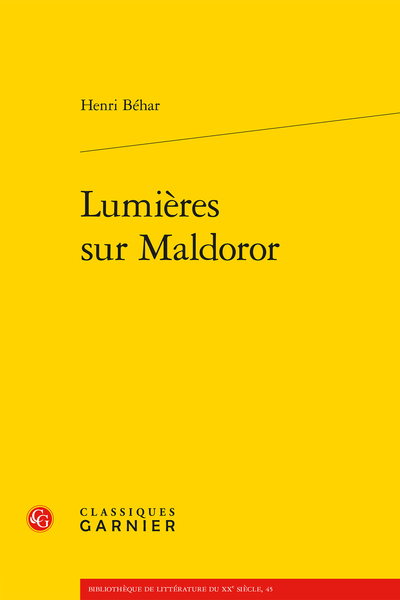
Review: Remue.net Lumières sur Maldoror Lumières sur Maldoror
Return to the work of Lautréamont / Ducasse
by Henri Béhar His life was brief (April 1846 - November 1870), his work includes only two titles: The Songs of Maldoror, published at the author's expense under the pseudonym of Count of Lautréamont in 1869 and the second, Poems I and Poems II, (two fascicles – April and June 1870 – which will then be gathered), signed with his real name, Isidore Ducasse. Of him, only one photo remains, discovered more than a century after his death. He was born in Montevideo and died in Paris. His body is buried in a common grave in Montmartre cemetery. During his lifetime, he had only rare readers and left few traces except his texts. All these elements, put end to end, reduced his chances of one day accessing posterity, especially since the copies of The Songs of Maldoror, printed in Belgium, were only put on sale, confidentially, (in a Brussels bookstore) in 1874 before being reissued in Paris in 1890. And yet, a century and a half after the poet's disappearance, the work of Lautréamont/Ducasse is still very much alive. Present, disconcerting, fascinating, iconoclastic, it questions generations of readers. It is studied, analyzed, commented on, recommended. Numerous works are devoted to it. Historians and researchers seize it, who cannot part with it, constantly finding new paths to explore. Henri Béhar is one of them. His background (he has edited the complete works of Roger Vitrac, Tristan Tzara and Alfred Jarry), his knowledge of avant-gardes, particularly surrealism and Dada, which he has been studying for decades, as well as his sharp and relevant eye prove precious to guide us, with method and efficiency, through the creative meanders of a word alchemist who belonged to no school. Nothing escapes him of the astonishing journey of The Songs of Maldoror which would never have reached us if a few poets, and not the least (Jarry, Soupault, Breton, Aragon, Tzara), had not spotted them, bringing them out of oblivion, drawing from them what to feed their own poetic journey and relaying each other so that they endure. Previously, in 1885, the poets of "La Jeune Belgique," making the same discovery, had alerted their French symbolist friends and Remy de Gourmont was immediately seduced by these Songs which detonated and gave a hell of a whip to poetry which, until then, had never yet vibrated in such a way. Henri Béhar has read the numerous essays, studies and prefaces devoted to The Songs of Maldoror and Poems. He undertakes here a thorough analysis (emphasizing his agreements or his reservations, adding his convictions) of the different approaches to a work that has always aroused debates and passions. He advances chronologically, begins with the life and journey of the poet, (great reader, aware of everything that is written, not supporting romanticism any more than sickly lyricism), stops on the edition of his texts, continues with their critical reception and then passes to their discovery by those who will make them known and, often draw inspiration from them, particularly Philippe Soupault, who really brought Lautréamont out of his long purgatory, in 1917. "I met Philippe Soupault at the end of 1962. I had just defended a thesis on 'the Dada Spirit,' the first of its kind at the university, and he himself was finishing the chapter 'Steps in the steps' for the collection Profils perdus, which was to appear at Mercure de France editions the following March. He then told me what an effort it had represented, for him, to find the exact state of mind that animated him, with his friends, some forty years earlier." Aragon, too, found in Lautréamont a literary precursor who would accompany him throughout his life. "Philippe Soupault was the first among us to possess a copy of the Songs. He lent it to us and it was in an incredibly maldororian setting that we read it, Breton and I, to each other, in turn, aloud." Many were those who were jostled by these Songs (as their author wished, moreover) and who, above all, not contenting themselves with the simple pleasure of reading, wanted to prolong it by taking a close interest in the effects that these proses produced on them. It is impossible to mention them exhaustively but Henri Béhar, throughout his work, precise and remarkably documented, takes the time to stop on each of them, of them (from Guy Debord to Marcellin Pleynet passing by Julia Kristeva, Sollers, Le Clézio and many others) demonstrating, with examples and citations to support, how much the writing of Isidore Ducasse can act like a magnet, capture the attention (or even the imagination) of whoever decides to immerse themselves in his proses. "For us, there was from the start no genius that held up before that of Lautréamont." (André Breton)
Henri Béhar: Lumières sur Maldoror, Classiques Garnier, library of 20th century literature. Jacques Josse October 27, 2023 Review by Hervé Bismuth Henri Béhar, Lumières sur Maldoror, Classiques Garnier, "Bibliothèque de Littérature du XXe siècle", n°45, 2023, 155 pages, 25 euros. The latest work by Henri Béhar, great specialist of Dada and surrealism, founder of the Center for Research on Surrealism and of the journal (then the site: https://melusine-surrealisme.fr ) Mélusine goes back to the sources, at least to one of the most notorious, that of the Count of Lautréamont and The Songs of Maldoror. There is obviously – how else? – also question of the Poems of Isidore Ducasse. Under the title "Prelude," the work begins for a few pages with the liminary presentation of the author, his work and his reception among some authors of the Belle Époque and the 20th century; the context of the publication of the Songs and the origin of the pseudonym Lautréamont are also presented. This introduction gives rise to a "Citations" section listing the most remarkable excerpts – and for some the most known – of the Songs but also of the Poems of Isidore Ducasse, and to a "Judgments" section grouping a dozen critical opinions spread over a century of distance. Follow under the title "The critical edition" a few pages skillfully documented on the critical editions of the work, themselves submitted to a critical look bearing on the choices – and sometimes the absence – of publications, also bearing on the recipient of this type of editions: "For whom does one edit?" This critical look, fed by the use of new technologies applied to literary study, of which Henri Béhar is a specialist and has been the initiator in France, recalls some questions proper to the world of critical editing by applying them to the sole Songs of Maldoror and bringing his own answers: variants, scholarly notes, language, context, intertextuality. The whole of these reflections proposes to be a guide for a competent, efficient and exhaustive electronic edition of the Songs, guide which affirms itself as a solemn warning of general scope ("The critical edition will henceforth be hypertextual, hypermedia and interactive or will not be," p. 45) and – who knows? – perhaps as a promise of a forthcoming edition of the Songs. The rest of the work is a patient state of the art of the intertextual questions raised by the work, problematized from the open questioning in the liminary chapter "Beautiful as a physiological theory" by the notorious affirmation of Isidore Ducasse in the Poems: "Plagiarism is necessary. Progress implies it [...]". This intertextual journey crosses the work both downstream and upstream, as the final study of the work recalls: "The method of absolute deviation: Isidore Ducasse reader of Charles Fourier". Downstream take place expected names: Jarry, Soupault, Aragon, Tzara, each of these four authors benefiting from a chapter of his own; an expected current as well: surrealism, which knew how to recognize the value of the Songs and Poems, and which was among the first to edit them. Regarding Aragon, Henri Béhar admits himself that the relationship that links him "to Lautréamont/Ducasse could be the subject of a story as long as The Defense of the Infinite" (p. 83). The necessity of condensing has this utility of recalling once and for all the permanence of Lautréamont in Aragon from his youth until his death and of only pointing out the explicit presences of Lautréamont in Aragon's work, which are numerous. Henri Béhar points them out chronologically, both in fictions and in various articles and prefaces, from Anicet ou le panorama, novel (1921); explicit references, citations but also assumed rewritings, such as the short story "L'extra" of Libertinage (1924) dedicated "to Isidore Ducasse" or again the Treatise on Style (1928) or such passage of The Defense of the Infinite (1927?) and up to the very title of The Travelers of the Imperial (1939). He thus establishes a balance sheet of literary research on Aragon's relations to Lautréamont and produces in turn a critique of the discourses held by the poet on his elder. The return to Lautréamont from two texts of 1967 and 1968 that Henri Béhar qualifies as "fundamental for literary history" (p. 93), "Lautréamont and us" and "The Man Cut in Two," occurs after almost thirty years of silence on Lautréamont, motivated by a return of Aragon on his youth "perhaps to better explain and justify what he had become." This return extends even into the preface to The Poetic Work (1974-81). This journey, condensed though it was, gives Henri Béhar the opportunity to pose as a balance sheet some theses, of which the most fruitful is in my opinion this one: the indifference between prose and poetry in the two works of Ducasse as a source of Aragon's writer positioning facing these two genres. It is with an Aragonian title, "Lautréamont and them," that this chronology of the reception of Lautréamont/Ducasse in the 20th century ends, devoted to the presence of the poet in the Tel Quel group and among authors like Philippe Sollers and Julia Kristeva, among the situationists and among the lettrists. Under the title "Finale," the conclusion of this critical balance sheet that largely deserves its title is the reproduction of a letter addressed by the author in 2004 to Jean-Jacques Lefrère, co-founder of the Cahiers Lautréamont, in which he explains in a few paragraphs his personal relationship to the work of Isidore Ducasse, long a "private affair." A letter in which hovers the memory, notably, of Pierre Brasseur's voice reading the song IV of the Songs of Maldoror. The work is a milestone of literary history concerning Lautréamont and surrealism, but also a practical guide for Aragonian studies. Its documentary quality is supported by a final index and an exhaustive bibliography – or almost: it only lacks the introduction by Lionel Follet of Aragon's Letters to André Breton (1918-1931) (Gallimard, "NRF", 2011). Hervé Bismuth