"An advertisement for the sky", in La Réclame, texts gathered by J.-J. Lefrère and M. Pierssens, thirteenth colloquium of the Invalides November 20, 2009, Du Lérot, 2010, pp. 182-169.
La Réclame
XIIIth Colloquium of the Invalides
November 20, 2009
Canadian Cultural Centre 5, rue de Constantine, Paris 7eOrganization: Jean-Jacques Lefrère and Michel Pierssens La Réclame, XIIIth Colloquium of the Invalides, November 20, 2009 Canadian Cultural Centre, 5, rue de Constantine, Paris 7e
9h Welcome of participants 9h15 Reading: La Réclame, text by François Caradec Maurice Culot: How to make bricks palatable Jean-Didier Wagneur: PUF and literature Olivier Salon: For herself Delfeil de Ton: Ask for the program Natalie Pelier: "La Réclame" by Jules Nast Jean-Paul Morel: Dr FAF's advertisements
10h 15 Coffee break 10h 45 Eric Walbecq: Bloy's third sector Laurence Guellec: The Harlequin billposter Paul Braffort: Advertising in song! Daniel Zinszner: In the land of lanterns Paul Schneebeli: The Scorpion of the chalice Pascal Durand: Mallarmé and advertising Henri Béhar: André Breton, "An advertisement for the sky" Marc Dachy: "Advertisement for myself" by Johannes Baader
12h – 14h Lunch 14h Sima Godfrey: Product placement in literature Eugénie Briot: Fragments of a poetics of commerce Alain Chevrier: Advertising poetry Marc Angenot: Poetry made by all or advertising in verse Oceane Delleaux: Strategy of the multiple Mete Camdereli: Advertising journalism among the Ottomans Denis Saint-Jacques / Marie-Josée Des Rivières: Magazine advertising in French Canada Alain Zalmanski: Object advertisements and objects to advertise
15h Coffee break 15h 30 Christophe Bourseiller: Roswell against Ummo: the UFO war Françoise Gaillard: A woman who displays herself Dominique Noguez: The ten most beautiful literary advertisements
16h15 Round table 17h Closing La réclame, thirteenth Colloquium of the Invalides, November 20, 2009, [Canadian Cultural Centre, Paris]; texts gathered by Jean-Jacques Lefrère and Michel Pierssens, Tusson: du Lérot, impr. 2010, 1 vol. (221 p.-[40] p. of pl.): ill. in black and in color, ill. cover; 23 cm; Collection: En marge; Advertising in literature
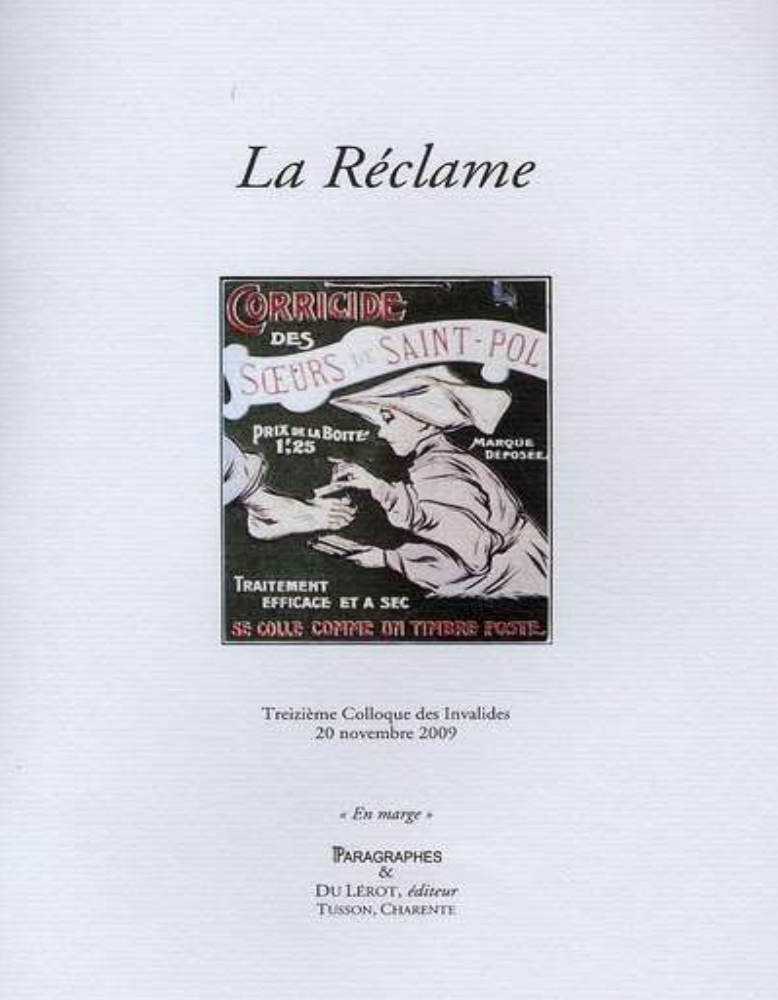
Table of contents: François Caradec: La Réclame Maurice Culot: How to make bricks palatable Jean-Didier Wagneur: Puff and literature Olivier Salon: For herself Delfeil de Ton: Ask for the program Natalie Pelier: "La Réclame" by Jules Nast Jean-Paul Morel: Dr FAF's advertisements Eric Walbecq: Bloy's third sector Laurence Guellec: The Harlequin billposter Paul Braffort: Advertising in song! Daniel Zinszner: In the land of lanterns Paul Schneebeli: The Scorpion of the chalice Pascal Durand: Mallarmé and advertising Henri Béhar: André Breton, "An advertisement for the sky" Marc Dachy: "Advertisement for myself" by Johannes Baader Sima Godfrey: Product placement in literature Eugénie Briot: Fragments of a poetics of commerce Alain Chevrier: Advertising poetry Marc Angenot: Poetry made by all or advertising in verse Oceane Delleaux: Strategy of the multiple Mete Camdereli: Advertising journalism among the Ottomans Denis Saint-Jacques / Marie-Josée Des Rivières: Magazine advertising in French Canada Alain Zalmanski: Object advertisements and objects to advertise Christophe Bourseiller: Roswell against Ummo: the UFO war Françoise Gaillard: A woman who displays herself Dominique Noguez: The ten most beautiful literary advertisements
Text of my intervention:
An advertisement for the sky (André Breton)
"It's said; I invent an advertisement for the sky! Everything advances in order." (Breton, OC I, 60) The formula is found in The Magnetic Fields. Although the work, and even the pre-original, are signed by both authors, it is by Breton alone. The poet institutes himself as a celestial advertising agent. What meaning to give to the word "sky"? the romantic firmament? the religious divinity? The context does not allow one to decide, and I think that the virtue of poetry, of automatic writing, is to privilege the indeterminate. But, in truth, it's a completely different phrase that I had in memory, and that I had copied when I consulted the Breton-Aragon correspondence: "For me, poetry, art, ceases to be an end, becomes a means (of advertising). Advertising ceases to be a means to become an end, Death of art (for art's sake). Demoralization. It is naturally necessary to take the word advertising in its broadest sense. It is thus that I threaten politics, for example. Christianity is an advertisement for the sky." (illustrated postcard AB to Aragon, April 16, 1919) Is this to say that the poet would want to inscribe himself in Claudel's lineage? Far from it, it is a question of taking example on religion to raise poetry to the same level of universality. To be persuaded of this, one must refer to the beginnings of the journal Littérature. Paradoxically, it is much too wise in the eyes of its founders. In Breton's head clash the symbolic remarks of Jacques Vaché, Isidore Ducasse and Tristan Tzara. Intuitively, he has grasped their common objective: to kill art, or at least the soothing use that is made of it. He himself and his friends, will they be able to operate in broad daylight? Such is the subject of a conversation that he would have had with Aragon, resulting in a secret pact, on which the latter has embroidered in the article "Lautréamont and us". It would have been a question of fomenting a coup d'état, using the Dada method, the one advocated by Tzara's Dada Manifesto 1918, which has truly dazzled him. He also develops his theory in a long missive to his dearest friend: "What do poetry and art do? They praise. The object of advertising is also to praise. I claim that the world will end, not by a beautiful book, but by a beautiful advertisement. [...] One can transpose in the abstract order: moralist, (Or else commerce.) Contests, surveys, prizes, etc. The "poem" must hold the street. But that it not be a poem, -- "what do you want?" one will ask. There will be no more poems, no more books! I threaten advertising (by sowing doubt). ... You will see me during the electoral period. No more commerce, no more politics. -- After: Power, justice, history: down with them! (= Long live: I read Hegel).[...] It is necessary that one always believe us poets. One will admit that modernism leads to everything, and a thousand exhibitions. Needless to add that I have never written anything so serious: I take the thing tragically. An abuse of confidence like an aborted attempt, I would punish. And I fear nothing [...] P.S. Note that for the moment I want nothing. Not even the ambition to enrich myself or to be a great man, It is what makes me dangerous." (April 17-18, 1919) Here we are at the heart of the crisis: the poet ceases to write to devote himself to this global transformation of society by means of a different poetry, launched into the universe by advertising. Ten days later, the tension has subsided: "You have not spoken to me enough about the R. I so needed you to say what value you find in this idea, how you continue to judge me. But I no longer write in verse, you can believe me. Say always." (April 27) "But I no longer write in verse," he assures. Indeed, the manuscript of The Mysterious Corset that he sends on May 1 to his confidant, is composed of ready-made expressions, advertising elements, varied typographic characters (OC I, 16). Nothing from his pen. Praise of advertising, voluptuous enchantment of feminine toilette, collage, effacement of self behind ready-to-use, such is the solution adopted to escape the terrible attraction of silence without falling back into the game of rhymes and mimes. Moreover, André Breton himself has testified to this episode: "I was saving my stake as I could, defying lyricism with blows of definitions and recipes (the dada phenomena were not going to be long in producing themselves) and making a show of seeking an application of poetry in advertising (I claimed that the world would end, not by a beautiful book, but by a beautiful advertisement for hell or for the sky." Manifesto of Surrealism, OC I, 324). There are many other references to advertising as a poetic solution in André Breton's writings in these years when surrealism was seeking itself, notably in his "Letter to the Seers" (La Révolution surréaliste, n° 5, Oct. 15, 1925, p. 20), where it becomes synonymous with scandal. However, it falls to Aragon to draw the lesson of the transformations of poetry in his "Introduction to 1930". He considers that the period 1917-1920 knew how to put an end to lyricism thanks to the watchword "advertising for advertising's sake", with this ambition of all poets to address the crowd, stopping it with a single word: "If one rereads the strange poems of this epoch, it is easy to perceive from one month to the next a new taste that becomes precise there and it is the taste for advertising." he writes (La Révolution surréaliste, n° 12, Dec. 15, 1929, p. 60). To conclude, it seems to me to read a personal confession, perfectly situating the place of advertising in Breton's poetics, in the last of the stories of Poisson soluble. He writes: "Moreover the walls of Paris had been covered with posters representing a man masked with a white wolf and who held in his left hand the key to the fields: this man, it was me." The negative and multiplied image of Fantômas, source of infinite dreams, is it not the proof that poetry can meet the people?
Henri BÉHAR