"PROLEM SINE MATRE CREATAM OR THE DAUGHTER BORN WITHOUT A MOTHER IN THE AGE OF INDUSTRIAL REPRODUCTION", PHILOLOGY REVIEW, UNIVERSITY OF BELGRADE, N° XXXIX, 2012, 2, P. 9-16.
Conference program: Conference: Round table: "Hybridization of genres in the European avant-garde": Nadrealizam
Hybridization of genres in the European avant-garde
Participants: Henri Béhar, Jelena Novaković, Annie Urbanik, Françoise Py, Bojan Jović, Predrag Todorović, Dina Mantcheva
French Institute in Serbia, Zmaj Jovina 11, Belgrade on October 19, 2012. (10:00-13:30)
Program
Henri Béhar, University of Paris III: "Prolem sine matre creatam or The Daughter Born Without a Mother in the Age of Industrial Reproduction"
Jelena Novaković, University of Belgrade, Faculty of Philology: "Hybridization of genres in surrealism: Without Measure by Marko Ristić"
Annie Urbanik – Rizk, Auguste Blanqui High School, Saint-Ouen: "Writing and photography in Breton's Nadja: at the limits of the unspeakable or the crossing of appearances?"
Françoise Py, University of Paris VIII: "Hybridization of genres in surrealism, from transgression to erasure"
Bojan Jović, Institute of Literature and Arts, Belgrade: "The 'chaplinade' as a prototype of the hybrid genre of the avant-garde"
Predrag Todorović, Institute of Literature and Arts, Belgrade: "Serbian Dadaism in the context of the European avant-garde"
Dina Mantcheva, "Saint Clement of Ohrid" University, Sofia: "The hybrid form of symbolist drama at the origin of avant-garde theater".
The participants: Henri Béhar, Jelena Novaković, Annie Urbanik, Françoise Py, Bojan Jović, Predrag Todorović, Dina Mantcheva.
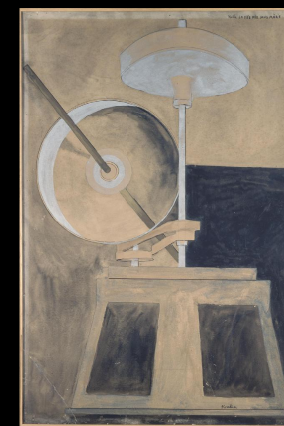
Francis Picabia: The Daughter Born Without a Mother (Centre Pompidou)
Here is the daughter born without a mother – Centre Pompidou
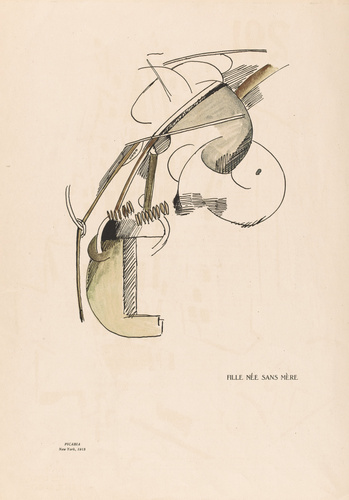
Musée d'Orsay, Alfred Stieglitz, "Daughter Born Without a Mother", drawing by Francis Picabia.
Belgrade Round Table, October 19, 2012.
Title: "Prolem sine matre creatam or The Daughter Born Without a Mother in the Age of Industrial Reproduction" by Henri Béhar.
Summary
Many years ago, enough to have the necessary perspective for a researcher, we created a literary history database (BDHL) which had the originality of formalizing the notion of genre through a cross-sorting exercised at several levels. If it is interesting to show how genres have evolved over the centuries, it is even more so, for our cooperation program, to analyze the transformations and variations of genres in the surrealist movement (in French). Here we show how the refusal of genres for some, generic indeterminacy for others, effectively results from a crossing, a hybridization of more traditional categories, to arrive at new varieties.
Long Summary
I use here the data provided by the Literary History Database (BDHL) created, on my initiative, in 1985. It proposes a genre system articulated on three levels plus one (the genre indicated on the work).
The first level of the genre system distinguishes: verse, prose, mixed, other, undefined.
The second level distinguishes between: fiction, ideas, intimate discourse, theater, poetry, undefined.
At level 3, we enter into the detail of the previous categories.
The title of this article refers to Francis Picabia's booklet, The Daughter Born Without a Mother, which uses a Latin formula placed by Montesquieu at the head of his Spirit of the Laws, to mark that he had no model. The collection includes 18 mechanical drawings and 51 poems.
Let's take the example of a double page of the collection, juxtaposing poem and drawing. Our analyses can extend to the entire Dada-surrealist corpus. The problem is that these are most often bibliophilic rarities, so that criticism uses the complete works of Picabia, Tzara, Ribemont-Dessaignes, which suppress the illustrations, which shifts the nature of the observations.
If such avant-garde works can enter this classification, it is because they respond to identifiable generic traits (prose, verse, fiction, lyrical, dramatic...) despite the refusal of genres by the movement that carries them. If there is a decline of genres, it is appropriate to retain the advent of new genres, identifiable, I have said, beyond cross-sorts, by the subtitle or paratext. Thus Grains and Bran which Tzara qualifies as "experimental dream", work alternating poems and critical notes until they meet, for the greatest confusion of the reader.
Extension: Poems and drawings of the daughter born without a mother: May 19 – July 24, 2021
ART | COLLECTIVE EXHIBITION
The exhibition "Poems and drawings of the daughter born without a mother" is resolutely surrealist. The twelve artists gathered play the game of an exquisite corpse, with the work of the Dadaist Francis Picabia as a starting point: to his pictorial and poetic creations of yesterday respond today a set of drawings and watercolors, paintings and sculptures, collages and installations. The Topography of Art thus hosts a collective exhibition in the form of an artistic conversation between the beginnings of the 20th and 21st centuries.
"Poems and drawings of the daughter born without a mother": a conversation initiated by Francis Picabia
The title of the exhibition "The Daughter Born Without a Mother" takes up those of several paintings as well as that of a collection of drawings and poems created in 1918 by Francis Picabia. The paintings were made in 1916 when Picabia was discovering the omnipresence of industrial mechanization in the United States. They represent the gears of a steam engine. The title, which also refers to the birth of Eve from Adam's body, is an ironic metaphor for a creation without conception. Francis Picabia's work thus combines observation of modern society and considerations on artistic production.
Poems and drawings of the daughter born without a mother: a secular dialogue
In the Topology of Art exhibition "Poems and drawings of the daughter born without a mother", twelve artists bounce back in their own way on Francis Picabia's creations, particularly on the different versions of this daughter born without a mother. In his work Words (2020), Horst Haack pays tribute to the "brother of Dada's father" by taking up a sentence written in 1915 by Picabia in an article in the New York Tribune: "The machine has become more than a simple instrument of human life. It is really a part of human life. I have appropriated the mechanics of the modern world and introduced it into my studio".
Chloé Julien, for her part, questions procreation in her series of collages "Young Girl Without a Mother" (2013), whose works intertwine fragmented female bodies until they become unrecognizable. Her collage Life Machine (2018) is an agglutination of mouths, hands and women's breasts. The works of Saadi Souami, Clarisse Hanh, Glenda Leon and the other artists exhibited at the Topography of Art, respond differently to the issues raised by Francis Picabia. A very rich dialogue ensues, a century later.