"Speaking Alone, by Tzara-Miró", Histoires littéraires, 2014, No. 59-60, pp.
As indicated by the organizer of this issue of the journal Histoires littéraires, it was he who asked me for a contribution on one of Tristan Tzara's most beautiful illustrated books, which he himself highly valued, both as a reader and as a collector. I therefore proposed to him to deal with Speaking Alone, in my eyes the greatest success of Tristan Tzara allied with Joan Miró. Here is what he writes in his presentation: "Thus, Henri Béhar agreed to approach one of the masterpieces of the illustrated book of the 20th century, whose title, Speaking Alone, testifies to the unique voice through which Tzara and Miró create their own language where signs — words, colors, lines — speak alone, effectively. This also shows us how difficult it is to find a term to describe this kind of work: illustrated book, artist's book, dialogue book? None of these appellations manages to circumscribe the object."
Contents / Histoires littéraires No.59 60; July-December 2014 Dossier: Text and Image Studies
J. Bogousslavsky: Introduction H. Béhar: Speaking Alone, by Tzara-Miró S. Dieguez: The Pictorial Narration of the Machine-Man O. Walusinski: Images of Hysteria J. Bogousslavsky: Max Ernst's "Literary" Path V. Duzer: Zacharie Astruc, Model and Character at the Crossroads of the Arts A. Rodriguez: Gustave Roud. From Poet to Writer-Photographer Ph. Kaenel: La Fontaine's Fables in Images
C. Le Quellec Cottier, L. Tatu: Representations of War A. Borrel: Méry Laurent at Jacques-Emile Blanche. Story of a Portrait C. Bonucelli: A Forgotten Obituary of Baudelaire J. Haussy: The Malraux Myth B. Noël: Unknown Profiles of Paul Verlaine Interview with René de Obaldia Reading Histoires littéraires, by Delfeil de Ton Chronicle of Sales and Catalogs In Society / Books Received
Speaking Alone, by Tzara-Miró
Since it is accepted today, for reasons that still escape me, that one can speak of the man Tzara without ever having read a single line of his, I would like here to take the opposite approach to common practice and deal with what, in my eyes, constitutes the most beautiful success of the post-war illustrated book: the volume Speaking Alone, born from the connivance of the poet Tristan Tzara and his long-time accomplice, the painter Joan Miró, both supported by a publisher of great talent, Adrien Maeght, himself a former lithographer engraver. The rarity of this magnificent work, its current price, could possibly justify the public's ignorance, if there weren't several editions of the text alone to satisfy any potential curiosity (when will there be a pocket format edition, like Breton-Miró's Constellations?).
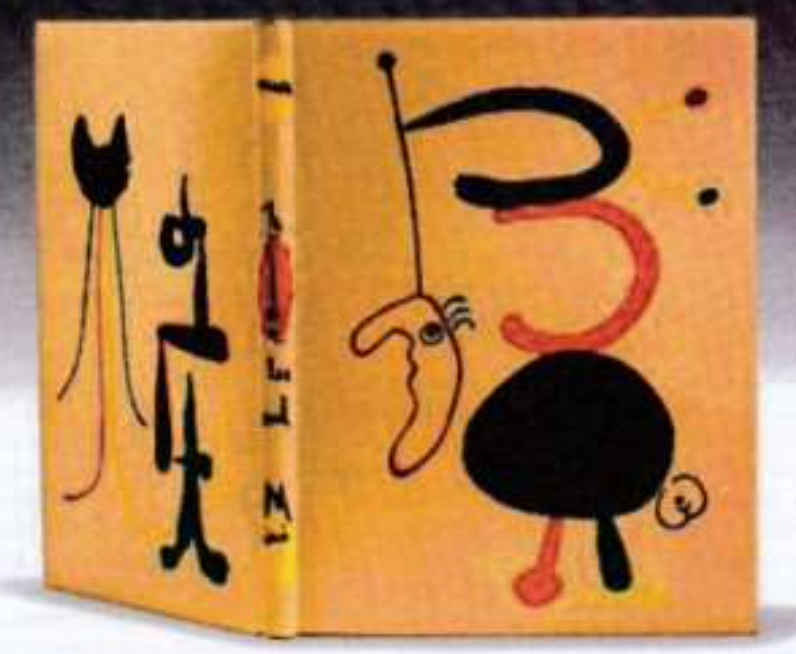
I will start with the usual bibliographic description: Tristan Tzara, Speaking Alone. Poem. Seventy-two original lithographs in black and colors by Joan Miró. Paris, Maeght, 1948-1950. 38x28 cm, 120 p., illustrated cover folded under cardboard and specially lithographed slipcase by Joan Miró. In sheets, 70 lithographs in black and colors including one as frontispiece and 19 full-page. Limited to 253 copies, the printing is divided into 20 copies on Montval vellum, 30 copies on Arches vellum, 200 copies on pure rag Malacca, and 3 copies reserved for the author, illustrator and publisher. Completed on November 23, 1948 at Fequet et Baudier in Paris, it will take no less than two years for Mourlot brothers to print the lithographs and destroy the stones after printing! In fact, the poem, composed by Tzara in the summer of 1945, results from a double conjunction: the Liberation on the one hand (which explains the desinit, "you came out alive" on which Michel Leiris will comment), and, on the other hand, a two-month stay that the poet made at the psychiatric hospital of Saint-Alban-sur-Limagnole (Lozère), at the invitation of his friend Doctor Bonnafé (himself obliged to remain in Lyon at the same time). The psychiatric establishment enjoys a great reputation. It was the starting point of institutional psychiatry, even before the discovery of psychotropic drugs, and its director, Lucien Bonnafé, did not hesitate to denounce the death of 40,000 insane people in insane asylums due to privations during the war. Contestatory, like his many surrealist friends (he had hidden Paul Éluard before), he wanted to be a "de-alienist", working for the liberation of the mentally ill and their reintegration into society. Speaking alone. How many times have I been reproached for it! As far back as I can go in my childhood, I think I have done nothing but that. Today, no one pays attention to it: they think I'm talking on a mobile phone! Is this a sign of mental disorder? I don't think so. It seems to me that Tzara agreed in this sense when he began to compose these poems, after long conversations with the hospital's residents, some of whom became friends. It was the first time he found himself in contact with mentally ill patients under treatment. Strongly impressed, and very touched by the sympathy they exuded, and their need for affection, for humanity he said, he could only give them a voice in his own poetry. Unlike Éluard who, in similar circumstances, wrote the Souvenirs de la maison des fous (1946) by painting extremely sensitive but entirely external portraits, Tzara's poems break the shell of beings and things, make language explode, giving it an appearance of disconnectedness, which is exactly that of his interlocutors. One obviously had to have gone through Dadaist experimentation to find oneself immediately at this level of natural expression. All the more so since, for Tzara, speaking alone is precisely the opposite of solitude, it is opening oneself to the world, immediately merging with nature, among plants and animals. Humanity is not deserted: it is rather an overflow of sensitivity, an intense need for affection that manifests itself through his verses. Let's open the book and read (1):
stranger in the sun of bells I saw you fleeting in the arms of dead leaves nothing but a window opening onto the air of free boats the fire choked in the wandering head (Stranger, p. 39)
in the water of stones that are there like on the shards of the sun to drink I found you again invincible forever warm like the ant on the untranslatable road you discovered yourself (Lost, p. 41)
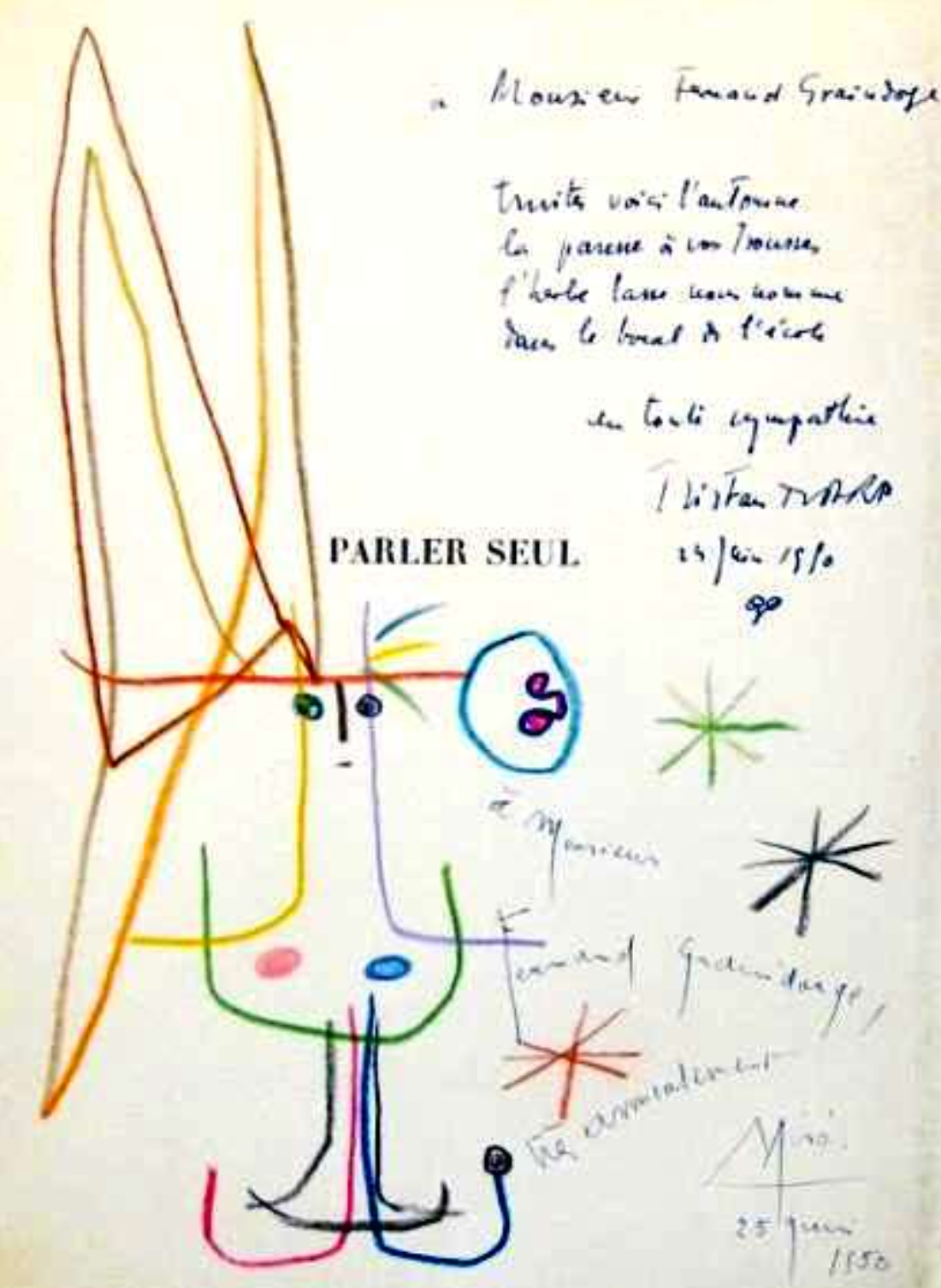
The collection was therefore completed in 1945. Tzara did not have it printed before finding an illustrator, capable of dressing it as Masson, Picasso, Matisse had already done for him before, and especially Miró who had just provided him with eight etchings for the Desespéranto (3rd part of The Anti-Head) in the Bordas reissue. It was quite naturally that he turned to him to entrust him with these poems of sand and waterfalls, of laughter and oblivion. All the more so since the artist had already adorned his collection The Travelers' Tree at Éditions de la Montagne (1930) with four lithographs. Maeght, who would henceforth be his exclusive dealer, did not hesitate for a moment. At the publication of the volume, Miró declared: "... I was very wrapped up [sic] for this because it's the first great book I was able to illustrate, all the more so since it's with Tzara who is an old friend, one of the first men I met in Paris in 1920, one of the first who defended me. All the more so since I thought a lot about the Dada movement which, in my opinion, has an enormous spiritual scope..." How to qualify this collaboration between the painter and the poet, and this unique success in the art of the book? Will we speak of "dialogue through the book", as Yves Peyré suggests? No doubt, but on condition of clearly seeing that this dialogue is entirely a posteriori or, at the very least, deferred. As proof, Miró's letter addressed to his comrade on April 5, 1948: "I like very much the text that I must illustrate, and I hope to do something good" (BLJD, TZRC 2729). We are therefore in the presence of an extremely classic case, that of a graphic designer who finds himself having to "illustrate" a pre-established poetic ensemble. However, unlike his predecessors, the painter does not seek to give a visual interpretation of the text, to make it more immediately understandable or to give it a free counterpoint. If there is art transposition (ekphrasis), as every time one passes from poetic language to another, this one is not banal, since each of the two artists pursues his own monologue in order to Speak Alone to the power of two. Here, Joan Miró does not attempt to respond to Tzara, nor to share with him his own point of view on the suggested remarks of "the stranger", of "the lost", on "the words of straw" or "the words of the old and the young", that is to say on each of the sections of the collection. But he structures the work using his own formal grammar, his personal numerical system, giving it the strongest cohesion, punctuating here and there, dreaming in his own way, by association of ideas, on the words perceived through the iridescences of the text. Michel Leiris immediately analyzed the process: "Parallel to the words which are seeds ('grains et issues' Tzara said elsewhere) the typographic signs, here, reveal themselves capable of germination too. Nothing more hazardous and, at the same time, better organized than this book which is birth of the book or progressive creation of which printing on the one hand and vocabulary on the other constitute, it seems, the only animating principles. No doubt they speak alone, these words which chain themselves without law other than poetry, and alone too these materials that Miró puts to work: characters, numbers, when it's not simple points or lines, in short, apparently random marks on the white of the page, but which one sees augmented with appendages and protuberances like the 'bulleted' or 'spectacled' letters of magical writings and of which, a little further on, one realizes that they contained in potential funny figures like a wall defect and already, virtually, the graffiti that it will become by means of some addition" (1950, Writings on Art, CNRS editions, p. 186). Don't think that Miró, when he takes up the division of each section by Roman or Arabic numerals, is content with common writing. One recognizes the Roman III, but an adventitious point makes one think of a cup-and-ball, a ball of wool or a sea urchin in becoming. Similarly, the Arabic 3 gets a ball on its head, or else extends with a thread, itself carrying Toto's head. The Arabic 4, in black, balances with a long train in swallowtail, and so on. "The palette would willingly reduce itself to red, blue, green, yellow and black, constantly combined in an arithmetic whose rules would be linked to a chromatic progression, if its signs suddenly did not germinate in the most unexpected way, the lithographic pencil endowing them with heads, appendages, limbs, colors that explode any beginning of convention," comments François Chapon playing with alliterations like any Racine (The Painter and the Book, p. 178). And to conclude to the analogy of the two approaches, of the painter and the poet. One would be tempted to see Chinese ideograms in it, and to follow the reasoning of a young Korean researcher, who sees at such a place a number transformed into a mountain, and immediately thinks of the typographic art of Moonjado (sort of typographic characters painting the traits borrowed from nature, birds, flowers...) if such a process were not premature regarding Miró. In truth, if one can rightly speak of a success for this art book, it is not only because the poet's language finds its echo in that of the painter, it is above all because the whole forms a book, with its own structure, its sequences of three pages punctuated by a full-page illustration, its rhythm, which never gets bogged down in formalism. In perfect agreement with the poet, the artist has appropriated the work from the cover to the colophon, affixing his mark and his elementary universe. In the end, Tristan Tzara could boast of having had a good nose in suggesting the Catalan's name to the publisher. He knew that his apparent timidity, his long silences, his infinite patience, covered an approach similar to the one he had wanted to put into words: "So, when I finished this poem, the problem arose for me to know who could illustrate it; now, there was only my old friend Miró who was closest to this spirit; because of the freshness of his feelings and the universe in which he lives, where he has put his painting and all his art. He feels very deep roots that bring him closest to man in the state of nakedness of consciousness (2)." This is, more or less, what he confided to the reader in an article, "Joan Miró and the Emerging Question", published in the Maeght Gallery's journal, Derrière le miroir, at the time when the typographic printing of his poem was being completed. He noted an art returned to its childhood and transformed, a surpassing having its own language and disposing of an alphabet of which each letter is the sign of a new life. Such artistic fraternity could only arouse the enthusiasm of amateurs. Henri BÉHAR
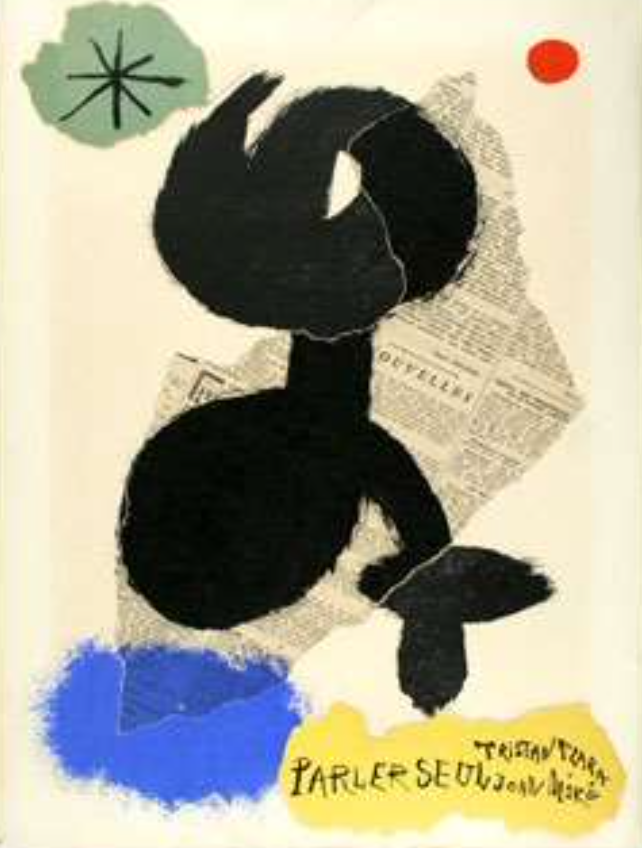
Illustrations borrowed from: François Chapon, The Painter and the Book, Flammarion, 1987, pp. 179-180. (this formula to avoid reproduction costs). See on this same site: Tzara-Picasso: The Rose and the Dog: The Perpetual Book Object: The Rose and the Dog (1958)] (melusine-surrealisme.fr) Read: Tristan Tzara, Complete Works, vols. I to VI, Flammarion editions, 1975-1990.
(1) I quote from the Complete Works of Tristan Tzara provided by me, vol. IV, 1980. (2) ORTF interview already cited, OC IV, p. 583.