The Perpetual Book Object: The Rose and the Dog (1958)
To those who have not had the chance to hold in their hands one of the most expensive books in French bibliophilia, I offer this brief presentation, supported by a more detailed illustration under PowerPoint, during the seminar "Book/Poetry/Typography", session of April 11, 2013: "Inventions and recreations of the post-Dada and surrealist book".
In March 1958, Pierre André Benoit, the Alès publisher specializing in rare limited-edition books, offered collectors a work destined for mythical reputation. This is The Rose and the Dog, perpetual poem by Tristan Tzara, illustrated by Picasso. It presents itself in the form of a 28.7 x 20 cm booklet in sheets, with a folded parchment cover, first board printed. The colophon indicates: "The Rose and the Dog was printed in 22 copies in Alès in March 1958, the plates were scratched after printing". Each copy bears in pencil the signature of each of the authors and the initials of the publisher. Printed on handmade laid paper, the work includes three original engravings by Picasso and the perpetual poem printed on mobile rosettes with a fixed center decorated by a Picasso engraving. This one hides a concealed "secret notice", printed on 5 lines in the middle of the 3rd disc of the poem.
Such is, at least, the descriptive notice that can be read in volume IV of the Complete Works of Tristan Tzara, published by Flammarion in 1980, presented by me.
The PAB catalog offers a notice apparently more technical regarding the engravings and the system used, but remains silent on the secret: "Perpetual poem by Tristan Tzara, Alès, March 1958, 27.5 X 19 cm. One full-page engraving as frontispiece, one full-page engraving on which is fixed a rotating system composed of two printed mobile discs with windows in the center of which is a small fixed round engraving, one round engraving on the justification page, printed in black. 22 copies on Montval, parchment cover, signed by the artist, author and printer, numbered from 1 to 22. (Some copies contain a suite of scratched plates on Auvergne). Some copies with paper cover, unsigned."
The catalog of Tristan Tzara's library, sold on March 4, 1989 under the hammer of Me Guy Loudmer at the Drouot hotel, in Paris, somewhat takes up the notice of the Complete Works, and mentions "the secret notice", while referring to the Bloch catalog (books n° 86).
I leave aside, for a future development, this secret problematic, which is not mentioned in any of the public notices to which the reader can access. It should also be specified that the National Library of France only acquired a copy in 1997, and that the one from the Jacques Doucet Literary Library comes from the Michel Leiris bequest, who died, as we know, in 1990. It should be noted that a luxurious copy, from the former Daniel Filipacchi collection, was sold at auction by Christie's in Paris on April 20, 2004. It is enriched with a red suite of the four Picasso engravings, as well as a second proof of the frontispiece in black.
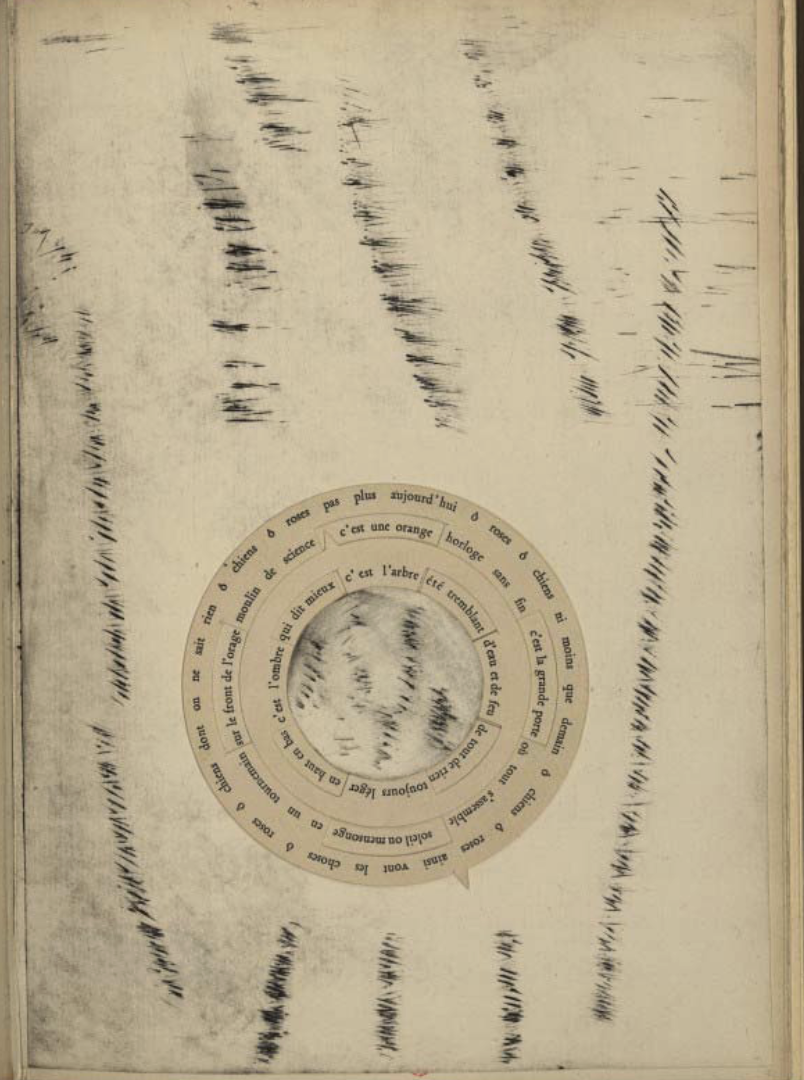
The present reproduction of one of the pages gives only a faint idea of the object that the author must manipulate at will, by turning each volvelle in one direction or another.
The idea of putting back into use these concentric discs used by medieval navigators to calculate their position came to Tzara while contemplating books of cosmography in the window of a scientific bookstore on rue Saint-André des Arts, according to the testimony of his friend, the painter Camille Bryen[1]. This was at a time when parking discs had not yet been instituted in Paris. Manufactured by the thousands, these hourly discs give a good idea of the functioning of what Tzara called a "perpetual object" in the sense that one never finishes producing verses. No doubt he also had in mind the discs of Marcel Duchamp, a painter he had known since the twenties, and with whom he still played chess.
He therefore conceived a poem in such a way that by changing the position of a verse (or a fragment of verse), in one direction or another, the reading of the text was modified, without however becoming absurd. Each permutation consequently produces a new reading carrying a new meaning.
Automatic poem, if you will, but not in the sense that André Breton gave to this term. If the infinite variations of the text prevent all its realizations from being foreseen in advance, the words do not come from the unconscious, since they were engraved beforehand. Only the poetic discourse is changed. But the most important thing is the recycling, in a poetic context, of the medieval volvelle, with the aim of implementing a combinatorics of poetry.
The PAB publisher therefore realized the object with which Tzara was satisfied enough to involve his friend Picasso in the adventure. He could have contented himself with this unique production, generating infinite reading. Indeed, a page has 3 volvelles of 7/5/3 verses each, i.e. 15 verses each, which gives 105 reading possibilities per page, i.e. 105! (factorial of 105), i.e. roughly 10 to the power of 50, i.e. 10 followed by 50 zeros, which is impressive enough in itself. Not counting that if we estimate the 105 initial verses as permutable, we would still have to multiply this astronomical number by 35×3!, the whole thing could still be squared, depending on the direction of rotation. But no one will think of reproducing the result, which exceeds human reading capacities. This shows how much Queneau's linear invention, a few years later, with his Thousand Billion Poems (Gallimard, 1961), is child's play compared to this apparently innocent object.
Tristan Tzara was so aware of the interest of his discovery applied to poetry that he entrusted some realizations to Pierre Seghers and Alain Bosquet, who published them in their anthology Poems of the Year 1959 (éd. Séghers). In the impossibility where we are, here, to reproduce these rotating discs, I have chosen to reprint these pages, both for the Complete Works and for the Complete Poems, published by the same publisher in 2011.
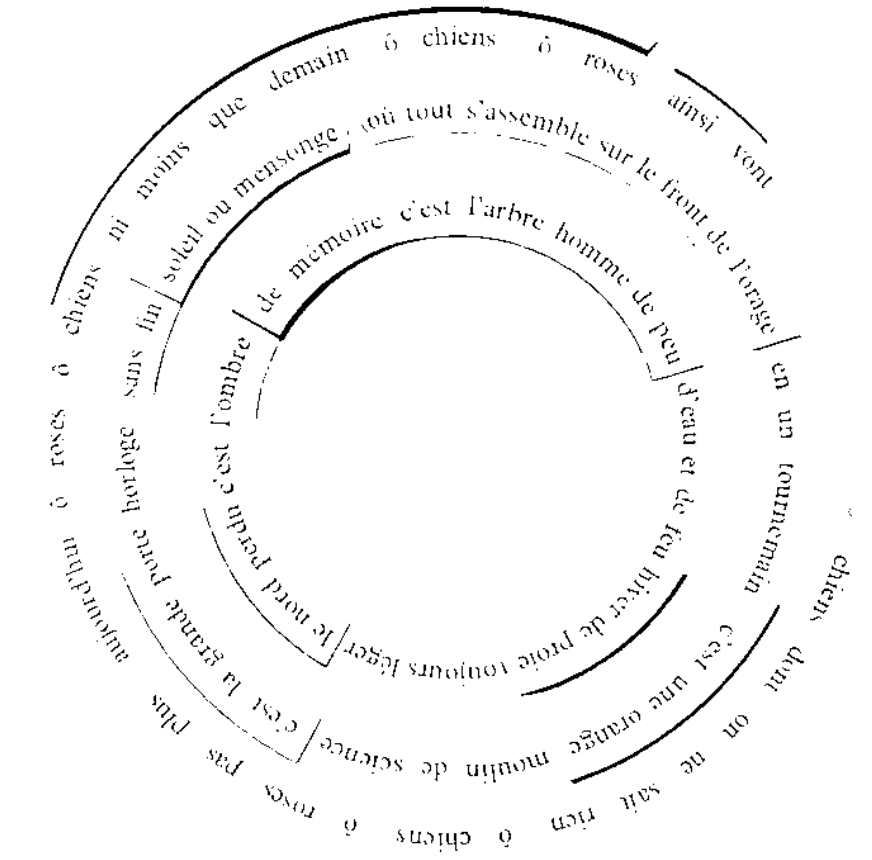
Let us return for a moment to this combinatorics of poetry. The idea is certainly not new, but it has been little practiced in our literature, and especially not with such productivity, for the reason that one quickly stumbles on a question of syntax and coherence of the text. As long as the meaning of the poem prevailed, it was not conceivable to go beyond three or four permutations per work. However, by practicing, since his Dadaist beginnings, a kind of poetry detached from meaning, which could be qualified as concrete poetry (like music or painting), the author of the Seven Dada Manifestos could glimpse a combinatorics of poetry. It remained for him to specify the protocol and to indicate the system (as one speaks of children's books with system). Add to this figured poetry (and not figurative) such as he produced in the form of calligrams (cf. his "Calligram 1916"), and we see that everything was in place to achieve such an invention.
The archives of Tristan Tzara, kept at the BLJD, allow us to follow step by step the realization of this "perpetual object", from the draft, covered, as usual with him, with graffiti and sketches of faces or masks, to the mock-up entrusted to the publisher. We find there notably, under the same title, the manuscript of a 45-verse poem in four stanzas, as a first draft of what, through the aforementioned permutations, will become a perpetual poem. I reproduced it in a note in the Complete Works (vol. IV, p. 637), but do not want to deprive the impecunious reader of it:
It's an orange
where everything comes together
it's the great door
in a twinkling
sun or lie
mill of innocence
on the brow of the storm
endless clock
in veils on the ground
earth without return
ashes on heads
words without memory
a little of everything
it's the shadow
up and down
it's the tree
water and fire
all the same
who says better
trembling summer
man without place
the lost north
memory
the bloody bridge
the agreed air
forever
thus go the things of which
we know nothing
no more today nor
less than tomorrow
oh roses oh dogs
Turn turn the heads
heads of men or trees
green oaks or beeches
serpents salvos
on the back of innocence
we multiplied
in imaginary sources
the water of the
the lie and science
it's an orange where everything comes together
in a twinkling sun or lie
on the brow of the storm endless clock
it's the great door
mill of innocence
It is perhaps not necessary, within the framework of this seminar centered on the making of fine books, to analyze each of the stanzas nor the poem in its entirety. Let us limit ourselves to noting the frequency of appositions and asyndetons, the frozen statements, which allow the text to be read despite the silences and ruptures of meaning. Can we, however, proceed to a game of verse permutations without destroying the coherence of the whole? For, if the dog runs after the rose, the reverse is rarely true. This is what I proceeded to do, not by turning the volvelles of a copy that was inaccessible to me, but by moving each line of the handwritten poem according to a simple rule of permutation. I invite the reader to do the same, and give him an appointment at the end of the manipulation, in eternity, or almost.
Beyond the competence of the publisher and printer, it is certain that the work would not have reached such a degree of success if it were not the product of two incommensurable artists, two accomplices accustomed to working together. There are many signs of their productive friendship and their understanding, especially with Tzara's collection, From Human Memory (1950), illustrated with the thumb dipped in lithographic ink by Picasso. In the case of The Rose, the dialogue (at a distance) between the two creators translates into echoes, Picasso's engravings supporting simplified graphics to the extreme, reproducible infinitely, like the verses engraved on the discs. The frontispiece and the colophon engraving placing themselves at the same level, both concrete-abstract, as the poem. Thus the spider that can be perceived there refers to the spider of the astrolabe.
Signs of recognition, in short, as if each pursued his path while hailing the other from the "other side" of the path, to ensure his presence.
Proof of this is this unpublished letter addressed by Tzara to Picasso a few days after the book's release. The poet adopts a helical form to write it, starting from the outside to go towards the center. The document was recently put up for sale on the Internet. Due to its great volatility, I allow myself to transcribe it here:
"My dear Picasso, If the water crackles in the post and if you hear the fire playing with fire with four hands, if from head to toe the violin covers itself with ridicule, if there is still a doorknob missing from the eye of the stars, if while time thunders on the wine of the arena the spring of tremors in Brandenburg walks quietly on the Croisette, if the ride of the zephyrs brings water to the mouth and if you see emerging from the waves the diamond herd of wrinkle-free bulls, it is because your friend is reviewing the friendship of your canvases and that the affection he bears you is inscribed at the center of everything that surrounds us and warms us. Tristan Tzara April 3, 1958"
This letter of satisfaction mimics, in a way, the product that has just been completed. We will notice the clarity of the subject, the affection expressed there, and the regularity of the syntax. This leads us to our conclusion, which justifies the inclusion of this very rare volume in the catalog of digitized books of the BLJD.
Escaping ordinary production, including that of art books or artists' books, the two accomplices (accompanied, it must never be forgotten, by their publisher) imagined a book in relief, using materials both traditional (parchment, laid paper, off-text engravings) and quite unusual in the book universe, such as celluloid, the assembly of concentric circles, engraving on such a product.
This system book, which certainly evokes children's books, is, moreover, a book in motion: it never says the same thing depending on which volvelle one turns. The mental landscape varies, perpetually.
Issued from collective work, like any craft product, this book implies an active reader, who lends himself to the game and turns the wheel endlessly, like an endless noria.
If no one has been able to know to this day the mysterious text inscribed in the center of the third disc, one can, without risk of error, emit the hypothesis that the three craftsmen had only one goal in mind: to make any poetic publication useless after this perpetuum mobile.
Henri BÉHAR
[1]. Cited by Gaëlle Pelachaud, Animated Books, from Paper to Digital. L'Harmattan, 2011, p. 190.