"Have Computer Tools Changed the Perception of Literary History in the 20th Century?", in: Historical and Metacritical Perspectives on Literary Criticism in the 20th Century, edited by Henryk Chudak, Publications of the Institute of Romance Philology of the University of Warsaw, 2002, pp. 7-34.
As I indicate in the introduction to this article, I felt obliged to participate in this colloquium of the University of Warsaw organized from October 26 to 28, 2000 by Henryk Chudak, whom I had known before in the same places, but in very different circumstances. It was also an opportunity to take stock, in my own eyes, of the contribution of computer tools that I had introduced at the University Paris III-Sorbonne Nouvelle and the practices that resulted from them in my own discipline, I mean literary history.
As every time it was a question of tools other than chalk and blackboard, I must say that my colleagues, both French and Polish, showed themselves to be at once interested and reticent, considering, in a way, that they were already doing, by hand, all the analytical work that I illustrated with slides. Nothing new under the sun, indeed, except that we were not following the same paths, and that we were not going at the same slowness!
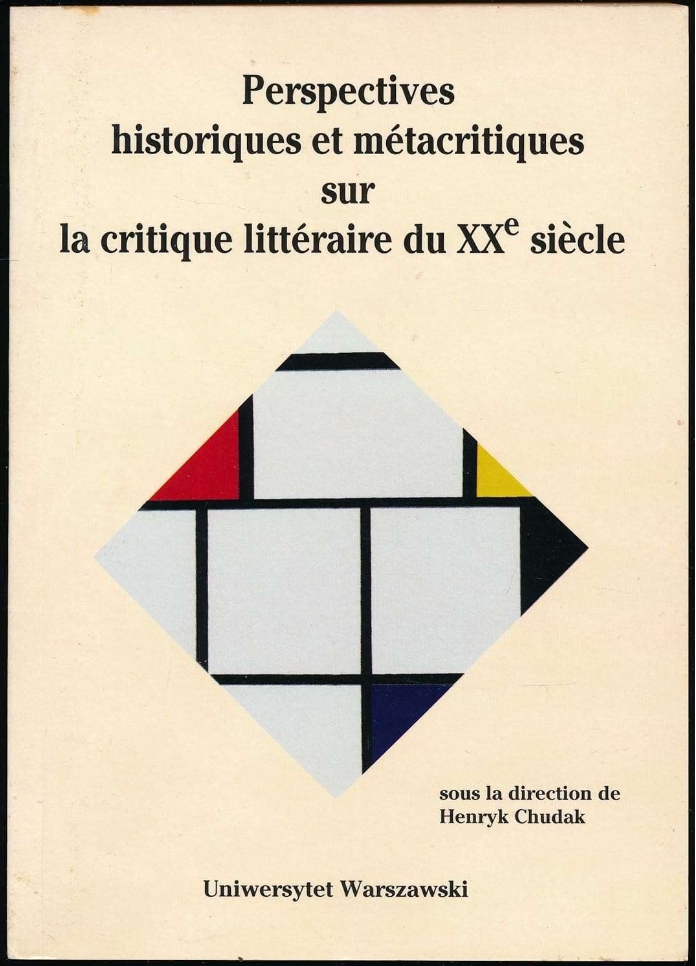
Historical and Metacritical Perspectives on Literary Criticism of the 20th Century. Proceedings of the international colloquium organized by the University of Warsaw, October 26-27, 2000 / edited by Henryk Chudak Publication: Warsaw: Uniwersytet Warszawski, 2000, 268 p.; 21 cm.
Article reprinted in
- Book: Literature and its Golem. Volume II
- Collection: Studies in Twentieth and Twenty-First Century Literature, No. 10
Extensions:
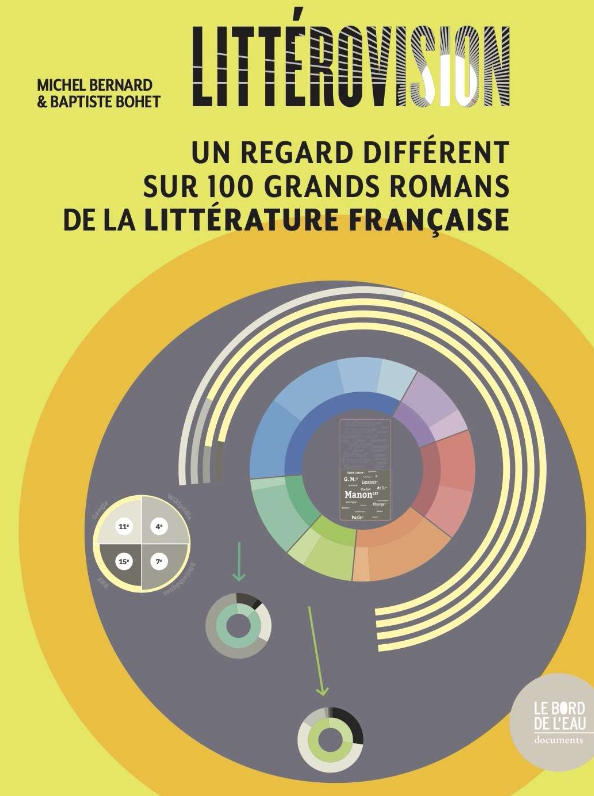
Littérovision
A Different Look at 100 Great Novels of French Literature
To see the great novels of French literature differently is the promise of this work which will allow the reader to discover the secrets of these texts whose posterity has made masterpieces.
Are Proust's sentences really so long? What is Marguerite Duras's favorite word in The Lover? When does Emma first appear in Madame Bovary? What are the novels that use the most future tense verbs? Is The Little Prince borrowed more from the library than The Princess of Cleves? Can one write a novel without semicolons? What is Modiano's favorite verb? With which novels does Albert Cohen's Belle du Seigneur share the most vocabulary? Does Boris Vian in Froth on the Daydream use more colors than Houellebecq in Whatever?
How have these texts, made of words and sentences, been arranged to result in these novels which, for centuries sometimes, make us dream, act, think, love? in a word, make us live? Thanks to innovative digital tools, the authors of this book allow us to access, in an original and atypical way, the intimacy of the most emblematic texts of our literature. After having carried out the synthesis of a large quantity of data, they offer us a visual representation, clear and stimulating.
Michel Bernard and Baptiste Bohet are both teacher-researchers at the Sorbonne Nouvelle University. Specialists in literature, they have been working for many years to propose a new approach to texts thanks to digital tools. Both in the framework of their research and in that of their teaching, they have at heart to make accessible to all the results of complex and evolving methodologies. They have for example published in 2017 Littérométrie. Digital Tools for the Analysis of Literary Texts, Presses de la Sorbonne Nouvelle.