“Apollinaire and Surrealist Theatre,” interview for the program of Les Mamelles de Tirésias, Opéra Comique, 2011, pp. 45–48.
This was, for me, a rather unique case: a written interview (I answered the questions of the publication’s editor), conducted before the premiere of the work at the Opéra Comique, with staging by Macha Makeïeff. I was not invited to the rehearsals. In other words, I had no idea what the performance would be like.
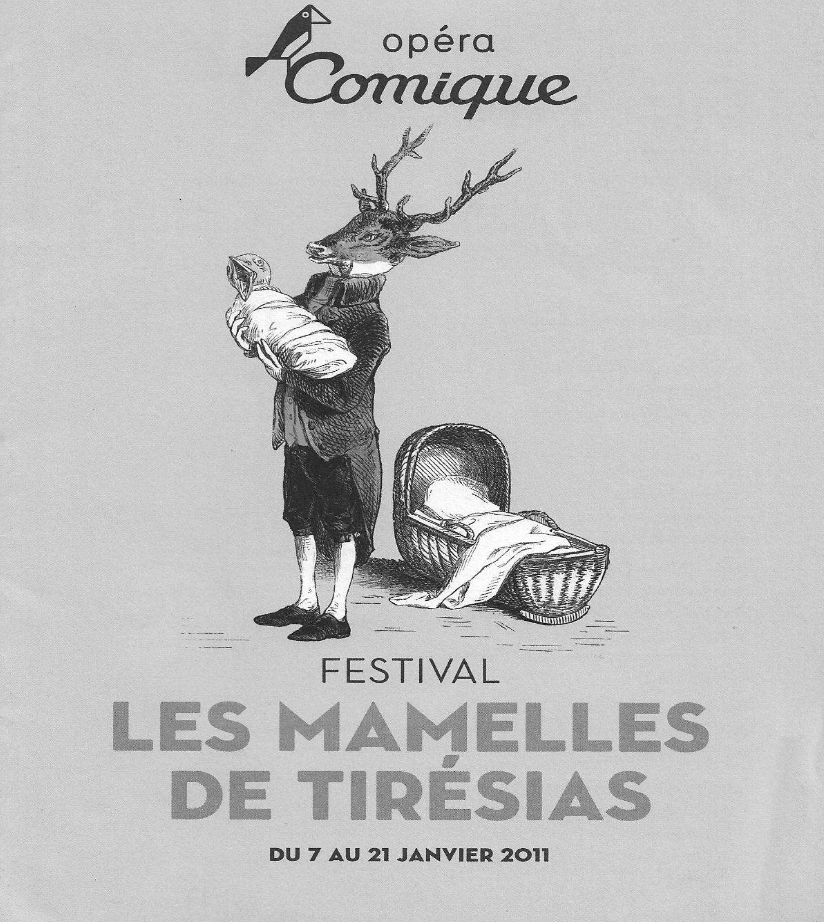
See the presentation:
Mamelles de Tirésias, 2011 Opéra Comique - Search (bing.com)
And the educational guide: Educational Dossier: Les Mamelles de Tirésias (opera-comique.com)
As my text is relatively brief, I reproduce it here in full:
Apollinaire and Surrealist Theatre
Interview with Henri Béhar
The Surrealism as understood by Apollinaire and by André Breton, as known through the Manifestos—do they differ from one another?
Yes and no. Yes, because Breton’s Surrealism took on three entirely different orientations over time. No, because Apollinaire and Breton were, in a sense, co-authors of the word. In several letters and interviews, Breton specified that he contributed to the preface for Les Mamelles as well as to the creation of the term, which Apollinaire nonetheless first used (with a hyphen) in the preface to Parade. In reality, it seems that the idea was born during conversations between the two poets in 1917: Apollinaire, then convalescing, hosted Breton—who was recovering from an appendectomy and, instead of remaining bedridden, came to consult him and browsed his library. Breton’s attachment to the word’s definition—set out in his 1924 and 1930 Manifestos—stems from the fact that he had, from the start, conceived the substance of Surrealism: to produce a superior form of realism, one that takes both the imaginary and the unconscious into account, both banished by rationalism. In the same spirit, Apollinaire advocates in Onirocritique for a boundless realism. Thus we understand Breton’s hostility toward Cocteau and his aversion to gratuitous fantasy or any procedure deemed anti-realist.
To what genre does Les Mamelles de Tirésias belong?
Breton and Apollinaire are both disciples of Alfred Jarry. Like Ubu roi, Les Mamelles is part of the “mirlitonesque” theatre: a light genre, designed for puppets, animated by songs in simple, familiar octosyllabic “mirliton” verses. This legacy is evident in Apollinaire's text: the “merdecin” (Act I, Scene 6 in Thérèse’s list of professions given by her husband) echoes the first word of Ubu roi, “Merdre!” A writer always marks his debts. Another of Apollinaire’s references is Rabelais, visible in the precise figure of 40,049 children. Les Mamelles tells a very simple story with lightly sketched mythological foundations. The work thrives on burlesque fantasy characteristic of the genre—the husband asks for bacon... to make bacon bits! The piece is peppered with references to Parisian working-class culture—the “Zanzi Bar,” for instance, was the name of several local cafés at the time. Finally, certain elements—masks, props, scenes like the duel between Lacouf and Presto—recall the puppet theatre, Guignol.
How did the premiere of the play unfold?
It was a real event, as the text felt quite out of place at the darkest moment of the war, after the failed Nivelle offensive. Apollinaire himself was a censor, working for several newspapers, and was well aware of the implications of censorship. He seized on topical subjects such as the absence of men sent to the front, general gloom, and the growing fear of a demographic collapse. The play, staged by a collective wishing to provoke a strong reaction, was a life-affirming hymn full of fantasy that shocked audiences at the Renée Maubel Conservatoire. Stage and audience faced off, far from the circular, in-the-round stage Apollinaire dreamed of. The audience numbered around 350, mostly friends. They waited two hours in nearly unbearable heat. Performed by amateurs, after scant rehearsal, in sets and costumes representing cubes and squares, the show shocked. That was exactly what Apollinaire and his accomplices wanted: not to present a thesis, Dumas fils-style, but to provoke. Tristan Tzara saw right through it, writing enthusiastically in his review Dada: “Laughter is the kindness of men.” In fact, the play has seldom been performed since its creation.
Is it a play with a message?
This theatre is fundamentally ambivalent, for Apollinaire above all did not want to deliver a lesson. Each spectator is left to decide for themselves what the work means. The poet himself was rather macho, politically on the right, and, thanks to the war, became a defender of “French values.” His origins and personal history made him anxious for recognition in his adopted country. Yet he also enjoyed following in Jarry’s footsteps: upending conventional logic, taking received ideas to the point of absurdity. With women stepping into civil roles in the absence of men at the front, why not imagine other scenarios in which men begin to procreate? All of Apollinaire resides in this contradiction between his loyalty and his disruptive spirit. He is unclassifiable. The same is true for this play and for others, for which I coined the category “Dada–Surrealist theatre.” Contrary to popular belief, Surrealist plays do exist. Neither Soupault nor Aragon, who were both alive at the time, contested my book Le Théâtre Dada et surréaliste when it was published in 1967.
What space could music occupy in the Surrealist project?
Breton’s musical culture was largely limited to Offenbach and Dranem (“There’s a quay on my street. There’s a hole in my quay. You’ll be able—no trouble at all—to see the quay on my street and the hole in my quay”), and he claimed that poetry didn’t need “to be set to music”—it was sufficient unto itself. But one shouldn’t generalize Breton’s musical ignorance to the whole Surrealist movement. Certainly, the group listened to him, but a spirit of experimentation prevailed. As for Surrealist operas, there are only a few, for example, those by Martinů: Tears of the Knife based on a text by Georges Ribemont-Dessaignes, and Julietta or The Key of Dreams on a text by Georges Neveux. I would emphasize that the lyrical dimension is intrinsic to “mirliton theatre”: verses call for stage music. Jarry himself had worked with composer Claude Terrasse. Tzara advocated for a “cosmic” theatre combining painting, music, movement, and words. This was Wagner’s idea, but some Surrealists resolved to realize it in a radically different way…
Born in Paris on the day of the collapse, Henri Béhar first attended the local school on Rue Léon Frot before climbing every step leading to the Sorbonne, where he taught for thirty-seven and a half years and presided for one five-year term. He began his research with a master’s thesis on Dada and is now concluding his career with the same topic, not without taking important detours through Lautréamont, Jarry, Roger Vitrac, Breton, and Surrealism as a whole.