Cultural note on Croquefruit, complement to the exhibition: THE ADVENTURE, CROQUEFRUIT | Pauline Pavec Gallery
I am very happy to learn that a Parisian gallery is presenting an exhibition on "the Adventure of Croquefruit", this cooperative founded in Marseille during the Occupation by Sylvain Itkine and his brother Lucien, about whom Georgette Gabay, their sister, had told us in a memorial article in the daily Le Monde. But I would like to return for a moment to the cultual and cultural origins of their product, the "golden fruit", which is quite simply the cooperative manufacture of a dish that all little Jews know well, whatever their relationship with religious practice! It is actually the "harosset" or "mortar" that each mother elaborates for the evening of Passover. It necessarily figures on the festive meal tray, taken in common: "The mother has lit the candles, she has arranged in the center a tray containing a grilled lamb chop, symbol of the paschal offering, the holocaust, the animal formerly sacrificed before the destruction of the Temple; a hard-boiled egg, symbol of mourning, in memory of the destruction of the Temple; the bitter herbs (maror) recalling the harsh conditions of slavery; the harosset (mortar) representing the construction works to which the Hebrews were subjected in Egypt; three matzot commemorating the exodus from Egypt; and four cups of wine that will be drunk at different stages of the evening, the men being leaned on the left side, as a sign of freedom." (H. Béhar, At Table with Albert Cohen, 2015, p.9).
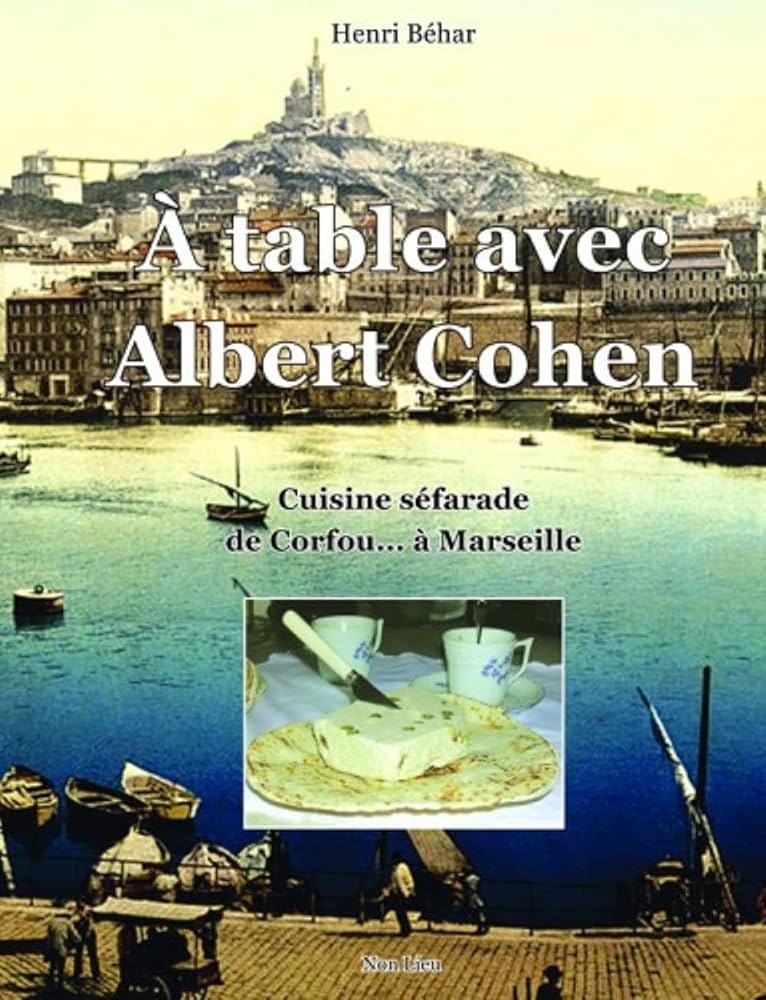
I gave the family recipe in this same work:
"Composition:
Dates: a handful
Figs: a handful
Walnuts: half a handful
Orange: one
Apple: one
Raisins: half a handful
Preparation:
Duration: a quarter of an hour
Crush the walnuts, pit the dates, put the raisins in a glass of water to soften them, peel and cut the apple into small dice, detach the orange skin with its pulp and cut it into small dice...
Consumption:
In turn, each guest takes a spoonful of haroset, which he places on a lettuce leaf (romaine), between two pieces of unleavened bread. He eats this mouthful at the evocation of the bitter herbs. This is definitely not a treat, even if children ask for more!
Paradox:
It may seem paradoxical to prescribe the making of such a sweet dish to evoke the deprivation of freedom..."
In truth, there are as many recipes as families celebrating the feast. However, the base remains identical: dried fruits, available in all seasons.
It is obvious that the Itkine brothers adapted to the Marseille situation by remembering the symbolic dish of their childhood. They saw in it a means of escaping food restrictions, and above all of overcoming obstacles to the freedom to create, as Mr. Derouet, promoter of this exhibition, has very well seen. Thus, this mortar commemorating the liberation of the Jews from their Egyptian slavery came to serve the liberation of surrealist poets and artists subjected to Vichy laws.
In these times of resurgence of anti-Semitism in France, it does not seem useless to me to specify and recall this highly symbolic origin of Croquefruit, and consequently, of the treat that will be given to each visitor of the exhibition.
Henri Béhar
See also the article Henri Béhar, At Table with Albert Cohen. Sephardic Cuisine from Corfu... to Marseille