Henri Béhar, At Table with Albert Cohen.
Sephardic Cuisine from Corfu… to Marseille
Paris, éditions Non lieu, 2015, 106 p., Alain Chevrier, Europe, March 2016, No. 1043, p. 345-346.
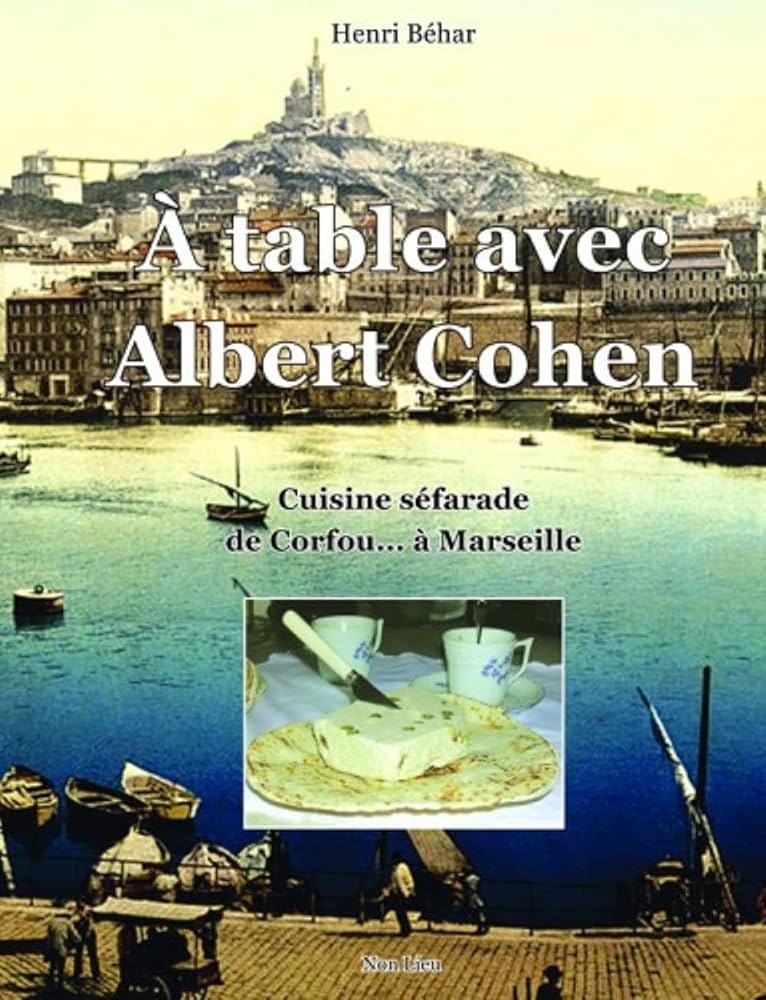
Henri Béhar is known as a great specialist of surrealism and avant-gardes, of André Breton, Tristan Tzara, Alfred Jarry, and as a pioneer of lexicographic research methods opened by the computer revolution. Here he gives a book where these methods are applied to Albert Cohen's work full of Mediterranean eloquence, and in a field that may seem marginal or restricted: food. The result is a book that belongs as much to literature about cuisine as to cuisine about literature, which should satisfy both readers and gourmets. He presents not only very numerous culinary mentions of the writer, without fearing to repeat some of them, as he has collected them according to his methods, but he puts them back into perspective each time within the Sephardic culture that he knows well. He even goes further: he reconstructs the recipes of the evoked dishes, and adds some personal touches. This is to say that he gets his hands dirty, and he invites the reader to do the same. The work opens with a reminder of the so-called Jewish Passover, very useful to gentiles who might be ignorant of its unfolding, then it presents in alphabetical order the "merchandise with strong odors," that is, the basic elements of this cuisine, among which boutargue, cascaval, loukoum (Albert Cohen's spelling, who moreover abhorred exotic lexical borrowings, he reminds us), rose jam, raki, resinated wine. Then, following the writer's citations, he gives recipes for more than forty dishes from Judeo-Balkan cuisine, such as roasted lamb shoulder, eggplant caviar, fritters, meatballs (often flattened), stuffed goose neck (but not stuffed carp, "cold fish" belonging to Ashkenazi culture), vine leaves, moussaka, chopped veal liver, among other Greco-Turkish "oriental splendors." Everything is served with humor that he shares with his chosen author, who invented the Rabelaisian character of Mangeclous, and never tired of reminiscing about his mother's cuisine ("Jewish" as one still says). Henri Béhar even amuses himself with a Talmudic discussion on some culinary incompatibilities when the writer gives dishes making meat and milk (therefore cheese or béchamel) coexist, contrary to the prohibitions of Leviticus, on the presence of yeast in the dough during Passover, as well as on the non-kosher character of fish without scales, crustaceans and seafood. We thus learn that sometimes ham can be considered as "the Jewish part of the pig" and be ingested in sandwiches in certain cases. The critic shares with the writer the nostalgia of their origins, especially since these have disappeared, and advocates tolerance towards other cultures and religions according to an engaged and well-understood secularism. The work is very well edited, like a "real" cookbook, with clear typography, a useful index, and appetizing or suggestive photographs that do not invade it, and of which the last is a very sympathetic cameo of the author himself. Let us conclude with him: Lehaïm! ("To life!"), and, shopping done, book open in one hand, quickly to the stoves!