The Paradoxes of the Second Manifesto of Surrealism
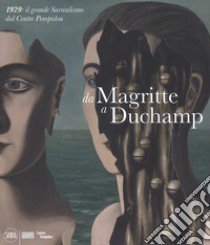
"I paradossi del Secondo Manifesto del Surrealismo", exhibition catalogue Pisa, 1929, il grande surrealismo dal Centro Pompidou. Da Magritte a Duchamp", Geneva, Skira, 2018, p. 154-174.
The catalogue of the Pompidou exhibition in Pisa From Magritte to Duchamp has just been published in Italian by Skira editions: See From Magritte to Duchamp 1929. The Great Surrealism from the Centre Pompidou on Unilibro.it
My contribution, "The Paradoxes of the Second Manifesto of Surrealism" is published there in Italian. Here is the original version, in French, of this text:
The year 1929 is hardly favorable for André Breton, both on the social and collective level and on the sentimental level, with a divorce that never ends, and a mistress who is to say the least fickle. The Surrealist Revolution, the journal he directs, alone, since its fourth issue, has not manifested itself for two years (No. 10, October 1, 1927). This is not brilliant for an organ that claims to show the creativity of the only revolutionary movement of the time, and not only on the artistic level! It is appropriate to put an end to this state of affairs as soon as possible. Following numerous conversations, not without long hesitations, Breton decided to produce an orientation text as he is the only one in the group who knows how to do it. Everyone recognizes at least this merit in him. This article will have to explain to readers the reasons for such silence and, at the same time, indicate the North for his disoriented friends. Reminder of principles, call to young people "in high schools in workshops even, in the street, in seminaries and in barracks", to all the pure who refuse the fold, this text that he wants both informative and performative will have to relaunch the movement through a collective effort of surpassing.
As formerly for the Manifesto of Surrealism, Breton begins with a reminder of the events prior to this text that he will entitle "Second Manifesto of Surrealism". Second and not deuxième: he knows his language: he is not the one who will spend his life redefining the orientation of the movement. There will be no third manifesto of surrealism.
Who does not know the point he designates to his followers: "Everything leads us to believe that there exists a certain point of the mind from which life and death, the real and the imaginary, the past and the future, the communicable and the incommunicable, the high and the low cease to be perceived contradictorily. Now, it is in vain that one would seek for surrealist activity any other motive than the hope of determining this point." Magnificently balanced, the formulation is memorable. It is nonetheless paradoxical, since this materialist, this monist, reserves a particular place for the mind, separated from the body! Just as paradoxically, he will associate it, the following year, with the place called the "sublime point" dominating the Verdon gorges. Illumination: between earth and sky, between the abyss under his feet and the storm above his head, he has indeed encountered this ideal point that he postulated! I see the most precise illustration of this in the photo of a lightning bolt streaking the night sky placed on the cover of this ultimate issue of The Surrealist Revolution. Place of the ideal observer, to speak like physicists, one cannot however detach it from the physical system in which one moves, "the life of this time".
However, before proceeding to the examination of this very concrete and situated life, Breton wants to recall the moral conditions that engage the surrealist. He then writes: "The simplest surrealist act consists, revolvers in fists, of going down into the street and shooting at random, as long as one can, into the crowd. Whoever has not had, at least once, the desire to end it in this way with the little system of debasement and cretinization in force has his place all marked in this crowd, belly at cannon height. The legitimation of such an act is, in my opinion, in no way incompatible with the belief in this gleam that surrealism seeks to detect in the depths of us."
Second paradox: this manifesto, which addresses the greatest number, displays, like symbolist writings, a haughty contempt for the collectivity. The formulation is to say the least unfortunate. It immediately gave rise to many pejorative comments. The author realizes this well, immediately, by explaining it in the wake, by showing that, as for the "supreme point", it is a matter of internal, primitive fury, and not of blind shooting. We know that writing this, Breton was thinking of the anarchist Émile Henry, guillotined in May 1894, at the age of 21, for having placed a bomb at the Terminus café. In his eyes, he was a pure one, who had put his acts in conformity with his thoughts. Paradox again: sensitive from his youth to anarchist theory, Breton seemed to retain only the violence, the most questionable aspect, and the most contested by the anarchists themselves! Parodying Lenin, this is what one could call the infantile disease of surrealism! It must be recognized that this reminder came at the worst moment, especially if one wanted to reconcile communism and its opponents! Hegelian dialectics cannot work here.
In the wake, Breton proceeds to eliminate his adversaries from the right and left, as if he wanted to regain a purity that never existed in the group. Dipping his pen in the inkwell of revolutionary rage, he denounces all those who have stood in the way of his unitary vision of the movement. All those who deviate from surrealist morality, for one reason or another. It's Francis Gérard "rejected for congenital imbecility". It's Soupault "and with him total infamy", it's Vitrac "true slattern of ideas". The insult is excessive, and, of course, unjust: "A policeman, a few revelers, two or three literary pimps, several unbalanced people, a cretin." That's for the proponents of the artistic and literary path. The others, the political ones, shall we say, are no less well seasoned, the Morhange, Politzer, Lefèbvre; Naville "from whom we patiently await that his insatiable thirst for notoriety devour him".
One has the feeling that, intoxicated by his own verve, Breton forgets his goal. He lets himself go to the pamphlet, instead of indicating the use that could be made, within a revived movement, of the various talents that claimed, rightly, surrealism. Was Soupault really for nothing in the initial formation? Should Desnos have been rejected so violently? And so many others, without whom surrealism would not have the colors we know it for. Worse, all the "ancestors" go down the drain, except for Lautréamont, miraculously saved from the debacle because we don't know much about his acts.
A finer analysis of the vocabulary specific to this manifesto would show the solution of continuity with the previous one. This one is more problematic; the questions of materialism, art and culture come back to the fore, while the names of Marx, Lenin and Trotsky or, on the contrary, Nicolas Flamel and other occultists appear explicitly, which initiates the resolution of opposites. On the other hand, the frequency of the soul or even of love testifies to a renewed concern, as evidenced by the publication, in the same issue, of the survey: WHAT KIND OF HOPE DO YOU PUT IN LOVE?
The prophet then succeeds the pamphleteer. After having announced the messianic times that will see the reconciliation (and perhaps the surpassing) of the contradictories, he asks to orient research towards occult sciences (without however abandoning the Marxist program). Recently nourished with esoteric literature, he proclaims: I DEMAND THE PROFOUND, TRUE OCCULTATION OF SURREALISM. He himself will say of this formulation that it is "deliberately ambiguous" by inviting "to confront in its becoming the surrealist message with the esoteric message.".
This is the height of paradox. Certainly, he plays on words by asking his friends (on whose behalf he speaks most often in this text: "my friends and I") to pursue research on esotericism, alchemy, etc., while asking them to disappear, not to sign their works, as suggested by the Belgian surrealist poet, Paul Nougé. However, how to relaunch surrealism if we hide it? Collective anonymity can amuse for a moment, but it cannot be a formula for the future. In addition, this approach is incompatible with adherence to historical materialism!
Posterity has mainly retained the exclusions, which is a pity, because there was more at stake than anecdotes. The excluded dared to turn against him, alive, the imprecation he addressed to a dead man, Anatole France: "It is no longer necessary that dead this man make dust!" In the headline of a four-page leaflet spreads the title, A Corpse, surmounting Breton's own photo, eyes closed, head crowned with a crown of thorns.
Who are they, the twelve apostles betraying Christ at the age of thirty-three (Breton's exact age)? The gesture is ambiguous on the symbolic level. The texts are not: "Illustrious Paladin of the Western world, Déroulède of the dream, false brother and false communist, false revolutionary but true ham, Jesuit of first force, castrated lion..." such are the least insults of this pamphlet published on January 15, 1930. On an idea of Robert Desnos, the operation was mounted by Georges Bataille, responsible, in fact, for the journal Documents appearing since April 1929, his collaborators from surrealism (Baron, Leiris, Limbour, Ribemont-Dessaignes, Vitrac, whom Breton suspected of having only their discontent to put in common), some commensals of the Deux Magots, friends of Simone, spared by the Manifesto (Prévert, Queneau, Boiffard, Morise) and the Cuban Alejo Carpentier, invited as a witness. But Artaud (who prefers the publication of a pamphlet on The Alfred Jarry Theater and public hostility) and Masson (who stuck to a frank confrontation, man to man, in the previous March) are not associated with it. No more than the "political ones". Breton is very affected by this, all the more so as the joke continues with anonymous calls in the middle of the night, sending of funeral wreaths...
In a certain way, these insults strengthen his determination. More so, they persuade him that in his capacity as head of the surrealist movement, he should have been more demanding earlier. Strongly supported by Éluard, he finalizes the definitive state of the Second Manifesto which he hands over to Léon Pierre-Quint (the director of Sagittaire editions) hoping for a rapid publication.
Indeed, the book appears in March 1930, augmented with a preface: a facsimile of the December Annales médico-psychologiques where the most famous French psychiatrists, Pierre Janet and Clérambault, demand prosecution against the author of Nadja. An extract from Edgar Poe proving his police methods; a quote from Marx to execute Bataille representing "toe-philosophers and excrement-philosophers", a long note citing letters from unknown young people indignant at A Corpse should suffice to respond to his detractors. Simultaneously, a prospectus, as a prayer to insert, must definitively nail their beaks. On two columns, it puts in parallel the declarations, before and after, of five of them. It's not without spice.
All this is terribly affective, as shown by the "Third Manifesto of Surrealism" that Desnos publishes in echo. Taking up the main charges brought against the leader of surrealism, it testifies that the bottom of the affair is indeed a crisis of personal confidence.
We are now beyond paradox! Breton suspected that by denouncing, in broad daylight, the perversions of some and others, he would trigger vigorous replies, like an active volcano! However, he acts as if, the heresies eradicated, the truth bursting forth, he would be congratulated for having returned to the morality of the early days. In fact, these internal quarrels did not interest readers. Fortunately, Surrealism at the Service of the Revolution, appearing in July 1930 would prove the regained vitality of a largely renewed group with the arrival of Buñuel, Dali, Char, Tzara, etc. who were not embarrassed by paradoxical thought.