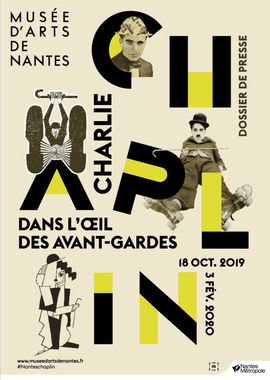
This article appeared in the catalog of the Charlie Chaplin in the eye of the avant-gardes exhibition at the Musée d'Arts de Nantes from October 18, 2019 to February 3, 2020
Since we are in the cinematic universe, the reader will allow me a long backward tracking shot to begin. Indeed, I will only speak here of Charlot, by his French name (totally unused in the Anglo-Saxon world), insofar as it is a popular character, anchored for centuries in our culture. Eight hundred years, approximately, that the French have rejoiced in Charlot's retorts.
I want to speak of "Charlot the Jew, who shat in the hare's skin": a figure of the comic tradition, to whom our medieval Rutebeuf dedicated a fabliau around 1265, taken up in his Complete Works in the 19th century[1]. He is certainly not as well known as the lament dedicated by the poet to his disappeared friends: "What have become of my friends/That I had held so close/And so loved/They have been too scattered/I believe the wind has taken them/Love is dead", but he marks a remarkable stage in our literature, by his moral aspect and scatological content. The title alone indicates the purpose: a minstrel named Charlot the Jew managed to get paid handsomely by the lord, employed by the Count of Poitiers, who thought he could abuse him. Was he Jewish? It doesn't matter: a second poem dedicated to the same character, the dispute of Charlot with the Barber, tells us: "Charles you are to all laws/You are Jew and Christian at once […]. " As the genre imposes, the text exposes the subject, which is a moral: it is not useful to want to deceive a minstrel, for he will always know how to avenge himself. Follows the exposition of facts. First stage: a certain Guillaume goes hunting for hare, on horseback, towards Vincennes. The game is taken, after so many detours that the horse catches fever and dies. The animal is carefully skinned, while Guillaume is furious. Second scene: a wedding where Charlot intervenes with the minstrels. At the end of the feast, the singers and comedians are rewarded, some by money, others by a recommendation for a patron. Our Charlot finds himself sent under Guillaume's orders, who receives him very kindly and gives him the hare's skin which is no longer worth a penny, although it cost him a horse's life. Displeased, he nevertheless accepts it and thinks of his revenge. He returns with the same gift carefully wrapped which he hands to Guillaume who thinks it is a present for his wife. He begins by putting his hand in it... Thus, the moral is demonstrated and the comedian avenged.
Miracle! I would have found the first occurrence of a well-known figure, put into images by Charlie Chaplin, that of the miserable actor, continually exploited, constantly despised, but who, in the end, always puts the laughers on his side.
Let me be understood well: I do not mean by this that in 1914 a film director was inspired by a medieval fabliau which provided him with the model for his character henceforth called Charlot. I simply want to point out that there is here a trait of our popular culture, which has remained through the centuries, evoked consciously or not.
Now, and this is where I want to get to, modern poetry, at the beginning of the 20th century, despite its scholarly appearance, wants to be popular above all. As much with Apollinaire who takes up the air of a weaving song[2] to celebrate Paris and its Mirabeau bridge, as with Tristan Tzara who, in Zurich, reads fragments of Nostradamus's Centuries at the Voltaire cabaret, sneering at the obscene references he thinks he can discover there.
For now, I leave aside the supposed Jewishness of the juggler that the patron thinks he can fool, and which was attributed to Charlie Chaplin at the birth of his hero. Nevertheless, it is a constant all the more troubling as Jews were hardly numerous in France at the time of Rutebeuf, between two crusades, between two collective massacres, between two expulsions...
Having already mentioned the Centuries, these prophetic poems, in Zurich, in the Dada poems, during the war of 1914-1918, I must now come to Charlot's participation in Tristan Tzara's experience. The latter loved the seventh art enough to entitle one of his most personal collections Cinema calendar of the abstract heart Houses with nineteen wood engravings by Hans Arp (1920). In his Radio interviews with Georges Ribemont-Dessaignes[3], he recalls his youth in Switzerland and the explosion of art accompanying Dada at its appearance: "I believe that civilization took a step forward at that moment: everything was arriving at the same time, think about it, jazz, Charlot's films. The first Charlot film in Zurich, in 1918! It was extraordinary" (TZR, OC V, 450). One understands, under these conditions, that he would refer to this new hero of his youth when he organized a demonstration of the Movement that he had imported himself to Paris. To fix the memory of it, he declares, always to the same interviewer: "For the demonstration of the Salon des Indépendants [February 5, 1920], we had announced the participation of Charlie Chaplin who, we said, had just joined the Dada movement. A considerable crowd invaded the Grand-Palais hall. As for Charlie Chaplin, he was far from suspecting our mystification. The session unfolded, if one can say so, in the greatest confusion. But it was especially the press that took the affair very badly. Having come in great numbers, the journalists wanted to see Charlot. Some were directed onto fanciful tracks. They never forgave us" (TZR, OC V, 404).
At first glance, the appeal to Charlot meant that Dada and the star had the same objectives of entertainment and protest, the hero knowing how to get out of trouble whenever he found himself in a painful situation. One thinks in particular of Charlot soldier (1918) which had this unheard-of power to make people laugh at the most trying situations. In fact, Tzara used the immediate celebrity acquired by the filmmaker, while his works were forbidden in many countries. In this regard, he could just as well have used the Cadum baby, which was leading in advertising since the end of the war, except that it had only a commercial purpose. Previously, the Dada 4-5 journal, published in Zurich, indicated: "Charlot Chaplin has announced to us his adherence to the Dada Movement" (p. 31). Quite credulous by nature and lending all audacities to his new correspondent, André Breton writes to him on June 12, 1919: "This echo on Charlie Chaplin delights me. But of course, it's not true?" Such an interrogation represents quite clearly the general attitude of the public before Tzara's jokes: and what if it were true? Conversely, it indicates that Charlot could well occupy a morally serious place, gathering the majority of votes.
Breton's question is justified by the fact that, during his military service in Nantes, he had frequented cinemas a lot in the company of Jacques Vaché, this young patient whom he had taken care of at the military hospital. Strapped into uniforms as varied as fanciful, Vaché parades his flamboyant hairstyle, his monocle and his freckles at the Pommeraye passage. In the dives of the quai de La Fosse, he drags Breton whom he presents as the poet André Salmon, to mystify the bourgeois, and also his companion, too conformist in his eyes. On November 14, 1918, he writes to him: "[...] I will come out of the war gently demented, perhaps, in the manner of those splendid village idiots (and I wish it), or else... or else... what a film I will play! – With crazy automobiles, you know well, bridges that give way, and capital hands that crawl on the screen towards what document!... Useless and inappreciable! – With such tragic colloquies, in evening dress, behind the listening palm tree! – And then Charlie, naturally, who grimaces, the pupils peaceful. The Policeman who is forgotten in the trunk!!"
Together, they go to the cinema to see the latest Picratt, Les Vampires, the first Charlot, or even the comic strips of Mack Sennett. On Sunday afternoon, they enter the dark halls, without even inquiring about what is playing, and only come out as night approaches. Sometimes, they bring something to eat, passing the cheese and wine to each other in turn, discussing out loud, as at table, to the great terror of the other spectators, who came for the film, them! "We were these gay terrorists, sentimental barely more than was reasonable, rascals who promise," relates Breton magnifying this era by memory. At this moment of the war, it was no longer a question of writing or thinking. One had first to get drunk on life, to drown anxiety and fear of death.
Remarkable thing: in the journal Cannibale, published by Francis Picabia between two deliveries of 391, Paul Éluard, the "mad Dada ally", draws up the list of his accomplices, and thus designates the one with whom he will compose L'Immaculée Conception, a book written automatically and supposed to relaunch surrealism in 1930: "Breton, tragic Charlot, Breton eleven little dead. Sure of never finishing with this heart, the button of his door."
If space were not so limited for me, I would observe the contribution of each of the Dadaist poets to the figure of Charlot, in counterpart to that which the painters, their friends, their brothers draw up. I would also show how, the Movement being international in nature, the same processes extended to Berlin in 1920, and as far as Moscow with Valentin Parnak... I cannot close the lens without citing Tzara one last time, about the Charlot of the second period, and about Apollinaire: "Already, if one knows how to listen well to Charlot's voice in Limelight, one realizes that the words are introduced there with the malice of clandestinity. This happens in a country whose rulers can no longer bear to hear the word progress without seeing red. At this stage where the dignity of man declines, everything becomes possible again, crime, assassination. It is the duty of poets – and of those who believe in poetry – to draw the conclusion, the true one, from the teaching that the assassinated Poet bequeathed to us, the teaching which, for having illustrated his death, will no less sustain the courage of the living" (TZR, OC, V, 163, on G. Apollinaire).
Also listen to "Dada are you there?", France Culture, with Cécile Girardeau and Henri Béhar
[1]. Unique manuscript: L, Paris, Bibl. nat., fr. 1635, fol. 62b-63b.
[2]. Lovers of modern poetry must know that one of the constants of modernity is that it always contains ancient elements. Thus, Apollinaire adopts the rhythmic structure of a song that the workers would take up in chorus when they wove the canvas. For "Le pont Mirabeau", it is "Gaiete et Oriour", story of two sisters who undergo an opposite destiny, which the poet could read in the Chrestomathie du Moyen Âge of the Hachette editions (1897).
[3]. These interviews were broadcast by the Chaîne Nationale (the ancestor of France Culture) in May 1950. They had the particularity of fixing, for the first time, with the very voice of the protagonists, the memories of Tristan Tzara, the main promoter of Dada in Zurich (1916-1919), then in Paris (1920-1023), questioned by a former Dadaist, who had very well understood the role of this movement in the intellectual adventure of the time.