"SURREALIST PARIS: INTERVIEW WITH HENRI BÉHAR", SITE AUTOUR DE PARIS, BY JULIEN BARRET, NOVEMBER 2020.
Surrealist Paris: Interview with Henri Béhar – Around Paris-The New Guide to Greater Paris (autour-de-paris.com)
See:
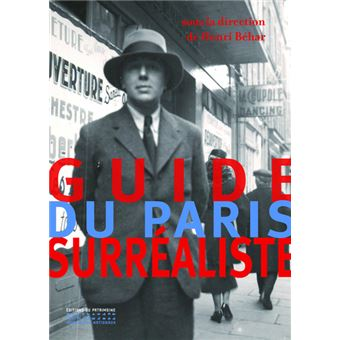
Guide to Surrealist Paris
SUMMARY:
A predominantly Parisian collective phenomenon, surrealism cannot be understood outside its geographical context. This book proposes a new way of approaching the city and literature together. Paris holds an essential place in the work of the surrealists, whether one thinks of Nadja or The Pedestrian of Paris. With nose in the air, book in hand, the reader will follow the favorite itineraries of Louis Aragon, André Breton, René Crevel, Robert Desnos, Jacques Prévert and Philippe Soupault, superimposing the Paris of the 20s on today's Paris. Like them, he will stroll through the streets, waiting for the new spirit and modern beauty.
In each of the 6 parts, the author uses the writer's work to build the route (with Breton on Nadja's trail...). Very evocative texts, numerous quotations, thematic boxes, an alphabetical directory of places frequented by the surrealists will help the reader to place them in the history of the city and in the practice of the surrealist movement, bringing out a bit of their magic.
Under the direction of Henri Béhar with contributions from Myriam Boucharenc, Jean-Michel Devésa, Laurent Flieder, Danièle Gariglia-Laster, Mireille Hilsum and Emmanuel Rubio.
In the footsteps of Breton, Crevel, Desnos, Prévert, Aragon or Soupault in the streets of Paris...
Discover the unique link between the surrealists and Paris.
To explore this Paris of the surrealists with its quaint and old-fashioned charm.
6 itineraries, maps and plans to find your way around the city.
Publication date: 03/22/2012
Publisher: Monum Patrimoine Eds Du
Collection: Paris Guides; Number of pages: 200.
See in addition the documentary work carried out by the BnF
Attention: the first illustration reproduces the cover of the single issue Surréalisme by Ivan Goll, and not the one that the surrealists will put into circulation in December under the title La Révolution surréaliste.
Similarly, I doubt that André Breton could have attended the premiere of Cocteau's Parade on May 18, 1917. On the creation and meaning given to the term "surrealism," see my article Language in the André Breton Dictionary, especially this:
"After the dada storm, the attention paid to language issues will not weaken, on the contrary. Retrospectively, in 1955, he will even make it the basis of a collective agreement and a common enterprise: 'It is today of common knowledge that surrealism, as an organized movement, was born in a large-scale operation concerning language' ('On Surrealism in its Living Works', OC IV, 19). Indeed, the first manifesto declared from the outset: 'language was given to man so that he might make surrealist use of it' (OC I, 334). Yet we would need to know what this surrealist use was, different from common use, on which Breton passed quickly, designating thereby an ordinary function of communication. Conversely, surrealist use would be, in a way, the poetic function of language (to speak like Jakobson), exercised in all its dimensions, in other words by exploring the conscious and unconscious.
Hence the imposition of the term 'surrealism', borrowed from Guillaume Apollinaire, in a clearly diverted sense, since Breton considers having himself whispered the Apollinarian formula 'when man wanted to imitate walking, he created the wheel which does not resemble a leg. He thus made surrealism without knowing it' (G.A., OP, 865). As early as 1917, he participated in the elaboration of the 'surrealist' concept that Apollinaire had just invented to qualify his play, in response to Jean Cocteau's realistic Parade. 'I can say that I collaborated on the preface of The Breasts – he writes to a friend. Man, in wanting to reproduce movement, creates the full wheel, without relation to the apparatus of legs he has seen running. The locomotive's motor apparatus rediscovers this articulation game from which the inventor's thought started. Surrealism includes this invention and this perfection.' It matters little that the author of Alcools used the same formula previously, what counts here is that Breton has incorporated it, that he has given it a much more concrete meaning, that he has made it his own formula. 'In homage to Guillaume Apollinaire, who had just died and who, on several occasions, seemed to us to have obeyed an impulse of this kind, without however having sacrificed mediocre literary means to it, Soupault and I designated under the name of surrealism the new mode of pure expression that we had at our disposal and which we were eager to make our friends benefit from.' (OC I, 327)...