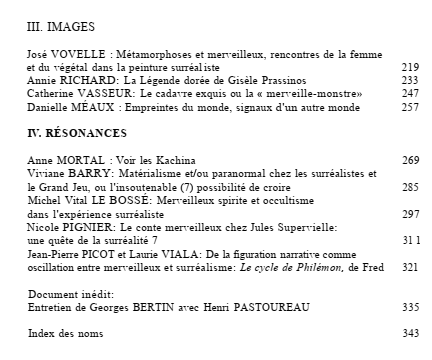
"THE MARVELOUS IN SURREALIST DISCOURSE, ESSAY ON TERMINOLOGY", MÉLUSINE NO. XX, 2000, PP. 15-29.
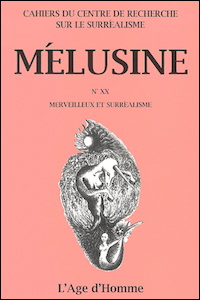
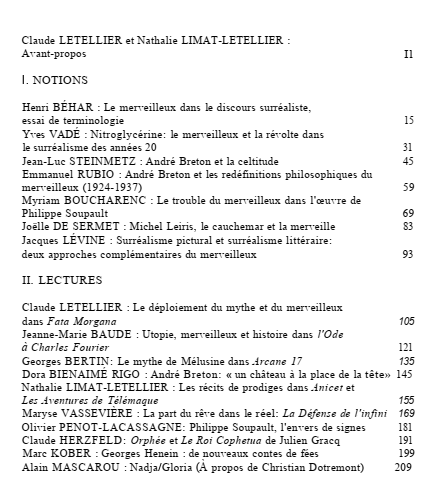
Proceedings of the Cerisy Colloquium, August 2-12, 1999
Claude LETELLIER, Nathalie LIMAT-LETELLIER (eds.)
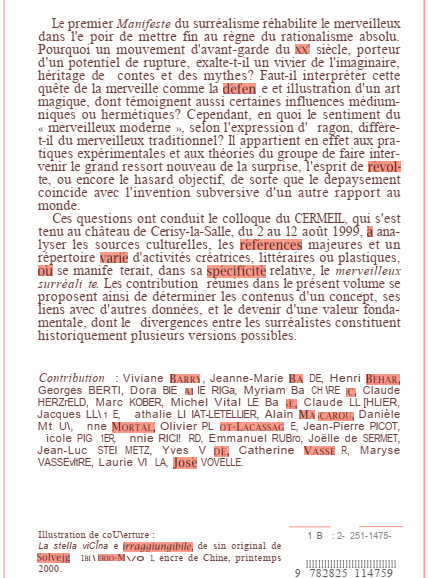
The first Manifesto of Surrealism rehabilitates the marvelous in the hope of putting an end to the reign of absolute rationalism. Why does a 20th-century avant-garde movement, bearer of a potential for rupture, exalt a reservoir of the imaginary, legacy of tales and myths? Should we interpret this quest for the marvelous as the defense and illustration of a magical art, as evidenced by certain mediumistic or hermetic influences? However, how does the feeling of "modern marvelous," according to Aragon's expression, differ from traditional marvelous? It indeed belongs to the experimental practices and theories of the group to bring into play the great new spring of surprise, the spirit of revolt, or even objective chance, so that disorientation coincides with the subversive invention of another relationship to the world. These questions led the CERMEIL colloquium, which was held at the Château de Cerisy from August 2 to 12, 1999, to analyze the cultural sources, major references and a varied repertoire of creative activities, literary or plastic, where surrealist marvelous would manifest itself in its relative specificity. The contributions gathered in the present volume thus propose to determine the contents of a concept, its links with other data, and the becoming of a fundamental value, whose divergences between surrealists historically constitute several possible versions.
Extensions:
Tania Collani, The Marvelous in European Surrealist Prose, Hermann Editeurs, 2010
Summary: Surrealism paid particular attention to the vast problematic of the marvelous. Due to the transcendence presupposed by the subject itself, the analysis of the marvelous within surrealism must be particularly rigorous to be truly meaningful, especially regarding the limits of the problematic. We therefore deemed it indispensable to analyze the subject according to three complementary methodological axes: a historical axis (first chapter), a theoretical axis (second and third chapters) and an analytical axis (fourth and fifth chapters). The historical approach, initially, allowed us to identify the boundaries of a more specifically European surrealism in relation to the successive international surrealist centers. Regarding general data, we frequently referred to the works of Maurice Nadeau, Marcel Raymond, Carlo Bo, David Gascoyne, as well as a series of works prior to and following these, which approach surrealism from a mainly historical point of view. In light of these studies, we were able to highlight the emergence of a mainly European surrealism in the interwar period, and this as early as 1922, since Aragon, Breton and Soupault, taking the journal Littérature as a platform for dissemination, were already working on the themes and ideas that would characterize the 1924 Manifesto. This specifically European period lasted until 1940, the year that marked the beginning of a massive emigration of intellectuals to the United States and South America. Moreover, this date proves particularly significant for our study on the marvelous, since the year 1940 coincides with the publication of The Mirror of the Marvelous, a work that accounts for the theoretical change in the approach to the marvelous within surrealism. During this period of about twenty years, the surrealist movement devoted numerous theoretical articles and essays to the marvelous. Taking into account the different underlying problematics of the subject, we were interested in the definition of surrealist marvelous by considering the definitions that come intrinsically from surrealism, on the one hand (Limbour's "viscous marvelous," Aragon's "everyday marvelous," Desnos's "cerebral marvelous," Leiris's "modern marvelous"), and on the other hand, by considering the critical contributions on the marvelous dated from the beginning of the 20th century and before, given that they may have influenced the surrealist definition of marvelous, or that they may have historically undergone the same influences as the surrealists – the works of Hubert Matthey, Alice MacKillen, Sucher, for example, are done in a strongly similar historical and cultural context. What seems immediately obvious to us is that the surrealist definition of marvelous far exceeds the specifically literary sphere, to touch the domain of existence. It is in this perspective that we must read the definitions of René Passeron – according to whom the marvelous is the "supreme aesthetic category of surrealism [...] the very essence of beauty" – and of Breton – who, in the Manifesto of Surrealism, declares his unconditional love for the marvelous and who, in the article "The Marvelous Against Mystery," pleads for "pure and simple abandonment to the marvelous, [...] the only source of eternal communication between men." The marvelous is therefore the only possible alternative to reality, the only transcendent dimension granted to modern man, deprived of God's help. The formulation of this marvelous is also readable at the fictional level, where it manifests itself less as an expedient intended to provoke an effect of wonder than as a veritable heuristic question for modern man. For the particular case of surrealist narrative works, the question that arises is that of homogeneity: on the one hand, we recognize a "true" surrealist marvelous, which manifests itself mainly during the twenties in the narratives of French surrealists; on the other, a more "traditional" marvelous, that is, devoid of references to modernity, which preferably expresses itself during the thirties, in the narratives of surrealist writers from the rest of Europe. It thus becomes evident that for the choice of the corpus, it was necessary to cross the two approaches, historical and theoretical. In this regard, we chose the authors of the corpus using as a reference criterion the adherence, and the signature that follows, to the different European surrealist manifestos (in Paris in 1924 and 1930, in Prague in 1935, in Santa Cruz de Tenerife and Brussels in 1935 and in London in 1936), or the active and assiduous participation in the group's journals during the indicated period of the interwar period. Anicet or the Panorama, Aragon's novel will be, chronologically, the first novel of our reference corpus, while Breton's Arcane 17 (written in 1944, completed and published in France in 1947) will be the last. Between these two dates, we have retained other works from the surrealist period particularly revealing for a discourse on surrealist marvelous: we think especially of the narratives of Aragon, Alexandre, Desnos, Crevel, Lecomte and Déry. To these volumes, we must add the surrealist narrative works in which a more traditional type of marvelous manifests itself; these are narratives, which generally form later than the previously cited works, such as the texts of Embiricos, Carrington, Prassinos Nezval, Sykes Davies, Read, Gascoyne and Luca. The surrealist group is animated by the conviction that the answer must be sought directly in man; by the will to give its just weight to human imagination. The marvelous, and this is true for all the activities of the movement guided by Breton, represents a safe refuge and an effective means allowing, in everyday life, to go beyond the tangible reality of things and to aspire to the infinite. We join here what Mabille writes, since beyond the pleasure, the curiosity that narratives or tales give us, "the real goal of the marvelous journey is [...] the most total exploration of universal reality." (The Marvelous in European Surrealist Prose, Hal)
The Marvelous Man – Exhibition, March 21-August 31, 2008, Château de Malbrouck in Manderen
After the meditative and autumnal vision of Marvelous! According to nature proposed at the Château de Malbrouck – a listed Historic Monument, near Germany and Luxembourg – during the winter of 2007, comes the spring and summer time of 2008 of dynamism and blossoming: that of the encounter with this controversial being, The Marvelous Man. "The marvelous is not the same at all times" wrote André Breton. Between surrealism and contemporary age, the visitor is invited to submit to the mirror test, between what he believes and what he sees, between what he lives and what he imagines, because the Marvelous Man is the one who does not let himself be dispossessed of his experience: ability to produce powerful dreams, ambiguous nostalgia for childhood, eroticism as the summit of the human spirit and, finally, this truth: what the marvelous shows is ultimately man himself.