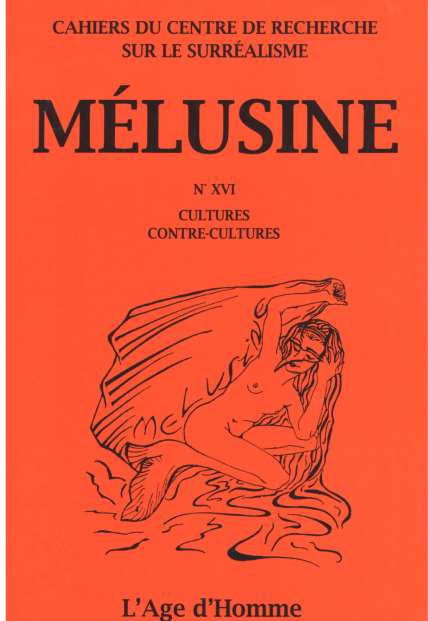
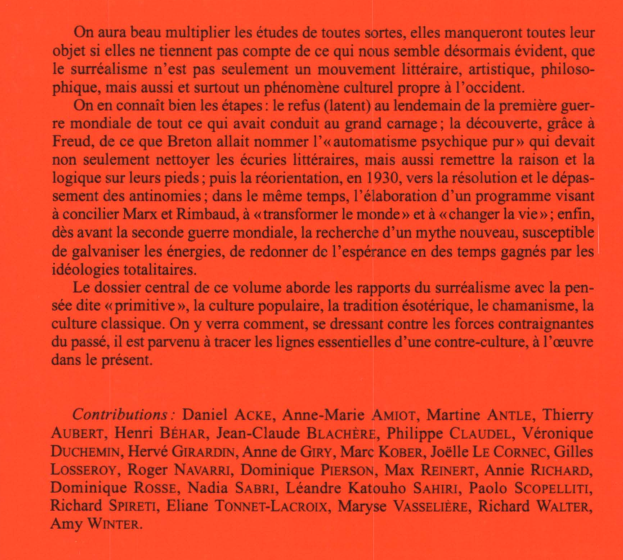
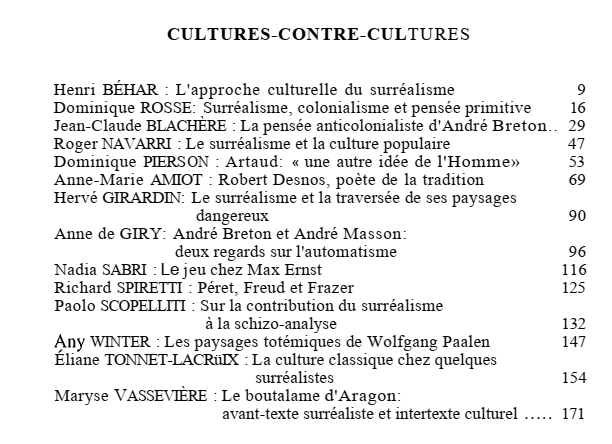
"THE CULTURAL APPROACH TO SURREALISM", MÉLUSINE, N° 16, "CULTURES, COUNTER-CULTURES", 1996, PP. 9-15.
Extensions:
Arts et sociétés n° 13-1 | Primitivisms | Sophie Leclercq Things, André Breton, Exhibitions, Paul Éluard, Surrealism, 3
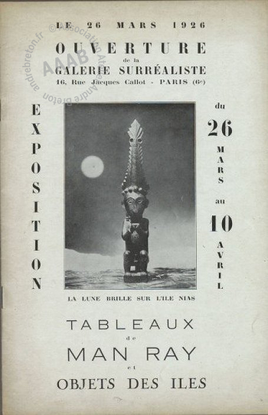
The surrealists reinvented the idol of origins. They dreamed their primitive apart from science and reality while curiously rediscovering the paths of history. From the 1920s onwards, they were among the very first to revolt against the servitude of non-Western peoples by calling, not in the name of good feelings to temper the modalities of their servitude but to radically condemn the very conditions of colonialism. Art history mainly retains André Breton's passion for Eskimo, Indian, South Seas masks or the dolls of the Hopi Indians of Arizona, of which he kept beautiful specimens. It is that he admired their expressive and poetic value, the very one he sought everywhere as so many signs of life in a modern world whose disenchantment he tirelessly denounced. For the heart of the problem was less the other than oneself caught in the nets of a West whose poets tirelessly announced alienation and decrepitude. Anti-modern but at the very heart of modernity, the surrealists opened the way to reflections that art history now takes note of. Aby Warburg, Jean Laude and a few others have said the indispensable contribution of anthropology and ethnology and how much the status of the artist and the work was wavering and necessarily the criteria of uniqueness, originality, superiority. At a time when the new Musée du quai Branly appears as a Pandora's box by inviting comparison with other countries and other forms of presentation of collections, the remarkable studies of Nélia Dias, Sophie Leclerq and Maureen Murphy reopen the file of an unstable identity. More broadly, it is the malaise of civilization that is at issue, a malaise Michel Leiris had noted the coexistence with a culture where everything seemed to be said because one had reached a certain technical development but where such development had only been made possible by stifling certain aspirations to the infinite.
Laurence Bertrand Dorléac Seminar of November 23, 2006
(In)actuality of Surrealism (1940-2020) A reassessment of surrealism since 1940: a large-scale and unprecedented work covering seven decades – a vast period little studied and during which the movement was often discredited, sometimes rejected –, questioning the discourses, narratives and debates of which the poetic, political and artistic commitments of the movement were the object, beyond the glorious interwar period of so-called "historical" surrealism, in the context of the profound social and cultural mutations of the world of the second half of the twentieth century.
Surrealism has long been amputated of part of its history. Literary figures, art historians have neglected the twenty-five years from the Liberation to the self-dissolution of the movement, in October 1969, and have hardly looked beyond. One can be surprised at this since the years thrown away testify to an ardent poetic, political and artistic vigilance. Surrealism then confronts the ebb and flow of a History exceeding national borders to become worldwide (decolonization, third-worldism, anti-Stalinism, Cuban revolution, American anti-imperialism, consumerism, ideology of the Thirty Glorious Years, popular revolts). Covering seven decades, this book restores the bitterness of the debates and the courage of the commitments to which surrealism was involved; it examines the interpellations of which it was the target, the narratives of which it was the object: by the existentialists, dissident surrealists, communists, lettrists, situationists, telquelians… up to the diatribes of a pamphleteering Jean Clair who retrospectively imagines its barbarity, at a time – the 2000s – when exhibitions in London, New York or Paris celebrate a patrimonialized movement and where North American universities speak of "total surrealism" in a globalized world.
"This collective work directed by Olivier Penot-Lacassagne brings together about thirty contributions on surrealism after 1940. Organized chronologically around the "declarations" and "tracts" published by the surrealist group between 1947 and 1969, the book overflows this usual framework to cover seven decades and present the intellectual, academic or patrimonial debates to which surrealism was involved. […] An important sum [which invites] to revisit literary history and the principle of insubordination in literature." Sébastien Dubois, Poezibao "This collective study proposes a large-scale approach marking the diffraction of surrealism since the Second World War. […] Beyond any geographical particularism, it emerges a practice at the intersection of decolonial, anti-racist, feminist or even queer struggles. (In)actual, the specter(s) of surrealism thus continue(s) to haunt revolutionary praxis." Corentin Bouquet, Fabula
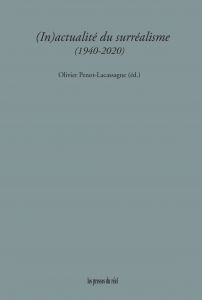
(In)actuality of Surrealism (1940-2020), Les presses du réel
A reassessment of surrealism since 1940: a large-scale and unprecedented work covering seven decades – a vast period little studied and during which the movement was often discredited, sometimes rejected –, questioning the discourses, narratives and debates of which the poetic, political and artistic commitments of the movement were the object, beyond the glorious interwar period of so-called "historical" surrealism, in the context of the profound social and cultural mutations of the world of the second half of the twentieth century.
Surrealism has long been amputated of part of its history. Literary figures, art historians have neglected the twenty-five years from the Liberation to the self-dissolution of the movement, in October 1969, and have hardly looked beyond. One can be surprised at this since the years thrown away testify to an ardent poetic, political and artistic vigilance. Surrealism then confronts the ebb and flow of a History exceeding national borders to become worldwide (decolonization, third-worldism, anti-Stalinism, Cuban revolution, American anti-imperialism, consumerism, ideology of the Thirty Glorious Years, popular revolts). Covering seven decades, this book restores the bitterness of the debates and the courage of the commitments to which surrealism was involved; it examines the interpellations of which it was the target, the narratives of which it was the object: by the existentialists, dissident surrealists, communists, lettrists, situationists, telquelians… up to the diatribes of a pamphleteering Jean Clair who retrospectively imagines its barbarity, at a time – the 2000s – when exhibitions in London, New York or Paris celebrate a patrimonialized movement and where North American universities speak of "total surrealism" in a globalized world.
"This collective work directed by Olivier Penot-Lacassagne brings together about thirty contributions on surrealism after 1940. Organized chronologically around the "declarations" and "tracts" published by the surrealist group between 1947 and 1969, the book overflows this usual framework to cover seven decades and present the intellectual, academic or patrimonial debates to which surrealism was involved. […] An important sum [which invites] to revisit literary history and the principle of insubordination in literature." Sébastien Dubois, Poezibao "This collective study proposes a large-scale approach marking the diffraction of surrealism since the Second World War. […] Beyond any geographical particularism, it emerges a practice at the intersection of decolonial, anti-racist, feminist or even queer struggles. (In)actual, the specter(s) of surrealism thus continue(s) to haunt revolutionary praxis." Corentin Bouquet, Fabula
Olivier Penot-Lacassagne is a senior lecturer at the Sorbonne Nouvelle University. He has directed and published several works, among which: Antonin Artaud, the perpetual incandescent, éd. CNRS, 2022