"THE PERPETUAL OBJECT BOOK, THE ROSE AND THE DOG (1958)", IN COLL. BOOK/TYPOGRAPHY, A HISTORY IN PRACTICE(S), PARIS, ÉDITIONS DES CENDRES, 2020, P. 115-122.
Cf: The Perpetual Object Book, The Rose and the Dog (1958), in coll. Book/Typography, A History in Practice(s), Paris, Éditions des cendres, 2020, p. 115-122. (New address: /en/henribehar/le-livre-objet-perpetuel)
[Download the PDF of the article]
Biblio: Tristan Tzara, "The Rose and the Dog" (1958), in OC IV, p. 419.
Article collected in the work: https://serd.hypotheses.org/7752:
Hélène Campaignolle-Catel, Sophie Lesiewicz and Gaëlle Théval (eds.), Book/Typography: A History in Practice(s)
BY JULIEN SCHUH · 01/13/2021
Hélène Campaignolle-Catel, Sophie Lesiewicz and Gaëlle Théval (eds.), Book/Typography: A History in Practice(s), Éditions des Cendres, 2020.
This volume places particular emphasis on typography: Massin recounts the investigation he conducted on the reprints of A Throw of the Dice Will Never Abolish Chance, Roxane Jubert questions the (typo)graphic composition work of Fernand Léger in The End of the World Filmed by the Angel Notre Dame, Michel Wlassikof documents the sources of the unique aesthetic of The Seventh Face of the Die... These are numerous unpublished typographic informations on the great books of poets and painters of the 20th century that renew their reading. This attention to the typographic component of works is enhanced by a complete dossier devoted to the work of typographer and engraver artist, Michael Caine. Built chronologically around works forming as many significant milestones in the history of the creative book, the volume analyzes the reprints and reinterpretations of A Throw of the Dice Will Never Abolish Chance, bringing together Massin, Tibor Papp, Albert DuPont and Isabella Checcaglini; the symbolist book at the end of the 19th century (Alfred Jarry, Marcel Schwob, Georges de Feure); the teens and twenties to probe the "new spirit" of the works of poets Apollinaire and Cendrars; the fifties with the study of three post-dada and/or surrealist works (Georges Hugnet, Tristan Tzara, Joan Miró); the notion of object-book developed in the Mexican and Brazilian cultural space (Vicente Rojo and Octavio Paz, Waltercio Caldas and Mira Schendel); the Francophone imaginary of the sound book of the 70s (Bernard Heidsieck, Michèle Métail) echoing the earlier experiments of the poetic journal Sic. The volume concludes with studies of works by André Frénaud and du Bouchet and an interview with Julius Baltazar, offering a retrospective look at thirty years of fertile creation in the field of the artist's book.
Contents:
Presentation 9
I – Mallarmé's "Throw of the Dice":
reprinted, reinterpreted
Massin, "As for Mallarmé". An edition of "A Throw of the Dice" 15
in the "Expressive Typographies" collection
Albert DuPont, A Throw of the Dice Will Never Abolish Chance, poem block poem, 25
Desire-Chance-Des (1999-2000)
Anne-Marie Christin, Matter of White 41
II – Displacements of the Symbolist Book
at the Turn of the Century
Julien Schuh, "Alfred Jarry's Books, Between Popular Art and Bibliophilia" 59
Agnès Lhermitte and Bruno Fabre, "The Door of Dreams" (1899) and Art Nouveau 67
III – The "New Spirit"
of the Book in Apollinaire and Cendrars
Jean Burgos, A Book Called to Make History: "The Rotting Enchanter" 79
by Guillaume Apollinaire
Claude Debon, "Calligrammes", Crucible of Poetic Modernity 87
Roxane Jubert, A Colorful Book, "The End of the World". 95
Visual and Kinetic Energy of a Creation by Cendrars and Léger
IV – Inventions and Recreations
of the Post-Dada and Surrealist Book
Michel Wlassikoff, Reflections on Photomontage and Typo-Photo 107
and on Some Possible Inspirations of Hugnet
for his "Seventh Face of the Die"
Henri Béhar, The Perpetual Object Book: "The Rose and the Dog" (1958) 115
Jiyoung Shim, Joan Miró, Illustrator of Poets 123
V – The Object-Book from the 60s to the 80s...
boundaries / beyond limits
Ana Mannarino, The Object-Book in Brazilian Art: M. Schendel and W. Caldas 133
Melina Balcazar, Around "Discos visuales" by Octavio Paz 141
VI – At the Challenge of the Score:
sources and futures of the "oro-book"
David Christoffel, The Partitional Imaginary of the Journal "SIC" 151
Marion Naccache, Bernard Heidsieck / "action poetry" 159
remarks on the action in question
Michèle Métail and Louis Roquin, One Hundred Percent 167
Jean-Pierre Bobillot, "Partitional Imaginary", Real "Contiguities" 173
VII – Contemporary Poets and Artists' Books
Jean-Yves Debreuille, André Frénaud – Viera da Silva, 183
"Flashes and Smoke Through the Countryside"
Michel Collot, André du Bouchet / Pierre Tal Coat, "Lays" (1975) 191
Jean-Pascal Léger, Around the Genesis of the Book "The Surplus" 197
by André du Bouchet and Albert Ràfols-Casamada. Testimony
Julius Baltazar, Interview 203
Appendix
The Typographer and the Artist: Michael Caine 209
Dossier assembled by Sophie Lesiewicz
Introduction, 209 / Bibliography, 218
List of Works Studied During the Seminar 250
Table of Illustrations 252
http://expositions.bnf.fr/brouillons/grand/103.htm:
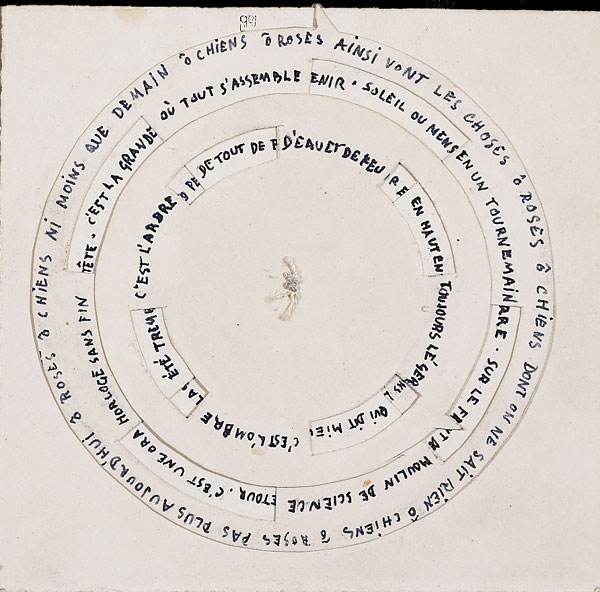
Original ed. illustrated with four engravings on celluloid by Picasso, Copy No. 3, one of the 22 announced print run; this one includes a long spiral dedication from the author to P.-A. Benoit.
Also included, from the printer-publisher's archives, the autograph manuscript of the "perpetual poem", as well as the corrected proofs of the same. BNF, Rare Books Reserve, Rés. 4° Z. PAB-éd. 24.
The printer's activity often corresponded in Pierre-André Benoit (P. A. B.) to the ball game: throwing, receiving an idea, sending it back to a partner and, through lively exchanges, generally epistolary, closing the game on the realization of the book, final point, most often winning, because surprising in its speed. For The Rose and the Dog, the idea had come from Tzara of a poem arranged on concentric circles, analogous to the volvelles of ancient astronomy books. Tzara thought, thanks to the arranged windows, to offer a multiple reading, almost endless. If the poem was relatively long to perfect, its realization according to the very precise manuscript that was sent to the printer, took only about ten days. On February 2, 1958, the proofs were corrected, the text slightly modified and a secret anathema added for those who would have the curiosity to dismantle the mechanism. The "object", as Tzara said, was completed by Picasso with four engraved plates, two of which were complementary: one in the center of the device, to hide the attachment, the other serving as support, like an open hand in the hollow of which this microcosm of poetry would turn infinitely.
See in addition: http://www.le-corpus.com/cours-ateliers/2021-22_chal_poeme-multiple/poeme-multiple.html
As well as the Musée de l'imprimerie exhibition: When Books Have Fun: https://www.imprimerie.lyon.fr/sites/micg/files/2021-02/livres_animes_pdf2_dp.pdf