Tristan Tzara, Historiography of Dada, Mélusine, No. 11, 1990, pp. 29-40
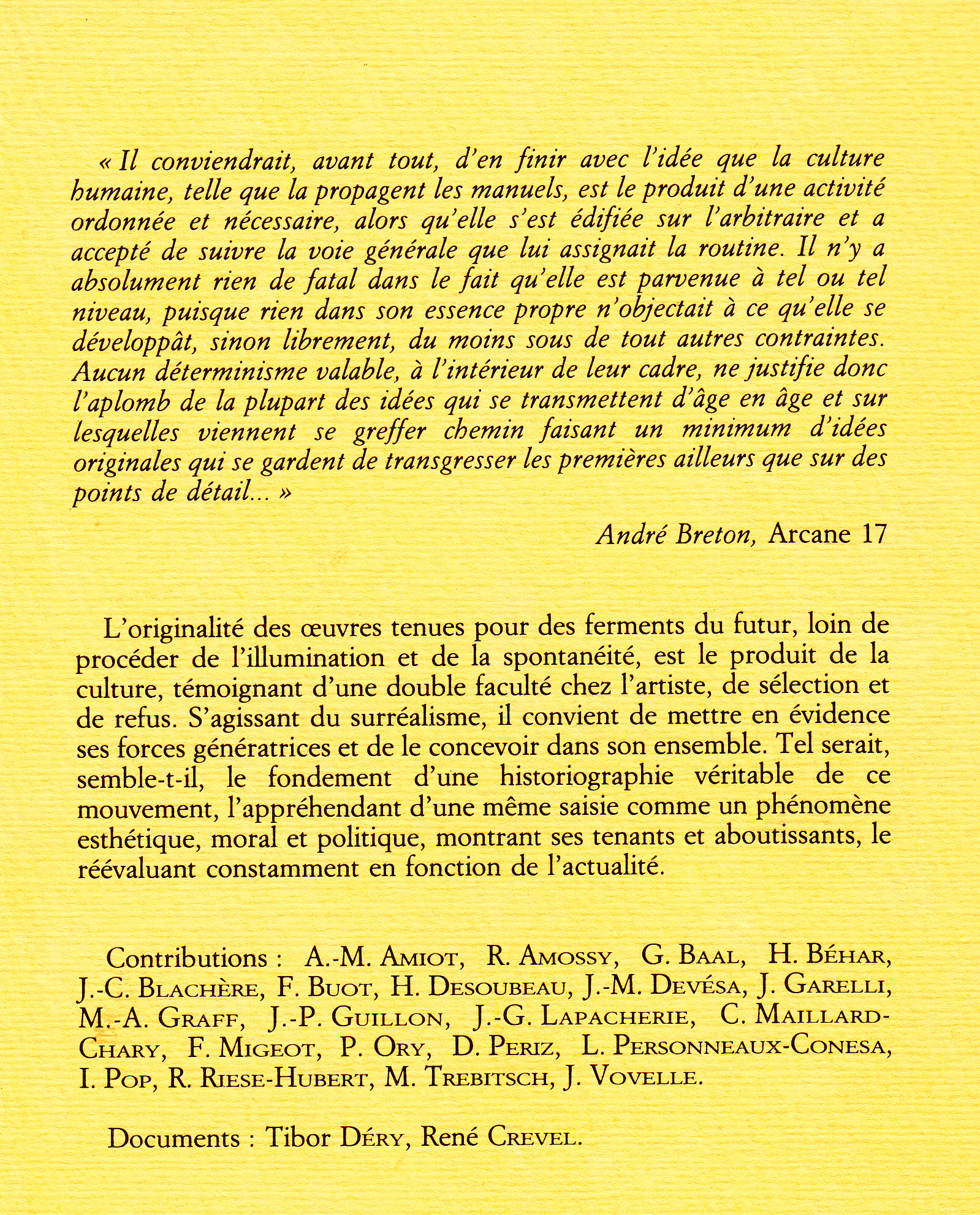
Text reproduced in: Henri Béhar, History of Literary Facts, Paris, Classiques Garnier, 2022, pp. 87-99.
Extensions:
See Cécile Bargues' thesis, Dada after Dada (1930s-1940s)
Summary
For Jean Arp, Kurt Schwitters or even Raoul Hausmann, the proper of Dada would be to survive itself by constantly changing face. This thesis traces what becomes of the movement in the 1930s and 1940s. It first focuses on showing its character of permanent transformation by relying on the works of Dadaists who still consider themselves as such, which is particularly the case of Raoul Hausmann. In a second step, a historiographic study, and an analysis of exhibitions, both in France and in the United States, come to specify the relations of Dada with the field of art history. Its rejection (in France) and its progressive integration (in the United States) act as a revealer of the presuppositions of the discipline. By a mirror effect, Dada comes to serve a questioning on the constitutive themes of the discourse of art historians of the studied period, whether it is nationalism, or modernism. These two approaches are intertwined with each other, the Dadaists assisting, and participating, in the historicization of the movement.
See also: Agathe Mareuge & Sandro Zanetti, Return of Dada (after 1945), Dijon, Les presses du réel, 2022, 764 p.
and the comment below, about Raoul Hausmann:
"Thus a History of DADA is permitted..." The paradoxical historiography of aging Dadaists, between knowledge production and persistent mystification Dada soluble in historiography? A History of DADA reveals the character of any History. History is only the pseudo-logic that an individual makes of reality, nothing but a bad reflection of complex objectivity, in a bad material. Thus a History of DADA is permitted. It does not present itself worse than many works of famous men, and it might be that on this occasion it reveals a true part of history. Not the history of heroes, kings and dictators, but only one side of our disgust with stupidity, of our disgust with civilization, of the organized cacacosmos. For it was not we who had 'made' Dada, DADA was a necessity.1 It is on these lines that opens the work Courrier Dada by Raoul Hausmann published in 1958, in which the "dadasopher" engages in a complex reconstruction of what Dada was, particularly Dada Berlin, of which he was one of the main actors alongside Baader, Heartfield and Herzfelde, Grosz, Höch or Huelsenbeck. A Dadaist historiographer? On what would his legitimacy to write a history of Dada be based? First, according to Hausmann, any history (to be understood in the sense of any writing of history, any historiography) is necessarily subjective: objective History does not exist – so why wouldn't Dadaists write their own narrative? Second, Dada was not a private affair that would have concerned a few artists and poets; it is about the relationship to the world, more precisely a disgust towards Western civilization, which made Dada a necessity, to the point that its actors have been, it seems, only contingent: through them, by them was made a moment of Western history, a history that is not political, diplomatic history, that of the great ones.
1 Raoul Hausmann, Courrier Dada, Paris 1958, 13. An abridged version of the original German Kurier Dada appeared posthumously: Raoul Hausmann, Am Anfang war Dada, Steinbach and Gießen 1992 (1972)