“Listen to the Dada Song”, Caietele Tristan Tzara, vol. III, 2013, pp. 243-246.
In June 2004, Laurent Lebon, then chief curator at the Musée national d’art moderne (Centre Pompidou, Paris), knowing my work on Dada and Tzara, contacted me to say he wanted to organize a major international exhibition on Dada. He was, of course, unaware of the one held at the Musée d’art moderne de la ville de Paris in 1966 by the Association for the Study of the Dada Movement, which I ran with Michel Sanouillet and Yves Poupard-Lieussou, under the direction of Bernard Dorival and more precisely Michel Hoog. And for good reason: the museum library had no record of it... I soon had the opportunity to give him a complete copy, and made myself available. For our part, our research center thought it appropriate to organize an international symposium in connection with the exhibition, preferably at the Centre Pompidou. That’s why Catherine Dufour and I got in touch with Marianne Alphant, director of “la revue parlée.” So, for six months, the four of us met one morning a week to plan the symposium in relation to the exhibition. In the end, Laurent Lemoine, thinking to “do dada,” integrated the symposium into a paid presentation session for his exhibition. Needless to say, I did not agree at all, but, unable to cancel the invitations and with no other venue, I kept quiet. During a dance festival, our guests had 5 minutes to present their topic. There was no discussion! As a bit of provocation, I chose to explain Tristan Tzara’s Chanson dada in a very academic way, just as I had presented the poet’s Œuvres complètes (Flammarion editions), waiting for the public’s reaction. At the end of the allotted time, Jean-Jacques Lebel loudly observed that I was boring the audience. I stopped, without a word. You can now read this talk in the Caiete Tristan Tzara, run in Bucharest by the tireless Vasile Robciuc (see below). The Dada exhibition took place from October 5, 2005 to January 9, 2006. See the very abundant Catalogue, presented like a phone book, printed on newsprint... See the notice the Centre Pompidou devotes to Tristan Tzara: Tristan Tzara (Samuel Rosenstock, known as) - Centre Pompidou And I who thought he was a poet, and a great poet!
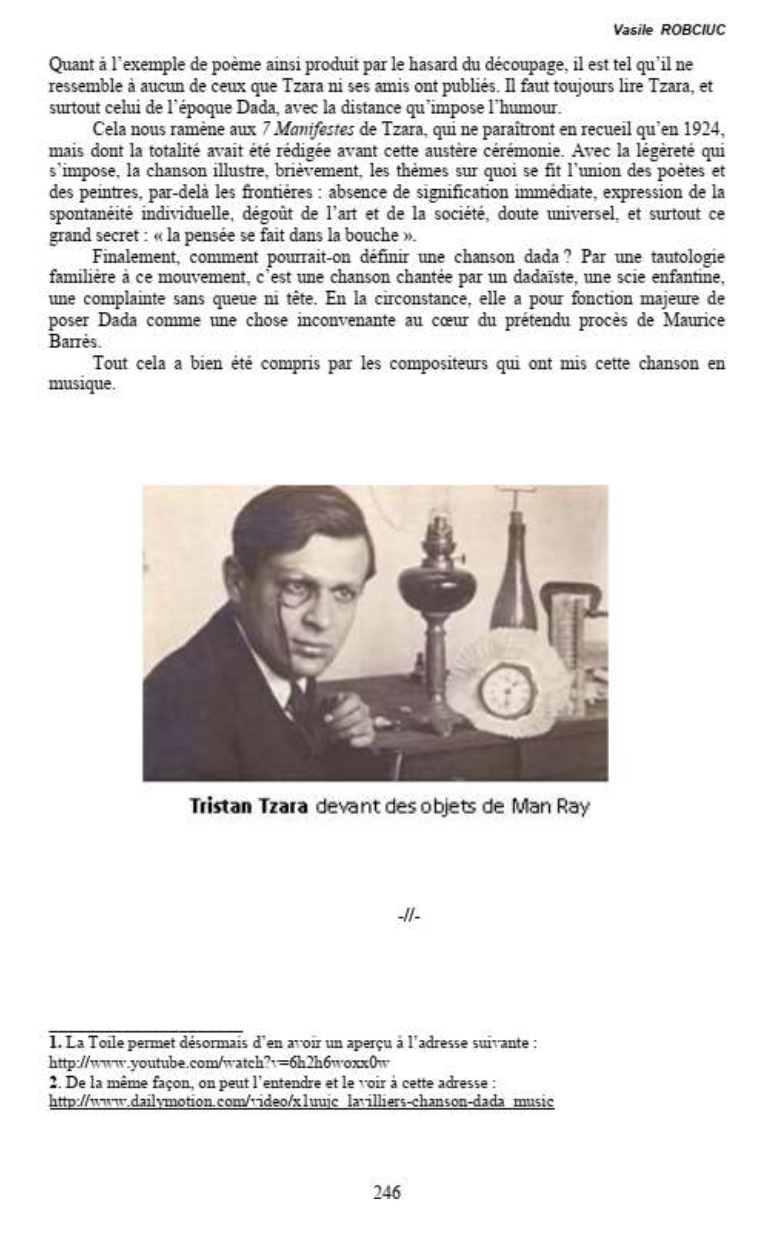
Text only:
Listen to the Dada Song
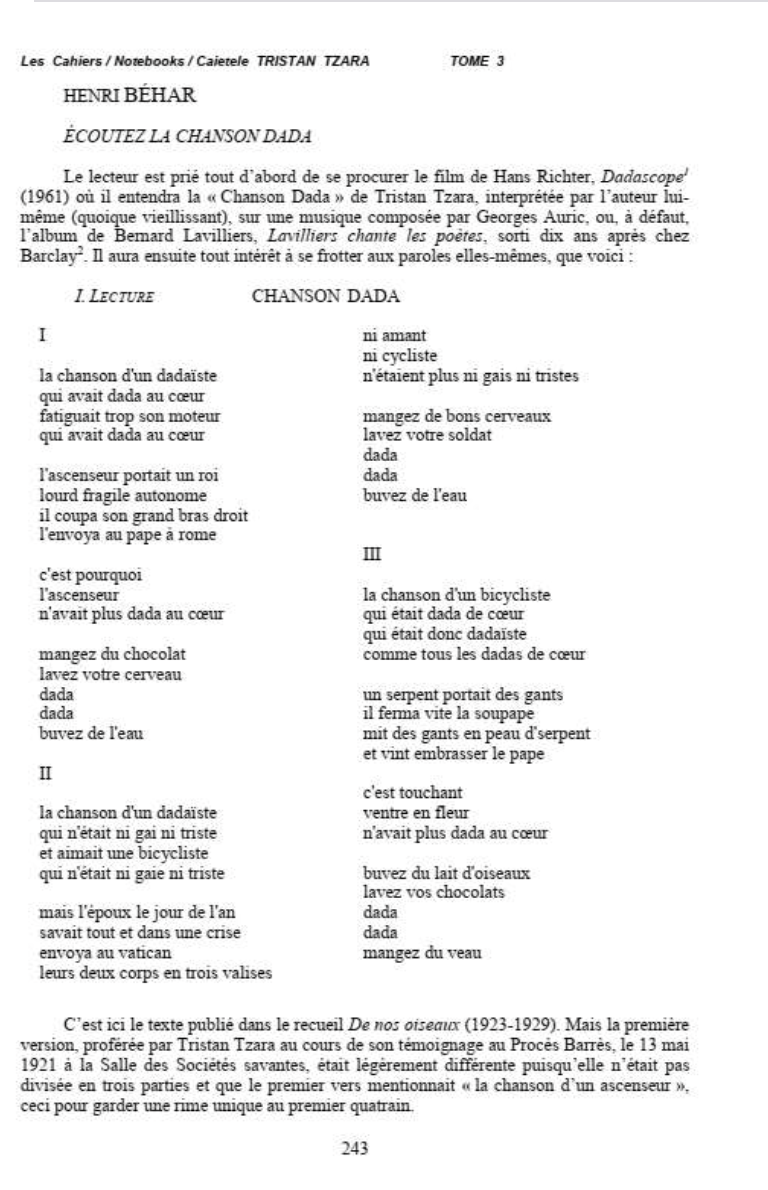
The reader is first invited to obtain Hans Richter’s film, Dadascope (1961), where he will hear Tristan Tzara’s “Chanson Dada,” performed by the author himself (albeit aged) [around 36:15], to music composed by Georges Auric, or, failing that, the album by Bernard Lavilliers, Lavilliers sings the poets, released ten years later by Barclay. He will then do well to tackle the lyrics themselves, which are as follows:
I. Reading DADA SONG
I the song of a dadaist who had dada in his heart tired his engine too much who had dada in his heart the elevator carried a heavy king fragile autonomous he cut off his big right arm sent it to the pope in Rome that’s why the elevator no longer had dada in its heart eat chocolate wash your brain dada dada drink water
II the song of a dadaist who was neither happy nor sad and loved a bicyclist who was neither happy nor sad but the husband on New Year’s Day knew everything and in a fit sent to the Vatican their two bodies in three suitcases neither lover nor cyclist were neither happy nor sad eat good brains wash your soldier dada dada drink water
III the song of a bicyclist who was dada at heart who was therefore a dadaist like all dadas at heart a snake wore gloves he quickly closed the valve put on snakeskin gloves and went to kiss the pope
it’s touching blooming belly no longer had dada in its heart drink bird’s milk wash your dada chocolates dada eat veal
This is the text published in the collection De nos oiseaux (1923-1929). But the first version, delivered by Tristan Tzara during his testimony at the Barrès Trial, on May 13, 1921 at the Salle des Sociétés savantes, was slightly different since it was not divided into three parts and the first line mentioned “the song of an elevator,” to keep a unique rhyme in the first quatrain.
II. The context
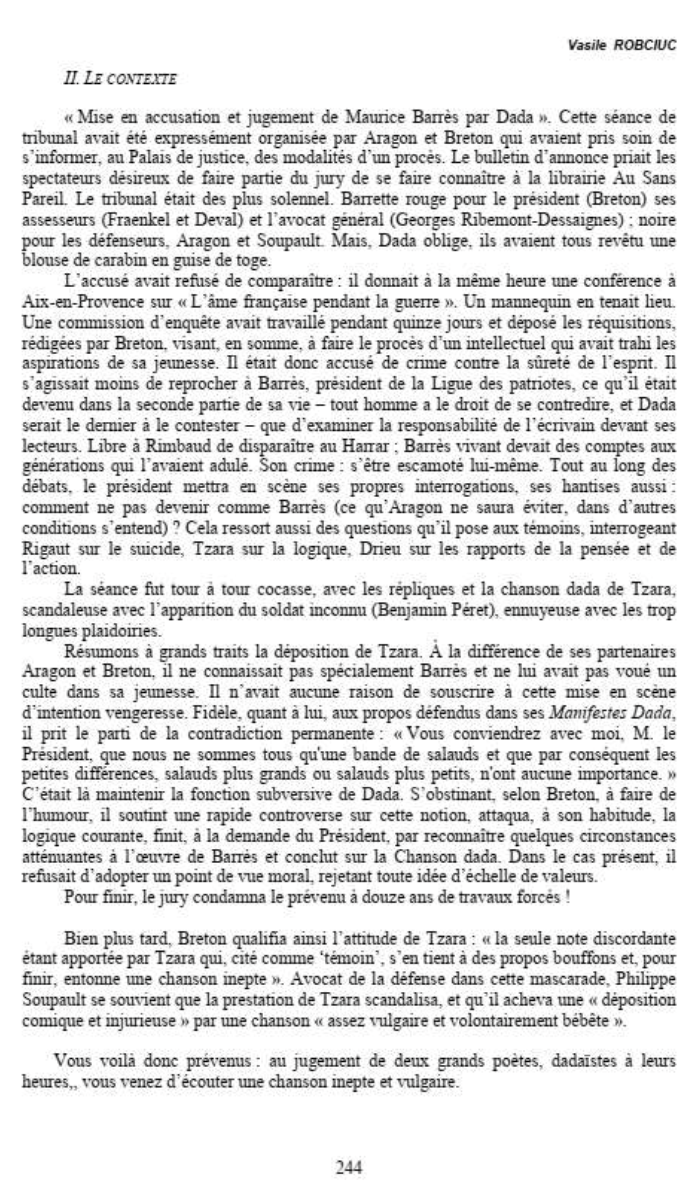
“Indictment and trial of Maurice Barrès by Dada.” This court session was expressly organized by Aragon and Breton, who had taken care to inquire, at the Palais de justice, about the procedures of a trial. The announcement bulletin invited spectators wishing to be part of the jury to make themselves known at the Au Sans Pareil bookstore. The court was most solemn. Red bar for the president (Breton), his assessors (Fraenkel and Deval), and the public prosecutor (Georges Ribemont-Dessaignes); black for the defenders, Aragon and Soupault. But, Dada obliges, they all wore medical smocks as robes. The accused had refused to appear: he was giving a lecture at the same time in Aix-en-Provence on “The French Soul During the War.” A mannequin stood in for him. An investigative commission had worked for fifteen days and filed the requisitions, written by Breton, aimed, in short, at putting on trial an intellectual who had betrayed the aspirations of his youth. He was thus accused of a crime against the safety of the mind. The point was less to reproach Barrès, president of the League of Patriots, for what he had become in the second part of his life—anyone has the right to contradict himself, and Dada would be the last to contest it—than to examine the writer’s responsibility to his readers. Rimbaud was free to disappear to Harrar; Barrès, alive, owed an account to the generations who had idolized him. His crime: having made himself disappear. Throughout the debates, the president staged his own questions, his obsessions too: how not to become like Barrès (which Aragon could not avoid, in other circumstances, to be sure)? This also emerges from the questions he asks the witnesses, questioning Rigaut about suicide, Tzara about logic, Drieu about the relationship between thought and action.
The session was by turns comical, with the repartee and Tzara’s dada song, scandalous with the appearance of the unknown soldier (Benjamin Péret), boring with the overly long speeches. Let’s briefly summarize Tzara’s testimony. Unlike his partners Aragon and Breton, he did not particularly know Barrès and had not worshipped him in his youth. He had no reason to subscribe to this vengeful staging. Faithful, for his part, to the positions defended in his Dada Manifestos, he took the side of permanent contradiction: “You will agree with me, Mr. President, that we are all just a bunch of bastards and that therefore the small differences, bigger bastards or smaller bastards, don’t matter.” This was to maintain the subversive function of Dada. Persisting, according to Breton, in making humor, he engaged in a quick debate on this notion, attacked, as usual, common logic, and finally, at the President’s request, recognized some mitigating circumstances in Barrès’s work and concluded with the Dada Song. In this case, he refused to adopt a moral point of view, rejecting any idea of a scale of values. In the end, the jury sentenced the defendant to twelve years of hard labor!
Much later, Breton described Tzara’s attitude as follows: “the only discordant note being brought by Tzara who, called as a ‘witness,’ sticks to buffoonish remarks and, in the end, sings a silly song.” Defense lawyer in this farce, Philippe Soupault recalls that Tzara’s performance scandalized, and that he ended a “comic and insulting deposition” with a song “quite vulgar and deliberately silly.” You are thus warned: in the judgment of two great poets, Dadaists in their time, you have just listened to a silly and vulgar song.
III. The text
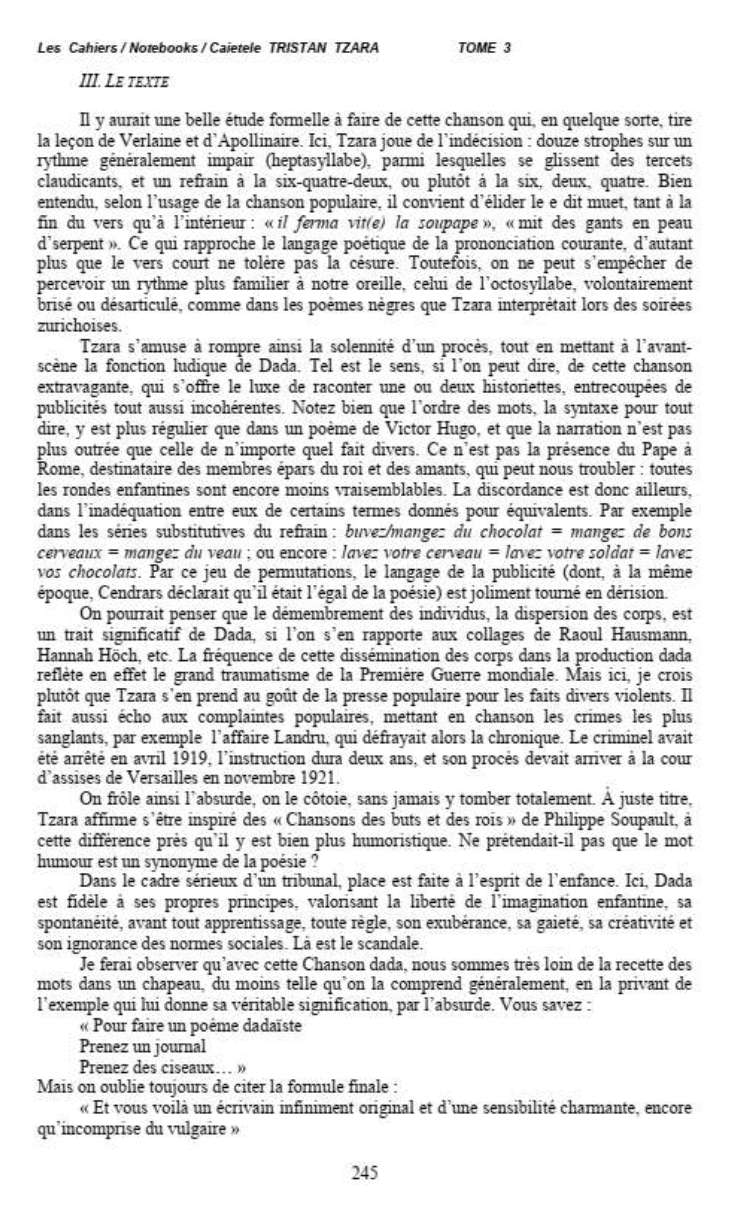
A fine formal study could be made of this song, which, in a way, draws lessons from Verlaine and Apollinaire. Here, Tzara plays with indecision: twelve stanzas on a generally odd rhythm (heptasyllable), among which limping tercets slip in, and a refrain in six-four-two, or rather six, two, four. Of course, as is customary in popular song, the mute e should be elided, both at the end of the line and within: “il ferma vit(e) la soupape,” “mit des gants en peau d’serpent.” This brings poetic language closer to everyday pronunciation, especially since the short line does not tolerate a caesura. However, one cannot help but perceive a rhythm more familiar to our ear, that of the octosyllable, deliberately broken or disjointed, as in the Negro poems Tzara performed at Zurich evenings.
Tzara enjoys thus breaking the solemnity of a trial, while putting the playful function of Dada center stage. Such is the meaning, if one can say so, of this extravagant song, which takes the liberty of telling one or two little stories, interspersed with equally incoherent advertisements. Note that the word order, the syntax in short, is more regular than in a poem by Victor Hugo, and that the narration is no more outrageous than that of any news item. It is not the presence of the Pope in Rome, recipient of the scattered limbs of the king and the lovers, that can trouble us: all children’s rounds are even less plausible. The discordance is therefore elsewhere, in the inadequacy between certain terms given as equivalents. For example, in the substitutive series of the refrain: drink/eat chocolate = eat good brains = eat veal; or again: wash your brain = wash your soldier = wash your chocolates. By this game of permutations, the language of advertising (which, at the same time, Cendrars declared was the equal of poetry) is nicely mocked.
One might think that the dismemberment of individuals, the dispersion of bodies, is a significant feature of Dada, if one refers to the collages of Raoul Hausmann, Hannah Höch, etc. The frequency of this dissemination of bodies in Dada production indeed reflects the great trauma of the First World War. But here, I rather think that Tzara is targeting the popular press’s taste for violent news items. He also echoes popular ballads, setting the bloodiest crimes to music, for example the Landru affair, which was making headlines at the time. The criminal had been arrested in April 1919, the investigation lasted two years, and his trial was to come before the Versailles Assize Court in November 1921.
Thus, we skirt the absurd, brush against it, without ever fully falling into it. Rightly, Tzara claims to have been inspired by Philippe Soupault’s “Chansons des buts et des rois,” with the difference that he is much more humorous. Did he not claim that the word humor is a synonym for poetry?
In the serious setting of a court, room is made for the spirit of childhood. Here, Dada is true to its own principles, valuing the freedom of childish imagination, its spontaneity, before any learning, any rule, its exuberance, its gaiety, its creativity, and its ignorance of social norms. That is the scandal. I would point out that with this Dada Song, we are very far from the recipe of words in a hat, at least as it is generally understood, deprived of the example that gives it its true meaning, by the absurd. You know: “To make a Dadaist poem Take a newspaper Take scissors...”
But the final formula is always forgotten: “And you are an infinitely original writer and of a charming sensitivity, even if misunderstood by the common people” As for the example of a poem thus produced by the chance of cutting, it is such that it resembles none of those that Tzara or his friends published. One must always read Tzara, and especially the Dada-era Tzara, with the distance imposed by humor. This brings us back to Tzara’s 7 Manifestos, which would not be published as a collection until 1924, but all of which had been written before this austere ceremony. With the lightness required, the song briefly illustrates the themes on which the union of poets and painters was based, across borders: absence of immediate meaning, expression of individual spontaneity, disgust for art and society, universal doubt, and above all this great secret: “thought is made in the mouth.” Ultimately, how could one define a Dada song? With a tautology familiar to this movement: it is a song sung by a Dadaist, a childish ditty, a nonsensical lament. In this case, its major function is to place Dada as an indecent thing at the heart of the so-called trial of Maurice Barrès. All this has been well understood by the composers who have set this song to music.
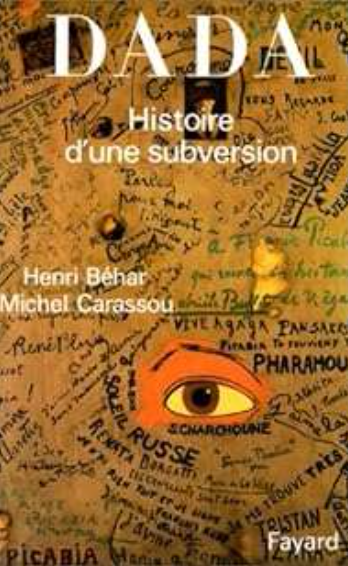
Read: Henri Béhar & Michel Carassou Dada, History of a Subversion, 261 pages, FAYARD
Summary:
Henri BÉHAR At a time when all the values of Western civilization seemed to have dissolved in the horrible carnage of the 1914–1918 war, the Dada movement brought a wind of rebellion and revolt. It created its own myth by displaying a purely subversive and terrorist spirit. It wanted to destroy again and again and gave itself the means, whether in art, literature, social and individual morality. If Dada died around 1924, the state of mind it gave birth to has not finished manifesting itself...
"To make a Dadaist poem. Take a newspaper. Take scissors. Choose in this newspaper an article having the length you want to give your poem. Cut out the article. Then carefully cut out each of the words that make up this article and put them in a bag. The poem will resemble you. And you are an infinitely original writer and of a charming sensitivity, even if misunderstood by the common people." Tristan Tzara.
Dufour, Catherine. The Cosmopolitan Vocation of Tristan Tzara (1915-1925). Paris 3, 2001. Full text downloadable here.
Summary: The corpus that made it possible to study the "cosmopolitan vocation" of Tristan Tzara includes the writings from the origins of his Romanian career, in 1912, to 1925, when his name temporarily faded from the Parisian literary scene. But many theoretical writings after 1925 were taken into account—for they constitute a critical historiography of Dada by Tzara himself—as well as his correspondence. The whole gave rise to a study in seven stages: the Romanian premises, the stakes of Zurich activism, relations with the Italian and Russian futurisms, with France, Germany, Belgian and Hungarian Dada-constructivism, the Black world. The research showed how Tzara, coming from the turmoil of an archaic world, turned towards the currents of European contestation, evolving from a literary to a lived cosmopolitanism, favored by the historical convergence, in Zurich, during the First World War, of all the currents of modernity: cubism, futurism, expressionism, etc. Tristan Tzara's "cosmopolitan vocation" is studied on the basis of the set of his writings spanning from his early works in Rumania (1912) to the provisory fading of his name far from the stir of Paris literary life. However his correspondence and many theoretical works written later than 1925 are also taken into account for they constitute a critical historiography of Dada written by Tzara himself. All these documents support a study coming in seven stages: the Rumanian premises, the stakes of Tzara's activism in Zurich, his connections with futurism (both Italian and Russian), with France, with Germany, then the Belgian and Hungarish dada-constructivism, the Black world. We show how Tzara, coming the turmoil of an archaic world, turned towards various streams of the European contestation. He moved from a literary to a lived cosmopolitanism, supported by the historical convergence in Zurich, right during World War 1, of all the trends of modernity: cubism, futurism, expressionism, and so on.
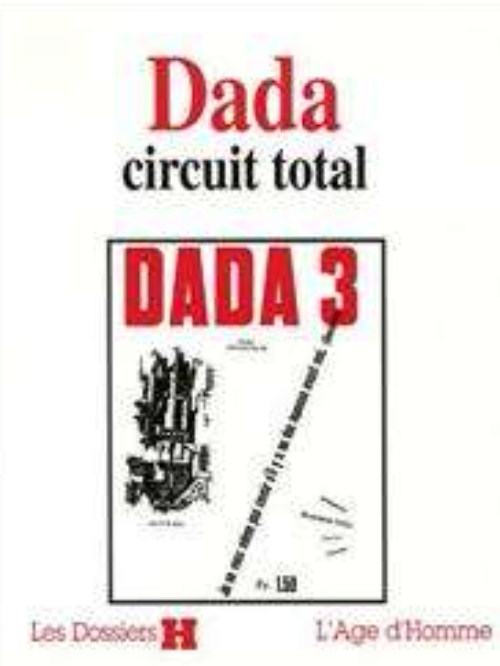
This ample and exhaustive dossier addresses the Dada movement from the “proto-dada” to all the major poles of “historical dadaism” Zurich Paris Berlin Cologne etc. The book is enriched with unpublished documents, general syntheses that existed only in foreign languages, new material in French from Hausmann, Huelsenbeck and Arp, studies and documents on Baargeld and Dada in Cologne. An event book not to be missed!
See: Exhibition Centre Pompidou: DADA (centrepompidou.fr)
Read on the Mélusine site:
- Dada as a European Phenomenon (by Henri Béhar)
- The Intertext of the World in the Twenty-Five Poems (by Catherine Dufour)
Further reading: H. Béhar: Dada in context (PDF)
Cécile Bargues: Dada after Dada. Repercussions, Overlaps and Receptions of Dadaisms. Doctoral thesis, Paris 1 Panthéon-Sorbonne, 806 p., text volume 525 p. + annex volume 281 p., 2012.
APPENDIX Béhar, Works on Dada
Books Study on Dada and Surrealist Theater, Paris, Gallimard, 1967, 358 p. coll. “Les Essais.” Translated into Japanese, Spanish, Polish, Italian. New revised and expanded edition: Dada and Surrealist Theater, Idées/Gallimard, 1979, 444 p. Dada in Verve, preface by Henri Béhar, Piere Horay, 1972, new ed. 2003. Dada, History of a Subversion, (in collaboration with Michel Carassou), Paris, Fayard, 1990, 264 p. New edition in 2005. Spanish translation, Peninsula, 1996; Japanese translation, Shi Sho Sha, 1997; Chinese translation, Gankui Normal University, 2003. Direction of journals, books and collections 1 to 3. Cahiers Dada-Surrealism, Paris, éd. Minard, 1966-1969. “Dada Collection” (Dilecta ed.) Tristan Tzara, The First Celestial Adventure of Mr. Antipyrine, ill. by Marcel Janco, 2005. Tristan Tzara, 7 Dada Manifestos, ill. Francis Picabia, 2005. Tristan Tzara, Twenty-Five Poems, ill. Hans Arp, 2006. Tristan Tzara, Cinema Calendar of the Abstract Heart, ill. Hans Arp, 2006. Dada, Total Circuit, (with Catherine Dufour), Lausanne, L’Age d’Homme, 2005.
Contribution to collective works Article “Dada,” in Encyclopaedia Universalis. Dada-Tzara chapter in Literary History of France, Paris, Editions sociales, 1979, pp. 203-209. Entries: Dada, Ionesco, Jarry, Surrealism, Vitrac, in: Enciclopedia del teatro del ‘900, edited by Antonio Attisani, Milan, Feltrinelli, 1980. “Comparative Poetics” section, in: Research and Multidisciplinarity, Proceedings of the Gif-sur-Yvette symposium. University of the Sorbonne Nouvelle, 1982, pp. 249-331. Literature entries in the Grand Dictionnaire encyclopédique, Paris, Larousse, 1982. Entries on Baron, Collage, Congress, Critique, Dada, Unusual, Theater, Titles, Tzara, Valençay, Vitrac and various works in General Dictionary of Surrealism and its Surroundings, Fribourg, Office du Livre, Paris, P. U. F. 1982. Contemporary French literature entries (authors, characters, themes, terminology) in Historical, Thematic and Technical Dictionary of French and Foreign Literatures, Ancient and Modern, edited by Jacques Demougin, Paris, Larousse, 1985. “Poetic Uses of Language: Dada and Surrealism,” in History of the French Language 1914-1945, edited by Gérald Antoine and Robert Martin, CNRS Editions, 1995, pp. 567-595. Preface by Henri Béhar: “No One is a Prophet in His Own Country,” in: Erwin Kessler: Tzara. Dada. Etc. catalog of 100 items from the collection of Emilian Radu, commented by Catalin Davidescu. Ed. Arcub, 2015, Bucharest, 244p. bilingual.
Articles “Adventure and Dice”, Cahiers Dada Surrealism, no. 1, 1966. “Should Dada Have Been Shot?” Les Nouveaux Cahiers, no. 5, June 1966.
“Before the movement, the Nantes group,” Dada, surrealismo: precursores, marginales y heterodoxos, Cadiz, 1986, pp. 77-80. “Dada as a new combinatory,” Avantgarde, Amsterdam, no. 1, 1987, pp. 59-68.* “Dada spectacle” in: Vitality and Contradictions of the Avant-Garde. Librairie José Corti, 1988, pp. 161-170. “Tristan Tzara, historiographer of Dada,” Mélusine, no. V. pp. 29-40. “The Dada Parenthesis” [Aragon], Europe, no. 745, May 1991, pp. 34-44. “Dada: An International Without Institutions?” in: National and International Avant-Gardes. Liberation of Thought, Soul and Instincts by the Avant-Garde. Texts collected by Judit Karafiath and Gyorgy Tverdota. Budapest, 1992 Argumentum, pp. 55-61. “Philippe Dada or the Failings of Memory”, [Soupault] Europe, May 1993, no. 769, pp. 7-14. “Éluard and the Dada Madman,” in Les Mots la vie, revue sur le surréalisme [sic], “Éluard a cent ans,” proceedings of the Nice symposium (January 1996), no. 10, 1998, pp. 13-33. “The Dada Simultaneism,” in Avant-Gardes and the Tower of Babel, Interaction of Arts and Languages, edited by Jean Weisgerber, Lausanne, L’Age d’Homme, 2000, pp. 37-44. “Tzara, Dada and Surrealism,” Itinéraires et contacts de cultures, no. 29, Tristan Tzara, Surrealism and the Poetic International, 2000, pp. 13-19. “Dada as a European Phenomenon. The Irruption of the Unconscious in Literature”, RILUNE (electronic journal), no. 6, 2007. “Dada is a virgin microbe, psychoanalysis a dangerous disease,” in Hypnos, aesthetics, literature and the unconscious in Europe (1900-1968) studies collected and presented by Frédérique Toudoire-Surlapierre and Nicolas Surlapierre, éditions l’Improviste, 2009, p. 191-212. “Dada in Context,” p. 5-17, in: Collegium, vol. 5, Writing in Context: French Literature, Theory and the Avant-gardes L'écriture en contexte : littérature, théorie et avantgardes françaises au XXe siècle. Edited by Tiina Arppe, Timo Kaitaro & Kai Mikkonen (2009) http://www.helsinki.fi/collegium/e-series/volumes/volume_5/index.htm “Is Provocation a Dramatic Category? The Example of Dada and Surrealist Theater,” in: Jaak van Schoor & Peter Benoy (red), Historische avant-garde en het theater in hetinterbellum, éd. ASP, Brussels, 2011, p.59-74. “La Colombe poignardée: Dada politique,” Dada and Beyond, Volume 1: Dada Discourses, Edited by Elza Adamowicz and Eric Robertson, Amsterdam/New York, NY, 2011. 246 pp. (Avant-Garde Critical Studies 26), p. 21-35. “Listen to the Dada Song,” Caietele Tristan Tzara, vol. III, 2013, p. 243-246. 2012/10/21 Belgrade: "The Girl Born Without a Mother" 2016/April/8 Zurich: fiftieth anniversary Paris MNAM exhibition 2016/May/27 Paris Romanian Embassy, "Why I Will Not Write Tzara’s Tomb 2016/Nov./10-11; Moscow, Dada is 100 Years Old, "Approximate Dada" 2016/June/24 Florence: ‘DADA da 100... ma non le dimostra’