“LITERATURE THROUGH THE STOMACH,” CAHIERS ALBERT COHEN, NO. 25, LITERATURE PUT TO THE TEST, MARCH 2016, PP. 187–198.
Cahiers Albert Cohen No. 25
Albert Cohen: Literature Put to the Test
Mathieu Bélisle & Philippe Zard
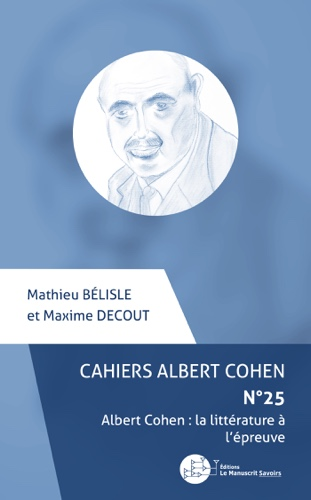
Albert Cohen’s name evokes the image of a unique, unclassifiable body of work that defies all our norms and challenges our reading habits. Comedic, lyrical, and polemical radicalism: here we find a sovereign and utterly unexpected way of renewing the novelistic genre. Although the writer claimed to have stopped reading in his thirties, his work is nonetheless marked by what might be considered a struggle with—and against—literature. His texts abound in allusions, quotations, parodies, pastiches, and rewritings, sometimes hidden, sometimes blatant, in which writing interrogates itself through the mirror of others’ writing. The studies gathered here examine the many facets of this relationship with literature, questioning the role of models and countermodels, influences and inspirations, that determine the unprecedented way in which Cohen constructs both a literary aesthetic and an ethics of literature.
===> This volume contains the presentations delivered at the Albert Cohen: Literature Put to the Test conference, held on May 28–29, 2015, at the University of Lille, under the direction of Mathieu Bélisle and Maxime Decout. Here is my contribution:
Literature Through the Stomach
I don’t know if you have ever read, at the beginning of an article, that the author refers to, and I quote, “Henri Béhar’s method.” It’s rather surprising, because while I admit to having tried to popularize the Hubert de Phalèse method—developed collectively and for which I am only the popularizer—I have never claimed a literary approach bearing my own name. But better late than never, as the saying goes!
Over the course of my academic career, I have tried to systematize two approaches to literary phenomena: first, the Hubert de Phalèse method, which relies on a specific use of digital tools; and second, cultural analysis of texts. Today, I would like to draw on both methods in relation to the work of Albert Cohen, by showing how, beginning with the stomach, he arrives at addressing the interdependence of all parts of the body—and thus, like Rabelais, ultimately, thought itself.
I. The Hubert de Phalèse Method
The Hubert de Phalèse method was developed with my students starting in the 1980s (1). It consists of several successive phases, which I consider essential for anyone wishing to study a text literally. Next comes the construction of a characteristic dictionary of the author's vocabulary, focusing in particular on difficult words—by which I mean words unknown to the ideal secondary-school student the teacher is ostensibly addressing—or whose context alters their usual meaning.
In short, using digital tools, one systematically searches for terms implied by this vocabulary, extracts them in context, and builds a sort of dictionary without omitting the nuances of each usage. Serial analysis brings out the subtlest variations of a term—how it contrasts with its surroundings.
Even though the process is assisted by software, there’s nothing mechanical about it, since the ultimate goal is to interpret a text, to arrive at a comprehensive hermeneutics of Albert Cohen’s life-work. I would add that citations require a back-and-forth: from table to mouth, from food to text, and vice versa.
II. Cultural Analysis of Texts
Just as with the Hubert de Phalèse method, I have on several occasions attempted to codify the method of cultural analysis of texts (2). The mere wording of the term makes the concept clear.
But, you might ask, since a text is written in proper French—as, at first glance, Albert Cohen’s clearly is—why speak of cultural analysis? Isn’t Cohen, regardless of the nationality listed in his passport, a worthy representative of our literature?
Certainly! Nevertheless, as with any French or Francophone writer, his work cannot do without our analysis.
Here I have to share the rage I felt upon reading some erroneous information found on the internet and even in so-called scholarly books. For instance, a reader sensitive to the beauty of The Book of My Mother claims to “interpret” a passage—which she quotes at length—by appending a recipe for Greek-style lamb. All well and good! Except that the recipe mixes meat and cheese—a combination that little Albert’s mother, Madame Louise Cohen, who knew all the precepts of her religion (which she passed down orally to her son), would never have allowed! One must always be circumspect. You don’t need to be circumcised to know that! Is it too much to ask that someone who wants to add their two cents to the writer’s marvelous prose at least do a bit of research first—and above all, if they are Catholic, to read the Old Testament? This, after all, has been encouraged by the Pope himself since Vatican II, and is essential for understanding French literature! Atheists, for their part, are not mistaken in this.
Another critic offers a recipe for moussaka supposedly taken from Mangeclous, but includes a béchamel sauce that is not in the text and has no business being there—again, because of the dietary rules outlined in Leviticus and passed down from generation to generation by women!
Yet another, a self-proclaimed expert on Albert Cohen, finds traces of Judeo-Spanish or Yiddish in the speech of Mariette, the old Swiss maid, when in fact she is simply using Rhaeto-Romance vocabulary—specifically Romansh, one of Switzerland’s four official languages!
In short, neither goodwill nor academic degrees are enough to understand what Cohen meant—whether consciously or not—today. That’s why I felt compelled to once again recommend a cultural analysis of Albert Cohen’s texts, assisted by computer tools, which I will illustrate briefly here.
III. Application to the Work of Albert Cohen: Literature Through the Stomach
Originally from Corfu, Albert Cohen invites the reader to the table of his childhood. Like all Orientals, this Sephardic Jew doesn’t just have the dishes of his family tradition served: he names them, describes them, and even provides the recipes! He wants to be perfectly understood. His literature is not only intellectually nourishing: like Rabelais’s work, it teaches a whole moral and political world by appealing to Messere Gaster.
To stay within the allotted time, I will limit myself here to the study of three elements: biblical culture; celebration; and language.
An Eastern and Biblical Culture
Mangeclous is the Panurge of modern times. To understand his behavior, to truly savor (the word is quite fitting) the food Albert Cohen evokes in his books, one must first immerse oneself in at least a minimal familiarity with the “Israelite” culture (to use the vocabulary of the Third Republic).
A descendant of the priestly caste, as his name suggests, and steeped in rabbinic tradition through a Romaniote father, we are told; deeply attached to his mother, the guardian of the Law, he casually mentions the elements that shape his characters’ worldview. Thus, Saltiel the Wise writes to his nephew Solal that in London, the buses “are the color of raw meat, an abomination beloved of the pagans, and if you marry as my heart desires, I ask your delightful wife to salt the meat well and even to rinse it before cooking to remove any blood that may remain in it” (Val.275). This holy aversion to blood—symbol of life—is in accordance with Levitical laws (17:10–16) and their practical implications as established in the Set Table (Shulchan Aruch), the dietary code compiled in Safed in the 16th century by Joseph Caro. That is why, when preparing food for a picnic, Mangeclous lays out “strictly kosher-certified beef sausages” (BDS, 559). Beef, because his friends could not eat pork, which is forbidden by their religion. As for himself, he allows himself “a few slices of ham, which is the pure and Israelite part of the pig” (BDS, 216), or again, “What? You eat pork?” gasped Solomon in horror. “Ham is the Jewish part of the pig,” said Mangeclous (Val.253), more as a provocative gesture, a mark of a freethinker!
Even in London, Mangeclous and his cousins eat only what is known as kosher food, permissible under Jewish law. He unpacks from two baskets a small snack he bought from a Levantine Jew:
“Four pairs of bottarga, of which I claim half by leonine right! No objections? Adopted! Twelve large fried and crispy squid, a little chewy for the tooth, which enhances their charm! Eight for me, as they are my supreme passion! Hard-boiled eggs galore, cooked all day long in water seasoned with oil and fried onions so the flavor soaks through! So I was assured by the noble grocer-caterer and coreligionist—may God bless him, amen! ...Come, gentlemen, to the table! Ready to feast!” (BDS, 559)
All these items, from the Mediterranean Basin, form the backdrop of the religiously laid table by Albert Cohen, who, it is worth noting, uses no local names except for “loukoum,” which appears in a thoroughly Gallicized spelling. Wearing beards and skullcaps, look at these cousins from Cephalonia—this mythical island that, of course, bears no relation to present-day Corfu!
Passover. The Seder
Let us not be mistaken: despite their constant eccentricity, the Valorous are very much of their time—they worship the one true God and are naturally religious. So when Solal recalls his childhood (as does the narrator), it is the first evening of the feast commemorating the Exodus from Egypt that comes to mind. He describes, using free indirect discourse, each stage of the ritual meal (which itself is designed to mark each part of the historical narrative), blending in the exact words of the sacred text:
“…oh my childhood in Cephalonia oh Passover the first evening of Passover my lord father would pour the first cup then he would say the blessing, in Your love for us You gave us this Festival of Unleavened Bread anniversary of our deliverance remembrance of the Exodus from Egypt blessed are You Eternal who sanctifies Israel, I admired his voice then came the washing of the hands then came the parsley dipped in vinegar then came the breaking of the unleavened bread then came the telling my lord father lifted the tray he said this is the bread of affliction our ancestors ate in the land of Egypt let all who are hungry come eat with us let all in need come and celebrate Passover with us this year we are here next year in the land of Israel this year we are slaves next year a free people then since I was the youngest I asked the prescribed question what makes this night different from all other nights why on all other nights do we eat leavened bread and on this night unleavened bread I was moved to ask the question to my lord father then he uncovered the matzot he would begin the explanation looking at me and I blushed with pride he said we were slaves to Pharaoh in Egypt and the Eternal our God brought us out with a mighty hand and an outstretched arm,” (BDS, XCIV, 753)
I do not intend here to break down this anthology-worthy passage without punctuation word for word, nor to provide a semiotic analysis of the ceremony. However, a reader who has never attended such a festive meal must at least know the basics—a few key notions which rightly fall under the umbrella of Jewish culture. To begin with, let us note the alternative name Jews themselves often give to this ceremony: the Festival of Unleavened Bread (Hag HaMatzot).
First of all, it must be understood that Passover commemorates several events at once—both traditional and historical. It holds a dual meaning: originally a pastoral springtime festival, it later became the commemoration of the Exodus from Egypt.
Solal recalls the family dinner ritual on the first evening of Passover. In French, the holiday is written la Pâque, feminine singular, a word that is meant to render the Hebrew Pesach, which refers to the passing over of the houses of the Israelites by the Angel of Death, who killed the Egyptian firstborns on God’s command. The circumflex accent in Pâque marks the etymological s (from Latin and Greek). It has since become optional due to a (failed, like all of them) spelling reform. The expression la Pâque juive (“the Jewish Passover”), as opposed to the Christian celebration Pâques, reads as a redundancy—at least in writing—since the definite article and the absence of a final s should suffice to distinguish between the two religions. Unfortunately, the situation is complicated by the fact that the Orthodox Churches (Greek and Russian) use the same spelling as the Jews! Therefore, clarification is sometimes necessary, even at the risk of redundancy. In this context, Albert Cohen might have chosen to transliterate the Hebrew word Pesach. But as we’ve seen, he deliberately limits lexical borrowings—especially from Hebrew—to the strict minimum.
Then, the table is set. The mother has lit the candles and placed in the center a tray containing a grilled lamb shank, symbolizing the Passover offering, the holocaust, the animal once sacrificed before the destruction of the Temple; a hard-boiled egg, symbol of mourning in remembrance of the Temple’s destruction; the bitter herbs (maror) recalling the harsh conditions of slavery; the haroset (mortar) representing the construction work to which the Hebrews were subjected in Egypt; three matzot commemorating the Exodus from Egypt; and four cups of wine to be drunk at different moments during the evening, with the men reclining on their left side as a sign of freedom.
Let us not forget the empty seat reserved for the prophet Elijah, who is believed to announce the coming of the Messiah. In the meantime, this place can be taken by a poor person.
The rabbis count fifteen steps in the course of the evening. Solal retains only about half. Allow me to refer you to them.
As he recalls his childhood memories with all their emotional charge, Solal highlights the pedagogical nature of this commemorative staging. At the same time, he celebrates the memory of his father, his beautiful cantor’s voice. The phrase “the lord father” sounds unusual in French. It is a calque of Judeo-Italian spoken by the mother, as well as of Judeo-Spanish commonly used by Jewish communities in Greece.
This majestic father is therefore not exactly that of the writer, but it is impossible not to see in him a tribute to the one whom the author treated harshly throughout his work, in favor of the Mother.
Despite the vividness of the memory and the rigorous unfolding of the ceremony, the Narrator (and consequently Solal) omits a number of steps, notably the tragic one in which the ten plagues of Egypt—from which the Hebrews were spared—are named. Those present turn their faces from the table, and the father, while reading aloud, pours water from a pitcher to symbolize the divine miracle.
- This has been brilliantly provided to us by Jean-Pierre Goldenstein in Linguistics and Literary Discourse, Theory and Practice of Texts, Paris, Larousse, 1983, 351 p.
The Terrible Days
Now, the two books mentioned were published after what is improperly called the Holocaust or, just as inaccurately, the Shoah (“annihilation” in Hebrew) or even genocide. After millennia of slavery, the Narrator writes in the shadow of mass destruction: “Suddenly I am haunted by the German horrors, the millions slaughtered by the wicked nation, those of my family in Auschwitz, and their fears, my uncle and his son arrested in Nice, gassed in Auschwitz” (Val.225).
This is the same person who, in a nightmare, sees his mother in occupied France, gathering rags from the street to put in a suitcase containing a yellow star (LM, 114). The same again, who recalls the loss of his mother in Marseille, while he himself was in London.
It is impossible to understand the feelings and behaviors of the characters without seeing that they are set against such a backdrop. But there is more, and it is perhaps even more deeply inscribed in their flesh. For, although they did not experience direct persecution or the Shoah (a term absent from Belle du Seigneur and Les Valeureux), they know what the pogroms were like for all Jewish communities of Russia, Poland, or the Ottoman Empire. Beyond his laughable quirks, it is precisely this history that drives Mangeclous and his fellow believers to hoard food, despite the comically exaggerated nature of their actions:
“The Jews hastened to have bars installed on their windows and, as in times of pogrom, amassed supplies: flour, potatoes, unleavened bread, macaroni, sugar loaves, eggs, beef sausages, chains of peppers, onions, and garlic, balls of sun-dried tomatoes marinated in oil, goose fat and jars of water, smoked meats, purgatives, and medicines.” (Mangeclous, 88)
In short, the carnivalesque work can only be understood through its opposite, the evocation of programmed death. Not the natural death of humankind, but that which was decreed in the name of unthinkable aberrations of the mind, at the so-called Wannsee Conference, January 22, 1942.
The Passover vigil ends with traditional songs, both pedagogical and moral in purpose. One is called Had gadia (in Hebrew, or more precisely, in Aramaic), and tells the story of a little kid that my father bought for me for two zuzim. And the cat came and ate the little kid that my father bought for me for two zuzim. And then came the dog that bit the cat that ate the little kid that my father bought for me for two zuzim. Then came the stick that struck the dog that bit the cat... The chain continues until the arrival of the Angel of Death, who slays the slaughterer who had killed the ox, and so on. Yet this is not the final word: finally, God, blessed be He, comes and slays the Angel of Death who... for two zuzim.
We see what lesson little children—indeed, even adults—can draw from this: that no one occupies a place that cannot be contested by someone more powerful.
This cumulative song, strictly speaking, of Sephardic tradition, is sung in Judeo-Spanish, but also in Hebrew and Yiddish. In his story, Solal doesn’t seem to remember it. Nevertheless, the Angel of Death is mentioned several times by the Valeureux. Thus, Mangeclous explains Mattathias's miserliness by the fear inspired in him by the Angel of Death:
“Moreover, I understand why he never stocks spices, it’s because if he were suddenly to expire in the arms of the angel of death and horrors, there would remain in his kitchen salt or pepper and it would be waste [...]!” (BDS, 746)
Conclusion
And now, on the table, are all the aromas, all the flavors, all the splendors of Judeo-Balkan cuisine that envelop you, spreading pleasure and joy of living, even in the darkest days, for its lesson is always the same: “lehaim”—to life, as he says, raising his glass of wine in a symbolic toast.
To read all of Albert Cohen’s work through the dishes he evokes is not only to journey through his imaginary world, but also to approach his creative process and, in the same way, to characterize the individuals to whom he gives such presence, such an unparalleled spiritual life, since food is inseparable from the individual. Like the one God they pray to daily, for them, body and spirit are one.
Let us not be mistaken: Albert Cohen’s language, carefully crafted, is a refined French that intentionally avoids local color. This is not a tourist or culinary guide. No tarama, no dolma, no fila or beureks, no albondigas, no boyos or yaprak, none of those terms that abound in cookbooks or even in the memoirs of Sephardic Jews. That is why we must look for “crackers,” “vine leaves” (Val.249), “meatballs” and other pastries, etc. So much so that one might feel like a guest at La Reynière’s table, surprised to find a cuisine based on oil where eggplant and tomato reign supreme. Notable exceptions: the raki offered by Aude to Saltiel (Solal, 233); loukoum, moussaka, and cascaval—perhaps because these are names and products of Turkish origin? And finally halva, an authentically Turkish word, barely uttered by Ariane, a harbinger of discord between the lovers (who would have done well to eat more of it!).
Besides this legitimate concern to use a purified, universal French—by an author whose mother tongue, he says, was Judeo-Venetian, spoken by only a thousand people on Corfu at the time of his birth—there is also, perhaps, the desire to strengthen the myth of the Valeureux of France, emancipated by the French Revolution, “made perfect French citizens by virtue of the charming decree of the National Assembly of September twenty-seventh, 1791,” according to Saltiel, proud to remain so and to maintain “the sweet language” of our country.
In any event, the remarkable absence of foreign vocabulary, the refusal of borrowings, testifies to Albert Cohen’s concern for assimilation, even integration. And this is a successful integration, not only through his career as a high-ranking international civil servant, but also as a French writer.
Let us not forget that he is an immigrant, and a Jew as well—which he cannot forget, as shown by the scene of the antisemitic street vendor, insulting him and pointing him out to public scorn on his tenth birthday (O You, Men of My People, p. 38)—an indelible scene, recurring several times and never to be forgotten, since he would return to it even past the age of eighty (Carnets 1978, p. 19). A founding, symbolic scene, revealing to him the impossibility of complete assimilation. This is not exactly the lesson he draws from it, just as Swann, excluded from the Verdurins’ circle, never believes for a moment that his exclusion might be due to his Jewishness—he who, at the same time, is welcomed and even sought after by the Faubourg Saint-Germain. Any honest reader, having reached the end of In Search of Lost Time, namely Time Regained, cannot fail to notice this[1]. Still, the matter of assimilation remains timely, and by its own internal contradiction, it adds tremendous richness to the work it engenders.
===> The third part of this talk was reprised, with a different introduction, in my volume: Essai d’analyse culturelle des textes, Classiques Garnier, 2022, p. 123-131.
- See my preface to Swann’s Way, Pocket edition.
Later, I would use the same arguments as an introduction to the volume À table avec Albert Cohen, at the Museum of Jewish Art and History, on January 17, 2016. Various technical mishaps, including the announcement of the event by email that very morning, meant I stuck to general remarks, answering listeners’ questions under the chairmanship of Professor Haïm Vidal-Séphia.
Talk given at the MAHJ on January 17, 2016
Presentation: À TABLE AVEC ALBERT COHEN
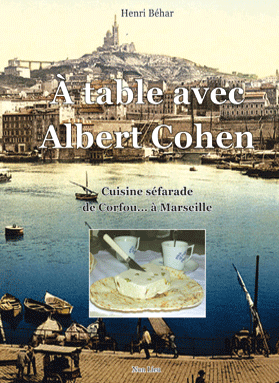
This book aims to foster an appreciation of Albert Cohen’s literature through the many references to food it contains, particularly dishes of Judeo-Balkan origin. This project is part of a broader cultural analysis of literary works. I start from the premise that one can only truly taste a text (quite literally) if one holds its keys—the cultural sources in which the author is immersed, sometimes unconsciously. In this case, the idea is to bring literature through the stomach! Thus, all fragments mentioning this food have been collected, only those referring to Sephardic culture (to which Cohen belonged body and soul) being retained, and to emphasize its specificity, recipes are appended. The book contains 40 entries and 20 recipes. These recipes correspond to the era evoked by Albert Cohen in his novels, in conformity with the dietary laws of his community. It would be preferable for the publisher to enlist a professional chef able to detail the preparation of each dish and provide photographs. Failing that, I provide my own ancestral recipe, which aligns perfectly with Cohen’s culinary customs (see examples in the “manuscript”). For example, I explain how to roast eggplants over a wood fire, as Albert Cohen’s mother did, imparting an aroma not found in today’s eggplant caviar recipes. Illustrations include at minimum photos of 20 prepared dishes. Add illustrations of oriental spice shops from the early 20th century, in Corfu and Marseille.
Book outline: Introduction, which justifies the project and method and warns against errors widespread on the Internet.
Part 1: Knowledge — what one must know to at least understand the characters’ customs and the historical backdrop the author invokes.
Part 2: See “goods with strong odors”: a brief overview of the foods mentioned, supported by citations, arranged as dictionary entries. This practical organization can be condensed and turned into continuous text.
Part 3: Cooking the “oriental splendors”: dishes mentioned in the text, sometimes alongside Mangeclous’s recipe, illustrated by a practical cooking guide.
Conclusion: In my view, this book could adopt the layout of a cookbook, if only to engage readers with this nourishing aspect of Albert Cohen’s work.
Henri Béhar
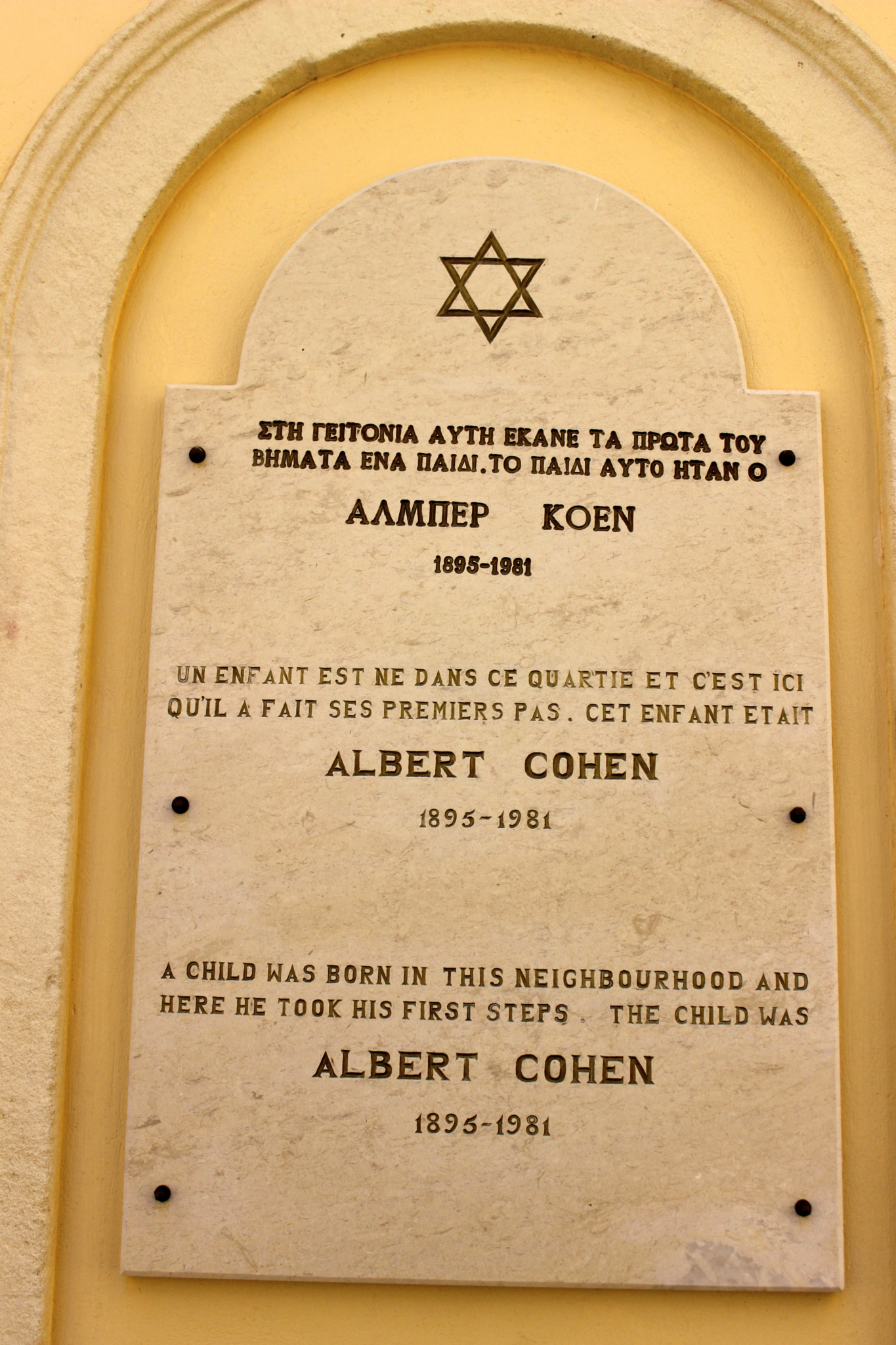
Plaque affixed to Albert Cohen’s birthplace
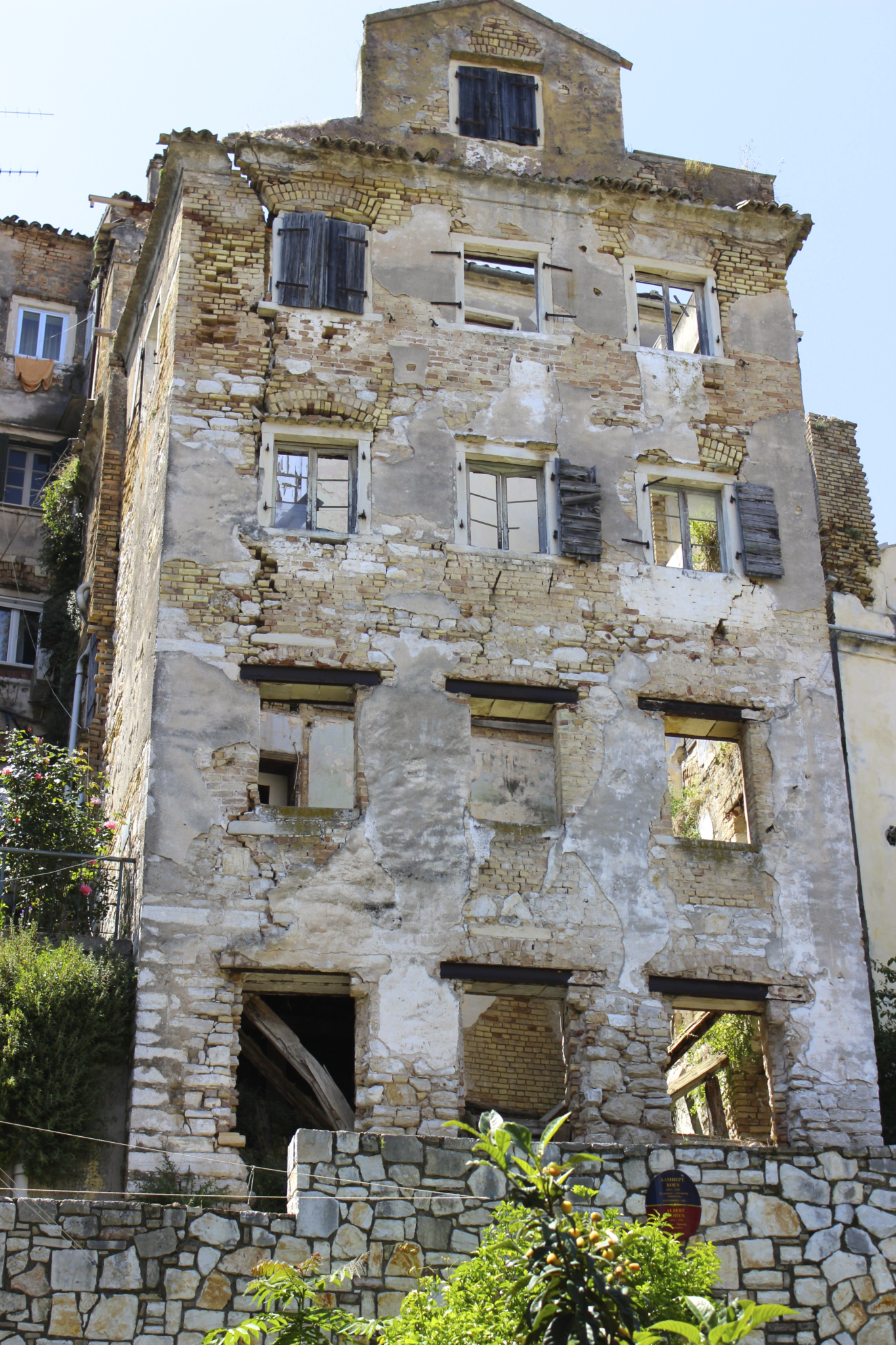
For information, Albert Cohen’s birthplace in Corfu (2013)
Book review by Alain Chevrier in the journal Europe, March 2016, no. 1043, pp. 345–346 right here.