"Introduction", Literary History Today. Under the direction of Henri Béhar & Roger Fayolle. Armand Colin, 1990, pp. 5-7.
The date of this work is important. It marks the moment when it was possible, in the French university, to introduce diachrony on the same level as synchrony, which concerned the structuralists. Indeed, the latter, preoccupied with ensuring their theories, had simply forgotten the framework of the Saussurean approach.
In my mind, as in that of the colleagues who had kindly agreed to join me, there was no question of making the dominant structuralist theories disappear, but rather of articulating them with the diachronic axis, in other words, literary history.
This is why, in collaboration with Roger Fayolle, I had launched an invitation to French literature professors from universities and high schools in the Paris region to examine together the means of articulating the two axes (synchrony and diachrony) distinguished by Saussure. More than two hundred colleagues therefore came to listen, in the Dussane hall of the École Normale Supérieure, to the speakers listed in the table of contents below. Coming themselves from different horizons, they complemented each other perfectly and ensured, in their respective universities, that literary history figured in the new programs, complementing the structuralist data.
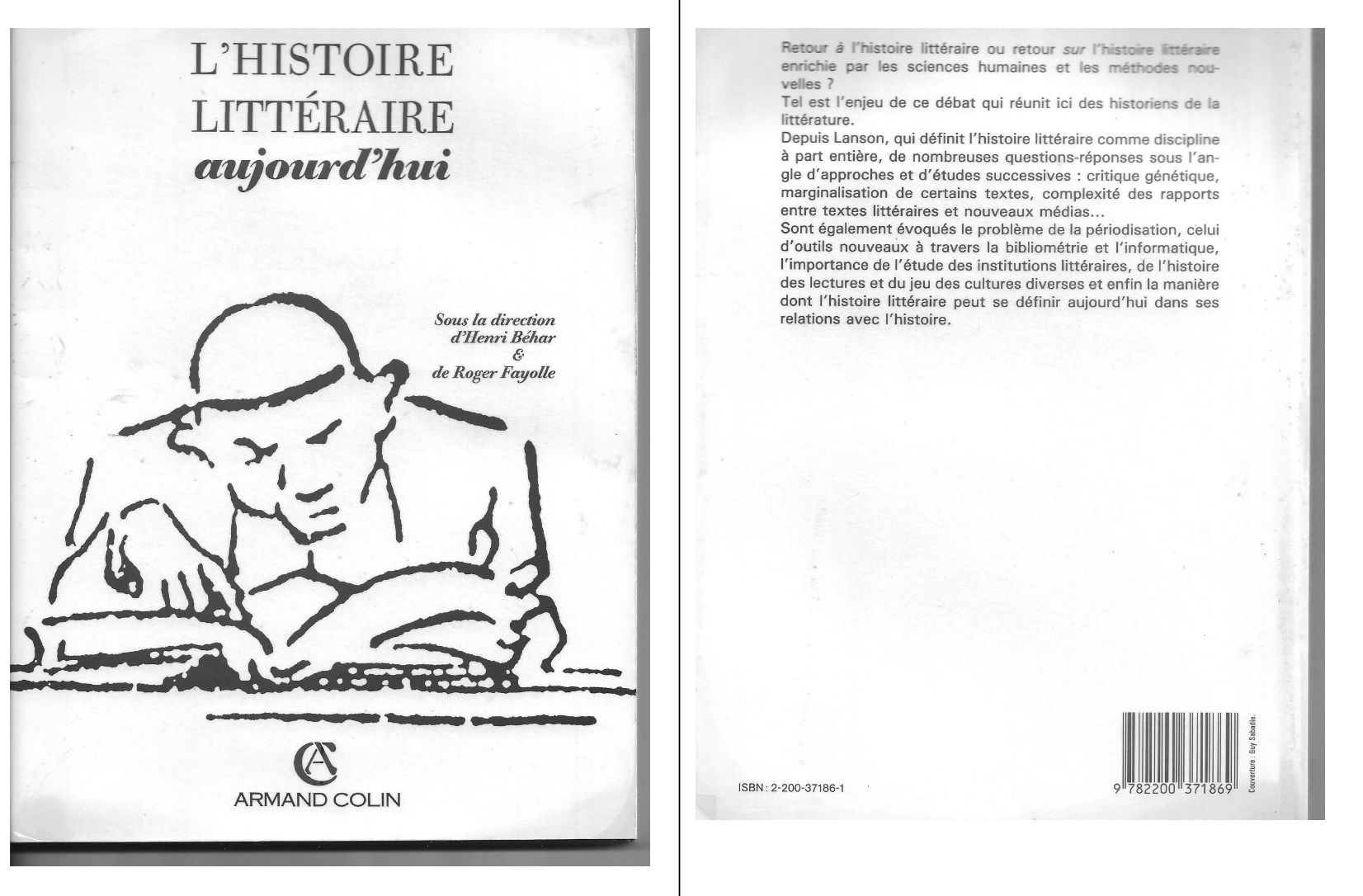
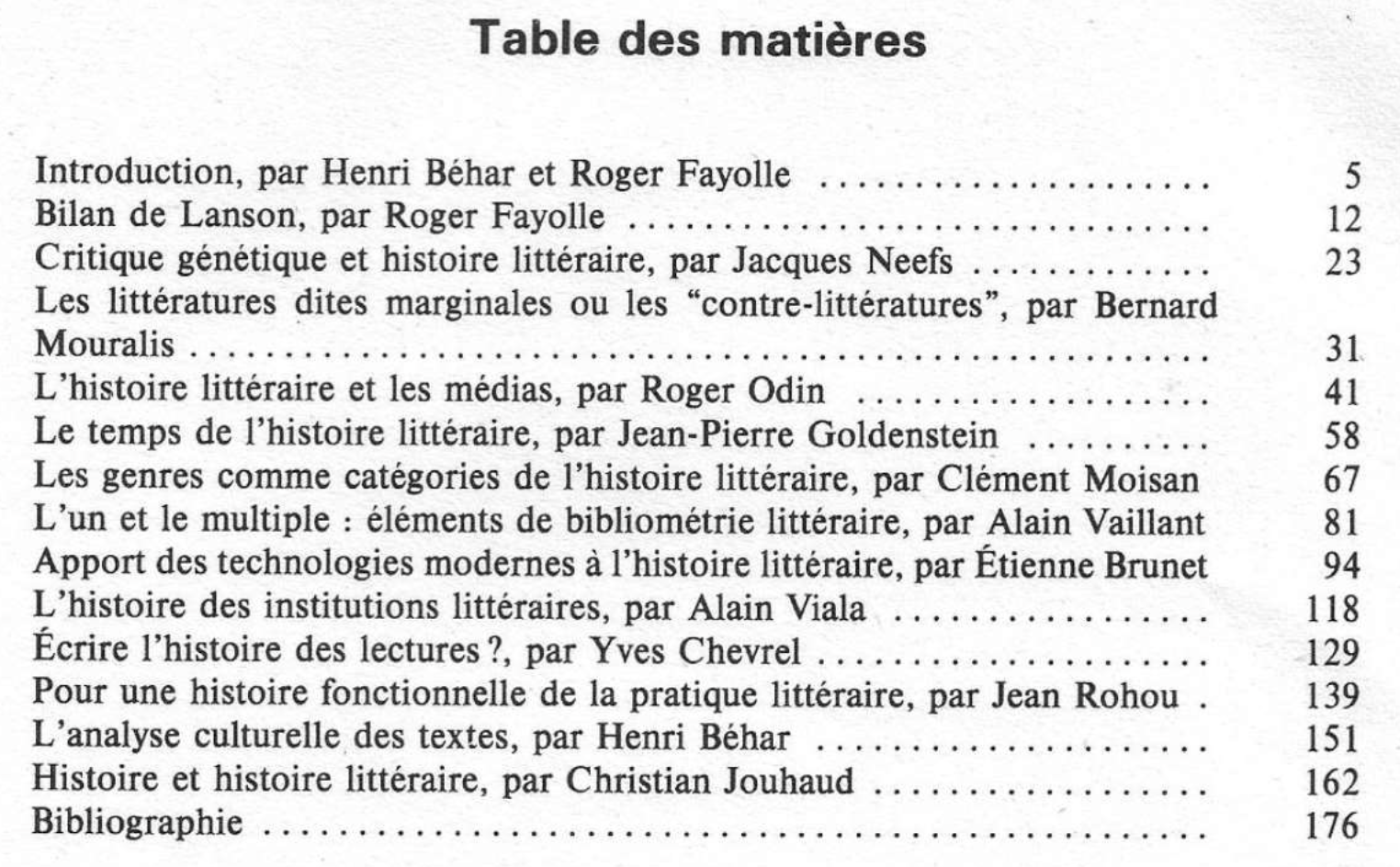
Literary History Today. Under the direction of BEHAR, Henri & FAYOLLE, Roger, Paris, Armand Colin, 1990; one vol. in-8, 187 p. - The volume brings together thirteen articles dealing from various angles with the problem of a possible return to literary history as a discipline in its own right, as Lanson had defined it, and, in all cases, of the status of literary history at the present time, in its relations with history on the one hand, and criticism on the other. The first three articles are of a recapitulative type: the "Lanson Assessment", signed R. Fayolle, proposes an overview of the career and concerns of the one who, according to the author of the article, far from being a theorist postulating an idealistic and abstract approach to literature, had above all pedagogical and political aims, showed a "perfect relativism" in methodological matters and was always concerned with taking into account the social scope of literary studies. In "Genetic Criticism and Literary History" Jacques Neefs presents a small "archaeology" of studies dealing with sources, influences and preliminary and final states of the published text, with, as support, concrete examples of works that have been the subject of genetic studies. Bernard Mouralis's approach, in "So-called Marginal Literatures or 'Counter-literatures', is essentially the same as that of Fayolle and Neefs, in that he also traces a diachronic trajectory: that of the authors of manuals and dictionaries of literature who gradually made room, alongside the "great Masters" and "masterpieces" of French literature, for so-called "minor" authors and genres, para-literary, or simply non-French Francophone. Then come three more analytical articles that problematize the status of literary history and its relations with other branches of the human sciences. Thus, Roger Odin ("Literary History and the Media") exposes, in a polemical and sometimes even provocative tone, the stakes for literary history of the entry onto the scene of audiovisual media and "new communication technologies". From his analysis, supported by an abundant bibliography, emerges the need to theorize, especially in France, the relationship between literary history and the history of societies, through, in this case, the consideration of what happens in the field of media. Jean-Pierre Goldenstein ("Time in Literary History"), for his part, questions the fundamentally positivist conception of a literary history modeled on the pattern of an "event-driven" history, "called into question for half a century already" and which, according to the author, gives us "these works centered on the individuality of a few great authors who succeed each other to found our literature". While recognizing the importance of chronology as a satisfying synthesis and organization tool, J.-P. Goldenstein insists on the absolute necessity of prior theorization so that this tool, debatable in itself, can provide "more structuring reference frameworks" instead of being considered as a scientific tool alone capable of opening the way to real knowledge of literary facts. In "Genres as Categories of Literary History" Clément Moisan examines and opposes the point of view of literary history and that of literary theory regarding the definition of genres. He then proposes a theoretical model of genre history based on the analysis of five components of the genre system likely to provide synchronic models which, in turn, would allow the establishment of a history of a genre, then, by comparison with other models of other genres, a History of literary genres. In the chapters that follow, each author outlines various perspectives, likely to contribute to the renewal and advancement of literary history today: Alain Vaillant ("The One and the Multiple: Elements of Literary Bibliometrics") proposes to show, by means of concrete examples (tables, curves and figures), that the statistical study of chronological series "can lead to substantial questions and knowledge": it can record the tension present in modern literature "between the production of texts and their communication" and, more generally, it poses "obstinately" the problem of literary creation. Etienne Brunet ("Contribution of Modern Technologies to Literary History") also preaches for the use of new technologies, and in particular computing, to quantify, not publishing but the evolution of literary trends from a dictionary of lexical frequencies. Alain Viala ("The History of Literary Institutions") considers that the study of literary institutions can make it possible to detect the variations undergone by the definition of the "literature" category and the relations of these variations with the making of works. Thus we arrive, according to A. Viala, at a questioning of the Lanson program (and this is the first of the authors of this volume who pronounces such a sentence!), namely "literary history at the service of explaining the great works of great authors" in favor of a study of the "permanent dialectic between works, mentalities and networks of values". Similarly, according to this perspective, the history of institutions would lead to a change in "the reference framework of periodization by centuries which was the corollary of the consecration effect". Finally, A. Viala postulates that literary history today must be at once interactive, global, social and also iconoclastic. Recapitulating the ideas of the Constance school on the aesthetics of reception, Yves Chevrel ("Writing the History of Readings?") first questions the possibility, validity and concrete conditions of realization of a history of readings. He reports on work carried out in France by "the comparatist school", and concludes by postulating that one of the main ambitions of a history of readings must be to contribute to a history of mentalities. In "For a Functional History of Literary Practice" Jean Rohou proposes a functional conception of literary practice, based on "a Freudian hypothesis inserted into a Marxist perspective". He operates a division into three types of literary practices: lyrical, dramatic and critical, according to the relationships between desire and reality that are established in the work, and postulates that such a division can serve to articulate a textual typology and to periodize history. Henri Béhar advocates a cultural analysis of texts ("For a Cultural Analysis of Texts") which, starting from texts, detects the implicit elements that the author has not specially designated because they constitute daily evidence in his eyes. The analyst fills "the holes in the fabric", situates the text in the cultural sphere and thus detects the reading stakes, the implicit rules, of the author-reader relationship. Taking up Bakhtinian terminology, Henri Béhar emphasizes that cultural analysis puts the chronotope of the text in consonance with that of the reader, being, ultimately, only "the introduction of the fourth dimension into the space of the text". Finally, in "History and Literary History", Christian Jouhaut evokes, through precise examples, the meeting points between history and literary history, to conclude that it is on the ground of social history that "renewed historical approaches to the specificity of literary productions" have recently been conceived. - Mónica ZAPATA.
Read: review by Zapata Mónica Revue belge de Philologie et d'Histoire, Year 1991, 69-3, pp. 655-657
See my contribution on this same site: "Cultural Analysis of Texts", Literary History Today, Armand Colin, 1990, pp.151-161.