“INQUISITIONS: SURRATIONALISM, POETRY, AND CURRENT EVENTS” IN: ANNE ROCHE AND CHRISTIAN TARTING, THE 1930s: GROUPS AND BREAKS, CNRS EDITIONS, 1985, PP. 225-236.
Anne Roche & Christian Tarting, The 1930s: Groups and Breaks: Proceedings of the Conference, Paris, 1985, CNRS Editions, 298 pages.
Chaulet-Achour, Christiane; Roche, Anne; Tarter, Christian; National Institute of the French Language (France). U.R.L. of Contemporary Literary Lexicology and Terminology; National Center for Scientific Research (France). Regional Publication Center of Meudon-Bellevue
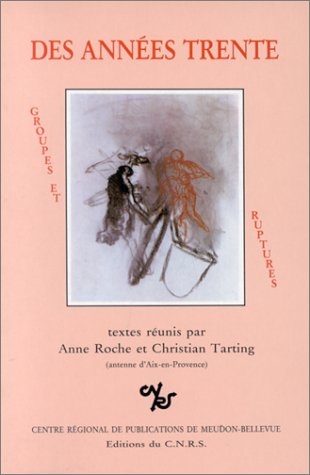
Below, I provide the table of contents of this volume, which recorded the proceedings of a conference organized at the University of Aix-en-Provence by a branch specially formed for the occasion from the research unit “Contemporary Literary Lexicology and Terminology” of the French Language Institute (INaLF), which I was supposed to direct. In fact, it was primarily intended to take stock of studies and research concerning the left-wing press in the 1930s. To add weight, a section on the centenary of the conquest of Algeria was included...
At the time, I was president of the University Paris III - Sorbonne Nouvelle, but I must say everything was organized without me to the extent that I only arrived the afternoon of the second day of the conference.
The proceedings were published through the efforts of Anne Roche and Danielle Bonnot-Lamotte, on behalf of our research team, officially housed in the CNRS premises in Meudon.
Since its publication, the work has been digitized by Numilog. This organization never sought authorization from the authors to sell its pale version on the Internet.
Proceedings of the conference organized by the branch of U.R.L. no. 5
at the University of Provence I, May 5-7, 1983
Number 7 of the collection “Publications of U.R.L. no. 5:
Lexicology and Contemporary Literary Terminologies”
National Institute of the French Language — C.N.R.S.
Authors: C. Achour — H. Béhar — J.M. Besnier — A. Blum — D. Bonnaud-Lamotte — M. Carassou — V. Couillard — D. Desanti — J.R. Henry — F. Henry-Lorcerie — G. Leroy — F. Marmande — C.
Table of Contents: WHERE DO RIGHT IDEAS COME FROM?
LEFT-WING JOURNALS’ DISCOURSE: OPENINGS
EUROPE: LITERARY PERSPECTIVES AND IDEOLOGICAL TENSIONS
Discussion – After A. Blum’s presentation
1933, A NORMATIVE YEAR? – (based on computerized corpora of Monde and the SA.S.D.L.R.)
1933: a key year
Monde in 1933
The S.A.S.D.L.R. in 1933
Lexicon and normative statement – Tentative delimitation of a lexical field
Methodological difficulties: the example of normative lexicon in Monde
Theoretical difficulty: the definition of the normative statement
Monde: two norms for two referents
Plunging into reality and making one’s own revolution
A disoriginated and nuanced normativity
Is ideological struggle behind history?
A farewell to the past
The S.A.S.D.L.R.: normative statement and referents – a different enunciation situation
Referent 1: proletarian literature
Referent 2: the revolutionary writer
Referent 3: surrealism
Referent 4: poetry in action, specificity of the year thirty-three Annex I
Annex II Discussion
ANTIFASCISTS AND PACIFISTS: THE ANTIFASCIST INTELLECTUALS’ VIGILANCE COMMITTEE
TESTIMONY OF MR. FRANÇOIS WALTER
Intervention of Mr. François Walter
THE CENTENARY OF THE CONQUEST OF ALGERIA
BREAK IN DISCURSIVE COHERENCE: The cultural grid of the colonized
Food… an assimilated gastronomy
Words… the language of stereotype
Marvelous and trades… a folklorized cultural production
Customs and magic… labeling of specificity
A literature on alert
A significant geographic space
A social space
Symbolic violence
THE CENTENARY OF THE “CONQUEST” OF ALGERIA – The acrimonious recognition of Joseph Desparmet
Ambiguity is inscribed in Desparmet’s very position:
Reference texts
THE CENTENARY OF THE “CONQUEST” OF ALGERIA – completion of a colonial combat literature
The Centenary of the Conquest of Algeria is an original phenomenon in many respects
The Centenary, fulfillment of the “Algerianist” movement
The partial sterilization, due to the success of the Centenary, of Algerianist literature finally favors the emergence of new literary products, more revealing of the changes in colonial Algeria
Discussion – After presentations by C. Achour, S. Rezzoug, A. Raybaud, J.R. Henry, and F. Henry-Lorcerie
THE RIGHT WING: EVOLUTION AND REALIGNMENTS
THE REVUE COMBAT (1936–1939)
Discussion – After G. Leroy’s presentation
ARAGON AND DRIEU – when one is the hero of the other’s novel
Dreamy bourgeoisie
Nobody’s son
Encounters
Discussion – After D. Desanti’s communication
THE FRENCH INTELLECTUALS – and the “Munich spirit”
Download the PDF of my presentation
Conscious that readers were unable to form an accurate idea of the contents of this sole issue of the journal, given that it had become inaccessible, I was relentless in my efforts to have it republished—not only through specialized publishers such as Jean-Michel Place or Les Éditeurs Français Réunis, but also via a national institution. Eight years after the conference, a CNRS commission approved the publication of the volume I presented in facsimile, enhanced with unpublished materials and a preface naturally reprising the terms of the introduction and discussion from Aix:
Henri Béhar, Inquisitions. From Surrealism to the Popular Front, CNRS éditions, 1990, 184 pages. Printed in 1,000 copies, it is now as out of print as the original[1][2][5]. This is why I reproduce here my original preface:
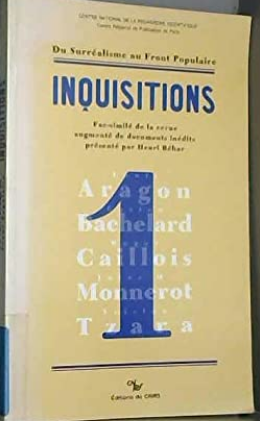
Inquisitions, Preface
The single issue of Inquisitions appeared in June 1936. It was fortunate to have been printed despite the strikes and factory occupations that began on May 26, ahead of the formation of the cabinet presided over by Léon Blum, on June 4.
Had the release of the journal been delayed for such reasons, which of its editors would have objected? None, since they all deeply felt they were working toward the establishment of the Popular Front, just as the strikers sought to strengthen the electoral victory of May 5 by wrestling substantial concessions from employers. Indeed, the Blum administration would soon be busy: immediately after the Matignon Agreements (June 7), it pushed through, in quick succession on June 11 and 12, laws on collective agreements, paid holidays, and the 40-hour work week.
A new era was beginning. The contributors to Inquisitions should have experienced it together—perhaps even helped shape its direction. They would have applauded the dissolution of the factious leagues (June 18); fiercely debated the nature of the support that, quite naturally to them, should have been extended to the legally-established government of Republican Spain, itself buoyed by another Popular Front. Although not especially versed in economic theory, the "Human Phenomenology Study Group" they constituted could have spoken out on the reform of the Bank of France (July 24), the devaluation of the franc (September 27)...
To maintain their cohesion, they would have written nothing about the Moscow Trials, the execution of Kamenev and Zinoviev (August 25), but they would not have stopped thinking about them, just as the official policy of non-intervention in Spain prompted individual reactions, given that the group had dispersed—foreshadowing, in its own modest way, what would later happen to the government born of the Popular Gathering, using the electoral terminology of the era.
Suppose they had limited themselves to more literary debates—what would they not have written about Gide’s Return from the USSR, Bernanos’s Diary of a Country Priest, Céline’s Death on Credit, Louis Guilloux’s Black Blood, Michaux’s Voyage in the Great Garabagne, Fondane’s La Conscience malheureuse, Montherlant’s The Young Girls, and Les Beaux quartiers by one of their own, Aragon, who would go on to receive the Prix Renaudot (while the Goncourt was awarded to Maxence Van der Meersch's L’empreinte de Dieu)? In fact, they did write on these, but elsewhere, in Europe, Commune, La Nouvelle Revue Française, or Cahiers du Sud, from which I have compiled this list of works by examining the reviews of July to October.
I evoke an improbable future, yet have not even mentioned the past and present of this review of which you now hold the facsimile in your hands. For it did not fall from the press by mere chance—no more than the Blum government emerged suddenly from the ballots! To reach such immense hope required lengthy discussions, debates, and even struggles: for socialists and communists to join hands in Place de la Nation on 12 February 1934, to the united cry of "Unity" from the crowd; for the founding (March 5, 1934) of the Committee of Vigilance of Anti-Fascist Intellectuals (C.V.I.A.) at the call of Rivet, Langevin, and Alain, in other words a socialist, a fellow-traveler of the Communist Party, a radical; and for the historic agreement (July 14, 1935) between the three parties that formed the Popular Front, with the support of union organizations, rallying "all forces determined to defend liberty against the threat of fascism." From there, an electoral platform was drawn up, serving as a reference for deputy candidates, that allowed them to triumph ten months later.
It is against this background of left-wing unity that the birth of the Human Phenomenology Study Group in October 1935 must be understood—a group intent on giving ideological substance to the Popular Front’s cultural policy by bringing together intellectuals from various backgrounds, steering away from well-trodden paths, and publishing a new journal—Inquisitions, its title to be understood in the sense of "inquiries" or "investigations." Still, the reflections of intellectuals within the Popular Front orbit cannot be understood without considering a particular factor: the relationship that the surrealists maintained with the Communist Party, to which five members (Aragon, Breton, Éluard, Péret, Unik) had joined openly in 1927, only for their leading figures, André Breton and Paul Éluard, to be expelled in 1933 from the A.E.A.R. (Association of Revolutionary Writers and Artists, founded by Paul Vaillant-Couturier in March 1932).
It is well known what disarray the signing of the Franco-Soviet pact of May 2, 1935 caused among them—and, above all, the grief and anger that overtook them when they were, in effect, excluded from the International Congress for the Defense of Culture in June 1935, following an entirely anecdotal incident (the "correction" administered by André Breton to Ilya Ehrenburg, author of Seen by a Soviet Writer, who called the surrealists idlers and sexual perverts). In an August 1935 pamphlet, "When the Surrealists Were Right," Breton recalled the movement’s aims regarding a culture that interested them "only in its 'becoming,' and this becoming itself first necessitates the transformation of society through proletarian revolution. They called, in particular, for the Congress to include the following agenda items: the right to pursue—in literature as in art—the exploration of new expressive means, and the right for writers and artists to continue deepening the human problem in all its forms..."[7].
Despite the active role played by René Crevel (whose suicide would shake them further), everything was done to stifle the impact of their declarations. Hence Breton’s final statement on Soviet Russia and Stalin: "This regime, this leader, we can only formally express our distrust toward them"[7].
Thus, most members of the surrealist group could only sever the last bonds tying them to what they had always considered the only party of the working class. Yet in the face of rising fascisms, they had to take a stand as revolutionary intellectuals and artists, if not in well-funded art magazines like Minotaure and Cahiers d’Art. Hence the short-lived, ambiguous, and contradictory attempt of the "Contre-Attaque" group led by Bataille and Breton from autumn 1935 to spring 1936—that is, until it was denounced by the surrealists for its "super-fascist" tendencies. See Robert Stuart Short, "Contre-attaque," in Entretiens sur le surréalisme, ed. F. Alquié, Paris, Mouton, 1968, pp. 144–176; José Pierre, Tracts surréalistes; Henri Dubief, "Testimony on Contre-Attaque (1935–1936)," in Textures no. 6, 1970. Or, on the other hand, the group around La Critique sociale (1931–1934) gathered by Souvarine, which included former surrealists Jacques Baron, Michel Leiris, Raymond Queneau among opposition communists; after the journal disappeared, their collaboration with Georges Bataille led to the publication of Acéphale and, later, the Collège de Sociologie, whose essential texts have been collected.
As for the rest—including notable names from contemporary journals, especially the NRF and Cahiers du Sud (Jean Audard, René Bertelé, Raymond Charmet, André Chastel, Luc Decaunes, Étiemble, etc.), perhaps attending out of friendship for certain speakers—all indications are that they were already aware of the debate of ideas stirred up by surrealism and the limits that the youngest, Caillois (just 23), and the oldest, Tzara (already considered an 'elder' at forty), found in it. But, except for Luc Decaunes, the youthful leader of Soutes, none joined the Communist Party. Were it not for the group’s small size and brief lifespan, I would say it was, for all that, rather representative of the Popular Front’s drive for unity. An analysis of its publication contents will confirm this.
Having gathered a few companions and long debated topical themes, they then needed to find a way to communicate what united them. Hence the idea for this journal, Inquisitions, so named by Caillois, thinking of the word’s etymological sense—inquiry, quest—in the plural to avoid confusion with the ecclesiastical tribunal. Tzara would serve as editor-in-chief, Monnerot as business manager, and leadership was collectively entrusted to Aragon, Caillois, Monnerot, and Tzara; administration was provided by Les Éditions Sociales Internationales (explaining Aragon’s presence). Caillois drafted a prospectus outlining the group’s declared aims and underscoring the journal’s originality as the organ of a study group (see this document p. 113). From manuscripts and typescripts preserved by Tzara (now held at the Jacques Doucet Literary Library), it is clear that each contributor strove to prepare summaries of the discussions after exchanges with respondents... In other words, the ultimate direction of the journal may have determined both its end and that of the group behind it. Indeed, the group had not met since March 1936; each member was taken up either with the electoral campaign or, in the case of Caillois, preparing for the competitive teaching exam (which he passed that same year). As a result, the very first literary review to be born of the Popular Front—and in its spirit—seems to me to have also been its first casualty. There were simply too many immediate demands from all sides to consider continuing such an experiment. The range of opinions among group members, their independence from the Communist Party, the party’s fluctuating policy toward intellectuals, and their own involvement in the Spanish Civil War all help explain (if not justify) the end of the journal—no doubt for economic reasons as well. Indeed, its publisher, Les Éditions Sociales Internationales, was also funding Commune and, indirectly, Europe, for which Aragon had just paid 20,000 francs. Succeeding Jean Guéhenno, Jean Cassou—a member of the cabinet of Education Minister Jean Zay and a Radical-Socialist—had become its editor-in-chief, heading a twelve-writer committee. Given such circumstances, was it necessary to maintain at all costs a laboratory journal when others, better established, could carry similar discussions to a broader, more popular audience? Whatever the reasons for its disappearance, the fact remains that Inquisitions provided an example of a journal of debate and intellectual struggle—necessary in that period, as the immediate reports show (see Dossier p. 163)—bringing together young people concerned with freedom and social justice. In revisiting some of the themes advocated by the Popular Front, they aspired to move forward. Their failure is equally that of the great movement that brought them together, in its attempt to reconcile surrealist inquiry and Marxist ideology as those parties interpreted it at the time[7][1].
André Breton: “When the Surrealists Were Right,” in Surrealist Tracts and Collective Declarations 1922–1939, introduction and commentary by José Pierre, Paris, Le Terrain Vague, 1980, p. 274.
André Breton: ibid., p. 281.
See Robert Stuart Short: “Contre-attaque,” in Interviews on Surrealism, edited by F. Alquié, Paris, Mouton, 1968, pp. 144–176; José Pierre: Surrealist Tracts, op. cit., pp. 281–301; Henri Dubief: “Testimony on Contre-Attaque (1935–1936),” in Textures no. 6, 1970.
See: Denis Hollier: The College of Sociology (1937–1939), texts by Bataille, Caillois, Guastalla, Klossowski, Kojève, Leiris, Lewitzky, Mayer, Paulhan, Wahl, etc., Paris, Idées/Gallimard, 1979, 399 pages.
Cf. Tristan Tzara, infra, p. [65].
This article, reprinted in Inquisitions, pp. 6–14, constitutes the conclusion of: Roger Caillois: Myth and Man, Gallimard, Les Essais VI, 1938, “For a Unitary Activity of the Mind,” pp. 209–222.
Roger Caillois: Approaches to the Imaginary, Gallimard, 1974. In it he recounts his disagreement with Breton regarding Mexican jumping beans: the former wanting to dissect them to find what moved them, the latter wanting explanatory solutions proposed before such dissection.
Tristan Tzara: Complete Works, Paris, Flammarion, vol. V, 1982, pp. 258–259.
Roger Caillois notes: “Myth of Man” opens with an article “For a Militant Orthodoxy” that I had first published in the first—and incidentally only—issue of the journal Inquisitions. “Inquisitions Orthodoxy” (even in the plural) were not terms chosen at random and I struggled to have the latter accepted as the publication’s title by its three other directors. Approaches to the Imaginary, Gallimard, 1974, p. 57.
Roger Caillois: Approaches to the Imaginary, p. 57.
See: Aragon: The Poetic Work, vol. VII, 1936–1937, Livre Club Diderot, 1977, p. 169.
Roger Caillois: Approaches to the Imaginary, op. cit., p. 58.
Paulhan Notebooks, vol. 6, correspondence Jean Paulhan – Roger Caillois, 1934–1967. Edition established and annotated by Odile Felgine and Claude-Pierre Pércz, Gallimard (to be published in 1991).
However, it continued under a barely modified form but with other participants at the College of Sociology.