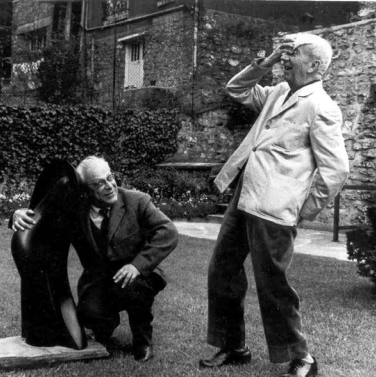
"A STELLAR FRIENDSHIP: ARP AND TZARA IN THEIR STUDIO", IN ARP IN HIS ART AND WRITING STUDIOS, PROCEEDINGS OF THE STRASBOURG COLLOQUIUM, PUBLISHED BY AIMÉE BLEIKASTEN, STRASBOURG MUSEUMS, 2011, P. 218-232.
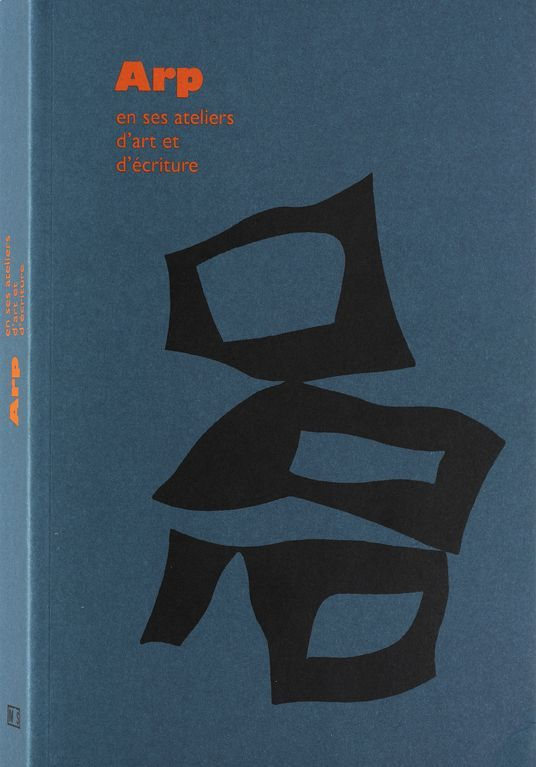
If Hans Arp's reliefs, collages and sculptures occupy an undisputed place in the history of avant-gardes, one sometimes neglects the indissoluble link that the artist has woven throughout his life between his literary work and his plastic work.
The work thus addresses these two aspects, seeking to reveal similarities in the creative processes. It also emphasizes his collaborations with Sophie Taeuber-Arp but also Tristan Tzara, Hugo Ball, Theo Van Doesburg, Sonia Delaunay... The catalog also proposes various transversal approaches, as well as testimonies from contemporary artists on their filiation with the Arpian work.
Under the direction of Aimée Bleikasten and Maryse StaiberAssociation Jean Hans Arp
"This is a very beautiful success that this volume which combines the fruits of an exhibition at the Museum of Modern and Contemporary Art of Strasbourg and the results of the Colloquium held at the "reunified" University of the Alsatian capital in 2009. The long research work on Arp that she conducted on the sculptor-poet, finally recognized in his city (as she likes to emphasize in her Foreword), has made Aimée Bleikasten the specialist of an artist of multifaceted and original talent who has become one of the exemplary figures of modernity, on both sides of the Rhine, in both languages, but also across the Atlantic. She extends here her contribution to the knowledge of Arp, whom she has moreover translated, by grouping, around her projects (all specialists have in memory the days of 1986 on "Arp, poet, plastic artist"), museum curators, art historians and aestheticians, Germanist poets, philosophers... She thus makes a multitude of lights cross on a work that remains current in its verbal and plastic apprehension of the modern world.
The contributions (23 in all) are grouped into 5 sections. If the first ("Arp in his country") acquits itself of the (justified!) reverence due to the genius loci, the others, in accordance with what the chosen title excellently announces, penetrate deeply into the work, its genesis (which joins the question of the "original ground" – Urgrund –, which is also found in Schopenhauer about music as it is already present among the pre-Socratics), its "factory", to take up this time the term used by another capital modern, Carl Einstein. See the two great notions around which the book is structured: those of "work" ("writing work", "work in common") and "studio" ("studio fables", "art studios"). Vision and recreation are claimed as labors involving the concrete, this material whose use, sensual and plastic, also makes one think of what Max Ernst experiments on his side, in Ardèche, in Touraine or in the United States. Contrary to what contemporary art sometimes offers us to see, Arp's works culminate neither in accumulation or waste, nor in the assembly of ready-made objects opposed, since Duchamp, to formal elaboration that opens to new meanings. In this regard, Bäbel Reetz's study ("Dada was not a farce", p. 233-247) circumscribes well the essence of what was attempted and that one can also try to integrate into a "cosmology". The book itself aims at the realization of form: the two articles on which it closes return, in complement to the opening, on "the decors of the Aubette in Strasbourg" and "the Strasbourg studios and construction sites" conceived and executed under the common aegis of Arp and Sophie Taeuber. In fine, a short bibliography of Arpian writings (p. 290-291) gives the list of publications and translations in French. In sum, a work that fully inserts itself into one of the major, current and future paths of French Germanistics: the alliance of literature and arts.
— J.-M. VALENTIN
Download the PDF of the article