"THE DADA PARENTHESIS", EUROPE, ARAGON POET, NO. 745, MAY 1991, PP. 34-44.
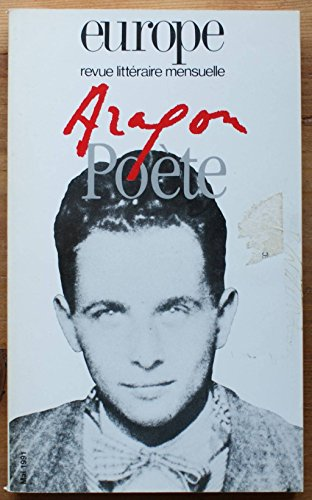
Dossier Contents:
– Charles Dobzynski Aragon, a poetics of totality p. 3 – Lionel Ray Prose for a portrait p. 16 – Jacques Gaucheron The man traversed by his song p. 19 – Henri Béhar The dada parenthesis p. 34 – Michel Apel-Muller Elsa in the text p. 45 – Bernard Delvaille "Tear out my heart you will see Paris" p. 54 – Noël Martine Contradiction and unity in Aragon's poetics p. 63 – Henri Meschonnic Tradéridéra like no one p. 74 – Lucien/Suzanne Victor/Ravis On the three "proses" of the Unfinished Novel p. 80 – Marie-Noëlle Wucher On the influence of a legend p. 91 – Charles Haroche Language and styles in Elsa's Madman p. 97 – Wolfgang Babilas From an enclave p. 103 – Roger Bordier The inevitable rendezvous p. 112 – Lucien Scheler The guest of the fourth winter p. 118 – Marko Ristíc Aragon's mirror p. 129 – Edouard Ruiz Chronological markers p. 132
Text reprinted in the Dossier H, Dada Circuit Total, L'Age d'Homme, 2005, pp. 287-295.
See in addition:
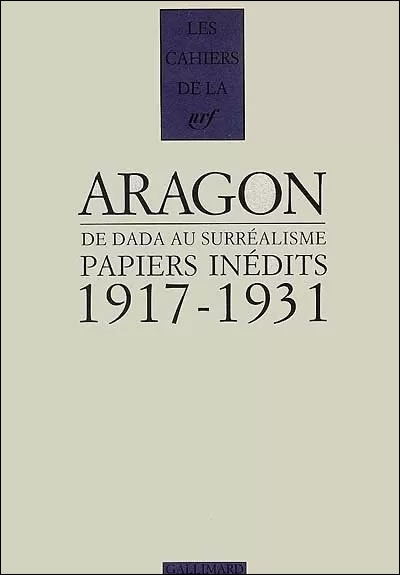
Aragon, From Dada to Surrealism, Unpublished Papers 1917-1931 Edition established and annotated by Lionel Follet and Édouard Ruiz (Gallimard, Paris, 2000, 429 p.) The unpublished works 1917-1931 of Aragon constitute an exceptional document in many respects. Notably the correspondence with Jacques Doucet (fifty-seven letters written from April 1922 to February 1927, it's the first hundred pages that open the volume) brings new and spectacular light on a less studied aspect of collectors' culture: their relationships with advisors, protégés, secretaries, employees, scouts and other factotums without whom their collection would not exist.
The very wealthy couturier Jacques Doucet (1853-1929) is indeed an amateur in whom the functions of collector and patron are mixed to the point of becoming totally inseparable. When he addresses André Breton, then Louis Aragon to help him acquire a contemporary library, one doesn't quite know which of the two visions prevails. Doucet counts on the two young authors to extend his traditional bookstore to literature in the making (books, manuscripts, but also testimonies, objects, studies on cutting-edge writing). However, one may wonder if the (modest) monthly payment of writers is not above all a form of patronage, the aid granted to authors cannot be considered as investments. Literature feeds neither its man nor its sponsors. Compared to the (meager) services that more than one renders to the collector in the field of painting (Breton thus receives a commission on the price of works that he manages to have bought by Doucet), one is entitled to wonder where the (paid) consultation stops and where patronage begins (magnanimous or still interested, but how, and why?).
The Aragon-Doucet correspondence amply reminds us: the relationships between collector and advisor were difficult, quickly proved tense, even impossible. The reasons for this misunderstanding were multiple – and manifest from the beginning. Between the great bourgeois and the young rebel the dispute was inevitable. And money was there to complicate everything: Aragon despised his employer, he did not hide from saying so, to Doucet himself as to others, who will repeat it in turn to many people. At the same time, the great socialite that Aragon is has a cruel need for money, hence many concessions and volte-faces, no less cynical than sincere, always ready to retract in one direction as in the other. To this is added another difference, even more vicious. Not only is Doucet rich, and guilty of being so, where Aragon is destitute, and furious at his indigence, but the couturier is also, always in the eyes of his employee, of rare stupidity (and of a curiosity that is at least unhealthy), while the one who has horror of living as a slave (fascinated) is certainly one of the most acute connoisseurs of all avant-garde creation. Social, political, ideological inequality is therefore also artistic and sensitivity inequality. For the writer, the collector is foolish – but still not to the point of being mistaken about those he invites to work for him.
Unpublished Papers 1917-1931. From Dada to Surrealism is a publication that shakes many ideas about the supposedly affable and cushioned world of great collectors. The book is a mine of information about the conflicts of which the collecting microcosm is the theater. These rivalries concern not only relationships with the tax authorities, family or other collectors, these eternal competitors, but also professional relationships, from employer to employee, that the pursuit of a real collection gives rise to.
The Aragon-Doucet correspondence exhibits in broad daylight that a private collector, often secret, is first of all a "network-actor". One never collects alone and the plural is anything but the mechanical multiplication of the singular. Advisors can be accomplices, and that's all the better, but it also happens that they are ungrateful, jealous, why not odious. Sometimes they even bite the hand that feeds them. The Doucet-Aragon meeting was not the beginning of an announced quarrel, it was the beginning of a real tragedy, with an inevitable denouement, without possible catharsis. It's up to us to draw the conclusions.
Jan Bætens
See original documents in The International Dada Archive
Consult the site Louis Aragon Online