"BRETON AJAMAIS", HISTOIRES LITTÉRAIRES, ANDRÉ BRETON DOSSIER, N° 53, 2013, PP. 3-4.
Having composed this dossier devoted to André Breton, I give below the introduction, preceded by an original photo provided by the journal.
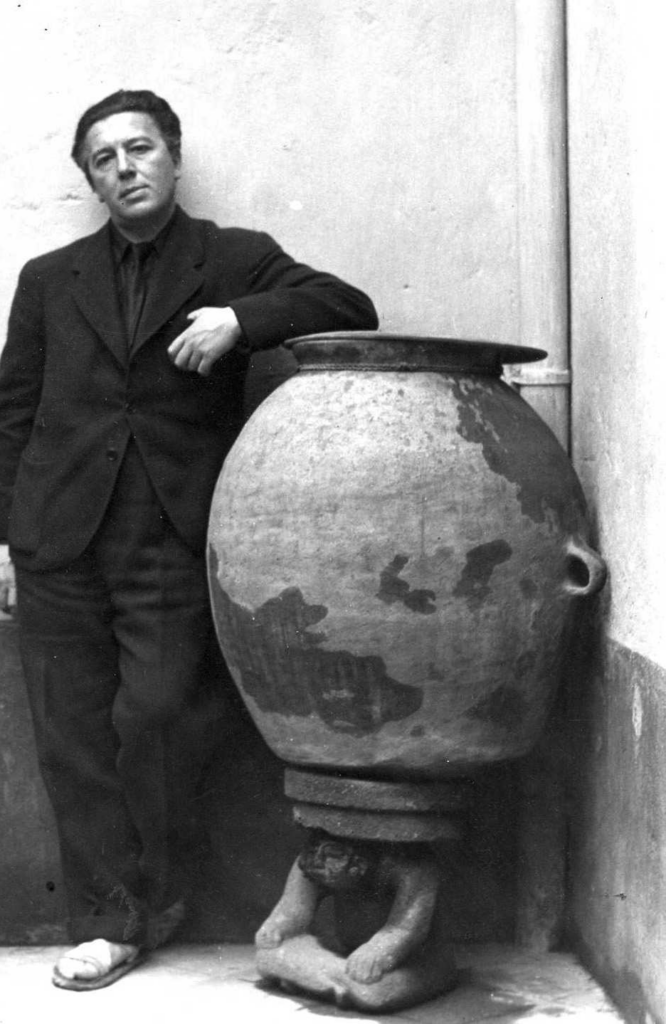
Here is Breton forever, Breton Ajamais, as Aragon prophetically nicknamed him in Anicet ou le Panorama, drawing a complex portrait of him, of a destiny that is at least ambiguous. Georges Sebbag shows or rather demonstrates that, from the start, the Aragon-Breton duo built a veritable philosophical project, thus inaugurating a surrealist revolution of the mind. Disturbing are the borrowings from Kant's starry sky, from Schelling's point of indifference but also from the immaterialist and nominalist George Berkeley (1). What makes literary history retain an immediate memory of certain authors? What leads it, that formidable tribunal, to consign them to oblivion, only to resurrect them a few decades later? Many instances intervene in this process of pantheonization, including for those who, in their lifetime, would have been offended by it, wanting to owe nothing to anyone. The fact is that André Breton did not know the traditional purgatory that follows very closely the disappearance of writers. The group of his young friends whom he had made orphans, in a certain way, worked to make him present before the community, while, for her part, his wife Elisa maintained his apartment as a veritable living museum. In execution of his will, and by a remarkable revolution (in the astronomical sense of the term) toward his youth, the Jacques-Doucet Literary Library received his correspondence, preserved despite the vicissitudes of life. The publication of his Complete Works in that other institution of literature that the Bibliothèque de la Pléiade has become gave to read the totality of his writings, bringing to light many unpublished works or scattered elements of his interventions in the century, while contextualizing them. Thunderclap in the silence of libraries, in 2003, the Breton Sale, as the dealers of rue Drouot liked to say, came to offer the public the unsuspected treasure of his collection or, better, of his cabinet of curiosities. We haven't finished talking about it, and the discussion continues on the Web. Starting from the immense documentation suddenly offered to amateurs, we wished, by gathering this dossier, to show the reader another Breton, such as he could not imagine him through the glasses of bad glaziers. Returning to the source, that is to say to the psychiatric training of the young conscript, Alain Chevrier shows what, from a scientific discipline, passed to the game and to the founding coherence of the surrealist group. Following in Chevrier's footsteps, Julien Bogousslavsky and his colleagues draw the portrait of Joseph Babinski, that pioneer of neurology, so little forgotten that a new pavilion of beautiful dimensions bears his name at the Salpêtrière. He strongly impressed Breton, who however was only his extern for the month of August 1917 at most. Surprised by the frequency of press clippings relating to real news stories, glued to the fake collections that Breton was building up, I, for my part, tried to establish the link that, from an exit from oneself, leads to a moral vision of society. From crushed dogs to man's best companion, there is only one step, gracefully accomplished by a young researcher, Christina Rudosky, who had the privilege of working on the André Breton site and was able to establish the path leading from one image to another up to a generalized aesthetics. "Love first. There will always be time afterwards to question what one loves," prescribed Breton. So be it, but what led him to turn toward the other and, most often, to privilege the foreigner, against the dominant tendency of the time? Breton xenophile, that is what Jean-Claude Blachère, tireless admirer of totems, was able to point out with remarkable effectiveness. It is an identical approach that pushes Elza Adamowicz to try to define, not the gaze but the eye of one who was more than an amateur of painting, a veritable art critic, disciple of Baudelaire and especially of Apollinaire. Having entered very young into the group of Breton's friends, it seems that Jean-Pierre Lassalle never came out of it. He tells us, with the maximum objectivity of which a witness-actor is capable, how Breton held himself there, less as a Commander than as a perpetual player. According to Aragon, Baptiste Ajamais "composed gallant verses and marveled at introducing the word chignon into poetry." Whatever one thinks of the computer tools made available to the public today, there is one thing that cannot be denied them: it is the fact that they serve to detect as well the frequency of certain words as their total absence. Having digitized Breton's works for my own account, I can certify that he never uses the word chignon in poetry! Going further in this direction, Michel Bernard, similar to "the man who noted absences," opens unsuspected doors that open onto the wide. Participating in the same spirit, Penelope today watching over the good functioning of the André Breton site by feeding it with new data every day, Constance Krebs testifies to the fact that this author is already on another planet, entirely virtual, devolving toward the fourth dimension.
- For more clarification, see: Potence avec paratonnerre. Surréalisme et philosophie by Georges Sebbag