THE UNKNOWNS OF SURREALISM
par Émilie Frémond
November 25, 2015
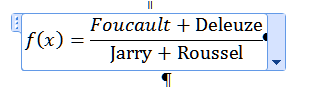
On: Georges Sebbag, Foucault Deleuze. New Impressions of Surrealism, Hermann, Philosophy collection, 318 pages.
We are well aware of all that we owe to Georges Sebbag, the tireless defender of surrealism, witness and participant in the movement’s final years who, while pursuing a career as a philosophy professor, managed both to preserve the memory of the movement and weave his own web around it. He is responsible for making accessible the archives of dreams, the records of surrealist game sessions, the content of the famous surveys (on suicide, the decisive encounter, desire, etc.), but also for meticulously tracing the trajectory of surrealist publishing and editing the correspondence of Jacques Vaché[i] — in other words, fulfilling a role of preserving and disseminating the documents that constitute surrealism’s history and allow its study to be continued or revisited. Yet beyond simply playing the role of curator or archivist of surrealist memory, Georges Sebbag has published since 1972 a series of essays developing a personal philosophy, the various “concepts” of which can be found on the author’s website[ii] — a philosophy that is shaped more or less closely through a rereading of surrealism.
This new essay, far from introducing a rupture, by juxtaposing, as it does, the names of two authorities of postmodern philosophy, operates rather as a genuine reappropriation of its author’s critical thought, which here applies reflections developed in the vicinity of surrealism, fueled by several exhibitions[iii]. From Le Temps sans fil (Wireless Time), published in 1984, through Microdurations. Atomized Time, and including L’imprononçable jour de ma naissance (The Unpronounceable Day of My Birth) where, based on a tragic fact (Breton writing to Jacques Vaché without yet knowing he was dead), a meditation on chance was elaborated, as well as texts on dreams, on Grandville’s philosophy of disguise, and on the surrealist object, each of these elements is reinvested within an eclectic and vast trajectory whose title Foucault Deleuze, as well as the subtitle — New Impressions of Surrealism — do not fully reveal its scope. If the essayist’s primary aim is indeed to trace back the course of time to reveal a little-known filiation between Foucault, Deleuze, and the surrealists, the demonstration actually encompasses a much broader spectrum — Grandville, Brisset, Roussel, Jarry, Nietzsche, Vaché, Rigaut, Breton, Aragon, Heidegger, Foucault, and Deleuze — through a series of coincidences and analogies that progressively transform the genealogical tree into a truly Deleuzian rhizome.
The previous work (Potence avec paratonnerre, Surrealism and Philosophy), published in 2012 in the same collection, had already announced that the present “work, centered on the interwar period, might have a sequel in which Salvador Dali, Georges Bataille, Ferdinand Alquié, Jacques Lacan, Gilles Deleuze and Michel Foucault would notably be invoked,” yet at this vast family reunion we are given to witness, in the purest surrealist tradition: analogical drive, kinships and hybridizations that defy chronology and the play of one within the other. With these New Impressions of Surrealism, it is somewhat as if the 2015 reader discovered the imaginary, updated, and completed notices of an Anthology of Black Humor still ongoing.
Literature and Philosophy: Communicating Vessels
Published in Hermann’s “Philosophy” collection, this Foucault Deleuze first recalls by its title some famous couples of philosophers whose kinship has long been fixed: Voltaire and Rousseau, Diderot and d’Alembert, Marx and Engels. The absence of a connective (even a hyphen) between the two men’s names produces an effect of confusion, perhaps discreetly reminding that Deleuze is the author of a Foucault (Éditions de Minuit, 1986), and that the two philosophers constantly engaged in mutual cross-references. No one, in any case, will be surprised to see highlighted within a philosophy collection the most media-savvy duo of philosophy, a duo that came to dominate the scene just as the surrealist group dissolved, in the late 1960s and early 1970s. The next generation, in sum. The subtitle is more surprising and introduces a stowaway who will not remain long hidden for those who might not have recognized behind these New Impressions of Surrealism the New Impressions of Africa by Raymond Roussel. Three tutelary authorities, therefore, three men: Foucault, Deleuze, Roussel, from whom Georges Sebbag proposes a crossed history of surrealism and the philosophy that succeeded it, in reaction against their common enemy: existentialism.
The ambition of this essay is nothing less than to reunite literature and philosophy. By tracing two successive trajectories backward in time— from Diderot up to the interwar period, the heyday of surrealism, and from the postwar era up to the 1980s — G. Sebbag aims to show what two major philosophers of the latter half of the twentieth century, both concerned with the question of language and the specific stakes of literature, owe to the Surrealist Revolution, proceeding through an inventory of motifs borrowed, concealed, transformed, or assimilated.
Across the fourteen chapters composing the essay — fourteen autonomous chapters, some monographic[iv], whose initial objective may sometimes become unclear but which gradually appear as different stages of an argument whose threads eventually intertwine [v] — Georges Sebbag reconstructs for us secret genealogies, proceeding much like Breton when he annexed to nascent Surrealism, starting from the Manifesto, a series of surrealists in advance[vi], before repeating the gesture in the Anthology of Black Humor and the Brief Dictionary of Surrealism by literally assimilating a number of chosen authors. Yet Georges Sebbag annexes no ancestor to Surrealism who has not received the assent of the family patriarchs — Roussel, Jarry, Brisset, and Grandville are celebrated by Breton, Leiris, or Ernst — but he invites us to consider on the same level Foucault, Deleuze, and the surrealists, as so many “elective affinities” capable of succeeding these “shadowy precursors”[vii] who for each of them were Roussel and Jarry.
The true common denominator of the thought of Foucault, Deleuze, and the surrealists, the works of Roussel and Jarry therefore constitute the spectral presence haunting these three ensembles—something Georges Sebbag seems to have intuited upon reading Deleuze’s article published in Critique et clinique 1993: “An unknown precursor of Heidegger, Alfred Jarry.” Much like Deleuze, who seemed unconcerned with whether Heidegger had read Jarry but rather viewed literature as a closed system within which he observed differences of potential[viii] and isolated the “differentiator of these differences” (Deleuze, Difference and Repetition, cited p. 281), G. Sebbag makes “Huysmans the shadowy precursor of Breton,” Jean-Pierre Brisset “the shadowy precursor of Deleuze,” and “Roussel, the shadowy precursor of Foucault” (p. 285). In this new surrealist genealogy, Georges Sebbag’s originality thus lies primarily on the side of the descendants. Now, while the essay allows us to discover particularly interesting links between the postmodern philosophers and Surrealism (but, let us say this right away, probably not all Surrealisms — Breton’s is not Artaud’s, nor Gherasim Luca’s, nor even Aragon’s), presenting Foucault and Deleuze as heirs to Surrealism will surely puzzle many philosophers. The friends of my friends are not all my friends.
Georges Sebbag’s wager, which appears from the introduction, is bold, but it is also the wager of the essay in the best sense of the term: to test a hypothesis to its ultimate consequences, to start from a ghost work in order to consider everything this critical fiction can productively entail. Indeed, the essay begins with a virtual work, a “hermit crab” work written by four hands, forty years after Breton and Soupault’s The Magnetic Fields, where the essay’s subtitle is recognizable: “In 1966, at the moment he announced the disappearance of man, Michel Foucault followed in the footsteps of the Surrealist movement. He found an ally in Gilles Deleuze with whom he wrote in sympathetic ink New Impressions of Surrealism.” The introduction is quite clear about the project inspiring the essay, about what Foucault borrows from Roussel (“the concepts of doubling and fold,” p. 9), whom the Surrealists also borrow from (though whether they borrow the same things is less certain), about what Deleuze borrows from Foucault … who himself borrows from Roussel[ix]. Here appears one of the essay’s characteristic features: in this chain of inspired thinkers and this concert of embedded voices, one is never quite sure not to have lost track. The argument, however, becomes clearer starting with chapter VIII:
We formulate the hypothesis that Deleuze and Foucault, without consulting each other, worked together to develop a philosophy of difference and repetition. The foundation of this thought was laid out by Foucault in his Raymond Roussel. Five years later, in 1968, Deleuze published Difference and Repetition […]. (p. 184)
The project, finally, takes on full meaning starting with chapter X, “Man and His Doubles”:
In 1966, Foucault presented a philosophy of doubling while Deleuze explored his thought of difference and repetition. But both willingly or not adopted most of the premises and conclusions of the Surrealist philosophical project. (p. 238)
Beyond thematic analogies (madness, dreams, taste for processes), G. Sebbag finally moves the connection between Surrealism and the two philosophers onto the broader field of humanism:
two voids now extend beneath the soil of the 1960s. One is left by the recently emerged man who is about to disappear. The other is that dug by Surrealism and the “swimmer between two words” in the humanist void for more than forty years. The Surrealist hollow, the void evading man and modernity, is a decisive yes without nihilistic aftertaste. Whoever unfolds the surrealist gesture or epic, who moves this empty square, performs a surrealist doubling and will write the New Impressions of Surrealism. (p. 304)
By showing how, in an uncoordinated manner, Foucault and Deleuze developed a philosophy of “difference and repetition,” G. Sebbag essentially focuses on the benefits of the chance encounter, at a worktable, of a rhizome (Jarry’s “rhizomorhododendron”), a device (Roussel’s metagram), a body without organs (Artaud’s), and a philosopher, an advocate of simulacra or doublings: “Jarry, Roussel, and their surrealist collaborators (practitioners of material, passionate, and temporal collage) fell in at just the right time,” he concludes (p. 304). Thanks to this essay, one better understands what each of these two philosophers had to gain by adopting this or that element of surrealism that resonated with their concerns: “the question of ‘how to write’” and the question of time — Deleuze’s conception of the pure event having, as the author shows, to do with Breton’s theorization of encounter and objective chance.
The conclusion of the essay completes the weaving enacted throughout the fourteen chapters, which successively take on the task of providing evidence: “At the turning point of 1963, Foucault and Deleuze [therefore] joined forces to discover a writing process and to remove the partitions separating the departments of philosophy and literature.” Following a method largely tested throughout the essay — a method consisting of interrupting the narrative of events with summaries or overviews in n points — G. Sebbag recapitulates the main points of the demonstration:
Aragon & Breton, Foucault & Deleuze share three features: 1. they translate at the highest level the spirit of their generation; 2. procedure-oriented like Brisset and Roussel, they cleave words and things; 3. they follow the dual trajectory of dream and philosophy, undertaken by Diderot, Grandville, Hervey de Saint-Denys, Jarry, and Bergson.
The proof is made, the case is heard — for those who have nevertheless managed not to get lost in a whirlwind of analogies — since the essay reads like a genuine combinatory game in which couples form and dissolve, not without some acrobatics. Alongside legitimate couples such as Aragon and Breton (incarnations of surrealism), Breton and Soupault (authors of The Magnetic Fields), Deleuze and Guattari (authors of A Thousand Plateaus), Luca and Trost (inventors of the “non-oedipal”), there are also contingent couples like Jarry and Heidegger, Brisset and Deleuze, Foucault and Roussel, as well as some illegitimate couples (legitimized solely by belief in coincidences, one might say), Jacques the Fatalist and Jacques Vaché, the nephew of Rameau and the nephew of Oscar Wilde (Arthur Cravan).
One regrets having to wait until the conclusion to discover that this work follows another essay, which was never mentioned earlier, a 2012 work in which most of the concepts forged by G. Sebbag are defined and here used as if perfectly transparent: the three types of collage (spatial, passionate, temporal) and automatic durations, respectively defined in chapters IV and V of the third part (Surrealist Concepts), as well as “wireless time.” It turns out that Foucault Deleuze reworks several elements developed in the previous essay, which partly explains the elliptical style for the happy few[x], especially in chapter I (“Aragon & Breton, a philosophical project”), which synthesizes the first two parts of Potence avec paratonnerre, even reusing some of its developments (on Barrès’ The Uprooted, for example).
The genealogical tree with n branches: formulas and demonstrations
Let us now enter into the details of the essay to understand the way the argument progresses, the table of contents being probably a bit too descriptive and thematic to reveal its movement. Chapter I, driven at full throttle, sketches broadly a “double-faced identity” of surrealism, “inseparable,” according to G. Sebbag, “from a philosophical project” (p. 13) whose moral dimension would distinguish surrealism from Dada. Kant, Hegel, Berkeley, Schelling are regarded as essential relays of the idealism of the first period in a very clear manner, the only criticism one could make here of Georges Sebbag being the principle on which he relies, correlated with the essay genre, which consists in neglecting academic work done on the question. When G. Sebbag declares in the conclusion that “historians, critics, and even the surrealist group’s internal tradition have magnificently ignored this philosophical component” (p. 339), one regrets that some vessels communicate so little, considering the numerous studies devoted to the topic in the past fifteen years[xi].
Chapter II at first seems offset with respect to the previous one, which exposed the premises of the demonstration by reminding us that surrealism was underpinned by a philosophical project. Some transitions, had they been provided, would doubtless have eased the readability of the argument. “The Animated Painting of the Surrealist Dreamer,” which mixes the title of an article by Breton (“The Animated Painting”) and the theme of transformism borrowed from Grandville’s The Other World, nevertheless offers a useful twelve-point panorama of surrealist research on the dream, which could already be read in 2013 (in Spanish or English) in the catalog of the exhibition Surrealism and the dream [xii]. Without transition (p. 40), the chapter then returns to the philosophical question with Diderot and D’Alembert’s Dream, loses sight of it again with developments on Grandville (quite interesting by the way), and regains it thanks to Bergson, with an openly syncretic stance: “Bergson theorizes the experiments of Diderot, the intuitions of Grandville, and the researches of Hervey de Saint-Denys.” Bergson and Breton being linked under the sign of distraction “vis-à-vis the real world,” one naturally moves to surrealist dream narratives, to the ambiguous relation of surrealists with Freudian psychoanalysis, to finally see formulated “a philosophy of the dream” (p. 40), whose seven postulates G. Sebbag summarizes (p. 62). The aim appears here to shift surrealist experience toward the “dormant philosophy of Diderot” and to dissociate it from Freudianism.
Building on the concept of the “shadowy precursor” borrowed from Gilles Deleuze and relying on a renewed exploration of the question of time, which he finds both in Jarry, the Futurists, the Surrealists, and Heidegger[xiii], G. Sebbag ventures in Chapter III to let a few coincidences of thought speak. Just as the Surrealists’ hostility towards Bergson’s philosophy did not prevent G. Sebbag from including the philosopher in the movement’s genealogical tree[xiv], the neglect or low esteem in which Heidegger was held (mocked and ridiculed by Max Ernst in a 1954 interview published in Médium) does not stop G. Sebbag from offering, after a twelve-point summary of Being and Time, a portrait of “Heidegger as Futurist and Surrealist,” inspired, as we understand retrospectively, by Deleuze’s article linking Heidegger and Jarry. This is perhaps where Georges Sebbag shows the greatest fidelity to the Surrealist spirit: disregarding proclaimed tastes and aversions and not hesitating to dress, as in Grandville’s drawings, a German philosopher in an Italian poet’s costume or, like in graphic exquisite corpses, to perform some exercises in fictional critique: the head of Marinetti, the torso of Heidegger, and the legs of Breton—wireless like the “wireless time” through which G. Sebbag links these otherwise contrasting personalities. Or without a net.
Chapter IV then logically deepens the thought of Jarry, and insofar as the latter constitutes one of Surrealism’s inspirers, “to uncover Jarry’s conception of time” means, for G. Sebbag, simultaneously accessing Futurism, Surrealism, and Heidegger (p. 88). With chapters IV and V begins a complex game of nesting dolls: Jarry, being Deleuze’s “shadowy precursor” of Heidegger, also becomes, in G. Sebbag’s eyes, the precursor of Deleuze himself, Breton, and the Futurists (p. 104). This game of overlapping influences turns into a true hall of mirrors when one reads that Deleuze’s relation to Surrealism, “undeclared” (p. 124), “is deduced from his long complicity with Michel Foucault […] who from the outset staked much on Raymond Roussel” (ibid.). Few can descend from such a dense genealogical tree at will.
By selecting the elements useful for his argument, the essayist allows us to revisit Jarry’s work as well as that of Lautréamont to establish a filiation common to Surrealism and Deleuze’s work (notably the rhizome). With a nimble style that does not conceal his pleasure in playing with words (“The duetists of A Thousand Plateaus choose drawing against design,” p. 112), G. Sebbag tirelessly weaves threads, despite being a defender of “wireless time”:
The author of Ubu Roi drugs himself without drugs by dreaming the Days and watching over the Nights. Surrealists drug themselves without drugs by using the Stunning Image. Deleuze and Guattari drug themselves by forging concepts and borrowing certain lines of flight. (p. 119)
The chapter culminates in bringing Breton and Deleuze together, transformed through analogy into new Theseuses breaking the thread of time. Chapter VI temporarily suspends the philosophical argument to focus on Grandville’s work and its influence on Surrealism, a filiation whose proof G. Sebbag finds in a letter from Breton to Lise Meyer. If one does not immediately see how Grandville’s “philosophy of disguise” aligns with Foucault and Deleuze’s work, it may be because G. Sebbag here reprises an article published in Grandville: another world, another time, on the occasion of an exhibition held at the Museum of Time in Besançon in 2011[xv]. Only the time travels of Grandville’s invented character, Kracq, evoke the reflection on wireless time, while the automaton machines may prefigure Deleuze’s desiring machines.
Chapter VII, devoted to the “concept of doubling” in Roussel’s work, can be linked to the previous chapter if one perceives what disguise suggests of duplicity and understands to what extent doubling may be an avatar of disguise. From Roussel’s 1904 novel, La Doublure, G. Sebbag will draw the core of the coming chapters, particularly since Foucault’s philosophy of difference and repetition is thought to have its origin there. G. Sebbag discusses the various meanings of doubling insofar as “Roussel’s problematic is based on the equivocation of language and the duplicity of images” (p. 152)—the link with Grandville becomes clearer—but he aims to provide an extensive definition of the notion: “doublings will be called external or internal juxtaposed layers” (ibid.), “mental or theatrical representations, subjective or concrete, subject to repetition” (p. 153), to which “semantic and phonetic doublings” are added. G. Sebbag revisits the plot of Locus Solus cataloging doublings (in six points corresponding to visitors’ stations), then undertakes the same exercise with L’Étoile au front in 18 points, corresponding to the 18 objects appearing in Roussel’s play, seen by the essayist within a vast network of doublings. Gradually, the puzzle pieces fall into place, and one comes to understand that the connection between Grandville and Roussel is borrowed from an article by Robert de Montesquiou (pp. 172–173), which, one might wish, had been placed at the beginning of the chapter rather than at the end, to avoid the impression that the initiator of the connection confirms the one who inspired it. The end of this chapter, however, links Diderot, Grandville, and Roussel:
Grandville reasons like Diderot. The apparent disorder of the dream is only illusory because a whole dynamic drives the images which metamorphose and succeed each other. […] This animated painting of the dream is found intact at Roussel in his traversing of doublings […]. (p. 175)
Chapter VIII, the longest in the book, probably constitutes the essay’s crossroads: we are now in 1963, and the floor is given to Foucault, reader of Roussel. G. Sebbag then recalls Roussel’s metagram device, allowing us to discover or rediscover Roussel’s work through Foucault’s discourse, but also to discover the philosopher through what draws and restrains him in Roussel’s oeuvre. It is indeed one of the essay’s strengths to present us with a novel optical instrument, a double-focus magnifying glass, making object and subject reversible to each other. Reading Foucault, one better understands, once again, G. Sebbag’s reasoning: “The word as a garishly painted cardboard face hides what it doubles” (quoted p. 179). Foucault as reader of Roussel reveals, by what seems like objective chance, the kinship between Grandville’s carnival and Roussel’s in La Doublure. The rest of the chapter truly takes off because the initial thesis comes to the fore. Foucault’s Raymond Roussel is set against Deleuze’s Proust and Signs, Foucault’s preface to Jean-Pierre Brisset’s Logical Grammar is confronted with Deleuze’s preface to Louis Wolfson’s Le Schizo et les langues, both published in 1970 and shown by G. Sebbag to form a two-voiced canon. Foucault cites Deleuze, while Deleuze cites Roussel via Foucault. The chapter’s end aims to trace back to the surrealists to show that they were the first to build a bridge between Jean-Pierre Brisset and Raymond Roussel and to continue their enterprise by inventing new writing techniques themselves.
Chapter IX aims to demonstrate how Foucault, through his tribute to surrealism, and by the way he uses certain expressions of René Char or André Breton (particularly “the unbreakable kernel of night”), speaks surrealist without knowing it (“Foucault and Breton actually say the same thing,” p. 205) or without saying it, thus following in the footsteps of surrealism: when he takes an interest in dreams and writes an introduction for Binswanger’s work, Dream and Existence, published in 1930, and when he delves into the history of madness. The first part of the chapter offers particularly interesting points of convergence, even if one might legitimately doubt that citing René Char or Yves Bonnefoy (somewhat hastily described as “ardent surrealists,” considering the works cited on p. 209) proves adherence to the surrealist legacy. If in the preface to his History of Madness in the Classical Age—which, it should be noted, was removed from 1972 onwards—Foucault omits to acknowledge his borrowings from surrealist poets, this might also reflect a deliberate decision not to claim the movement’s heritage. To say that “the preface to Foucault’s thesis is placed under the auspices of Nietzsche and two former ardent surrealists” (p. 209) is therefore perhaps a bit forced, given that their names are carefully omitted and quotations sometimes altered, a fact Georges Sebbag himself notes but interprets as a callback to a practice of Isidore Ducasse. The reminder (pp. 209-212) of the various ways in which the surrealists’ interest in madness was expressed is very useful, and it is one of the essay’s virtues to regularly provide thematic chronologies organized into several points. The rest of the chapter is less convincing, as it attempts to connect L’Art magique and L’Histoire de la folie under the sign of Bosch, Jacques Vaché, and Artaud behind the notion of “absence of work”—a characteristic of madness—and gathers on the “theatrical and philosophical stage of the multiple” of Rimbaud’s “fabulous opera” a series of characters whose inclusion is difficult to justify.
Chapter X, entitled “Man and His Doubles,” and Chapter XI introduce new characters onto this “stage of the multiple”: Lautréamont, Bachelard, Nietzsche, Klossowski, Bataille, Blanchot, and the Tel Quel group (no one from the intellectual scene of the 1960s is missing), all introduced by an intercessor, surrealist or an ancestor of surrealism. G. Sebbag’s tour de force, however, is to read The Order of Things, published in 1966, through the lens of Raymond Roussel (dating from 1963), asserting that “the archaeology of human sciences described” in the essay “is but the intermittent history of man and his doublings” (p. 233), and to reveal the underlying links between Deleuze and Roussel, which pass through Klossowski, in whom Deleuze and Foucault take an interest via Nietzsche—where we find again the swirling chain of inspirations already mentioned. The panorama of the intellectual scene painted by G. Sebbag helps to understand how exchanges occur, how Blanchot’s reading of surrealism can make surrealism legible and audible to Foucault, and how the latter can come to pay a vibrant tribute to Breton in the year of his death. We commend Georges Sebbag for allowing us here to reread or discover (although he does not quote it in full, his summary provides an illuminating paraphrase) a remarkably subtle reflection by Foucault in this interview entitled “He was a swimmer between two words.” It is moreover after meticulously recalling the terms of the homage that the author can deliver the final blow: “The author of The Order of Things shows […] that he has nothing left to hide. He embraces the entire surrealist legacy concerning language, knowledge, and experience” (p. 260) and further adds on the next page: “in the 1960s, Foucault cannot establish structuralism because he renews surrealism.” Just as Grandville offered an immersion into the other world, G. Sebbag thus invites the reader to discover the other world of philosophy. As for how Foucault can be simultaneously surrealist and structuralist in Roussel[xvi], perhaps the answer lies in the way Roussel is designated in relation to the Foucault/Deleuze pair: a “joker” (p. 265).
The last three chapters (XII to XIV), largely inspired by Deleuze's philosophy and concepts, finally aim to connect the philosophy of the author of Logic of Sense, particularly the notion of pure event, to surrealism and to everything that the thought of chance and "petrifying coincidences" (Breton) imply in a reflection on time. Thus, the case of Joë Bousquet, in whom Deleuze is interested, is related, for example, to the accidental enucleation of Victor Brauner, who had depicted himself a few years earlier with a gouged-out eye; the reference to Novalis, common to the poet and the philosopher, then shows that "Deleuze agrees with the author of the Manifesto on the ideality of the event" (p. 289), and even the use of the electrical metaphor of potential differences is linked to Deleuze's thought (p. 284), with, it is true, some precautions. While one can still more or less follow the argument of Chapter XII, the embedding of discourses reaches such a degree of complexity in the following chapter ("Cleaving Words and Things") that the virtuosity of the aerial acrobatics performed by G. Sebbag risks definitively losing the reader who is not well-versed in this intellectual gymnastics. Indeed, it concerns Deleuze's commentary on Foucault's work, who himself comments on Roussel's work, and it is implicitly understood that the idea of reinterpreting Foucault's work from his Raymond Roussel originates with Deleuze. Deleuze's folds on Leibniz eventually join Michaux's folds, Roussel's doublings, Breton's "great transparents," all in a swirling game of analogies and putative exchanges. The end of Chapter XIII, which sees Derrida playing at inventing différance, Lacan rediscovering Roussel in object a, Deleuze opposing differentiation and differenciation, creates the effect of a final bow by all the actors reunited on the stage of this "theatrum philosophicum" (title of an article by Foucault, this time a commentator on Deleuze) to pay homage to Raymond Roussel, where, if Georges Sebbag is to be believed, the most important poetic and philosophical avant-gardes of the 20th century seem to have originated.
After this grandiose finale where all the actors of structuralism seem to commune in the memory of Roussel, Chapter XIV gives the impression of a post-term addition or an excrescence. Certainly, the development on the thought of the two Romanian surrealists, Gherasim Luca and Dolfi Trost, from whom some Deleuzian concepts directly inherit, provides interesting information and convinces of a certain connivance between Deleuze and some surrealists, the stammering of language allowing a bridge to be built between Roussel and Luca. However, one might have wished to see cited (and who knows, debated?) Paolo Scopelliti’s 2002 work, L'Influence du surréalisme sur la psychanalyse, in which the author quite meticulously studies the question of the relationships between Deleuze and the two Romanians[xvii]. Similarly, just as Foucault, in the preface to his History of Madness, cited Char and Bonnefoy without naming them, Deleuze and Guattari obscure the surrealist affiliation of the two Romanians whom they nevertheless praise and prefer to consider as “strangely unrecognized authors” (cited p. 336). Without neglecting such a denial, G. Sebbag often merely expresses his surprise where one would have liked to see a debate open. To delve into this refusal of surrealism, Foucault’s and Deleuze’s desire to erase traces might perhaps have harmed the coherence of an essay that strives precisely to reveal traces and furrows, even if sometimes only to suggest possibilities[xviii]. Is the essay not built on a ghost-work?
Dizzinesses of Doubling
If we take up the sewing metaphor the author uses repeatedly—derived from one of the meanings of the word “doublure” (lining or doubling)—Georges Sebbag’s essay will appear as a rhapsody-essay. Composed in places of texts previously published elsewhere, in other contexts and for other purposes (without this being explicitly stated), the whole does not avoid repetitions[xx], but it testifies to a lively and invigorating passion for surrealism and reveals a mind in direct engagement with the entire constellation of the movement. It is somewhat as if G. Sebbag, taking up the famous double page published in Littérature in 1923 (no. 11-12) entitled, as we recall, Errutaretil [xxi]—a revolutionary reading of literature, if ever there was one—had chosen, without saying so, to invent a path through the various names appearing on this frontispiece of surrealism’s history[xxii], to pencil in all possible routes and to inscribe in sympathetic ink a few additional names. In sum, to write another overturning history: that of philosophy, an Eihposolihp unavowed, much less easy to read or pronounce, one will agree.
One may not always be convinced by the influence games and the addition of these new branches to surrealism’s genealogical tree, especially since we hear relatively little of surrealism’s voice among the philosophers of the 1960s, the very moment on which G. Sebbag chooses to focus. The reflection often feels one-sided, starting from the two philosophers Foucault and Deleuze, with G. Sebbag doing a bit with surrealism what Benedetto Croce did with Hegel’s philosophy when he wrote in 1910 What is Living and What is Dead in Hegel’s Philosophy. We know nothing of what the surrealists of the 1960s—whom Georges Sebbag joined in 1964—said or thought of Foucault and Deleuze, or if they even read them.
Yet if, finally, one chooses to substitute to the network of analogies and the deterministic interpretation underlying it a series of homologies, to consider no longer but the history of the schemata of poetic or philosophical thought (simulacrum, repetition, device), one finds good reasons in Georges Sebbag’s essay to believe that the questioning of the language of poets and philosophers has some chance of meeting elsewhere than on the speculative thinking ground.
[i] A large number of these works were published by Jean-Michel Place in the “Surrealist” collection; see notably Surrealist Inquiries, Surrealist Games, Surrealist Sleeps and Dreams all published in 2004. See also Surrealist Editions 1926-1968, IMEC, “Contemporary Publishing” collection, 1993; Jacques Vaché, Seventy-nine War Letters, Jean-Michel Place, 1989.
[ii] http://www.philosophieetsurrealisme.fr
[iii] Exhibitions: Charles Fourier and Grandville in Besançon, 2010 and 2011; El Surrealismo y el sueño in Madrid, 2013; and collaboration with Emmanuel Guigon, director of the Museum of Fine Arts of Besançon, on surrealist objects.
[iv] For example, “Aragon & Breton, a philosophical project” (chap. I), “Heidegger as Futurist and Surrealist” (chap. III), “The Motionless Races of Alfred Jarry” (chap. IV), or “Grandville philosopher of disguise” (chap. VI).
[v] One must wait until page 93 to see Gilles Deleuze appear after the introduction thanks to a development on Alfred Jarry, and page 126 for a section devoted to Michel Foucault.
[vi] Recall the famous list: “Chateaubriand is surrealist in exoticism,” “Victor Hugo is surrealist when he is not stupid,” “Jacques Vaché is surrealist in me.”
[vii] The term “shadowy precursor” or “dark precursor” is used by Deleuze in Difference and Repetition (1968) and forms one of the guiding concepts in Sebbag’s essay. Conversely, we borrow the expression “elective affinity” from André Breton who in “Fronton-virage” used it to designate Jean Ferry and Maurice Heine, both close to surrealism, for how they surpassed their role as mere commentators by gathering the conditions for spreading their chosen works: those of Roussel, precisely, and those of Sade. See The Key to the Fields, Complete Works, vol. III, Marguerite Bonnet et al. eds., Gallimard, “Bibliothèque de la Pléiade,” 1999, p. 840.
[viii] “Deleuze supposes, writes Sebbag, that there is in every system a shadowy precursor, invisible and insensible, who determines in advance the path of the lightning that will strike between different intensities,” where we see G. Sebbag preparing the connection between Breton’s definition of the surrealist image and the question of potentials in Deleuze, pp. 283-284.
[ix] “the concept of doubling […] can be converted into terms of difference and repetition” (p. 9).
[x] The passages quoted lack footnotes. It is therefore advisable to know where to find Aragon's text "Du décor" and to keep in mind the Kant quotation “on cinnabar, now red, now black” in Le Paysan de Paris, supposed to be "the most significant," if one wants to follow the four-point comparison drawn by G. Sebbag between the story told by Barrès in Les Déracinés and the history of the surrealist group. Likewise for certain passages where the specificity of each author is summarized in an elliptical parenthesis: “Other double-faced individuals came after Ducasse: Alfred Jarry (identity of opposites), Raymond Roussel (doubling), Francis Picabia (immobile indifference), Arthur Cravan (poet and boxer), Marcel Duchamp (meta-irony), Arp (heads or tails)” (p. 24), not to mention those undistinguished collage-quotations that will flatter the initiated but irritate others. See for example pp. 26 and 27 where motifs from L’Amour fou are interwoven in a series of wordplays without the work itself ever being mentioned.
[xi] See Emmanuel Rubio: Les Philosophies d’André Breton 1924-1941, L’Âge d’homme, 2009, a work based on a thesis defended in 2002 under the supervision of Henri Béhar; “Présences de Schelling dans Le Paysan de Paris,” Recherches croisées Aragon/ Elsa Triolet, no. 8, 2002; “Hegel, l’amour et Le Paysan de Paris,” in L’Atelier d’un écrivain: Le xixe siècle d’Aragon, texts edited by Edouard Béguin and Suzanne Ravis, Publications de l’Université de Provence, “Textuelles littérature” series, 2003; “Le mythe de Moedler,” Une tornade d’énigmes, Le Paysan de Paris de Louis Aragon, texts edited by Anne-Elizabeth Halpern and Alain Trouvé, Éditions L’Improviste, 2003, as well as Nathalie Piégay-Gros’s article in the same volume, “Philosophie de l’image.” See also Franck Merger, “L’allégorie de la ‘grotte’: enjeux philosophiques et littéraires d’un passage du Paysan de Paris,” Annales de la société des amis de Louis Aragon et Elsa Triolet, no. 4, 2002; Philippe Sabot, Pratiques d’écriture, pratiques de pensée: figures du sujet chez Breton, Éluard, Bataille et Leiris, Villeneuve d’Ascq, Presses universitaires du Septentrion, “Problématiques philosophiques” series, 2001 (whose Chapter I includes a section titled “Is there a philosophy of surrealism?”), but also the much earlier work by Roger Garaudy, Du Surréalisme au monde réel. L’Itinéraire d’Aragon, Gallimard, 1961, in which the debts to Kant, Hegel, and D’Holbach were already discussed.
[xii] Georges Sebbag, “La pintura animada del surrealista que sueña,” El Surrealismo y el sueño, Madrid, Museo Thyssen-Bornemisza, 2013, pp. 57–65. The republication of this text in the present essay is never indicated, nor is it on the author's website.
[xiii] The question of time appears to be the most recurrent one in G. Sebbag’s works.
[xiv] For example, consider this phrase from a surrealist tract: “Haven't we had enough about Mr. Bergson, Bergsonism, and the Bergsonians?” (“À suivre,” 1929) and in the famous Lisez/Ne lisez pas, one may recall that Freud should be read, but not Bergson, who is linked in matters of idiocy to another surrealists’ bête noire: Paul Claudel. Aragon, for his part, says in Traité du style of this “philosopher [he] hardly likes.”
[xv] Text available online on the author’s site at: http://www.philosophieetsurrealisme.fr/grandville-philosophe-du-deguisement/. Only one sentence was modified in Chapter VI (pp. 131–150), and a title was added.
[xvi] “Foucault can only be a structuralist on a Rousselian plane” (p. 261).
[xvii] Paolo Scopelliti, L’influence du surréalisme sur la psychanalyse, Lausanne, L’Âge d’homme, “Bibliothèque Mélusine” series, 2002, pp. 121–178.
[xviii] Ever cautious, Georges Sebbag multiplies suspensive formulas (our emphasis): “All these shifting visions [those of Grandville] which Diderot would not have disowned” (p. 44); “one may wonder, after this survey, if the surrealists did not frequent the same philosophical paths as the author of Being and Time” (p. 75); or again “as if [Foucault] had in mind the operating table evoked by Breton in Ralentir travaux” (p. 224); “it is probably thinking of Roussel’s metagram, supplier of doublings, that Foucault detects the function of metathesis produced by the mirror [in Las Meninas] (p. 225), “the final pages on Ariadne’s double affirmation [in Deleuze] will undoubtedly inspire Michel Foucault” 237; “one imagines that two phrases must have resonated in the mind of the Poitiers native [i.e. Foucault]” (p. 268); “Perhaps a nod to Les Champs magnétiques by Breton and Soupault” (p. 306).
[xix] Notably pp. 22/32; pp. 20/50; pp. 8/59; pp. 32/80; pp. 79/131; pp. 147/174.
[xx] To view the original of this double page, see the Bibliothèque Jacques-Doucet site: http://www.doucet-litterature.org/spip.php?article51 and Marie-Claire Dumas’s article “Errutaretil, ou la littérature selon André Breton (et Cie ?),” which provides an initial description. Marie-Paule Berranger’s article “Errutaretil: ciel de lit du surréalisme,” offers an enlightening reading: http://www.doucet-litterature.org/spip.php?article55
[xxi] Sade, Diderot, Grandville, Jarry, Roussel, Vaché, Cravan, and Lautréamont occupy prominent places in this constellation.