ARCHINARD, A MYSTIFICATION?
par Jean-Paul Morel
October 7, 2017
Archinard, a Mystification?
"Mundane, chemist, whore, drunkard, musician, worker, painter, acrobat, actor, Old man, child, swindler, thug, angel and reveler [...] I am all [these] things [...] What to do?" Maintenant, n° 2, July 1913, "Hie!"
"Art, Art, how much I don't care about Art! Shit, God damn it!" Maintenant, n° 3, Oct.-Nov. 1913, "Oscar Wilde is Alive!"
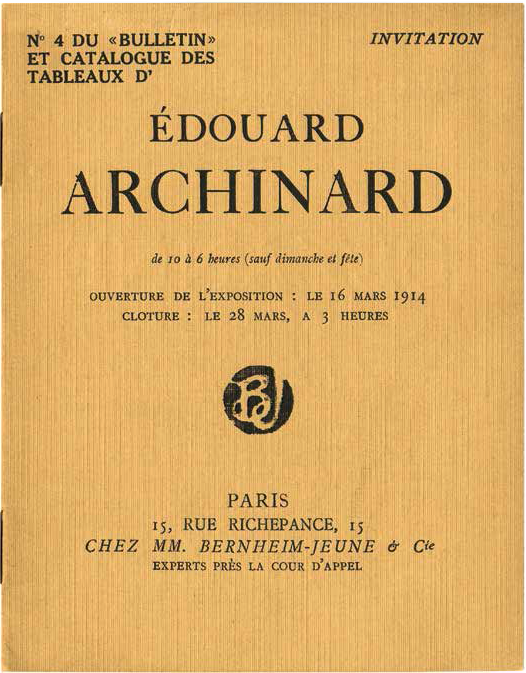
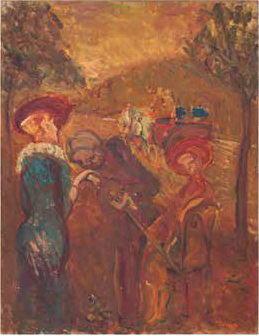
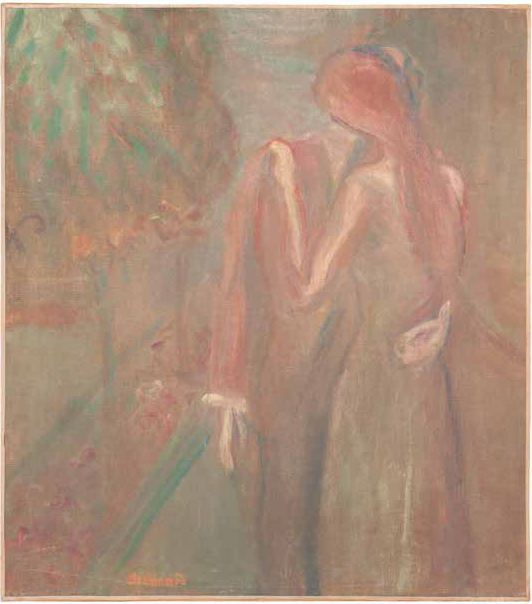
"Édouard Archinard, probably pseudonym of Arthur Cravan, painter, born at the end of the 19th century, perhaps in Geneva. Perhaps died at the front during the First World War. XIXth-XXth centuries. French. Painter of genre scenes, animated landscapes. Post-impressionist.": it is in this elliptical style – habitual with him when he lacks information – that the Bénézit [i] records this mysterious Archinard. He had barely been added, by André Salmon's pen [ii] (for his second edition in 1949), these few "stylistic" precisions: "Little is known about this painter's life. [...] Although drawing his themes from daily reality, he departs as much from pure imagination as from literal translation. His color, very personal, seeks only harmony, without any concern for truth. His drawing, of total freedom, evokes the rapidity of execution of fresco technique." At most, it had been possible to note that an exhibition of his works (40 exactly) had been organized at the Bernheim-Jeune gallery on the eve of the First World War, – from March 16 to 28, 1914, and doubtless at the instigation of Félix Fénéon, its artistic director –, with catalogue in support, published – integrated in its Bulletin n° 4 (March 14, 1914, p. 1-9), – but simple listing of exhibited works, without presentation text, with however 6 precious B&W illustrations.
Fabien Avenarius Lloyd, as born, had already opted, we know, for the pseudonym of Arthur Cravan for the launch of his review Maintenant in 1912: "Arthur", in manifest homage to the undisciplined (and undisciplinable) Rimbaud; "Cravan"(s), from the name of the birth village of his long (and patient!) companion "Renée" – a beautiful young woman of thirty years [iii], say the commentators, whom he would have abducted from the art critic Gustave Coquiot... But why also, and in addition, "Archinard"?
It didn't take a great scholar to read there an anagram of "anarchy", with the "d" near; but with a bit more sagacity, it sufficed to go back to an expression very prized by caricaturists in their critiques of the Salons, expression itself diverted from an expression dated end XVIIIth, "is it bacon or pork?" [iv].
That said, Arthur refers himself to a pastor of Alsatian origin, Charles Archinard (Wesserling/Alsace, 1819 – Chailly/Switzerland, Dec. 19, 1905), who became director and professor at the Cantonal College of Lausanne from 1864, and who had the good fortune to inaugurate the new buildings, rue du Valentin, in 1879 [v]. And it is indeed there that Fabian Loyd did his first classes [vi].
But perhaps we must also see there a trait of humor from Cravan. Making then the "front pages" of politics (and colonial politics), a certain Louis Archinard, from a Protestant family of Le Havre (Le Havre/Seine-inf., Feb. 11, 1850 – Villiers-le-Bel/Seine-et-Oise, May 8, 1932), who had just been promoted to army corps general and had distinguished himself as "pacifier" of French Sudan (present-day Mali), at the cost notably of a horrible carnage at the expense of the Bambaras in April 1890. From 1881 to 1914, he crossed without difficulty all the grades of the Legion of Honor; and we owe him, it seems, a Practical Instruction Manual on Fencing and Duels, Calais, Impr. des Orphelins (sic! you can't make this up!), 1900.
But let's return to Art, which he says on more than one occasion to have in detestation. Who is this "one of my friends, Édouard Archinard", who, in his review of the 1914 Salon des Indépendants, settles his account with Maurice Denis [vii]? Is it the same one who, at the same moment, and with the complicity without any doubt of Félix Fénéon, exhibits 40 of his canvases at the Bernheim-Jeune gallery, 15, rue Richepance?
Let's already signal that, without citing his author by name, Guillaume Apollinaire will say, of the "brochure sold at the door of the Independents", "having tasted the savory pamphlet" [viii]. And here now are the rare testimonies that we have been able to gather of the Bernheim exhibition in the press of the time:
Gil Blas, n° 18538, March 16, 1914, p. 4, unsigned [doubtless Louis Vauxcelles, responsible for the column]
"The Arts
Edouard Archinard Exhibition – It is today that opens, at the Bernheim jeune Gallery, the exhibition of the works of this young painter whose manner is not always without recalling – according to the photograph at least – that of Picasso or Bonnard.
The catalogue, presented with taste and sobriety, contains n° 4 of the sagacious and charming Bulletin of M. Félix Fénéon."
La Renaissance, politique, littéraire et artistique, 2nd year, n° 12, March 21, 1914, p. 25, signed Robert Hénard
"Berhneim-Jeune Gallery – E. Archinard Exhibition. – What to say of M. Archinard's paintings? Vague, non-existent forms, in still vaguer milieus... thirty to forty sketches of a generally reddish, russet tone... And this is called: "It's the exquisite hour" [n° 12], "The air was soft like warm water" [n° 15], "Passing quickly" [n° 37], etc. Let's pass!"
[An advertisement for the exhibition appears on page 32.]
Der Cicerone: Halbmonatsschrift für die Interessen des Kunstforschers und Sammlers, Leipzig: Klinkhardt und Biermann, 6th year, Heft 9, May 6, 1914, p. 336, signed "O.G." [namely, Otto Grautoff, its correspondent in Paris]
"Ausstelllungen. Pariser Frühjahrsausstellungen.
Bernheim-Jeune veranstaltete eine Ausstellung von Edouard Archinard, einem mittelmässigen Eklektiker." /"Exhibitions. Spring exhibitions in Paris. Bernheim-Jeune organized an exhibition of Edouard Archinard, a mediocre eclectic."
Difficult to be more laconic!
We know, thanks to André Level's Souvenirs [ix], that Cravan has quite a bit of dealings in the art milieu, broker for the same André Level precisely, also for Charles Malpel, high defender of modern art installed in Toulouse [x], and that he even envisaged opening his own gallery, under the name of "Galerie Isaac Cravan". Enterprise remained without sequel, but of which subsist at least two advertising placards:
"GALERIE ISAAC CRAVAN of 2,500%! SPECULATORS! Buy Painting What you will pay 200 francs today Will be worth 10,000 francs in 10 years."
More enlightening on his aesthetic choices:
"GALERIE ISAAC CRAVAN Modigliani Italian Hayden Polish Rivera (champion of cubism) Spanish Van Dongen (The Dutchman watching) Dutch"
But quid of the painter, who is indeed part of the titles of which he boasts? Must we take the risk of an inventory? especially since our man likes to disguise himself, and that the titles given to the works that can or cannot be attributed to him, resemble more to an improvisation decided on the eve of a hanging than to a real will of identification of the paintings. Let's risk it nevertheless.
As Bernard Heidsieck has exposed in one of the rare catalogues devoted to his work [xi], have been able to be listed under the signature of Edouard Archinard, 4 canvases, dated "Nice, 1914, 'reliable', coming from the Félix Fénéon collection and bequeathed by him to the doctor who had treated him at Valescure in 1939, Dr. Émilie Janicot [xii]. Another "Archinard" would have transited through the painter Émile Compard, also a gift from Félix Fénéon, also dated "Nice, 1914", bequeathed by his daughter Brita, sculptor, wife of the sculptor Alberto Guzman, to Bernard Heidsieck.
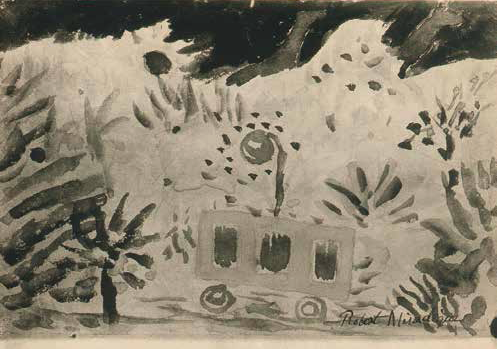
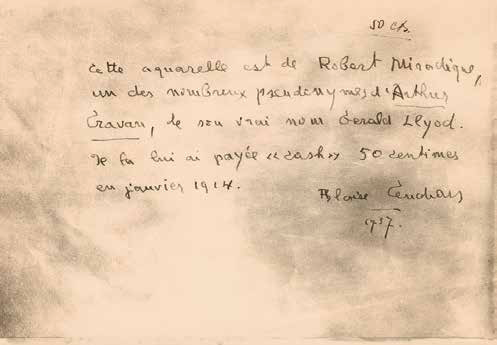
Under the signature of "Robert Miradique" reappeared at the sale of the Bernard Loliée Library, in April 2016 [xiii], a watercolor bearing on the back the following attestation: "50 cts. /This watercolor is by Robert Miradique, one of the numerous pseudonyms of Arthur Cravan, real name Gerald Lloyd. I paid him 'cash' 50 centimes in January 1914. /Blaise Cendrars/1937" [xiv].
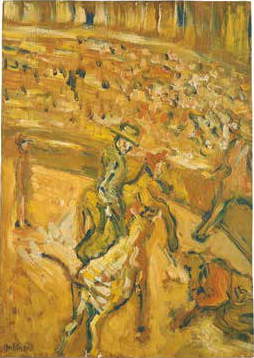
Remains (and it's not a lesser remainder!) the question of the 40 canvases exhibited in March 1914 at the Bernheim-Jeune gallery, to which must be added 2 canvases presented under the same signature, in the same gallery, on the occasion of a collective exhibition, from May 1 to 11, 1917. Canvases on the whole of very different facture, and which make Maria Lluïsa Borràs doubt their authenticity [xv].
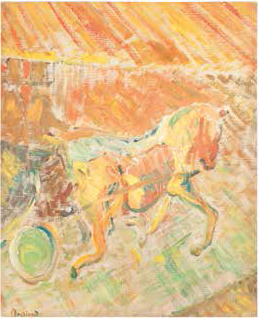
So, mystification, if not swindling, mounted in concert between Arthur Cravan and Félix Fénéon? One cannot help thinking, in the artistic domain, of Frenhoffer, painter imagined from scratch by Balzac [xvi], or better still, of Jusep Torres Campalans, said Catalan painter – biography and works imagined and created no less from scratch by the art critic Max Aub [xvii].
Let's therefore find the canvases now...
Jean-Paul Morel – April 2017
[i] Critical and Documentary Dictionary of Painters, Sculptors, Draftsmen and Engravers of All Times and All Countries, created by Emmanuel Bénézit in 1911, latest edition Gründ, 1999, 14 vol.
[ii] André Salmon will expand a bit more in his Souvenirs sans fin, 2nd époque (1908-1920), Gallimard, 1969, XIV – "Éloge d'un grossier personnage", p. 215-220, without however evoking the painter.
[iii] She figures in fact in the civil status of Cravans (Charente-inférieure), under the name and first name of Alphonsine Bouchet, born August 22, 1880, daughter of tailor and stonecutter.
[iv] Spanish seems, like Italian, to have limited itself to this transcription "no ser ni carne ni pescado".
[v] Cf. Charles Archinard-Roman, "Le collège cantonal: notice historique lue le 26 août 1879, jour de l'installation du collège au Valentin". To note that fencing and horsemanship were also taught there.
[vi] See "Davel – Inventaire des archives cantonales vaudoises" (online inventory).
[vii] "L'Exposition des Indépendants", Maintenant, n° 4, March-April 1914: 30th Salon of the Society, which took place at Quai d'Orsay-Pont de l'Alma, from March 1 to April 30, 1914. One has naturally, and rightly, compared this article to the articles given by Félix Fénéon to the anarchist review Le Père Peinard in 1893, in particular to the "Balade chez les artisses indépendants" published in issues 212 and 213 of April 9 and 16, 1893 (reprinted by John Halperin, in O.P.Q.C., Geneva-Paris, Librairie Droz, tome I, 1970, p. 222-228)
[viii] Guillaume Apollinaire, "La critique des poètes", Paris-Journal, March 5, 1914 (reprinted in Gallimard, Pléiade, t. II, 1991, p. 671-673 – here, p. 673).
[ix] André Level (1863-1947), Souvenirs d'un collectionneur, Paris, Alain C. Mazo, 1959. The initiator, we know, of the operation "La Peau de l'Ours".
[x] Charles Malpel (1874-1926), Notes sur l'art d'aujourd'hui et peut-être de demain, Paris, Bernard Grasset/Toulouse, Privat, 1910, 2 vol. On the eve of the First World War, he had also opened a gallery in the capital, at 15, rue Montaigne.
[xi] Arthur Cravan: poète et boxeur, catalogue of the exhibition organized by Marcel Fleiss in his Galerie 1900-2000, 8, rue Bonaparte, Paris VI, from April 7 to May 5, 1992, Terrain vague/Galerie 1900-2000, 1992, p. 69-70. And let's add here: Arthur Cravan, le neveu d'Oscar Wilde, catalogue of the exhibition organized at the Museum of Modern and Contemporary Art of Strasbourg, from Nov. 18, 2005 to Feb. 26, 2006, under the dir. of Emmanuel Guigon, Musées de Strasbourg, 2005.
[xii] Was found the heir his daughter, Françoise Janicot, wife of Bernard Heidsieck.
[xiii] Sotheby's Sale – Paris/ Me Binoche & Giquello, 76, rue du Fbg St-Honoré, Me April 27, 2016, lot n° 425. Acquired for 30,000 Euros (37,500 with rights). Thanks to Jean-Paul Goujon for these precisions.
[xiv] Is this what Blaise Cendrars refers to when he writes: "In 1936, a day of pea soup when I had my hotel room to pay, avenue Montaigne, I sold to Matarasso, the autograph dealer of rue Bonaparte, everything I held from Arthur Cravan: papers, letters, watercolors, the draft of a great poem remained unpublished and the complete and very rare collection of his review Maintenant". Henri Matarasso, expert in Rimbaud matters, was installed since 1935 at 72, rue de Seine; with Cendrars, memory is never sure...
[xv] Cf. Maria Lluïsa Borrà, Arthur Cravan: une stratégie du scandale, Jean-Michel Place, 1996.
[xvi] "Le chef-d'œuvre inconnu. Conte fantastique", 1st ed. in feuill., L'Artiste, July 31, 1931, p. 319-323 and Aug. 7, 1831, p. 7-10. Let's signal in passing that it is to Pablo Picasso that Ambroise Vollard will entrust the illustration of his own edition of the work in 1931.
[xvii] Max Aub, Jusep Torres Campalans (1886-1956), Gallimard, 1961 – published with the complicity of André Malraux. Which has obtained right of citizenship in the Encyclopédie des farces et attrapes et des mystifications, by François Caradec and Noël Arnaud, J.-J. Pauvert, 1964, p. 382-383. An exhibition, Jusep Torres Campalans, Ingenio de la Vanguardia, was realized at the Museo Nacional Centro de Arte Reina Sofía de Madrid, from June 13 to Aug. 23, 2003, catalogue under the dir. of Paloma Martín Llopis, Madrid, 2003.