NORA MITRANI, SURREALIST WITH SUCH A SECRET FACE
par Stéphanie Caron
Secretive, Nora Mitrani? The adjective may seem, at first glance, rather ill-suited to describe a woman whose body, open sex and taut buttocks, is now displayed at will in almost every exhibition of Bellmer's works. For indeed, anyone who has seen the series of engravings the artist made for Story of the Eye by Bataille, or in homage to the Marquis de Sade, cannot help but be struck by the shamelessness of the model, who exposes to all eyes the most secret parts of her anatomy. Yet, few spectators are able to name this model; even fewer could identify, in this name, that of a writer. For the name Nora Mitrani has been almost completely erased from literary history, and if it reappears there sometimes, it is almost always alongside those of Hans Bellmer or Julien Gracq, whose companion she was in turn. In her, one sometimes also recognizes the elder sister of the filmmaker Michel Mitrani, one of the leading figures of French Radio Television, who notably brought to the screen a beautiful adaptation of Julien Gracq's novel, A Balcony in the Forest, in 1978 ↑.
Lover, sister—she whose first name, etymologically, destined her for the light, would she today exist only in the shadow of the more or less great men she encountered—and, it must be admitted, well chosen?
The fact is that, little concerned with notoriety and even with publication, the young woman seems to have largely contributed to her own obscuration. Thus, when she enters literature, it is through the narrow door of postwar surrealism, a movement now relegated to the margins of the avant-garde, and whose literary critics never tire of commenting on its agony, when they are not simply celebrating its funeral. "Surrealism has nothing more to say to us' ↑, wrote Sartre as an epitaph, the very year Mitrani joined the group newly reunited around Breton, back from the United States in 1946. Yet, not content to fully embrace the movement's ideas and accept its demands, at a time when women were often only the companions of surrealists, Nora Mitrani quickly established herself as an "orthodox surrealist" ↑. Many of her texts thus echo a (literary, artistic) news often polemical—a characteristic that no doubt contributed to their neglect. No poems, few stories: this work consists mainly of essays, texts on literature or cinema sometimes dated, and published in now-defunct journals. Although "rich in the exceptional quality of the writing and the diversity of subjects treated' ↑, it has rarely been reproduced. It was not until 1988 that most of these texts were collected by Dominique Rabourdin—friend of Michel Mitrani and Julien Gracq and great admirer of Nora Mitrani—and published in a small volume by Eric Losfeld / Le Terrain Vague ↑.
Given, then, the silence that surrounds the writer today, it is to a simple question, freely adapted from one posed one day by a surrealist companion of Mitrani, that these few lines will attempt to answer:
If God is a kite,
Who the devil is Nora Mitrani? ↑
Of this "fascinating woman, with extraordinary eyes' ↑, a few photographs have captured the strange beauty. A slight silhouette, very soft black eyes that always seem to look elsewhere, a light smile that barely dimples a plump cheek—the only thing that sometimes betrays, perhaps, past wounds is the melancholic veil that sometimes shadows her face. Nora Mitrani was born, under the sign of Sagittarius, on November 29, 1921, in Sofia, Bulgaria, to parents of Judeo-Spanish and Italian origin. Around 1930, her family emigrated to France, and the young girl continued her secondary studies at the Hélène-Boucher high school in Paris. During the German occupation, her mother and most of her relatives were deported and killed at Auschwitz. She would discreetly allude to this tragedy in 1952 in "The Flame and Its Shadow":
"But for a long time, the night was for me only a German night without a secret sun, the long confusional night inhabited by monsters. It suited me enough that I did not seek in it the demand for light, a diamond that hides at the heart of the deepest midnight. The discovery of humor can be a late grace." (RCV, p. 42)
It was thus under a false identity that Nora Mitrani continued her philosophy studies at the Sorbonne. During these formative years, the young woman seemed inhabited by contradictory aspirations: she was attracted to Catholicism, but would soon lose her faith in favor of revolutionary ideas. A Trotskyist, she nevertheless devoted her doctoral thesis to the Christian philosophers Malebranche and Maine de Biran. "She would later say," writes Dominique Rabourdin, "that all these stages were necessary for her before discovering surrealism" (RCV, p. 149).
During the occupation, Nora frequented the home of Alain Gheerbrant, the future director of Editions K. It was there that she met Hans Bellmer at the end of 1945: Gheerbrant, who was preparing a clandestine reissue of Story of the Eye by Georges Bataille, illustrated by Bellmer, hosted the artist—lodged with friends in Castres, Revel, Toulouse, or Carcassonne—when he came to Paris. A relationship developed between the forty-year-old draftsman and the twenty-five-year-old student. She joined Bellmer several times, first in Toulouse, then for the first time in Carcassonne at the end of April 1946, when Bellmer introduced her to his friend Joe Bousquet:
"Pierre Cabanne describes a Bellmer who is difficult to be around, seeking rebellion and scandal. His conduct, and especially the fact that he 'does not organize his prodigious artistic resources enough in the form of a profession allowing him to live,' earns him a vigorous dressing-down from his friend, who also reproaches him for having settled—with what money?—in the most expensive hotel in the city, the Terminus." ↑
In September, Bousquet arranged for the couple to be hosted by the painter Jean Camberoque, who had just illustrated his latest work, Le Meneur de lune. The meeting between Bellmer, Bousquet, and Mitrani was decisive—it gave birth to the famous anagrams created together from a hemistich by Gérard de Nerval: "Rose au cœur violet."
In Artemis, one of the sonnets of Les Chimères, Nerval wrote: "Rose au cœur violet, fleur de Sainte Gudule." Nora Mitrani, a fervent reader of the poet, planned to make the first hemistich of this verse the title of an essay she intended to write about Bellmer from the beginning of their relationship. This title was obviously not chosen at random: the memory of Nerval's verse was evoked by Bellmer's work (where the theme of the rose joins that of the vulva, or more often the anus) as well as by the title of some of his drawings such as "A la rose" or "Rose ou verte la nuit." But the important thing is that this title, coming from Mitrani, arose even before the anagram project, and in a way inspired it. In an interview with Bernard Noël, Bellmer returns to the genesis of this experience:
"Nora wanted to title the book she was writing about me Rose au cœur violet. It's a verse by Nerval. I found it too flowery, too sweet. We were in a grocery-bar. One or the other suggested making anagrams with Nerval's verse. Yes, it was like a fever. Anagrams are better made by two, a man, a woman. A kind of competition, or rather a liveliness that mutually stimulates..." ↑
Thus, from the seventeen letters of "Rose au cœur violet," Nora Mitrani and Hans Bellmer composed a first series of four-handed anagrams. In the days or weeks that followed, they invited Joë Bousquet to join their literary games. This collaboration resulted in about sixty anagrams, whose highly eroticized meaning completely subverts Nerval's hemistich:
To devote oneself to you, oh cruel one To you, pink snake Oh, to want to be the cause Cover yourself, the street dares Open yourself, oh the sweet one Vile bone sickened the road Violated heart dared to kill
As Alain Chevrier has already noted, "Rose au cœur violet: this is not the classic image of the female sex in the language of flowers, but that of the anus' ↑. Jean-Claude Marceau adds:
"The title refers to the erotic expression 'faire feuille de rose' and to the coloration of the mucous membranes. And 'violet,' bishop's color, can also be heard as 'violated.' Joë Bousquet, let us recall, had the project to write with Bellmer a 'Justification of sodomy.' [...] This calligram in the shape of an inverted cross multiplies references to phallic symbolism and onanism, as well as to sadomasochistic fantasies of prostitution and rape. Each line of these anagrams deals with an erotic theme, more or less disguised." ↑
The experience was decisive for the two lovers. Nora Mitrani would publish sixteen of these anagrams at the top or bottom of the pages of her essay on Bellmer, aptly titled "Rose au cœur violet." Bellmer, for his part, would publish the whole set in 1957, expanded and presented as a poem, in the definitive version of his famous work: Petite anatomie de l’inconscient physique ou L’Anatomie de l’image. It is also known that the artist would continue, from 1954, these "games for two" with his new companion, Unica Zürn, who herself would obsessively write anagrams ↑. But above all, the anagram now became central to Bellmer's reflections on anatomy, illuminating the phenomena of permutation he would describe in L’Anatomie de l’image in two now-famous lines: "The body—it is comparable to a sentence that invites us to disarticulate it, so that, through an endless series of anagrams, its true contents may be recomposed." ↑
In July 1947, another decisive experience for the couple. On a beach where he was vacationing with Nora, Bellmer took intimate photographs of his friend ↑:
"She had allowed obscene photographs to be taken of her. Through the view of these proofs and the coincident provocation of too strong a dose of cocaine, the girl"s buttocks tend to become the predominant image, which merges more and more, in a concrete vision, with the celestial image, until the identity of the most fleeting expressions of this figure with the blind smile of the two immense eyes that are the hemispheres of the rump opening onto the anus. Desire is carried there exclusively, confusing the masculine and the feminine, the I and the You, sodomizing the I in the You."
Recalling the discoveries of this "intense week" in a letter to Georges Hugnet, Bellmer speaks of it as an experiment: "I keep photos and sketches for a series of engravings that I will push to the extreme" ↑. Indeed, these photographs of Nora Mitrani inspired some engravings that Bellmer made for Story of the Eye by Bataille, as well as for the homage he paid to the Marquis de Sade at the end of the 1940s. However, the role of the young woman in the artist's work is not limited to that of a model, lending her body to the phantasmatic figures staged by her companion. After making, around 1946-1947, a rather classical "Portrait of Nora Mitrani," Bellmer integrated her between 1947 and 1950 into a magnificent series of "Double Portraits," including a "Disrobing" from 1949 representing him emerging from his companion's body. The face or body of Nora Mitrani can also be recognized in certain 1948 decalcomanias, such as "La pauvre Ann (L’Ange déchu)." ↑
That same year, 1948, the two lovers made regular stays in Paris where they lived, rue Falguière, with their friend Rilka ↑. The manuscript of Nora Mitrani, "Rose au cœur violet, à propos de Hans Bellmer," was then finished, and was to be self-published in Toulouse. In fact, it would not be published until 1950, opening the collective volume Hans Bellmer, vingt-cinq reproductions, edited by Christian d’Orgeix. Mitrani's signature appears alongside those of Jean Mayoux, André Pieyre de Mandiargues, Jean Brun, Jacques de Caso, Yves Bonnefoy, and Gisèle Prassinos.
This text, which opens the edition of Nora Mitrani's writings, offers, in many respects, a masterful analysis of Bellmer's work. Certainly, the author's great intimacy with the artist nourishes and considerably enriches her remarks. Thus, the young woman can evoke the heartbreaks, the painful separations on which her companion's work was built:
"Yet this assassin of good consciences lives with the stubborn dream of a childhood love regained thanks to two perpetually threatened images: a woman, a disturbing and faithful projection of his own narcissism, a child, Doriane, a very small child, his own, who caressed his forehead." (RCV, p. 15)
Nevertheless, Nora Mitrani's writing perfectly matches Bellmer's fantasies, appropriating them to the point of substituting, in some passages, the "I" for the "he" usually required:
"Every man and every woman knows or senses, whether they want to or not, the erotic dazzlement and its procession of bitter ecstasies, of impossible denials.
"I would like to dress in the heavy, trembling vest of her breasts."
But very quickly comes the moment when his inevitably hated body seems to me both derisory and touching, his dreams and his childhood derisory. Would not his prenatal life be the object of my desire? She might accept, so that I am no longer alone, to return with me into the same womb." (RCV, p. 16-17)
The whole text shows clearly enough that Nora Mitrani was not the humble servant of Bellmer's work, but his accomplice, even his muse—in a word, a free woman also in search of erotic vertigo. Thus the figure of Sade, also celebrated by both artists, is here invoked to shed light on Bellmer's work—the first in a long series of references that will be found in almost all of Mitrani's texts. This passion of the young woman for Sade, as well as for Bellmer no doubt, is explained, above all, by the ability of both men to provoke scandal, a word and concept that literally magnetizes all the young woman's work. Scandal whose effects she also admires in the work of Georges Bataille, to which Bellmer would give dazzling plastic echoes.
Moreover, one of the interests of this first essay also lies in the fact that, beyond the discourse on the Other, specific concerns of the author can be discerned, which will persist and develop from one text to another. Starting with the refusal, from the first page, of the conventional image of woman, reduced to her only disembodied beauty:
"Erotic representations, if they do not provoke vertigo or tears, are despicable. And from the moment that, through them, vertigo and scandal are born, they are judged suspect. Their content offends a certain notion of 'sacred' that one caresses despite broad tastes, certainty that the pregnant belly of the woman is 'holy' as is 'holy' the very little girl. The forbidden and the nice, rather than this multiple woman resplendent with the endless variations of lived coenesthetic experience;—let a conventional feminine beauty remain inviolate within the most dangerous passion." (RCV, p. 13-14).
Another typical trait of Mitrani is the constant desire to open up to the everyday, with a particular valorization of the object:
"Through his passion of ice, burning, fanatical, Bellmer reveals to us certain instinctive solutions to the endless conflict that will always have opposed man to the external object." (RCV, p.24-25)
One could also cite, among the obsessions that emerge in this first essay, love, the couple, of which the young woman offers this beautiful image:
"A fleeting but painful tension, nameless, keeps this man and this woman apart on the sandy beach. Suddenly, no one will say why, they each dig a hole in the sand a short distance apart. Soon their fingers scratch with much more ardor, their gestures seem to become intentional. Below, the sand becomes fluid and cool; and then, under the sand, their hands meet." (RCV, p. 25-26)
However, love, for Nora Mitrani, is far from being reduced to those "fragile and brilliant efflorescences of life" that she elsewhere salutes in the New Zealand poet Katherine Mansfield ↑—as evidenced by the aphorism that almost opens her text on Bellmer: "Mortal gravity of love."
In fact, what bound Mitrani to Bellmer died at the very beginning of the 1950s. Geographical distance, as well as a certain form of jealousy on Bellmer's part, seem to have gotten the better of their passion. The two artists nevertheless separated, as they say, on good terms. Bellmer would remain long attached to Mitrani, whom he described in 1957 as "friend, comrade, collaborator and, it seemed to me, as sister of the Impossible." Thus, it was to his former companion that he would systematically turn, long after their breakup, to finalize and correct his texts before publication. The face of the young woman would also long haunt his drawings or engravings, which can be seen in many works after 1950. And when Bellmer learned, in May 1961, what he called "the atrocious news of her death," he immediately sent a distraught letter to Breton: "Nora never ceased to be a great and intimate friend to me" ↑. Conversely, Nora Mitrani would remain marked by the years spent alongside Bellmer. Gracq recalled, as Dominique Rabourdin noted, Nora speaking of Bellmer's gentleness. Thus, when she evokes in 1959, in "An Enchanted Solitude":
"the double click that would make possible the superposition of two images on the same blank film, the confusion obtained in an instant and for an instant, of separated bodies: I caress a body enchanted by the desire of the other, which is no longer mine and which is not quite his..." (RCV, p. 105),
one thinks of the "Double Portraits' made by Bellmer, and especially of the "Disrobing" of 1949.
To Bellmer, Nora Mitrani finally owes having encountered what would constitute, in the words of Dominique Rabourdin, "the axis of her life": surrealism. It is likely, in fact, that it was Bellmer who introduced Mitrani to Breton, around 1946 or 1947, and likely also that, from the outset, Mitrani pleased the surrealists, and especially Breton. Her notorious relationship with Bellmer, the fact that she had been his model, enveloped her in a sultry aura that was no doubt pleasing to the, mostly male, representatives of the group. Thus Alain Jouffroy remembers a "beautiful, charming woman, a little libertine and not hiding it, not feminist, individualist, quite revolutionary in spirit, with a sense of provocation" ↑. But her training as a philosopher was also appreciated, and it is known that, almost from the start, Nora Mitrani took an active part in the debates that animated the "worn plush benches and fake mahogany tables' of the café on Place Blanche, where the surrealists then met ↑. The young woman was associated, via Bellmer and Bousquet, with the International Surrealist Exhibition of 1947, which, inaugurated on July 7, 1947, at the Maeght gallery, marked the official resumption of Breton's activities in Paris after his return to France the previous year ↑. But Mitrani's adherence to surrealism was truly confirmed in June by her signature at the bottom of the leaflet "Inaugural Rupture," in which the French group defined its "prejudicial attitude towards any partisan politics." Mitrani would sign almost all the leaflets launched by the surrealists ↑; from 1949 until her death, she also contributed to all the surrealist publications: Néon, The Surrealist Almanac of the Half-Century, The Age of Cinema (a journal founded by three young surrealists, Kyrou, Benayoun, and Goldfayn, which devoted a special issue to surrealism in 1951), Medium, Le Surréalisme, même, then Bief. The young woman would publish, in all, about fifteen texts in these various journals, as well as about ten in other outlets.
Her favorite subjects are varied. She wrote, notably, two important articles on Sade, thus becoming the first "Sadian woman" of surrealism. The first, "Scandal with Such a Secret Face," appeared in 1950 in The Surrealist Almanac of the Half-Century ↑. Albert Camus would even draw on it to write The Rebel, where he unfortunately confused Nora Mitrani's syntax with that of Sade. François Di Dio, the soul of Soleil Noir, would offer his friend the opportunity for a clarification, in the form of an "Editor's Note" published in February 1952 in "La révolte en question," the first of two issues of the journal Positions published by Soleil Noir:
"Nora Mitrani asks us to insert the following correction:
'Page 64 of The Rebel, Albert Camus writes: [...] When the crime of love is no longer commensurate with our intensity, we might perhaps attack the sun, deprive the universe of it, or use it to set the world ablaze, that would be crimes, that...
I refer my reader to my article entitled "Scandal with Such a Secret Face" [...] One is moved when this monster of a marquis from the 18th century suddenly uses such a modern phrase: commensurate with our intensity. But, on reflection, this seems rather surprising. Sade, an extraordinary precursor in other respects, belongs to his century by his style and syntax. The explanation? A shift in quotation marks [...]. When I myself quoted this sentence in the text I mentioned above, I had to, for the purposes of the demonstration, precede my quotation with a circumstantial clause; I invented it.'" ↑
In "Scandal with Such a Secret Face," Mitrani situates Sade in a genealogy of accursed thinkers who, since the "iconoclasts of geocentrism, theocentrism, anthropocentrism," continue through Hegel or Marx. All were, according to her, "accused, beaten, humiliated," for having substituted for the principle of identity that, occult, of analogy:
"Inscribed in the fabric of the real, no force in the world has so far succeeded in stifling it. For its content is too extraordinarily childlike: the same processes take place by analogy in the part as in the whole, in consciousness as in the object, in the human body as in the solar system." (RCV, p. 38)
Dear to Mitrani, this question of analogy would be taken up, developed—and its lineage extended to surrealism—in a lecture she gave the same year in Portugal under the title "The Burning Reason. From Romanticism to Surrealism." She would also insert entire sections of "Scandal with Such a Secret Face" into it, following a principle of recycling already tried in this same article, where she literally reuses passages from "Rose au cœur violet" written about Bellmer.
Very different is the second text on Sade that Nora Mitrani published in Medium in 1954: "Something New on Madame de Montreuil' ↑. Highly polemical, it attacks indeed some famous exegetes of the Marquis de Sade, accused of having opted, in the face of their subject, for two equally condemnable attitudes: "divinization and excessive adoration" or "sweetening and taming." From Swinburne to Camus, some of the most eminent Sadians, such as Georges Bataille, Pierre Klossowski, and especially Gilbert Lely, are thus torn apart, their work reduced to "clammy compilations." It is true that, at the time Mitrani wrote these lines, Breton—and with him the whole group he led—was at odds with Lely, whose interpretation of Sade's political commitment was in complete disagreement with that of the surrealists ↑. It is therefore not surprising that Nora Mitrani, in these lines devoted to Sade's mother-in-law, takes the exact opposite of one of the theses defended by Lely in his Life of the Marquis de Sade, published in 1952: for Lely, Sade's misfortunes come essentially from the hateful persistence of Mme de Montreuil against him. Mitrani opposes to him the research of Jean-Jacques Pauvert, whose introduction to Justine or the Misfortunes of Virtue constitutes in her eyes "a remarkable work of disillusionment for the reader":
"Myths are destroyed there, which too many exegetes of Sade themselves suffered the seduction of. That of this 'wicked Mme de Montreuil,' tireless persecutor of her daughter's husband, is not the least, insofar as it gives us one of the keys to sadistic behavior. The son-in-law and the mother-in-law seem at first quite charmed with each other (it would seem, according to some documents cited by Pauvert, that the young Sade found more charm in Mme la Présidente than in his young wife)." (RCV, p. 56)
Nora Mitrani would write no other article on Sade, but the shadow of the marquis hovers over most of her later writings. For example, consider the answers she gave in 1957 to a survey on a painting by Gabriel Cornelius von Max conducted in Le Surréalisme, même:
"This woman, highly sadistic, rigorous, formal or conventional in her relations with her lover, has just learned by a letter from him that at the time set during their previous meeting, he will not come to undergo the torments she had reserved for him that day. [...] Furious, unable to contain her violence, she whips herself to exhaustion and collapses on the floor, like a dead woman." ↑
These lines fully justify the judgment that Julien Gracq would make in 1988 about the work of his former companion:
"The pages of Nora Mitrani mark above all her place in postwar surrealism in that—without in any way abandoning the positions of Breton as expressed in Nadja or Mad Love—they refuse any reluctance before the 'dangerous landscapes' sometimes opened up, precisely, by Bellmer's drawings as by Bataille's books." ↑
It is therefore quite natural that Nora Mitrani was invited to collaborate, in December 1959, in the international surrealist exhibition organized at the Daniel Cordier gallery under the title EROS. She wrote for the catalog "An Enchanted Solitude," a kind of literary reverie inspired by the refusal of O, the heroine of Pauline Réage, to caress herself in front of Sir Stephen, as well as six entries in the Succinct Lexicon of Eroticism ↑. Apart from the one devoted to the German singer Wilhelmine Schroeder-Dariant (who is said to have been a nymphomaniac whose supposed Memoirs are now available from Pauvert), all the entries signed with her initials concern characters or themes of which she was a "specialist." She had had the opportunity to mention Sir Stephen, the lover of the very docile O, in "An Enchanted Solitude," and had already torn apart Pierre Klossowski's Roberte in 1953 in "Diptych of Love and Cold Blood." As for the three thematic entries she was responsible for, only "Makeup" is surprising—"Concupiscence" and "Scandal' seem self-evident:
Concupiscence. — Basic natural inclination that makes us desire the enjoyment of sensual goods and especially carnal pleasures. Touching and possessing a body cure the burning sensation caused by its image. The Church forbids both this burning and its mode of cure. (p. 18)
Makeup. — Creams and powders whose secret was supposedly taught to women by fallen angels, according to Tertullian. They use them to seduce men but also to veil their own nudity from themselves. Daytime collaborator of man, woman only makes up her face, but the creature of the night also makes up those hidden places where her body opens and bristles. (p. 28)
Scandal. — Sudden unveiling, for purposes of provocation or challenge, of what society and conventional morality tolerate only when camouflaged: the so-called shameful parts of the human body, the exploitation of man by man, the existence of torture, but also the too unbearable brilliance of a being out of step with his environment. (p. 67)
Besides eroticism, one of Nora Mitrani's favorite subjects concerns women, and more generally the feminine condition. Feminist, Nora Mitrani certainly was, but with a gentle, non-combative feminism, in which the claim for male-female equality, and the recognition of woman as a thinking subject, is coupled with an acceptance of femininity in what it can sometimes have of the almost caricatural. For Mitrani, the ideal woman, as celebrated in all her facets by the surrealists, would be a hybrid of "carnal creature" and Nadja, of "public rose" and "magician, sibyl, mediator of the invisible" ↑. If she rejects "the Marylins and other sumptuous technicolor cinema creatures who, molded in red velvet, dance, mouth and eyelids half-closed, distraught, in the world of men" (creatures straight out, it seems, of Henry Hathaway's Niagara), she nonetheless shows a clear interest in what she calls "the ambiguity of the she-woman." This is evidenced by the article she contributed in 1957 to Le Surréalisme, même under the title: "Of Slaves, Suffragettes, and the Whip." There she opposes, to the effort of women to appropriate "the logic of men, their works and their torments," an effort in which they lose their own identity, Rimbaud's faith in a different woman, "poet but still unknown on earth." Closer, in short, to the feminism of a Suzanne Lilar, who was a friend of Gracq, than to that of Françoise d'Eaubonne, Nora Mitrani is more interested in essence than in the feminine condition. The end of this article, as a tribute to O, the heroine of Pauline Réage, explicitly takes the opposite view of Simone de Beauvoir's theses:
"Mrs. O, despite her degradation, perhaps because of it [...] is a happy, fulfilled woman. [...] The woman become object, consenting up to that point, because that is her pleasure, whipped, but that represents a kind of aggression towards men: they no longer recognize themselves." (RCV, p. 101)
Reading the texts she left, it is clear that Nora Mitrani positioned herself more as a "guardian of the surrealist temple" than as an innovative and contesting figure. She embraced, in particular, all of Breton's causes (against Camus, against Lely), probably because of her friendship and deep admiration for the author of Mad Love. The two writers were indeed linked, until Mitrani's death in 1961, by a deep affection, attested notably, on Breton's side, by the dedications he addressed to Nora ↑. However, Nora Mitrani's situation within the surrealist group is singular: very close to Breton, Bellmer, Gracq, or Mandiargues (she was also very close to Bona), she remained quite distant from the other members. The rare photographs in which she appears, at the café, among the surrealists, show her rather apart, and she would sometimes seek external platforms, such as L’Actualité littéraire. Nevertheless, she played an active role within the group, of which she was, notably, one of the spokespersons abroad.
Thus, in January 1950, Nora Mitrani left for Portugal, where a wealthy uncle welcomed her, to give a lecture on surrealism in the university garden of Fine Arts in Lisbon. Entitled "The Burning Reason. From Romanticism to Surrealism," this lecture, still unpublished in French, was published, in Portuguese, in the journal Cadernos surrealistas ↑. It is a very dense article, which discusses, in thirteen typewritten pages, the new orientations of postwar surrealism, tempted by the occult, hermeticism, and mythical thought. From the first page, the tone is set: "The great culprit (we would be tempted to say the great guilty one) of this hunt for vertigo called the rationalism of modern times, is Descartes." A Descartes who embodies, in the author's eyes, the "tradition of the day," characterized by the spirit of separation, the sense of measure and clarity, as opposed to the "tradition of the night" in which what Mitrani calls "the royal lineage from romanticism to surrealism" is inscribed. From this latter tradition, according to her, derive the works of Hegel, Sade, Marx, Freud, as well as those of Rimbaud, Nerval, Lautréamont, or Breton, who have in common being underpinned by an occult principle of analogy, which she defines as the perception of the relationships that govern the totality of the world.
Certainly, one can reproach Nora Mitrani for making, in this article, a somewhat forced apology for surrealism, presented as the ultimate culmination of a whole tradition of thought that she traces back to Heraclitus, at the cost of some ideological shortcuts and very debatable formulas, such as: "The surrealist experience has always been, insofar as it coincides with the poetic experience." However, placed in the context in which it was delivered, this lecture takes on all the appearance of an act of resistance: promoting surrealism in Salazar's country was obviously not without ulterior motives or danger. From this trip to the Lusophone country, Nora Mitrani would also bring back a series of articles on the political situation in Portugal, which she would publish in July 1950 in the periodical Le Franc-Tireur. She would sign these articles with the pseudonym Daniel Gautier, to protect her family living in Portugal from the prosecutions that her criticisms would have provoked.
During this same trip to Portugal, Nora made two important encounters. The first, with the poet Alexandre O’Neill, one of the founders of the Portuguese surrealist group, with whom she would have a short but intense love affair, thwarted by the P.I.D.E (Polícia Internacional e de Defesa do Estado) which refused to issue Alexandre the passport allowing him to join Nora, who was waiting for him in France. The young man was, it seems, desperate and, even if he married a few years later, he would not forget Nora Mitrani, to whom he would dedicate a beautiful posthumous tribute in 1962. Here are two excerpts from his Poemas com endereço ↑:
| Para ti o tempo já não urge, | For you time no longer presses, | |
| Amiga. | Friend. | |
| Agora és morta. | Now you are dead. | |
| (Suicida ?) | (Suicide?) | |
| Já Pierrot-vomitando-fogo | Already Pierrot-vomiting-fire | |
| (sempre ao serviço dos amantes) | (always at the service of lovers) | |
| não entra no nosso jogo | no longer enters our game | |
| como dantes. | as before. | |
| Mas esse obscuro servidor, | But that obscure servant | |
| que promovemos uma vez | that we once promoted | |
| (ainda eu não te dedicara | (I had not yet dedicated to you | |
| aquele adeus português...), | that Portuguese farewell...), | |
| corre, lesto, como uma chama, | runs, swift, like a flame, | |
| entre nós dois (o saltarim!) | between us two (oh Saltarim!) | |
| e desafia-nos prà cama. | and challenges us to bed. | |
| Esperas por mim? | Are you waiting for me? | |
The second encounter that marks this stay in Portugal is with the work of Fernando Pessoa, a discovery that Nora Mitrani would recount in 1957 in the second issue of Le Surréalisme, même. There, she published an important dossier on the great Portuguese poet, then practically unknown in France, collecting a letter and several poems, which she accompanied with a brief presentation entitled "Poetry, freedom to be...":
"In Fernando Pessoa, Portuguese poet, we recognize the pride of Hegel and the philosophers of nature, the exemplary attitude of the idealist thinker who knows that nothing is impossible for the human mind, not even the gift of life. In this possessed and miraculously free man (for he plays with those who possess him), the poetic act becomes verifiable in its genesis at the heart of the being who, by himself, breaks his moorings to attempt the fabulous adventure, always renewed: to tear the Other from oneself, to clothe it in living flesh and, projecting it into space, to give it its chances." (RCV, p. 95)
Another contribution of Nora Mitrani to the international influence of surrealism: in February 1960, she participated with Octavio Paz, Joyce Mansour, Robert Benayoun, and Jacques-Bernard Brunius in a radio broadcast entitled "In defense of surrealism," the text of which was reproduced in Bief under the title "The London Dialogue." Her long and vehement intervention responded to a question from Brunius concerning the action of the surrealists on the social level:
"Naturally, we want revolt to end in revolution, but if we are talking about revolution in the political and social sense defined by the Marxists, let us say that this kind of revolution is not enough for surrealism. [...] The high standards of living, leisure and holidays for all, all these conquests of the proletariat have been won in recent years by reformism, not by revolution... This promotion of the masses actually represents a betrayal: class consciousness gives way to the struggle for security and to bureaucratic types of organized irresponsibility." ↑
Very different from that of her comrades, Nora Mitrani's discourse is marked—besides her strong political commitment—by the vocabulary and analysis of sociology, characteristic of the orientation she had chosen for about ten years.
At the beginning of the 1950s, Nora Mitrani was admitted to the Centre d’études sociologiques of the CNRS—where Pierre Naville, who had been part of the first surrealist group, also worked, though apparently they did not meet. In 1955, she was one of six women in a team of thirty-five researchers, and one of the few not to focus her research on specifically women's issues ↑. She actively participated in the research groups on the Sociology of Knowledge and the Sociology of Moral Life under the direction of Georges Gurvitch, and undertook a thesis on the problems of technocracy and techno-bureaucracy, a study that would remain unfinished, but part of which was published in the Cahiers Internationaux de Sociologie between 1955 and 1961. In an article paying tribute to Nora Mitrani's sociological work published in the Revue française de sociologie, Jean Cazeneuve asks why she chose such a field of research:
"Why did this subject attract her attention? It is difficult to see how Nora Mitrani's surrealist literary tendencies could have led her to this choice. At least her attachment to certain aesthetic values can explain her artist's reaction to the cold and inhuman technical manipulation in technocratic projects. The most curious minds sometimes have a taste for antithetical research." ↑
Is the choice of such a field of research as surprising as Cazeneuve suggests? The world of technology also fascinated the surrealists, notably in the form of the machine or the automaton, which appears in many writings or paintings of the group. Nora Mitrani herself succumbed to it, evoking in "Diptych of Love and Cold Blood' a machine imagined by an English psychiatrist, the homeostat, which would assume the functions of the brain. There is therefore no contradiction between Nora Mitrani's sociological research and her belonging to surrealism, in which she perhaps found, on the contrary, a way to subsume and poeticize a pragmatic and technical reality that also interested her. Significantly, Mitrani ends her writing on the homeostat by quoting the end of Jarry"s Supermale: "So, as it was mathematically predictable, if the machine truly produced love, it is THE MACHINE THAT FELL IN LOVE WITH MAN."
In love, Mitrani would be again—and probably for the last time—during the 1950s. It was probably through Bellmer, whom she represented in Paris when he was absent, that the young woman met Julien Gracq at the very beginning of the decade. The two writers may have met at the publication of the first issue of the journal Positions: "La révolte en question," to which Gracq also contributed. But their relationship probably began in 1953, after an interview Gracq gave to Nora Mitrani about her translation of Kleist's Penthesilea, which Jean-Louis Barrault, planning to stage the play at the Marigny Theatre, had commissioned from her ↑. Given the discretion with which the couple, jealous of their privacy, behaved, little is known about their relationship. Some, like Jean-Claude Silbermann, nevertheless remember the young woman at the time she was seeing Gracq: "[she was] a beautiful distant woman—but not aloof—quite solitary: a kind of nobility lost between fear and nonchalance. Well dressed, a bit of a lady, suit type." ↑ For the rest, the enigma remains almost complete: it can only be said that Gracq and the young woman never lived together, except during holidays, which they often spent with Elisa and André Breton. A beautiful photograph by Elie Charles Flamand, poet and member of the surrealist group, reproduced in the special issue of Magazine littéraire devoted to Julien Gracq, shows the couple in August 1958 at Saint-Cirq-Lapopie, where the Bretons resided ↑.
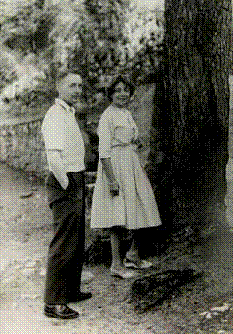
Gracq Sale, Nantes, Nov. 12, 2008, Couton and Veyrac, no. 260
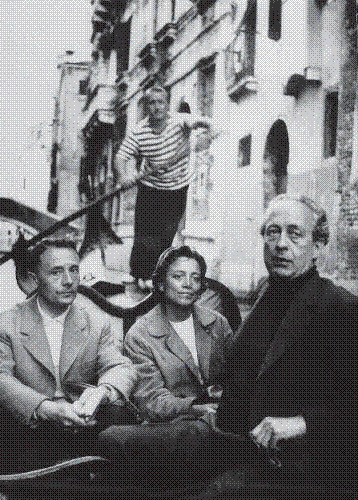
The friendship that united the two writers with Bona and André Pieyre Mandiargues is also well known; they visited them in Venice in 1959—a widely circulated photograph from the Gracq sale shows Gracq with Mandiargues and Mitrani on a Venetian gondola. Finally, mention should be made of the very close relationship the couple had with Michel Mitrani, who was close to Gracq long before making A Balcony in the Forest.
Their respective works tell us little more: Nora Mitrani would not refer to Julien Gracq again after their 1953 interview, and he never mentioned his companion before the preface he wrote, at Dominique Rabourdin's request and at Mandiargues' insistence, for Rose au cœur violet. Was the young woman totally foreign, however, to the "decisive reorientation" that took place in Gracq's novels during the 1950s, a reorientation that Michel Murat dates precisely to 1953 ↑? The representations of femininity and the couple, in particular, underwent a significant evolution in Gracq's writing at this time. The resistance, violence, and sense of otherness provoked by women in Au château d’Argol, Le Rivage des Syrtes, or "Prose for the Stranger"—where she could only be "loved in absence"—gave way in A Balcony in the Forest to the possibility of a couple. Although ephemeral, and refusing the name of love ("It was less and better," Grange specifies), "the love relationship has become breathable" ↑. It is also marked by a discreet sign of perversion, suggested in the 1958 novel by the strange duo of Mona and her "maid' Julia, a caricature of a maidservant. A reminiscence of Story of O, which we know interested Mitrani? While it is impossible to determine which of the two writers introduced the other to Pauline Réage's novel, it is probable that "the pages written [by Mitrani] about Story of O," which Gracq cites among the young woman's "texts to be privileged' ↑, nourished his own attraction to this novel. Signs of this attraction discreetly persist even in "King Cophetua," one of the three stories collected in 1970 in The Peninsula: a large house at the end of a dark park, a torch, silence, a haughty but submissive woman offered to the narrator—many ingredients invite us to read this text (among other references) as the repetition of a much earlier amorous ritual, to which Mitrani's pen had often contributed.
At the end of the 1950s, Nora Mitrani fell ill. Julien Gracq alluded to this illness in a handwritten card dated July 31, 1959, to André Breton: "I regretted that your departure for Saint-Cirq and Nora's health problems made us miss that excursion we had planned near Paris." ↑ Barely two years later, in March 1961, the young woman, aged 39, succumbed to cancer. No one named the disease. André Pieyre de Mandiargues spoke of an "illness that hardly forgives," and Michel Mitrani only wanted to remember "her extraordinary humor in such painful circumstances' ↑. Nora chose to end her days at the Goetheanum in Dornach, Switzerland, where she joined the disciples of Rudolf Steiner, founder of the Universal Anthroposophical Society. It seems that, shortly before her death, she returned to faith and asked to be buried according to the Catholic rite. Her funeral took place in May 1961 at the Church of Notre Dame des Champs, near her apartment on rue de Rennes in Paris, and she was buried in Montparnasse Cemetery.
After her death, Françoise Mallet-Joris (probably at Gracq's request, who was a friend of Suzanne Lilar, Mallet-Joris's mother) published her longest—and almost only—story: "Chronicle of a Grounding," which closes the volume Rose au cœur violet. In this very beautiful, autobiographical-inspired text, Nora Mitrani recounts, not without humor, a cruise on the Rhône she undertook with three of her friends. Parodying the form and style of adventure novels, she unfolds, in fact, the story of a non-adventure, whose anti-heroes are deprived, even as they are shipwrecked, of the drama they were entitled to expect:
"At the sudden intrusion of the romantic and death, at the opportunity to reveal exceptional qualities of composure and heroism, we are not entitled. The beautiful, truly pathetic shipwrecks, those that stand out in chiaroscuro from the background of old stories, those will remain forever imaginary. Our reality is without glory and without any photogenic quality, a comfortable drama that does not even lack the on-board radio and its Sunday program, The Listeners' Record: 'From a group of sanatorium loungers to their godmother.' 'A great plumber goes off into the sun...'" (RCV, pp. 126-127).
In 1988, Julien Gracq cited this story among the texts of his former companion that he preferred, for its "biting humor," "the richness of its writing," and "its successful naturalness in the risky enterprise of rendering a fragment of life as it is lived." He also recognized in it the timbre of a voice,
"vehement and often passionate, which at the time cared little about being heard outside the somewhat closed circle of postwar surrealism, but which, for having had to fall silent so quickly, has not lost its power to alert the ear. 'From the outset,' André Breton wrote of Nora Mitrani [in a letter to Gracq at the time of Nora's death], 'I had been sensitive to the timbre of what she wrote, and which was her own: a very beautiful alloy of the noble and the serious with the ardent.'" (RCV, p. 10)
Bibliography ■ The bibliography of Nora Mitrani is reproduced at the end of the volume compiled by Dominique Rabourdin: Rose au cœur violet (Eric Losfeld / Le terrain vague, "Le désordre", 1988, pp. 153-155).
Not included, however, are:
The corrective note concerning Camus's The Rebel that Nora Mitrani published in Positions, no. 1: "La révolte en question," Le Soleil Noir, February 1952, p. 79.
Nora Mitrani's responses to a "Survey" on a painting by Cornelius von Max reproduced in Le Surréalisme, même, no. 3, autumn 1957, p. 77.
The entries written by Nora Mitrani in the Succinct Lexicon of Eroticism (catalogue of the EROS exhibition, December 1959), reissued by Eric Losfeld/ Le Terrain vague, "Le désordre", 1970.
■ Some texts by Nora Mitrani, sometimes with a presentation by the author, have been reproduced in the following works:
Obliques, no. 14-15: "La femme surréaliste", Paris, éditions Borderie, 1977, pp. 190-191.
Penelope Rosemont, Surrealist Women (an international anthology), London, The Athlone Press, 1998, pp. 226-236.
Georgiana Colvile, Scandaleusement d’elles, trente-quatre femmes surréalistes, Paris, J.-M. Place, 1999, pp. 206-207.
Paul Hammond (ed.), The Shadow and its shadow. Surrealist writings on the cinema, 3rd edition, London, City Lights Books, 2000, pp. 147-148.
Vincent Gille, Si vous aimez l’amour… Anthologie amoureuse du surréalisme (preface by Annie Le Brun), Paris, Syllepse, 2001, pp. 260-261.
Jacqueline Chénieux-Gendron, "Il y aura une fois'. Une anthologie du Surréalisme (preface by Werner Spies), Gallimard, Folio, 2002, pp. 140-143.
■ Articles, notices
Adam Biro and René Passeron (eds.), Dictionnaire général du surréalisme et de ses environs, PUF, 1982.
Jean Cazeneuve, "L’œuvre sociologique de Nora Mitrani", Revue française de sociologie, second year, no. 4, October-December 1961, pp. 304-306.