"SYLVAIN ITKINE AND THE SCARLET DEVIL", LITERARY HISTORIES, 2010, VOLUME XI, N° 44, P. 38-48.
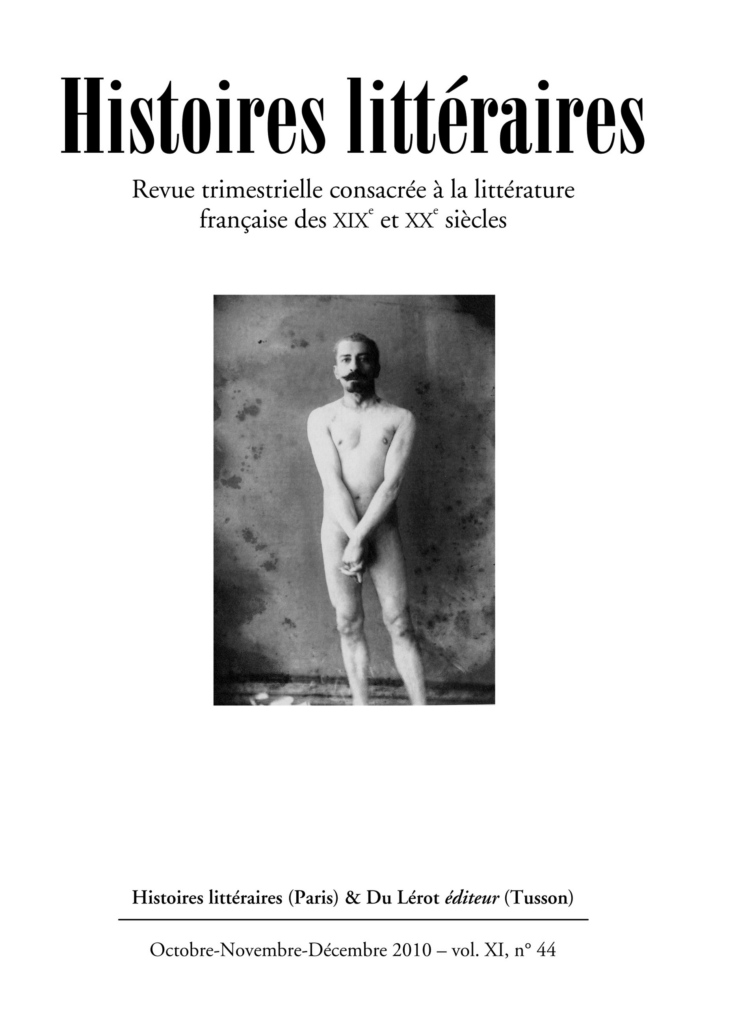
See the Literary Histories journal website
My article deals with a theater director, with no connection to the other contributions in this issue of the journal. Here it is in full, with its illustrations:
Download the PDF of my article on S. Itkine
Text reprinted in: Henri Béhar, Ondes de choc, L'Age d'Homme, 2011.

Back cover
Three common and simultaneous points characterize the different currents of the avant-garde now called "historical": rupture, the constitution of a community, finally a political determination. Having established that any avant-garde is necessarily political, Henri Béhar does not evade the delicate problem of the commitment of the critic and the historian.
Bringing together a selection of communications and essays published in journals, this volume is organized in three parts.
The first groups together research relating to the explosions of the Dada bomb that Max Ernst refused to gather: Tristan Tzara's role in the diffusion of Futurism, his discovery of Negro poetry, his productive friendship with Hans Arp; the political factor at work in the movement, and its discovery of the unconscious.
The second part examines the groundswells that occurred, in general, on the boards, both through the treatment of Shakespearean scenarios and through the foundation of the Alfred-Jarry Theater, the irruption of Artaud's laughter, the surrealist stagings of Sylvain Itkine with the Scarlet Devil, the generally ignored role of Roger Vitrac in cinema and finally a global examination of provocation as a dramaturgical category.
By analogy with the language of geologists who thus designate the Pacific zone where 75% of terrestrial earthquakes occur, the third part takes to analyzing the surrealist ring of fire through singular figures or moments: the Paulhan-Breton relationship, the relations with the Grand Jeu, literary criticism at work in surrealist journals, the eminent role played by Dali, from scatology to eschatology, the movement's relations with the political and, finally, its role in the elaboration of the "Manifesto of the 121."
The whole is preceded by a broad panorama, casting a lucid and amused look at some fifty years of personal work on the question.